Showing posts with label Los Alerces National Park. Show all posts

Wednesday, July 10, 2013

Bilking the Foreigner? Discriminatory Pricing in Argentina and Chile (Part 2)


Recently I wrote on the topic of discriminatory pricing against foreign tourists in Argentina and Chile, with which I disagree. My opinion brought a vocal dissent from my cousin, María Elisa Rodríguez, who is a tourism guide in the town of El Calafate, in Argentine Patagonia. I will translate her remarks here, and then offer my response:
“I do not agree, this information is not objective and not completely true. In Argentine national parks, we charge one fee for residents and another for non-residents; that is, foreigners living in the country pay the resident fee, and Argentines living overseas pay the non-resident fee. The rationale is as simple as it is fair: residents support the national parks with their daily taxes, and for that reason they get a discount.”

“Without going overboard, this practice is common in Europe, where museums have a differential fee for EU residents and non-residents, and also in the US (it surprises me that such an experienced traveler would feel annoyed, instead of trying to understand the reasons behind a policy, whether or not he agrees with it, especially when his own country applies it). For example, see the following link: http://www.nps.gov/findapark/passes.htm.”

With all due respect to María Elisa, who is highly intelligent and knowledgeable about many things in the travel and tourism sector, I think she has misread my comments. When I have written about Argentine and Chilean “reciprocity fees,” I have simultaneously criticized US immigration for its restrictive visa requirements, including the need for an in-person interview that often obliges applicants to make a special trip to a US embassy, at extra expense, from distant destinations within their own countries.

She is correct that Argentine national parks (such as Los Alerces, at top) have differential fees for Argentines – well, some of them do – but those fees are sometimes lower for local residents than they are for Argentines from the rest of the country. I question, though, whether non-resident Argentines ever pay more than resident Argentines – my Argentine wife, who has lived in California for more than 30 years, has visited Argentine parks many times, and no official has ever bothered to ask about her country of residence.

María Elisa mentioned US national parks but, at the link she cites, it says that the US$80 annual pass (which two people may use, and which is valid for all passengers in a given vehicle) is “available to everyone,” not just US citizens. Separate and cheaper passes are available only for US citizens or permanent residents age 62 or over, and for those with permanent disabilities. It is true, as she says, as that European museums charge differential rates, but I had never seen that in the US until last week, when I paid US$10 to visit the Denver Art Museum (my cousin, a Colorado resident, paid US$8).
It’s worth adding, as I’ve written before, that even though Chile collects differential rates at some of its national parks, anyone can purchase a Pase Anual (annual pass, about US$20) valid for all protected areas except Rapa Nui (Easter Island, now collected at a booth at Aeropuerto Mataveri, above), Torres del Paine, and Reserva Nacional Los Flamencos (near San Pedro de Atacama), which do have differential fees. For US$60, Chile also offers an annual family pass valid for two adults and up to four children.

On a related topic, I should repeat that in at least one matter Chile practices discriminatory pricing in favor of foreign visitors. They are exempt from the 19 percent impuesto de valor agregado (IVA; value added tax or VAT) for accommodations when paying in dollars or other foreign currency; thus, a US$100 hotel room costs them US$81 instead. Personally, I’ve always felt this was unfair to Chileans and, as I’ve indicated in the paragraphs above, would prefer to see all visitors treated equally.

On a related matter, Uruguay also discounts IVA to foreign visitors, even on restaurant bills.

Moon Handbooks Chile, in Los Altos
In just a week – Wednesday, July 17, at 7 p.m., to be precise – I will offer a digital slide presentation on travel in Chile at Santa Clara County’s Los Altos Library (13 S. San Antonio Road, tel. 650/948-7683). Coverage will also include the Chilean Pacific Islands of Rapa Nui (Easter Island) and Juan Fernández (Robinson Crusoe), as well as southernmost Argentina (Tierra del Fuego and the vicinity of El Calafate) that appear in the book. I will also be prepared to answer questions about Argentina and Buenos Aires. The presentation is free of charge, but books will be available for purchase.

Monday, October 25, 2010

Bandidos Rurales: Beyond Butch and Sundance

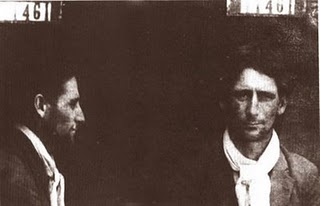
Like the Wild West of the United States, Patagonia was a frontier region and, as such, it was often a lawless place where might made right - and, as often as not, that might came out of the barrel of a pistol or a rifle. Like the West, it spawned legends such as the Robin Hood figure Juan Bautista Bairoletto (pictured below in a mugshot) and the rebel ranchhand José Font (also known as Facón Grande, or “Big Knife,” he was a key character in director Héctor Olivera’s film La Patagonia Rebelde). In fact, the Argentine folk-rock singer León Gieco recorded an album, Bandidos Rurales, whose title song gave the same treatment to Bairoletto and others that Bob Dylan did to John Wesley Harding.

In fact, several Old West figures, such as the self-styled sheriff and tall-tale teller Martin Sheffield of Texas, even made their presence known in southernmost South America (Bruce Chatwin recounted Sheffield’s tale in his classic travelogue In Patagonia). Sheffield’s was not the only yanqui presence in Patagonia, though - in the early 1900s, Robert Leroy Parker and Harry Longabaugh fled the United States to homestead near Cholila, a hamlet in southern Chubut province, where US author Anne Meadows tracked down their homestead more than a decade ago.

Better known as Butch Cassidy and the Sundance Kid, Parker and Longabaugh didn’t last long at Cholila, but they did build a distinctive cabin that survives today. The province of Chubut acquired the then crumbling cabin (pictured above), long occupied by the aging gaucho Aladín Sepúlveda (who died in 1999), and has since restored it without turning it into a theme park attraction - at least, there are no cardboard cutouts of Paul Newman and Robert Redford standing outside or peeking through the windows.

Meadows detailed her findings and much more in a book, Digging Up Butch and Sundance, that has gone through several editions since its initial publication in 1994. More than anything else, their book has been probably responsible for bringing gringos to Cholila, even if many only catch a glimpse of the cabin from the left side of the bus that goes from the city of Esquel through Parque Nacional Los Alerces to the town of Lago Puelo.

Butch and Sundance, though, may not have been the most interesting outlaw in Patagonia - that title might well fall to an unsung Englishwoman, their contemporary Elena Greenhill, whose story may hit the big screen some time in the future. According to the Buenos Aires daily La Nación, Olivera would like to bring journalist Francisco Juárez’s account of Greenhill’s life to the cinema.

And there’s a colorful story to tell. Born in Bath, Ellen Greenhill arrived in Chile in 1888, at the age of 13. Six years later, she married a rustler twenty years her senior who died, mysteriously, in the backcountry - amid tales of marital discord and spousal abuse. Continuing her husband’s activities, she became known as la bandolera inglesa (the English bandit) and, though she apparently never killed anybody herself, she once kidnapped two Chubut policemen and humiliated them by forcing them to do household chores.

That challenge to their machismo, apparently, inspired the police to seek revenge. At the locality of El Chacay, on the Patagonian steppe midway between Esquel and the coastal city of Puerto Madryn, they set an ambush at which Greenhill died in 1914.

Events Reminder: Last Chance for Exploring Argentina
This week, I wind up my tour promoting Moon Handbooks Argentina with two events in Chicago: Tuesday evening with a 6 p.m. dinner meeting at the Adventurers Club, under the auspices of the Geographic Society of Chicago, and Wednesday afternoon at the Chicago Cultural Center, also with the sponsorship of the Geographic Society, at 3:15 p.m.

Friday, October 31, 2008

Your Patagonian Hideaway

Six years ago, in the aftermath of Argentina's unprecedented economic collapse and a dramatically devalued peso, my wife and I bought an apartment in Palermo, one of Buenos Aires's finest neighborhoods. At the time, we thought it was a stretch for us but, with an inheritance and some equity in our California house, it was not out of reach. I don't want to broadcast what we paid for it but, in retrospect, we regret we didn't buy two.

Given the depressed peso, quite a few foreigners have bought into the Argentine real estate market since then, with greater or lesser success. I analyzed some of the rewards and pitfalls in Buenos Aires in an earlier post, but that dealt with existing housing. Getting something built can be another issue entirely, as my friend Patrick Symmes, author of Chasing Che, found when he set out to build his dream fishing cabin near the Patagonian town of Trevelin, in Chubut province.

In the course of researching his book on Che Guevara's 1950s motorcycle trip through the Americas, Patrick became enamored of the region - and who wouldn't, given landscapes like those of nearby Parque Nacional Los Alerces (pictured above)? The reality of getting his cabin built, though, was a real challenge, as he details in the October issue of Outside Magazine. Anybody considering a similarly adventurous project would do well to read his good-natured, but ultimately serious, account of his experience.

Sunday, July 20, 2008

Getting Off the Ground in Argentina

Flying anywhere in Argentina is difficult without passing through Buenos Aires, the hub for almost all air services, so it's often necessary to backtrack to the capital to make connections. There are no direct flights between the provincial capitals of Salta and Mendoza, for instance, so it's obligatory to change planes at Aeroparque Jorge Newbery. This would be roughly comparable to flying between San Francisco and San Diego via Denver.

That's why it was interesting when last Friday morning, at 6:35 a.m., I received an email from the city tourism office of Puerto Madryn, in Argentine Patagonia, that Andes Líneas Aéreas was about to start flights to and from the city of Esquel, that morning. Such a route would make it easy to travel between wildlife-rich Península Valdés, near Madryn, and Parque Nacional Los Alerces, near Esquel (which also has a fine ski area just minutes from town).

Meanwhile, Spanish-controlled Aerolíneas Argentinas, with 80 percent of the domestic air market, is about to be renationalized, though there's speculation it may then be resold to Argentine interests. According to the Buenos Aires Herald, many Aerolíneas difficulties "stem from union mischief and state interference — domestic fares have not been allowed to keep pace with costs and fuel subsidies have faltered despite soaring world oil prices." With a workforce allegedly a third larger than it needs, it's hard to see how the Aerolíneas money-pit might be attractive to serious investors, and how service might possibly improve this coming season.

LAN Argentina, the domestic affiliate of Chile's efficiently run LAN Airlines, has taken up some of Aerolíneas slack, but precariously funded smaller airlines often come and go, with erratic service. At 9:09 a.m. that same morning, I received a followup email from Puerto Madryn stating that "due to circumstances beyond our control," the inaugural flight to Esquel would be suspended until Monday, July 21.

Tuesday, May 13, 2008

Ash on Demand: Natural, Political and Economic Disasters

Even as Volcán Chaitén continues to burble, and ash turns to mud in the rain, it's getting harder and harder to say what the real disaster is. By any reasonable standard, Chilean emergency services did an exemplary job of evacuating the town of Chaitén and, though there have been some complaints from evacuees over their inability to return for their possessions and especially their pets, the only fatality was a 92-year-old woman who suffered a heart attack during the evacuation. At that age, she might have died in any event.

Chaitén's latest problem is a flood on the Río Blanco that has left more than a meter and a half of volcanic mud and other debris in parts of town. What has happened, apparently, is that tree trunks and other flotsam have formed a debris dam at the Avenida Carrera Pinto bridge that leads to the southbound Carretera Austral (Southern Highway); the water has backed up behind it and then spread onto the floodplain. With only a handful of emergency workers available in what is clearly a dangerous situation, there's not the manpower to do much about ensuing property damage. It's been suggested that the town might have to be relocated.

At the same time, some politicians from the conservative UDI party have started to scapegoat the government and environmental philanthropist Doug Tompkins over the issue of building an interior road through the Parque Pumalín reserve. Tompkins has not opposed building a road to connect Puerto Montt to Chaitén, but has suggested that a coastal route, with a couple short ferry connections (such as the one that now crosses the Estero de Reloncaví southeast of Puerto Montt) , would be better than a road through Pumalín's impossibly rugged interior. It would also be far cheaper, but their primary goal seems to expropriation of a foreigner's property (though in fact Pumalín now belongs to a legally constituted Chilean foundation) rather than a road per se.

Even if an interior route were built it would, by my calculations, be no shorter than 350 km and, over such mountainous terrain, it would take at least seven hours for emergency vehicles to arrive from Puerto Montt. From the port of Quellón, across the Gulf of Corcovado on the island of Chiloé, the ferry crossing to Chaitén takes five hours on the rustbucket Alejandrina. In reality, it would be more efficient to improve the ferry system - a single ferry can carry deliver more relief supplies (including vehicles) faster than a flotilla of trucks that, in the case of Chaitén, could easily be blocked by floods (or even lava flows) in this sopping midlatitude rainforest.

In reality, nationalism trumps pragmatism in the political debate. Former President Ricardo Lagos, though, injected an element of common sense when he labeled the interior alternative as impractical "big words," even as he admitted it might eventually be built.

In the interim, ash continues to carry across the border into Argentina, covering large segments of Los Alerces National Park, on top of a major fire it suffered last summer. Up to two million sheep that graze the Patagonian steppe may be vulnerable because the ash is covering their pasture, according to Mercopress. Airborne ash has restricted flights from Buenos Aires to Argentine Patagonia.

Meanwhile, some Argentine "entrepreneurs" are seeing Chaitén's eruption as an opportunity. On Mercado Libre, the country's counterpart to eBay, several sellers have put fallen ashes up for auction.

Saturday, May 3, 2008

Ash Falling on Alerces

In August 1991, Chilean Patagonia's 1,935-meter Volcán Hudson spewed an ashfall of more than five cubic kilometers that carried into the South Atlantic Ocean and even across the Pacific to Australia. In the immediate area, around the Aisén region town of Chile Chico and its Argentine neighbor Los Antiguos, more than 1.5 meters of ash accumulated in some spots. It fouled the water, ruined crops, killed livestock that could not reach forage, and drowned forests of southern beech such as the one depicted here along the Río Murta.

Farther north in Chilean Patagonia, where the narrow endemic alerce (false larch) is the signature tree species, a similar event is forcing at least a partial evacuation of the port of Chaitén (population about 4,000). According to the Smithsonian Institution's Global Volcanism Program, the town's namesake volcano, an 1,122-meter peak only about ten km away on the edge of the Parque Pumalín conservation project, is spewing plumes of ash up to 55,000 feet above sea level. Fortunately there is no snow on the volcano - because the peak drains toward the town of Chaitén, there would be serious flood danger. The caldera, though, does have two small lakes that could drain if the caldera were breached.

Again according to the Smithsonian, Chaitén's last known eruption was 7,420 B.C., plus or minus 75 years, so this was unexpected. Early reports, in fact, were that the eruption came from snow-covered Michimahuida, pictured here; an eruption on Michimahuida - the last was in 1835 - could cause major snowmelt and flooding.

Meanwhile, the prevailing westerlies are carrying ash toward the town of Futaleufú, Chile's whitewater rafting capital, and across the border into the Argentine city of Esquel (which canceled school classes yesterday), east of Los Alerces National Park. According to one Internet newsgroup report, some Futaleufú residents were wakened repeatedly by tremors during the night, and went outside to find the town covered by what appeared to be snow but, on closer inspection, was ash. There are photos of the town online at the Chile forum All Chile.

UPDATE: As of early Saturday evening, Chilean time, Chris Spelius of the Expediciones Chile kayaking and rafting company tells me that his wife is trapped in their Futaleufú house with the windows taped, without water and with diminishing food supplies. According to Chris, "No vehicles are moving as the volcano dust conducts electricity and ruins the alternators. There are about 50 vehicles abandoned on the road between Chaiten and Futaleufú ... " The border crossing to Argentina is open, but "but no one wants to take a vehicle since most vehicles do not last 30 miles in the dust."

Thursday, February 28, 2008

Patagonia on Fire

On the outskirts of Argentina's Los Alerces National Park, west of the city of Esquel and near the border with Chile, an arson-set fire is threatening stands of the endemic alerce, the "Redwood of the South." Also known as the false larch, the alerce occurs in a narrow geographical range in the southern Andes, along both sides of the border, though a handful of isolated stands also occur near the Chilean coast. For centuries, it was a valuable timber species for its beautiful grain and resistance to rot; it's now protected in both countries, though there are legal loopholes that timbercutters have exploited, and also cases of clandestine cutting. Its presence on the Chilean side was one of the major reasons for the private conservation initiative at Parque Pumalín, but the potential loss of any alerce forests is cause for concern.

UPDATE: As of Friday, February 29, an unexpected heavy rain--the first since November--was helping firefighters control the blaze. According to the Buenos Aires daily Clarín, only about 100 hectares of the 263,000-hectare park had burned, so it looks as if the worst case scenario has been avoided.

Patrick Symmes, author of Chasing Che, has a fishing cabin near the town of Trevelin, on the southern edge of the park. He writes me that "Helicopters and airplanes were coming in and out of Trevelin's little grass airfield all the time."
Custom Search