Today is the 50th anniversary of Argentina’s most brutal military dictatorship ever but, in the beginning, it was a bloodless displacement of President Isabel Martínez de Perón, widow of the famous caudillo Juan Domingo Perón. It soon devolved, though, into a bloodbath of some 30,000 Argentines—among them María Eugenía Sanllorenti de Massolo, my brother-in-law’s first wife.
Maru Sanllorenti, mother of Manuel Massolo
A student activist, “Maru” was abducted on the street in the city of La Plata, about 50 km southeast of Buenos Aires, but by good fortune her husband Carlos Massolo, her infant son Manuel, and my wife María Laura (Manuel’s aunt) escaped that fate because they were at home in a house near the city’s hippodrome. Given that many babies and infants were abducted and gifted to military families, we are fortunate that Manuel is still with us.
Poster for Manuel's Exhibition in Buenos Aires
Today Manuel is an occupational therapist and a painter, whose artistic reflections on the coup and its aftermath—Dictadura a Diario (Dictatorship Day by Day)— are on display this month at the Casa de la Provincia de Buenos Aires, a short walk from the Congreso Nacional (National Congress Building). In addition to his day job and painting, Manuel also speaks to visiting overseas tour groups at the Parque de la Memoria, which features a wall with names of all those who disappeared under the dictatorship, in northern Buenos Aires barrio of Núñez.
Manuel points out Maru's name to his son at the Parque de la Memoria.
In recent years, the coup’s anniversary has been marked by solemn ceremonies attended by the country’s highest authorities. That’s not the case this year, as “libertarian” President Javier Milei, elected in 2024, is a coup denialist who has gone about dismantling these events and sabotaging institutions and groups that held the coupmongers to account. That said, Argentine courts have recently ruled against appeals from pilots who threw prisoners from helicopters into the ocean, and others who aided illegal adoptions of kidnapped children.
President Milei’s political party goes by the name of La Libertad Avanza (“Freedom Moves Forward”), and it has taken credit for reducing inflation and encouraging foreign investment (at the expense of skyrocketing unemployment). Nevertheless, that seems an odd moniker for an entity that declines to address the issue of Argentina’s human rights violations—the President’s only observations on massive demonstrations taking place today were that it didn’t tell the whole story. It’s perhaps noteworthy that new colloquialisms now describe Milei’s fanatical followers as libertarados (roughly translatable at “liberdimwits”) and libervirgos (‘liberincels”). There are probably many others even less complimentary.
I have always been a baseball fan and, in the course of my guidebook-writing career in theSouthern Conecountries, I would often say that I left home when theWorld Seriesended and returned forOpening Day. This wasn’t quite literally true, but it did mean that I had something to occupy my time in the Northern Hemisphere when nothing was happening on thediamond(a truly appropriate description of any baseball field, including this unexpected gem in the Argentine city ofSalta).
The Argentine city of Salta has a new baseball stadium, but this older diamond was still a gem.
In mid-1981, when my wife first arrived in the United States from Argentina—a country in which baseball is still a fringe sport—she immediately took to Fernando Valenzuela, the Los Angeles Dodgers’ Mexican pitcher who served as a symbol of inclusion in her new home country. It helped, of course, that I was a Dodgers fan since my childhood—since the early Jackie Robinson years—and we have maintained that loyalty toward what has long been baseball’s most admirable franchise. By signing Robinson, the Dodgers had led the way in crossing the “color line” that had excluded black players from Major League Baseball.
Dodger Stadium, where the legendary Fernando Valenzuela began his career.
That progress, however, hasn’t been without setbacks. The Dodgers won the World Series in 2024, and that victory came with an invitation to visit the White House that has been traditional since 1924. Many of us hoped that the team would decline the invitation to interact with an occupant (who shall remain nameless here) whose loathsome public persona, including overt racism, was unpleasant at best. Then, however, we could at least rationalize that the visit was part of a longstanding apolitical tradition.
Argentina's military dictatorship kidnapped and murdered my future brother-in-law's first wife in 1976.
The Argentine dictatorship abducted Maru from this apartment in the city of La Plata in 1976.
The last straw, here, should be the White House’s grotesque caricature of former President Barack Obama (this country’s first black President) and his wife Michelle as apes in the jungle. What would Jackie Robinson say? Perhaps someone in the Dodgers ownership should ask Rachel Robinson, Jackie’s 103-year-old widow and head of the Jackie Robinson Foundation, her opinion.
At the very least, the Dodgers could decline the invitation with a statement saying “We did that last year, thank you.” Then we could wholeheartedly cheer for the Dodgers’ third consecutive championship—a three-peat—in 2026.
Should the Dodgers decline the invitation, they could face backlash from a vengeful White House that went ballistic over Bad Bunny's Super Bowl half-time show, which celebrated the culture of Puerto Rico—a territory whose inhabitants are US citizens—and other Latin American peoples. There's at least one Dodger who would almost certainly boycott an invitation—the charismatic utility infielder/outfielder Enrique (Kiké) Hernández is a Boricua who was an enthusiastic presence at Sunday's game and halftime show. Relief pitcher Edwin Díaz is also Puerto Rican.
As US citizens, both of them would have little to risk by declining the invitation. However, the Dodgers also have players from Cuba, the Dominican Republic Venezuela, Japan, and South Korea who could conceivably have their work visas revoked by a vengeful White House. There are many more in the Dodgers' minor league system, so this could wreak true havoc.
Post-Script: I just realized this is my first blog entry in more than three years. I'm not traveling quite so much now, though there is a new edition of Moon Handbooks Patagonia, and I'll try offer my insights a bit more frequently.
Over more than four decades, I’ve visited the city ofUshuaiaat least a dozen times—first, in 1979, when Argentina had nearly provoked a potentially ruinous war with Chile overthree small islands in the Beagle Channel. At the tip of the South American continent,Tierra del Fuegohad long had a reputation as the“uttermost part of the Earth”but, with only about 11,000 people, Ushuaia then was nothing like the Antarctic cruise ship capital it is today.
At that time, about to enter grad school at Berkeley, I had only a general understanding of the area’s lengthy penal history and, given Argentina’s brutal military dictatorship, poking around places like the former Presidio Nacional (National Prison)—then under naval control—was inadvisable. It’s this history, and related developments, that Ryan C. Edwards explores in A Carceral Ecology: Ushuaia and the History of Landscape and Punishment in Argentina, recently published by the University of California Press.
Ushuaia has always enjoyed an imposing setting, but it was once a rugged frontier outpost.
In 1884 Argentina initially established a lighthouse and military prison at Isla de los Estados (Staten Island), a rugged offshore island at the eastern tip of Tierra del Fuego, but the extreme climate—incessant winds, rain, and snow—dictated its abandonment for a site on the big island’s southern shore in 1902. What is now the city of Ushuaia had been a rather less rugged encampment of British missionaries and Argentine gold-seekers for decades before that.
There's now a national park footpath to the Chilean border (though it's formally illegal to cross).
By some accounts, Ushuaia was nevertheless a “natural prison” from which escape was nearly impossible. The Isla Grande de Tierra was then a roadless wilderness—even though the Chilean border was technically within walking distance—surrounded by violent seas (Anarchist Simón Radowitzky, who assassinated Buenos Aires police chief Ramón Falcón 1909, did make a valiant escape attempt). Still, the Argentine government built a solid prison to confine its convicts—or did it?
Cellblocks of the former prison (now the Museo Marítimo)
The prison, which closed in 1947 but reopened as a museum 50 years later, took its architectural inspiration from Philadelphia's Eastern State Penitentiary. Of an initial plan of eight radial cellblocks, only five were completed and it was, in fact, a “prison without walls,” many of whose inmates worked in and for the community. There were violent criminals, such as the serial killer Cayetano Santos Godino, who were confined to small cells, but many others worked on outside projects—some of them dangerous, such as logging in the forests that would eventually become Parque Nacional Tierra del Fuego. Others were confinados (political prisoners), such as journalist Ricardo Rojas, who enjoyed “off-campus” housing and could meet with his colleagues away from penal supervision, could purchase better rations, and could even publish accounts of their internal exile in the “Siberia of Argentina.”
Inside the cellblocks
Originally built for timber extraction, the restored railway is now a tourist attraction at the national park.
The prison closed when a consensus developed that Ushuaia’s extreme environment, in a thinly populated area, was not conducive to reintegrating prisoners into society. That said, it was the prisoners whose labor, including building a short-line railway for timber extraction, laid the foundation for what is now the national park in a city that has also become the gateway to Antarctica for a growing fleet of international cruise ships.
The port of Ushuaia is now the gateway to Antarctica for cruise ships.
The prison facilities themselves became a naval base but, as a museum, they’re a visible part of what’s become known internationally as “dark tourism” that also includes similar sights/sites as California’s Alcatraz Island and South Africa’s Robben Island. Again, when I first visited in 1979, this was still to come. The story of how it came to be is engrossing.
This mural of prisoners in Ushuaia is a reality check on what it was like in penal days.
If I have one quibble about this book it’s that, despite the fact that the author was an undergraduate in the Department of Geography at Berkeley, he seems unaware that the author of this review (a Berkeley PhD) had written about Ushuaia in a multitude of guidebooks for various publishers over the last four decades. While I wouldn’t suggest that I have greater insights on the city and its history than his exhaustive research in both primary and secondary sources, an analysis of guidebooks (not just mine) might have added something to the topic of tourism.
Recently I dreamt that, having arrived at Buenos Aires’sAeropuerto Internacional Ministro Pistarini(commonly called “Ezeiza”), I was in a taxi to our apartment in the barrio ofPalermo—where my wife and I had been longing to go ever since the pandemic began. En route, though, I realized I’d left the keys at our California home—and then I awoke wondering whether that was a metaphor for the times we’re in. In fact, we’d planned to fly to Argentina this New Year’s Eve, and were eager to see friends and family in and around the Argentine capital, but I’d begun to have my doubts as news of the Omicron variant hit the country especially hard.
In fact, I’d contemplated postponing the trip a few days earlier, but María Laura was still committed to going until Monday, when she first expressed doubts and then consulted with siblings, nephews, nieces, and friends (some of whom are directly involved in the healthcare system there). Everyone concurred that the situation was worsening, and expressed doubts about the trip despite their eagerness to see us.
Argentina's vax rollout has actually been pretty good, but I couldn't resist posting this photo from my nephew's Parque Patricios neighborhood.
For our part, we are fully vaccinated and boostered, and live in an area where people take vaccinations and masking seriously, so we were never panic-stricken. That said, we could still theoretically be carriers, and we didn’t want to risk a breakthrough case that could put others at risk. We also worried, however, that flight cancellations and layovers might disrupt the trip—partly because San Francisco International Airport (SFO) is notorious for weather delays and also with respect to our connecting flight in COVID-friendly Texas. That state has great food and music, but deplorable government.
That said, we look forward to trying again in March or so. I might stay a bit longer than the month we originally planned on, as I’m starting to work on the upcoming sixth edition of Moon Patagonia—perhaps an excursion to Ushuaia is in order.
Meanwhile, in Chile…
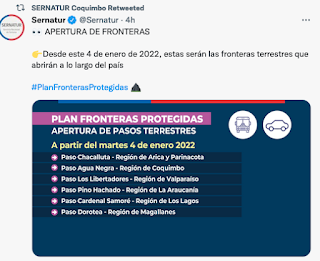
Chile, of course, will be a key part of the Patagonia update, and its high vaccination rates have made it an example to emulate in handling the pandemic. It’s been circumspect about the entry of non-resident foreigners, though, and that seems likely to complicate the upcoming tourist season, even though more border crossings are opening with Argentina and its other neighbors. Still, there are fairly stringent requirements, including quarantine, and the Chilean bureaucracy has also been slow to acknowledge intending visitors’ vaccination status—according to a friend of mine who’s a permanent resident, a friend of his spent two weeks stranded in Lima because LATAM Airlines would not let him board a connecting flight.
Chile's border are reopening, at least in theory.
For me, as an independent traveler having to cross the border multiple times while updating my book, frequent retesting and quarantines would mean significant delays and expense. As the attached screenshot shows, that situation may be improving), but requirements are likely to change even more so that southern spring—October or November—seems more agreeable.
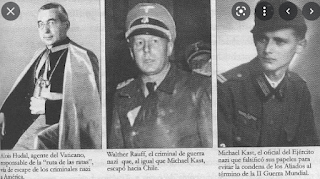
The losing candidate's late father, at right, was literally a Nazi.
Even so, Kast partisans’ accusations of extremism have continued, the “markets” were not pleased with the result, and the peso has slipped against the US dollar (any visitor so inclined could now eat a Weißwurst more cheaply at the Bavaria restaurant chain that is the basis of the Kast family fortune). Still, as Chile proceeds with a Convención Constitucional to draft a new constitution to replace the Pinochet-friendly document authored by the late rightist lawyer Jaime Guzmán, the challenges to a long overdue reform won’t disappear. The new charter must be approved by plebiscite but until then and even after, governing could be a challenge.
In Other News…
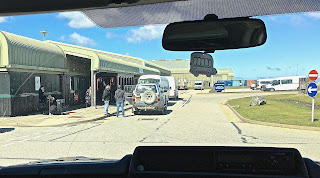
My Patagonia title also includes the Falkland Islands, where I once spent an entire year and have revisited at least half a dozen times. Except for my initial trip, when I flew from and back to the United Kingdom (with a memorable stopover on Ascension Island), I’ve always arrived via the southern Chilean city of Punta Arenas but, since the start of the pandemic, there’ve been no flights on that route, which requires overflying Argentine airspace.
The passenger terminal at the Falklands' Mount Pleasant Airport
In 1939, as the Spanish Civil War wound down, thousands of refugees fled across the border into France—which then confined tens of thousands in a deplorable detention camp at d'Argelès-sur-Mer. In partial response, poet Pablo Neruda—also a diplomat—chartered the French cargo vessel Winnipeg to carry 2,200 Spanish refugees across the Atlantic and through the Panama Canal to his homeland of Chile where, despite isolated episodes of xenophobia, they integrated themselves into local society.
Chartered by Pablo Neruda, the French freighter Winnipeg carried Spanish refugees to Chile.
That’s the historical background for Isabel Allende’s latest novel, A Long Petal of the Sea, which becomes a tale of exile and adaptation that includes several larger-than-life figures, most notably Neruda himself but also the late President Salvador Allende (Isabel’s father’s cousin) and the notorious Augusto Pinochet (mentioned only in passing). Some characters are fictionalized versions of historical figures, such as pianist Roser Bruguera, clearly based on the painter Roser Bru (who turned 98 in February).
Isabel Allende's novel focuses on one exceptional refugee family.
Bruguera is one focus of a complex family story that melds with an equally complex political history that involves her going into exile, with her husband Víctor Dalmau, from Pinochet’s dictatorship. Allende is especially good at depicting the intrigues and obstacles her characters must navigate, including neighborhood informants, imprisonment, intra-familiar conflicts that tore many Chileans apart, and the disruptions of exile.
The first Spanish refugees would have passed through Arica's customs house (now a cultural center).
Being a geographer, I try to be alert to people and place, and I found one unfortunate error. I expected that, after the Winnipeg passed through the Panama Canal, it would go directly to Valparaíso, whence the refugees would proceed to Santiago and elsewhere in the densely populated heartland. As it happened, though, the ship made a stop in the northern port of Arica, a city I know well, where Chilean officials met the vessel and some of the passengers came ashore to stay.
The nitrate port of Pisagua was the northernmost point on Chile's contiguous rail network.
Allende, though, claims the officials arrived by train, but the northern Chilean railroad network, developed to help exploit the Atacama Desert’snitrate deposits, never reached Arica—the most northerly major station was in the port of Iquique, roughly 200 km to the south (though there was a smaller station in the nitrate port of Pisagua, only about 125 km to the south). It might have been possible to reach Arica by rail at this time, but that would have involved a roundabout route via Buenos Aires and slow trains to northwestern Argentina and then Bolivia, where the Ferrocarril Arica-La Paz connected the two countries. Given the time, distances, and often contentious relations between Bolivia and Chile, it’s unlikely that anyone would have taken this route and, as it happens, there were flights from Santiago to Arica as early as 1929.
Oficina Chacabuco was the camp where Víctor Dalmau was presumably imprisoned.
Allende describes, but does not specifically identify, the location where her protagonist Dalmau “ended up at a camp for saltpeter miners in the north that had been abandoned for decades and was now converted into a prison.” That description fits Oficina Chacabuco, about 100 km northeast of the port city of Antofagasta, which is now a national monument and in situ museum that I’ve visited several times. She also offers a plausible description of the Dalmaus’ ostensible rural retreat, outside Santiago, when they return from exile in Venezuela.
All in all, Allende’s novel is a rewarding read that provides an insider’s view of refugees, immigrants, and the contributions they make to their new countries—with lessons for countries still including Chile and, of course, the United States (where Allende now makes her home).
On February 24th, I received my second dose ofModerna’s COVID-19 vaccineand, two weeks later, I undertook a full-scale grocery mission toBerkeley Bowl Westfor the first time in a year (my wife—also fully vaccinated now—was doing the shopping in that time, while I had only made occasional brief sorties to a neighborhood grocery). It felt like a milestone, one of the first, perhaps, in my quest to return to southernmost South America (even if, for now, I may have to settle for the pears on display here).
The aisles at Berkeley Bowl, on my first visit in a year
A nice pair?
I have yet to renew my passport—having waited purposefully until a new and competent administration took over the reins of government in Washington—but, in any event, I won’t be heading south until November at the earliest. That said, I couldn’t help but notice that LATAM Airlines was offering flights from Los Angeles to Santiago for as little as US$500 r/t. For some time after I returned from Chile to LAX last March 27th, the pandemic had closed the border to all but Chilean citizens and permanent residents but now, it appears, times may be changing.
Is Chile Winning the Arms Race?
Part of the reason, surely, is Chile’s success in vaccinating its population. According to Latin America Reports, five million Chileans may have already received their inoculations, and the government has agreements with China (Sinovac), Pfizer, Johnson & Johnson, and AstraZeneca to acquire 36 million doses (the country’s population is roughly 19 million). While President Sebastián Piñera’s second term has been shaky, there’s no doubt that his administration has been proactive in protecting the population (though there’ve been conflicting data on the Chinese vaccine’s effectiveness). Quarantines, curfews, and other sanitary measures also remain in force.
What does this mean for intending for potential foreign visitors (like myself and my readers)? Because of the previous US administration’s malfeasance and negligence, it’s been worrisome that US passports may have lost the cachet they once had but, as LATAM’s promotional fare would suggest, that’s not an issue at present. That said, any trip to Chile will run into various restrictions: there are several COVID requirements, including a negative PCR test, a sworn pre-boarding statement, a health insurance policy, an electronic tracking form on arrival, and an obligatory ten-day quarantine. Santiago’s Aeropuerto Internacional Arturo Merino Benítez is the only authorized entry point, and there are additional requirements for traveling beyond Santiago, especially to Patagonia, which may entail additional PCR tests.
How Hard is the Border?
These are Argentina's open border crossings - but with restrictions
In my case, the need to cross the Argentine border complicates matters even further, but I’m probably better placed than most. At present, the only non-Argentines permitted to enter must be relatives of Argentines and, being married to one for nearly 40 years, I technically qualify—but only if there’s a family-related issue at stake. There are just a handful of open crossings, the most convenient of which is Aeropuerto Internacional Ministro Pistarini, commonly known as “Ezeiza,” in suburban Buenos Aires. The only option in Patagonia is Paso San Sebastián, shared by Argentina and Chile, in Tierra del Fuego, but if I somehow managed to enter Argentina, a patchwork of local and provincial travel restrictions could make any such achievement a pyrrhic victory. Instead, I’ll wait.
In most years, the Northern Hemisphere winter becomes my Southern Hemisphere summer and, while I’m not a stereotypical summer beachgoer, these short California days get me thinking about the area below the Equator. Sadly, during this pandemic, it’s gotta be virtual, but one option is the cinema. Fortunately, Argentina has one of the Western Hemisphere’s most vibrant film industries, and this has been an opportunity to catch with some things I hadn’t yet seen. It’s vicarious travel but, on one level, it’s satisfying until I can return to the road—ideally, later this year.
In that context, here are brief reviews of Argentine films that I’ve watched lately, all on Netflix. Only one of them is recent, but all of them focus on absorbing (but less than edifying) aspects of life in the country.
Pizza, Birra, Faso (1998)
I’d long intended to watch Pizza, Beer, Smokes (title explanation follows in an endnote), but only recently managed to watch the feature film directorial debut by Uruguayan-born Adrián Caetano (who partnered with Bruno Stagnaro; English-language interview with Stagnaro here). It’s the tale of a group of petty thieves with few scruples—colluding with a taxi driver to rob his passengers, for instance, and stealing the earnings of a double amputee street musician.
Part of their activity is cheekily adolescent, as when they scale a fence to break into the landmark Obelisco—equivalent to DC’s Washington Monument—and climb its staircases in the darkness with the aid of cigarette lighters and paper scraps. Later they get into more elaborate and violent schemes, including an attempted restaurant robbery at gunpoint, but there is also comic relief, as when the delincuentes—who don’t know how to drive—rely on one of their taxi victims, a grandmotherly woman, to chauffeur them around the city. In an fit of compassion, they drop her off at the city airport, where she calls the cops on them.
In the movie the gang climbs the Obelisco, but the directors couldn't get official permission and thus used a studio to replicate the interior staircases.
It is something of an ensemble cast, though Héctor Anglada stands out as El Cordobés, an immigrant from the provinces who wants to run away to Uruguay with his pregnant girlfriend but can’t resist attempting one last big score (in real life, Anglada died in a motorcycle accident at the age of 26). Without spoiling the ending, I will say that this is not an inspiring movie, but it does depict a reality that most visitors will not experience but should at least acknowledge.
Ugi's is the gang's pizzería of choice.
Endnote: Pizza, beer, and smokes are the gang’s priorities, but it’s symbolic of their (lack of) status that, when one of them suggests pizza at the modest Banchero (known as creator of the iconic fugazzeta), the rest of the group overrules him for takeout at the lowest-common-denominator chain Ugi’s. Birra, of course, is the Italian word for beer, and is widely used in Buenos Aires; their preferred Quilmes is the Ugi’s of fermented beverages (no craft brews for these guys!). Faso, meanwhile, is a lunfardo (slang) term for cigarettes (everybody in this film smokes), but it can also mean a joint.
Palermo Hollywood (2004)
Set mostly in one of Buenos Aires’s fashionable neighborhoods—home to the TV and movie industry, and vigorous nightlife—Eduardo Pinto’s film has much in common with Caetano’s, but there’s a major distinction. The protagonists, Mario and Pablo, may be petty thieves (not to mention party animals), but they’ve formed a friendship across class boundaries. While Mario’s father is prosperous and politically connected, Pablo’s working-class family is feeling the pressures of living in an area that’s undergoing rapid gentrification (The trailer above is Spanish-only).
Mario and Pablo profit off Palermo Hollywood's nightlife, but the barrio's gentrification is squeezing Pablo out.
Like the characters inPizza, Mario and Pablo find themselves in a dangerous situation that, in this case, will test the limits of their loyalty to each other. For ne’er-do-well Mario, his lifestyle is a sustained teenage rebellion against his father, but for Pablo it’s his only option for survival and escape from an untenable personal predicament. To say much more would spoil an ending that some might think they anticipate.
Brian Maya, who plays Mario, also wrote the screenplay. Palermo Hollywood showed at the 2005 Sundance film festival.
Al Acecho (2019)
The most recent of these films, Francisco D’Eufemia’s Al Acecho (translated somewhat ambiguously as Furtive) tells the tale of a Pablo Silva, a park ranger who’s trying to reinvent (redeem?) himself after apparent legal problems. In the process, Silva finds himself dealing with various problems including corruption in the park’s administration, some of whom may have condoned or even promoted poaching in an area of surprising biodiversity.
Viewers shouldn’t rush to sanctify Silva, portrayed by Rodrigo de la Serna (who appeared as Che Guevara’s companion Alberto Granado in The Motorcycle Diaries and also plays a key role in the Spanish Netflix hit Money Heist). As with Palermo Hollywood, the ending may not be totally unexpected given the way the plot develops, but it’s not what D’Eufemia’s opening scenario might give us hopes of seeing.
One review described the setting for Al Acecho, Parque Provincial Pereyra Iraola, as “remote” and “little visited.” Even allowing for the fact that the film is fiction, I can’t refrain from pointing out that the park is only about 20 km northwest of the Buenos Aires Province capital of La Plata, and just 40 km from Argentina’s capital, via a major paved highway (When my wife was a student at the Universidad de La Plata, she went there with her brother and friends on day trips for barbecues). I apologize but, as a geographer, I still can’t overlook these things.
Tuesday afternoon, I received my first dosage of the Moderna COVID-19 vaccine, and am scheduled for the follow-up in about a month. The vaccination itself was painless but, later that night, my left shoulder started feeling sore and I could not shift positions as I normally would during sleep. In the morning I awoke with a slight headache, but that subsided after a walk with the dog(s) – unfortunately, as I’m recovering from ankle surgery, I’m in a walking boot and can’t handle them myself, but my wife and daughter can still hold the leashes.
Since then, the pain has dissipated and I look forward to receiving the booster shot that should provide immunity from the virus—liberating me, in theory, to travel again, though there are so many contingencies that I don’t anticipate returning to South America until at least the end of the year.
Now it’s the morning after a four-year nightmare and, while I have no immediate travel plans, I feel confident to submitting my application to a professionally run government department. Moderna and a new government may be the vaccines we needed, but they’re only a start. Still, it seems, we may be better in a better position than our trans-Atlantic cousins suffering through the self-inflicted economic and political traumas ofBrextremism—not to mention their own issues with the pandemic.
In the early to mid-1980s, when I first visited and then lived inBuenos Aires, it was in the Congreso neighborhood barely two blocks from the national legislature (which was out of service then, as Argentina chafed under a military dictatorship). Still, the area itself retained a certain elegance, with the ponds and fountains of thePlaza de los dos Congresosand architectural landmarks such as the Art NouveauConfitería del Molino.
The Plaza de los dos Congresos as seen from the Palacio Barolo (the tower of the Confitería del Molino is visible to the right of the Congress building).
My wife-to-be’s parents owned our modest apartment on Cangallo (now Perón) that was barely two blocks from the Congreso, and was within walking distance of numerous landmarks, including the Molino. They had bought the tiny (cozy?) two-bedroom unit to house their kids while attending the Universidad de Buenos Aires; there were three other apartments in the low-slung building, and everybody had access to a rooftop terrace for asados. Part of the time we shared it with my brother-in-law and his wife, and part of the time we had it to ourselves.
Today, high fences block access to the pools of the plaza (the Congreso rises behind the monument).
Accustomed to single family houses, I sometimes found the apartment cramped, but it was easy walking distance to the theater and cinema district—not to mention the world’s greatest ice creamery—along Avenida Corrientes, and to the country’s symbolic heart along the Avenida de Mayo. At the east end of Avenida stands the Casa Rosada presidential palace but, from vantage points like the observation deck of the Palacio Barolo, the west end view of the Congreso and its plazas was truly spectacular.
In better times, families gathered outside the pools, and kids waded in them.
Sadly, the area often looked less appealing close up. I always enjoyed watching kids wade into the pools on hot summer days but, in the aftermath of Argentina’s 2001 economic meltdown, city government fenced off access to them, and areas that were once gathering places became little more than thoroughfares. Even before that, in 1997, the landmark Molino shut down and gradually deteriorated even though it was declared a national historical monument shortly thereafter.
The Confitería del Molino is a true landmark (the decorative windmill itself is not yet functional, according to reports).
I didn’t really frequent the Molino, though I did pay one memorable visit when a local journalist made numerous useful suggestions for the first guidebook I ever wrote on the Argentine capital. Now, I read, the scaffolding has gone down from a major restoration and the building itself, now property of the Congreso, will reopen to include a new version of the confitería; while I have no photos of the interior, Madonna shot a kitschy 1995 video there that displays the main floor and its columns.
The renovated Cine Gaumont is another positive development in what has been a declining neighborhood.
While the neighborhood is still recovering from decades of neglect, there are other hopeful signs such as the revival of the classic Cine Gaumont, operated by the Instituto Nacional de Cine y Artes Visuales (National Institute of Cinema and Audiovisual Arts). Meanwhile, our old apartment—now the property of my wife and her three siblings—is rented out to a Colombian immigrant family. Despite the worn exterior, it’s still comfortably livable.
Our weathered apartment building, on Perón (ex-Cangallo) is better than it looks from the street.
Even though I may never live in the neighborhood again—since 2002, we’ve owned an apartment in Palermo—I look forward to revisiting the Molino and, perhaps, enjoying my morning medialunas alongside the congressional powerbrokers. At least, when it becomes possible to travel there again.


.jpeg)
.jpeg)
.jpeg)

.jpeg)