Showing posts with label Women. Show all posts

Wednesday, December 30, 2020

Break It All! Rocking Around the Americas

In the current months of semi-quarantined torpor I have, like millions of others, spent an inordinate amount of time in front of the tube. Often my tastes run to Scandi-Noir mysteries but, over the past week, we discovered a worthwhile alternative that takes me back to Buenos Aires and elsewhere in Latin America with Rompan Todo (Break It All), a six-part documentary on rock music south of the border (despite some notable omissions, to be detailed below).

Rompan Todo focuses primarily on Mexico (Mexico City, mostly) and Argentina (primarily Buenos Aires), and evokes nostalgia not just for the distant origins of that scene, but also for the city that I can’t visit for the foreseeable future. I’m of the generation for which rock music is a touchstone, and I touched on the Argentine scene myself in a National Geographic Traveler assignment a decade ago.


In the Beginning…

The series, though, starts with the California-born Richard Steven Valenzuela—better known as Richie Valens—who energized aspiring south-of-the-border musicians with his now standard “La Bamba,” adapted from a Mexican folk song. Not so many years later, though, the influence came from across the Atlantic with the Beatles. As the series’ Argentine producer Gustavo Santaolalla notes, the earliest Argentine bands often performed cover versions in English and were often derivative—Sandro, the “Argentine Elvis,” performed Spanish-language versions of songs like Tim Hardin’s “If I Were a Carpenter.”

This tribute album to the late Sandro is a fine introduction to Mexican and South American bands.

From the first, governments and other institutions like the Catholic Church were skeptical and often hostile toward rock. In 1971, for instance, Mexico had its own Woodstock in the unexpectedly politicized Festival de Avándaro, and Mexican officials forced rock to go underground—almost literally—for years. Argentine musicians underwent a similar experience in the approach to and aftermath of the 1976 military coup that resulted in exile for many.
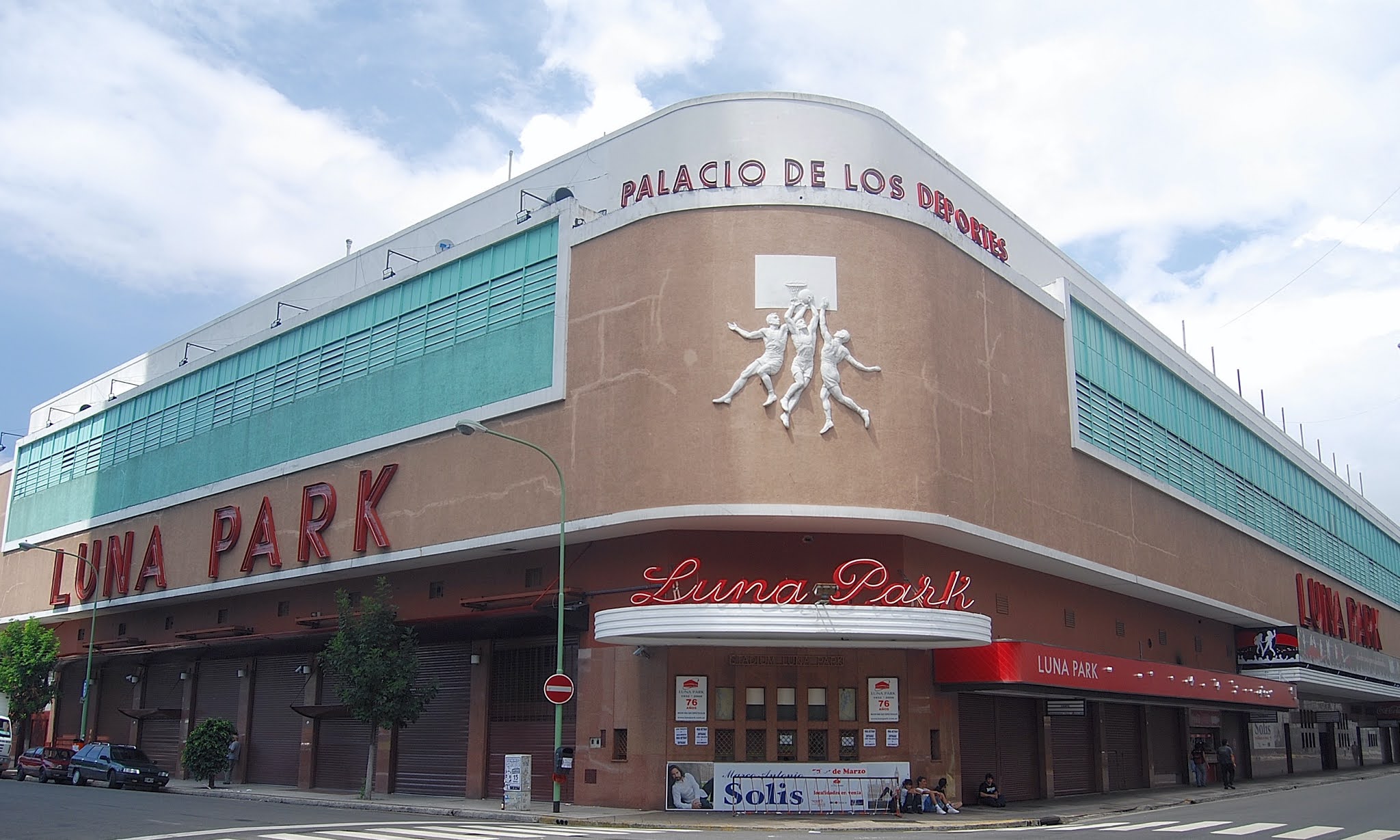
Billy Bond's fans trashed the interior of Luna Park.

One of those was Billy Bond, whose appearance in the film was a revelation–I’d never even heard of the Italian-born rocker (given name Giuliano Canterini) but, from the footage here, he seems a precursor of punk. In 1972, when he and his band La Pesada del Rock and Roll played the iconic Luna Park Stadium—an auditorium where Eva Duarte first charmed Juan Perón en route to becoming Argentina’s most powerful woman ever—Bond urged his cheap-seats fans to descend to the unsold vacancies closer to the stage, resulting in vandalism and a police round-up. Within two years, apprehensive of Argentina’s authoritarian trends, Bond left for Brazil, but continued to produce Argentine bands and, in the course of this series, he proves himself to be admirably articulate (The series, by the way, takes its name from an album by Uruguay’s Los Shakers, but “Break It All” might as well have been Bond’s motto in his youth).


Meanwhile, in Chile

Chile's coupmongers executed Víctor Jara in 1973.

Chile underwent a similar trauma with the 1973 coup that overthrew constitutional President Salvador Allende and essentially shut down the music scene—beginning with folksinger Víctor Jara, whom Augusto Pinochet’s forces tortured and killed in an especially gruesome manner. My experience there has been more limited, though I did have the good fortune to meet, in Santiago, Claudio Parra of Los Jaivas, a group that formed in 1963 (the band name, by the way, is an adaptation of their original English “High-bass,” though it can also mean a species of crab found in Chilean waters).

Los Jaivas backstage at the Teatro Universidad de Chile (Claudio Parra is second from left)

I had assumed the band left because of the coup, but Parra corrected me on that—as the film makes clear, they had already decided to head to Argentina for commercial reasons, and the coup merely delayed their departure. They then spent several years there and in Paris before returning to Chile, where they still tour every year. When I saw them in Santiago around the turn of the century, they struck me as a Pink Floyd comparable and, onscreen here, La Ley’s Beto Cuevas compares their Alturas de Machu Picchu (Heights of Machu Picchu, based on a poem by Pablo Neruda) to Floyd’s Live at Pompeii.


Rock Nacional, In the Post-War

My own experience with Argentina's rock nacional dates from the post-Falklands/Malvinas War period, when the dictatorship faltered (in a brief interview, the Dylanesque León Gieco ruefully admits that he and other musicians were complicit in supporting the war and, by extension, a regime they presumably loathed). After the conflict, though, they focused on songs with Spanish rather than English lyrics—Charly García, for instance, has recorded a Spanish-language version of the Byrds’ “I’ll Feel a Whole Lot Better” and once, in an under-the-railroad-tracks dive in Palermo, I heard him do “Soldado de Lata,” a similar adaptation of the Small Faces’ “Tin Soldier.”

A performance at Palermo's Roxy Live Bar (the bassist, second from right, is Charly García's bandmate Zorrito von Quintiero).


Fito Páez performs in El Calafate.

Other than García, the biggest names I’ve ever come close to are Soda Stereo, the first Argentine band to become a major international touring sensation, and Fito Páez, now a solo artist who also worked with García and others. I know little about Soda’s music, but I happened to be in the provincial capital of Tucumán when their publicists were passing out promotional packs of cigarettes in the central Plaza de la Independencia prior to a concert (I was not impressed). Páez I saw as part of El Calafate’s annual Festival del Lago in 2014, but the outdoor sound system was less than ideal.


Oversights and Omissions

One unspoken theme through most of the series is the scene’s overwhelmingly masculinity, but there are several prominent women, most notably Andrea Echeverri of Colombia’s Aterciopelados and Mexico’s California-born Julieta Venegas, who has worked with Santaolalla (who lives in Los Angeles). I’ll note that when I saw Charly García in Palermo, his lead guitarist was María Gabriela Epumer, who died at 39 due in part, apparently, to a medical misdiagnosis. Truly unique is Los Jaivas’ Juanita Parra (in the Chile section photo above), who replaced her father Gabriel as the group’s drummer after a fatal automobile accident. Santaolalla, though, says rock’s future is female—and, as a producer with pedigree, he’s in a position to contribute to that.

In summary, Break It All remains a worthy account of rock music south of the border (and the Equator), but with one other major omission—although it subtitles itself “The History of Rock in Latin America,” Brazil is conspicuous by its absence. I’ll confess to knowing little about its music beyond bossa nova, but a cursory glance at Wikipedia suggests that the region’s largest country has had a flourishing rock music scene ever since the mid-1950s. Perhaps Netflix should retitle the current series to represent its Spanish-language bias, and then underwrite a separate work on the history of rock em português.

Sunday, July 21, 2013

Is Chilean Politics Depressing? Leave It to the Women, Then


Argentines have a reputation for navel-gazing, and I’ve often written about the obsession with psychoanalysis in Buenos Aires. That’s not nearly so conspicuous in Chile, but it became front-page material this past week when rightist presidential candidate Pablo Longueira, who won a close primary election for the Alianza por Chile coalition of current president Sebastián Piñera, abruptly resigned from the race because of “depression.” The combative Longueira’s resignation is just one more negative in a topsy-turvy year for the conservative right in Chilean politics.
The Alianza, which consists of Longueira’s hard-right Unión Democrática Independiente (UDI, Independent Democratic Union) and Piñera’s more temperate Renovación Nacional (RN, National Renewal) thus found itself without a candidate even as the November 17 election was less than four months away. RN candidate Andrés Allamand, who lost narrowly to Longueira in the primary, seems reluctant to re-enter the race now that the UDI’s Evelyn Matthei (pictured above) has done so (Chile’s constitution prohibits immediate re-election of the president, so Piñera is not eligible).
Matthei, who is Piñera’s labor minister, would take on ex-president Michelle Bachelet (pictured above), who is the candidate for the Concertación para la Democracia (Consensus for Democracy), which groups several centrist and left-of-center parties (Bachelet herself is a Socialist). In a region known for its machismo, it looks as if two women will be the major candidates in the upcoming election.

That’s not the only unusual aspect to the matchup, though. Oddly, the fathers of both candidates were air force generals in 1973, when the military junta led by General Augusto Pinochet overthrew constitutional president Salvador Allende. Bachelet’s father Alberto, though, was an Allende loyalist who later died in prison, from heart disease, after being tortured. Matthei’s father Fernando, on the other hand, supported the Pinochet coup and later served as part of the junta that governed Chile from 1973 to 1990.

Ms. Matthei, whose chances of defeating Ms. Bachelet are next to nil, has surprisingly progressive views on abortion and same-sex marriage (at least in the context of a socially conservative country), though Bachelet is probably more outspoken on those topics. Matthei, though, is an unrepentant spokeswoman for economic privilege, as an article in the satirical weekly The Clinic recently suggested.

With Matthei's nomination, the self-destruction of Chile’s already discredited far right will probably continue. The unfortunate aspect is that her campaign will probably contribute to polarization in the country’s politics, and that is potentially depressing. Perhaps that’s why Longueira backed down, but it’s likelier that his depression came from the fact that he was already doomed to lose, badly.

Those of you headed to Chile until mid-November will get to see the campaigns in action. If nobody gets a majority (there are some minor party candidates), there will be a mid-December runoff, but probably Matthei herself will be surprised if Bachelet does not win in the first round.

Tuesday, July 26, 2011

Torture Tours, Part 3? The Esmeralda Anchors at San Francisco


According to many reliable sources, the handsome Chilean barquentine Esmeralda - the world’s second tallest and second longest sailing ship – became a floating torture center in the aftermath of the 1973 coup that overthrew President Salvador Allende. Internationally, the most notorious case was the disappearance of Anglo-Chilean priest Michael Woodward, whose remains have never been located despite a signed death certificate by a naval hospital physician.

Nearly a score of officers are presently under arrest in the case, which is moving slowly through the Chilean courts, but the navy has never acknowledged responsibility. Like its Argentine counterpart, it was the most hardline of Chile’s armed forces, even if no single individual had the high profile of army General Augusto Pinochet. Its motto continues to be vencer o morir (conquer or die).

Because of that history, the Esmeralda, which serves as a training vessel for naval cadets, often gets an unpleasant reception when it at ports around the world. In fact, on its current tour six-month voyage, its initial North American stop at San Diego drew a small protest. When I went with my Argentine wife (whose sister-in-law was a possible victim of their navy) to see the ship last Saturday at San Francisco’s Pier 27, though, there were long lines but no demonstrators.

There were, of course, security checks in which my small backpack had to stay behind but my wife’s large purse did not. The Chilean crew was courteous and hospitable (only a handful of its more than 350 personnel were present), but the visit itself had two shortcomings: it was limited to the tall ship’s main deck – the interior was off-limits - and there was no historical information whatsoever. There was nothing even about the ship’s origins in Spanish shipyards in 1946, nor its acquisition by the Chileans to offset debts dating from the Spanish Civil War. Unless you already know, you wouldn’t appreciate that the condor on the bowsprit is one symbol, along with the huemul (Andean deer) of Chile‘s coat of arms.

Nobody, of course, expected to find anything about the Esmeralda’s unsavory past under the dictatorship, especially given the judicial investigations currently underway. At the same time, there are indicators that the navy has moved, however slowly, from its traditional conservatism – one of 28 women on board, 22-year-old Francisca Lema is the first female officer to serve on board a Chilean vessel. Until recently, women in the navy were limited to shore duty.

Most visitors to the Esmeralda used their time snapping photos of themselves and their families, along with the crew. At the same time, the crew commercialized the visit by selling bottles of Chilean wine (from the decent but unexceptional Misiones de Rengo label) and bottled pisco sours (definitely inferior to fresh mixed).

The Esmeralda’s next stops are Victoria, British Columbia (August 1-5); Vancouver, British Columbia (August 6-10); and Pearl Harbor, Hawaii (August 30-September 3). In Canada, according to the CBC, there are likely to be protests.

Help Support Southern Cone Travel
If you have found this article informative, please consider clicking on one or more of the AdSense links that accompany it - always presuming, of course, that it’s a product or service that interests you.

Friday, November 19, 2010

Tacos Chilenos

Despite the title, this article is not about food. Despite the longstanding links between Chile and Mexico, the taco is not really part of the Chilean diet, and the country’s misleading name itself has nothing to do with the spicy peppers that give Mexican food its character (even if, in fact, you can find pretty good Mexican food in Santiago, less so elsewhere in the country).

For reasons that, as a nonnative Spanish speaker, I have never been able to fathom, taco has two separate and utterly unrelated meanings here. In one usage, a taco is a traffic jam (¡un tremendo taco!). I’ve seen many of those in Santiago (though I generally get around public transportation here, I did have to drive yesterday and found myself briefly bumper-to-bumper at rush hour).
In Chile, women wear tacos.
At the same time, tacos (in the plural) mean a woman’s high heels (tacones of four or five inches are not unusual) and, if Olympic competitors had to wear them, Chilean women might bring home more gold than has ever come out of the country’s mines. In general, urban Chilean women wear high heels to work, but I’ve seen them in the most unlikely places - once, for instance, I met a small group who were trying to hike the coast range summit of Cerro La Campana in shoes more suitable for the boutiques of nearby Viña del Mar.

In another instance, in Santiago, I saw a woman on high heels while using crutches - perhaps the ultimate example of “unclear on the concept” - to get around the city’s infamously uneven sidewalks, which can be treacherous enough for those with sensible shoes and total orthopedic health. In fact, at one time, even Carabineros policewomen dressed in skirts and (relatively low) heels that would have made it difficult to run down a malefactor - not to mention their disadvantages in a hand-to-hand scuffle. According to Carabineros lieutenant Guisela Soto Valenzuela, “We have used trousers since the year 2000, thank God, because for women in operative units it was difficult to run with skirt and heels.” Now part of the security detail at the presidential Palacio de la Moneda, the 25-year-old Soto Valenzuela adds that, “In any event, the default option in the palace detail is trousers and boots.”

There are signs, though, that the everyday default option of heels continues to change. According the daily Última Hora, the Asociación Chilena de Seguridad (Chilean Insurance Association) and Sernam (the national women’s service) have begun a campaign to get Chilean women out of their heels and into sneakers, at least to get to work. Their statistics tell them that heels cause 800 multiple contusions, 830 hand and wrist contusions, 1,400 knee contusions, 3,600 ankle sprains, and 7,000 accidents en route to or from work, at a cost of 32,600 lost work days.
On the Metro, tacos are not recommended footwear.
Frankly, that doesn’t seem a huge number in a country of 16 million citizens, even if only half of them are women and many of those women would have no need for them (I’m discounting the handful of men who might wear heels). Yet the warnings are clear: yesterday, leaving Estación El Golf on Línea 1 of the Metro, I photographed the above warning: “Walk Safely. Walking is Good for You. Wear Sneakers on Your Way to and From Work.”
Even if well-intentioned, a campaign against sexist violence used cluelessly homophobic language.
Lately, though, Sernam has sparked a far greater controversy with the language of its recent campaign publicizing the issue of violence against women. Common on buses and Metro trains, these display images of men such as the soccer referee depicted here, who says that “Every weekend I get called ‘faggot’ at the stadium.” Then, continues the ad, “A faggot is someone who mistreats a woman. Let’s say it to those who deserve it.” The campaign’s pejorative language has engendered strong condemnation from gay organizations in the country and, at the very least, it's clumsy - if not reprehensible - to try to equate wife-beaters and homosexuals.

Monday, October 25, 2010

Bandidos Rurales: Beyond Butch and Sundance

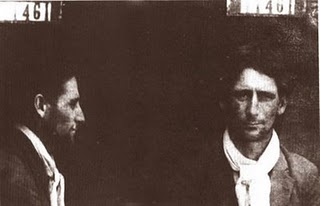
Like the Wild West of the United States, Patagonia was a frontier region and, as such, it was often a lawless place where might made right - and, as often as not, that might came out of the barrel of a pistol or a rifle. Like the West, it spawned legends such as the Robin Hood figure Juan Bautista Bairoletto (pictured below in a mugshot) and the rebel ranchhand José Font (also known as Facón Grande, or “Big Knife,” he was a key character in director Héctor Olivera’s film La Patagonia Rebelde). In fact, the Argentine folk-rock singer León Gieco recorded an album, Bandidos Rurales, whose title song gave the same treatment to Bairoletto and others that Bob Dylan did to John Wesley Harding.

In fact, several Old West figures, such as the self-styled sheriff and tall-tale teller Martin Sheffield of Texas, even made their presence known in southernmost South America (Bruce Chatwin recounted Sheffield’s tale in his classic travelogue In Patagonia). Sheffield’s was not the only yanqui presence in Patagonia, though - in the early 1900s, Robert Leroy Parker and Harry Longabaugh fled the United States to homestead near Cholila, a hamlet in southern Chubut province, where US author Anne Meadows tracked down their homestead more than a decade ago.

Better known as Butch Cassidy and the Sundance Kid, Parker and Longabaugh didn’t last long at Cholila, but they did build a distinctive cabin that survives today. The province of Chubut acquired the then crumbling cabin (pictured above), long occupied by the aging gaucho Aladín Sepúlveda (who died in 1999), and has since restored it without turning it into a theme park attraction - at least, there are no cardboard cutouts of Paul Newman and Robert Redford standing outside or peeking through the windows.

Meadows detailed her findings and much more in a book, Digging Up Butch and Sundance, that has gone through several editions since its initial publication in 1994. More than anything else, their book has been probably responsible for bringing gringos to Cholila, even if many only catch a glimpse of the cabin from the left side of the bus that goes from the city of Esquel through Parque Nacional Los Alerces to the town of Lago Puelo.

Butch and Sundance, though, may not have been the most interesting outlaw in Patagonia - that title might well fall to an unsung Englishwoman, their contemporary Elena Greenhill, whose story may hit the big screen some time in the future. According to the Buenos Aires daily La Nación, Olivera would like to bring journalist Francisco Juárez’s account of Greenhill’s life to the cinema.

And there’s a colorful story to tell. Born in Bath, Ellen Greenhill arrived in Chile in 1888, at the age of 13. Six years later, she married a rustler twenty years her senior who died, mysteriously, in the backcountry - amid tales of marital discord and spousal abuse. Continuing her husband’s activities, she became known as la bandolera inglesa (the English bandit) and, though she apparently never killed anybody herself, she once kidnapped two Chubut policemen and humiliated them by forcing them to do household chores.

That challenge to their machismo, apparently, inspired the police to seek revenge. At the locality of El Chacay, on the Patagonian steppe midway between Esquel and the coastal city of Puerto Madryn, they set an ambush at which Greenhill died in 1914.

Events Reminder: Last Chance for Exploring Argentina
This week, I wind up my tour promoting Moon Handbooks Argentina with two events in Chicago: Tuesday evening with a 6 p.m. dinner meeting at the Adventurers Club, under the auspices of the Geographic Society of Chicago, and Wednesday afternoon at the Chicago Cultural Center, also with the sponsorship of the Geographic Society, at 3:15 p.m.

Tuesday, February 9, 2010

Sex & Food in Buenos Aires (Part 2)

A few years ago, in Buenos Aires, Ámbito Financiero film critic and independent director Diego Curubeto invited me to a shoot for his first film, a hybrid docudrama on actress Isabel Sarli. Finally, this month, “Carne sobre Carne” (Flesh on Meat, Spanish-language trailer at the link) has gone into limited release and has drawn rave reviews in newspapers ranging from the left-of-center Página 12 to the middle-of-the-road Clarín and the conservative La Nación, as well as the English-language Buenos Aires Herald (link available only after 2 p.m. Buenos Aires time, daily).

Curubeto uses the story of Sarli (born 1935), whose films seem tame today but were considered scandalous in her 1958-1979 heyday, as a case study of censorship in an Argentina that was dominated by conservative institutions like the Catholic Church that, in turn, supported some of the continent’s most vicious military dictatorships. In interviewing Sarli at her suburban Buenos Aires home for a BBC documentary, Curubeto noticed a pile of film canisters that, as it happened, contained uncensored versions of her films as they were seen overseas (including in the United States). This inspired the project.

I played my own small part in this - literally so, as Curubeto recruited me, on the spot, to act in the 3 a.m. shoot (the Ministerio de Obras Públicas, a rationalist skyscraper that houses the public works ministry, was unavailable except at that hour). Sitting at a desk, improvising with an ancient dial telephone in my hand, I portrayed Roman Polanski’s Polish-producer-in-London-exile in an argument over distribution rights with Sarli’s director/producer/lover Armando Bó. Unfortunately, my scene didn’t make the final cut, but I’ve been assured it will appear on the DVD version (whenever that might come out) and I at least made the list of credits.

Despite my exclusion, the theatrical version of the film does include major Argentine cinema figures such as Gastón Pauls (who starred in the multiple award-winning Nine Queens). "Carne sobre Carne" is playing every Tuesday and Saturday night this month at the Museo de Arte Latinoamericano de Buenos Aires (MALBA), the continent’s foremost modern art museum.

Meanwhile, on a peripherally related theme, Argentine president Cristina Fernández de Kirchner, whose plunging popularity perplexes her Peronist loyalists, stuck her foot in her mouth last month. Addressing an audience of pig farmers, and responding to public complaints over falling beef supplies and rising prices, she suggested that pork would not only be cheaper but would also offer an additional advantage: ““I've just been told something I didn't know; that eating pork improves your sex life ... I'd say it's a lot nicer to eat a bit of barbecued piglet than take Viagra.” Certainly, at least, it beats swine flu.

Fernández's words, of course, led to a lot of off-color commentary in the press, the best of which came from the online magazine Planeta Joy, which published a list of the five best places to eat pork in Buenos Aires, plus suggestions for the best nearby telos to “quench your desire.” In a slightly different manner, I addressed this topic in an earlier post with a similar title - thus, the “Part 2” that appears above.

Tuesday, June 17, 2008

Bachelet Plays Berkeley

I've mentioned it before, but it's worth restating how much Chile and California have in common. It starts with their physical geography, where both have long Pacific coastlines, low coastal mountains, fertile central valleys, and high interior mountain ranges. In both, summer-drought Mediterranean climates with heavy coastal fog are balanced by wet winters.

In the early 19th century, though, Chile was miles ahead of California in its political and economic development, and had many northern European immigrants - at one point, the port of Valparaíso had two English-language newspapers. California, by contrast, was a thinly populated backwater until declaration of a "Bear Flag Republic," the Mexican-American War of 1846-48, and the discovery of gold eventually led to its absorption by the United States.

Valparaíso, of course, was the first port of call for ships rounding the Horn en route to San Francisco, and Chilean residents soon found their way north during the Gold Rush. Among them were merchant Faxon Atherton (his namesake suburb is one of the Bay Area's wealthiest communities); James Lick (a piano builder and landowner who donated an observatory on Mt Hamilton, near San Jose, to the state of California); and Irish engineer Jasper O'Farrell, who arrived under Mexican rule, but remained to be San Francisco's surveyor. Most of these men were married to Chileans.

During the Gold Rush, though, Chilean miners were a notable presence, commemorated through place names such as Chileno Creek (Marin County) and Chili Bar (Placer County). At the foot of San Francisco's Telegraph Hill, near Francis Ford Coppola's Zoetrope Studios (916 Kearney Street), an historical plaque commemorates the neighborhood known as "Little Chile." Not all of them were anonymous, as Vicente Pérez Rosales (for whom a Chilean national park is named) wrote of his Gold Rush experiences in Recuerdos del Pasado (a new edition recently appeared in English as Times Gone By).

Michelle, Ma Belle
Given these geographical parallels and historical links, it's unsurprising that Chilean President Michelle Bachelet would give an address at the University of California, Berkeley, last Thursday. The University of California and the Universidad de Chile have long provided reciprocal assistance to academics conducting research far from home, and the Chile-California Chamber of Commerce encourages business contacts. In the aftermath of Chile's 1973 military coup, many political exiles found refuge in the state, among them novelist Isabel Allende. Allende, who now lives in Marin County, linked Valparaíso and San Francisco in Daughter of Fortune (1999). Many Chilean winemakers have come to work and study in California, and some producers have vineyards and wineries in both places.

Before an adoring audience, which gave her a standing ovation after a question-and-answer period, Bachelet spoke in generalities about globalization and Chile's economic fortunes, reduced poverty rates since the return to constitutional government, education (including sponsoring talented Chileans here for post-graduate work), and the need for multilateralism in addressing issues such as global warming (which came across as soft-spoken criticism of the current U.S. administration). Most questions had to do with Chile's energy crisis and the issue of renewables - part of the reason her stop included a visit to the Lawrence Berkeley Laboratory - but none of them dealt with the controversial issue of damming Patagonian rivers. All the questions were written and thus subject to screening; because of time limits, only a few could be answered.

My own time limits prohibit any further analysis here, but video for the hour-long event is available through the website of Berkeley's Center for Latin American Studies. Bachelet has a good command of English (not so fluent as Arnold Schwarzenegger, but better than George W. Bush).

Win This Book!
For those who have made it this far, a simple contest: the first respondent who can tell me which of the photographs in this post come(s) from California, and which from Chile, gets a free copy of my guidebook Moon Handbooks Chile.

Sunday, February 3, 2008

Barbie Power!

For over half a century, starting with Evita Perón, Argentine women have directly influenced politics at the highest levels. Even if Evita and the hapless María Estela Martínez ("Isabelita") gained their influence through marrying Juan Perón, there's no question they exercised political power, both openly and behind the scenes.

At present, of course, the highest profile female politician is President Cristina Fernández; even if she owes part of her success to her husband and predecessor Néstor Kirchner, there's no question she's clever and charismatic in her own way. Since the 2002 political and economic crisis, one of the main opposition figures is former congressional deputy Elisa Carrió, who finished second in the 2007 presidential election. Former Buenos Aires province gubernatorial candidate Margarita Stolbitzer has long been influential in the Radical party of former president Raúl Alfonsín (despite their name, the Radicals are a fairly conventional--and ineffectual--middle class party).
Outside the Barbie Store in Palermo
Culturally, though, there's another extreme: an obsession with impossibly slender fashion models that starts early. There’s no better place to observe the phenomenon than Buenos Aires's first-of-its-kind, Mattel-sanctioned Barbie Store that not only sells dolls, but encourages pre-teens (and their mothers) to emulate their style. Where else can five-year-olds saunter down the runway, in clothing inspired by their anorexic template of a toy, for their birthday parties?

Franchises are available.
Custom Search