Showing posts with label Food. Show all posts

Saturday, December 10, 2022

Returning to Santiago (and all that entails)

At very long last, this past Monday, I arrived back in Chile for the first time since March of 2020, when I abruptly flew home to California as the seriousness of the COVID-19 pandemic became obvious. I was originally to arrive on the previous Saturday but, late that week, LATAM suddenly canceled my nonstop Friday flight from Los Angeles International Airport (LAX) to Aeropuerto Arturo Merino Benítez (SCL).

Thanks to my heroic travel agent—there are still such things!—I was able get rescheduled for Sunday even though not without trepidation that the new flight might also be canceled. Analía Rupar-Przebieda (an Argentine resident of Southern California) first tried to reschedule me on Delta (a LATAM partner) via Atlanta, but Delta refused (even though the SFO-LAX leg of my flight was with them). That would have gotten me to SCL on Saturday as planned, but the rescheduled LATAM left on Sunday and didn’t get me here until early Monday morning.

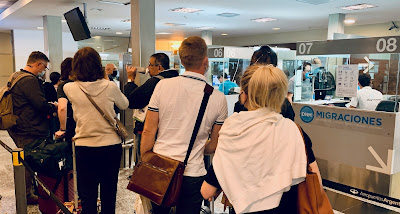
The lines at immigration were long, but moved surprisingly quickly.


The flight was reasonably comfortable if crowded, and I was one of few coach passengers wearing a mask (those in first and business seemed to take it more seriously). On deplaning and arriving at immigration, though, we were faced with the longest lines I’ve ever seen at any airport. We also saw a warning for monkeypox—Chile continues to take contagion seriously—but the lines moved surprisingly quickly. So did the customs and agricultural checkpoint, so I was finally officially in the country.

Is monkeypox the next big thing?


Now to get to the city, and I purchased a seat on a shared TransVIP shuttle and was surprised to find a 5.5 percent surcharge on my foreign credit card. This has also been the case on some restaurant meals, but not on a purchase I made at a downtown department store. I had arrived with a small amount of Chilean cash but, at the new international terminal, the exchange houses were offering very poor rates and there was no functional ATM anywhere to be seen.


I rested most of Monday, other than a fine Peruvian dinner at with my host Marializ Maldonado at Del Carajo, across from the Hipódromo (racetrack) in the untouristed neighborhood of Independencia. The next day, I found a BancoEstado ATM and learned that their once-free ATMs now charge Ch$5500 (roughly US$6.50) for any withdrawal from a foreign account. Yesterday I made the maximum withdrawal of Ch$200,000 (about US$230) with the private Banco Itaú at a cost of Ch$6,000 (US$7). I haven’t yet tried to change US cash in the city, because I’m saving most of that for unpredictable Argentina.

With luck, my so far trusty Suzuki will be back on the road soon.


In preparation for upcoming Patagonian road trip, I’m now awaiting replacement of the catalytic converter on my 2005 Suzuki Grand Nomade, which failed its most recent revision. The most worrisome part of this, at present, is the availability of a replacement part, though my trusted mechanic Mauricio Donoso sounds reasonably optimistic.


Another issue I’ve had to deal with is cell phone service. My US carrier provides phone and data coverage here, but with limits—not exactly clear—on how much, and I’ll be in Chile and Argentina for three months. Because my new iPhone 12 uses an E-SIM rather than a physical chip, I cannot use a pay-as-you-go option here and, without legal residence in the country, nor can I open an account with a monthly plan. Yesterday, though, my host Marializ added me to her plan (and I’ll reimburse her), but that’s not an option for the overwhelming majority of visitors. Some will be limited to WiFi.

Friday, April 22, 2022

Purgatory 2.0? EZE to DFW (and, Fortunately, Beyond)

Early last week, anticipating our flight back to California (via Dallas), we rose early and went to the closest location of CentraLab, a private medical testing company in Buenos Aires. To return to the US, being fully vaccinated against COVID-19 is still insufficient to return; it requires either a PCR or an antigen test the day before flying. It’s worth noting that this is not a 24-hour requirement; our flight was scheduled for 8 p.m. Friday evening, but any time on Thursday would have been acceptable.

Results of the antigen test (with personal info edited out)

The obligatory attestation...

We were hoping to be able to schedule the tests there, but that location did not handle COVID testing. Rather, they said, we would have to schedule an appointment online for a different venue—but one that was still only a US$2 cab ride from our apartment. If our appointment hadn’t been at 8:45 a.m., we’d have walked there but, as it was, we got there shortly after 8 and they saw us almost immediately. In just two hours we received the results and could relax. After filling out the obligatory attestation for US immigration, we finished our last full day with an Italian dinner, with my brother-in-law and his wife, at Trattoria Olivetti (its walls decorated with typewriters), just across the street from our place.

The exterior of Olivetti
And the interior...

The next afternoon, getting to the airport was a bit more complex than we anticipated. Leaving the apartment, we immediately caught a cab to the central Terminal Madero in the expectation of catching a Tienda León remise (livery car) to Aeropuerto Internacional Ministro Pistarini (aka Ezeiza). Because there were two of us, this would be only marginally more expensive than taking the bus, but on arrival we learned that there were no longer any remises operating at the site. The only option was the bus, for which we would have to wait nearly an hour, so we opted for catching another taxi in the street, for which we paid Ar$6000 including tolls.


That was more than the Ar$3820 (US$35.32) I had paid for a remise from the airport a month earlier because, lacking sufficient Argentine cash, I had to use my US credit card. In this later instance, though, I paid with “blue dollar” pesos which made the cost US$34.31 for the two of us (had we taken the first taxi all the way from our apartment, it would’ve been cheaper yet).


Arriving at Ezeiza, we found a fairly long line for our American Airlines flight to DFW, where we would have a four-hour layover before connecting to San Francisco, but we got through immigration and security quickly—or did we? While I used to enjoy flying, I’ve grown to loathe airports but I have appreciated the fact that, in Buenos Aires, we don’t have to remove our shoes and all the electronics from our carry-ons.

This guy's 2008 visit to Buenos Aires didn't go over well.

I spoke too soon, though—when we lined up to board the flight, I found myself randomly (?) singled out for a secondary check that did involve removing my shoes and my electronics, and even inspecting my iPad for, apparently, traces of explosives. For this I blame the individual in the photo above who, until 2017, was the worst president in my country’s history. He and others of his party have done lasting damage both domestically and internationally.

We didn't get much flight information...

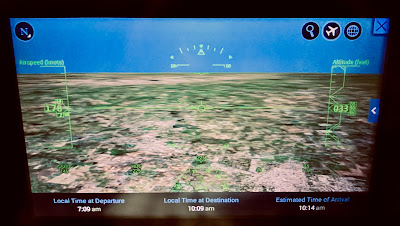
Last month’s flight from DFW to Argentina was, without question, my worst experience ever in the air, and one I didn’t care to repeat. Here, though, my initial impression was positive as the Boeing 787 sported a great-looking touch screen for entertainment, but that didn’t last long. For some time, according to the electronic in-flight map on which I normally enjoy watching the plane’s progress, we never left the ground and the hour never changed from 7:53 p.m—“distance to destination 0 km, time to destination 0 minutes.” Eventually a rotating globe appeared, but it soon showed us off the coast of West Africa, approaching the Ivory Coast port of Abidjan!


That, of course, did not inspire confidence, and things got worse as it became apparent that the overhead reading lights did not work in any section of the plane, and to read my paperback novel I had to hold my phone’s flashlight with the book in my lap. Meanwhile, the in-flight food offerings were so unappetizing that I consumed nothing but water. Mercifully, I managed to fall asleep for about a third of the ten-hour ordeal and, when we arrived in Dallas, we passed quickly through immigration and customs, with not even a perfunctory look at our baggage.


So, this flight wasn’t quite so bad as the previous one but, that said, we were now in COVID-friendly Texas where, despite the ongoing mask mandate in airports, at least a third of all passengers couldn’t be bothered about spreading a potentially deadly disease. Fasting to avoid contributing even a penny to this dysfunctional state, we waited at our gate only to learn that a last minute change would require us to sprint more than a mile through the sprawling terminal. Texas is the new Purgatory, and it was a relief to board a flight to the comfort and safety of California.


Thursday, March 24, 2022

Pedaling the Pampas

The Plusmar bus line crosses the Pampas from Retiro to Olavarría.

After I spent a week adapting to a five-hour time change and recovering from the hangover of perhaps the most miserable flight of my life, my wife arrived in Buenos Aires and, after a couple more days, we took the bus to her hometown of Olavarría for the first family reunion since the pandemic struck. Leaving our Palermo apartment early, we caught a 7 a.m. bus that, in the morning rush hour, took more than two hours just to get beyond the city limits. After that, it was another four hours across the interminably flat Pampas in comfortable conditions—many of Argentina’s long-distance buses have seating comparable to business class on an airplane.

The Olavarría terminal early in the morning.

Rodolfo tends his rabbits at the chacra.

After María Laura’s sister Estela picked us up at the Olavarría terminal, most of that day and the next consisted of lunches and extended family dinners with her and her brother Rodolfo, at whose house we stayed. On the Friday, though, we rose early and, after a quick breakfast, we climbed aboard borrowed bicycles for a ride to Rodolfo’s countryside chacra, where he raises rabbits, chickens (and eggs), sheep, and even a few pigs. It’s about 12 miles (20 km) outside town but, despite the endlessly flat terrain, the ride proved more strenuous than I anticipated.

There were few landmarks along the route, but this roadhouse on the paved highway was one.


Estela and María Laura at the gate to the chacra.

Accustomed to the hills of the Oakland and Berkeley, which can be steeply challenging, I expected this ride to be a breeze—and in a sense it was, as gusty headwinds slowed our progress over the bumpy sand and gravel backroads (mostly used by farm traffic). Because of those conditions, my average speed was probably lower than most of my usual rides, which usually include downhill segments that allow for coasting at higher speeds. Only one short segment was along a paved highway, where we used the firm grassy shoulder to avoid speeding trucks and SUVs.

Our route from Olavarría to El Aromo and back

In the end, our route covered 21.96 miles (35.3 km), according to the Strava app that I use for cycling. What startled me a bit is that the Health app on my phone recorded this as the equivalent of walking 20.3 miles (32.7 km), which is one indicator of the fatigue levels we all felt on returning to town and the calm waters of the Arroyo Tapalqué, part of a pleasant greenbelt just outside Rodolfo’s front door. After dismounting, though, it was siesta time.

The ride ended at Rodolfo's house in town, alongside the Arroyo Tapalqué greenbelt.


Wednesday, March 9, 2022

Is Purgatory Real? SFO to DFW to EZE on American Airlines

I’m not Catholic—in fact, I’m an atheist—but after completing my first flight in two years, I think I finally understand the concept of Purgatory. Early Sunday morning I started the initial leg of an odyssey that took me from San Francisco to Dallas Fort Worth to Buenos Aires and, except at the very beginning and the very end, it was a disagreeable experience that I felt might never end.

First the good—after my wife dropped me off at SFO, the counter attendant who did my check-in was a simpático Uruguayan who did his best to promote his homeland, though it’s unlikely I’ll cross the Río de la Plata to Montevideo or any other port in the Banda Oriental on this trip. After checking my vaccination card and PCR test (no more than 72 hours prior to departure for Argentina), he also snagged me aisle seats for both legs of the journey (In theory I still prefer window seats to enjoy the landscape from 35,000 feet, but my prolonged recovery from last year’s ankle surgery has made ease of access more important than it used to be).


Things quickly deteriorated from there and that, of course, meant security theater from the so-called “Department of Homeland Security.” On my body scan, they saw things they didn’t like—one of which was a money belt that included the US cash I was carrying to Argentina because the official exchange rate is so disadvantageous. That was fairly easy to explain, but they also detected a “suspicious” elastic knee support I was wearing because of recent soreness and, even worse, a support sock apparently set off their metal detectors (I’ve been wearing one ever since my surgery, and it contains trace amounts of copper). In both cases I rolled up my trousers to invite a direct inspection, but the individual who detained me felt obliged to call in a superior who eventually authorized me to continue.

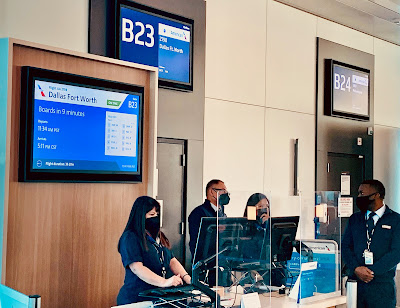
SFO to DFW left on time from Gate B23.

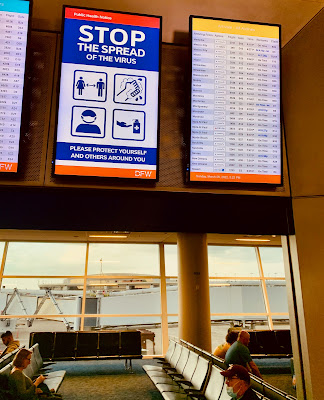
At DFW, prominent signs didn't necessarily mean compliance.

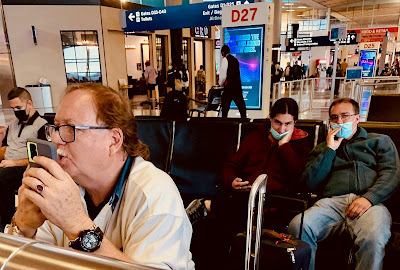
Gathering my belongings and putting my shoes back on, I proceeded to the gate and, surprise of surprises, the flight to DFW (Dallas Fort Worth) left on time and even arrived a few minutes early, with no anti-masker incidents on board. Immediately I noticed, though, that in COVID-friendly Texas many people were disregarding CDC masking regulations despite numerous posted signs. At SFO, mask compliance appeared to be 100 percent, while at DFW I would estimate that some 30 percent were ignoring the regulations in one way or another. The worst case that I observed was a 60-something porteño loudmouth on his phone at a charging station; when I gently suggested he should use his mask, he went ballistic.

The loudest scofflaw was an Argentine shouting into his cell phone.

DFW recently made No. 8 on a list of the country’s ten-worst airports. That’s partly because of frequent delays and, indeed, our departure for Buenos Aires was more than two hours after the scheduled time. It got worse, though, as the gritón mentioned above was just one seat away and, for most of the flight, couldn’t be bothered to wear his mask. He was not the only one, though, and even some of the flight attendants couldn’t be bothered on a plane that was nearly full. There was also one of the worst shrieking toddlers ever to keep me from even attempting to sleep.

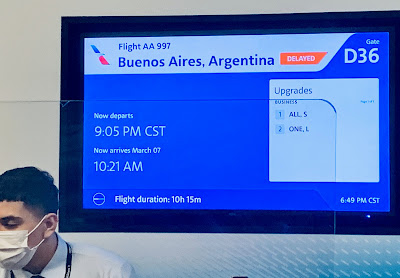
AA 997 left more than two hours late from Gate D36.

I passed on both dinner and breakfast—life’s too short to dine on airplane food, and I eaten had a decent prosciutto sandwich while waiting for takeoff. I did sample a glass of a Pinot Grigio on board (American has been one of the last airlines to resume alcoholic beverage service), but it was almost undrinkable. My only regret is that I hadn’t realized that my video screen included a window-seat view camera which, though not so good as an actual window seat, at least provides a rough view of the landscapes below.

Unfortunately, I only discovered the window-seat camera view shortly before we landed in Buenos Aires.

Immigration was fairly quick and efficient at Ezeiza.

Once we deplaned on Monday morning, things got better. Immigration lines weren’t long, and the official who processed me asked only to see my declaración jurada (affidavit) for evidence of vaccination and other info (it’s obligatory to fill out the declaration 48 hours prior to departure for Argentina). I quickly showed him the PDF on my phone, and then he put the first stamp in my brand-new passport. I then went to the office of Transfer Express for a cab, for which I had to pay the official exchange rate via credit card because I fell just short of enough Argentine pesos acquired at the so-called “blue rate” on my last visit.

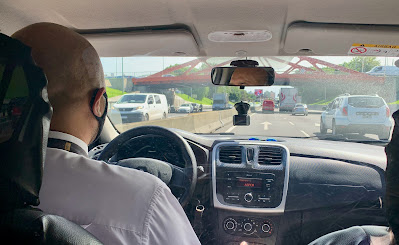
A glass partition separated me from my Venezuelan driver, but didn't inhibit conversation.

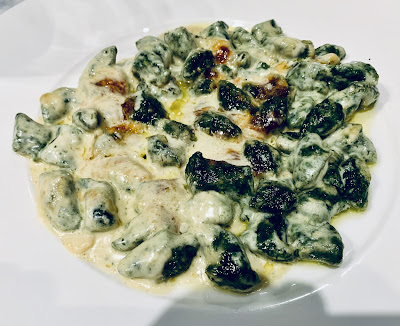
Traffic into town wasn’t bad, and my cabbie was an agreeable Venezuelan with whom I could talk baseball—a pleasant coda to perhaps the worst flight I’ve ever endured—despite the glass partition that now minimizes driver-passenger contact in the pandemic world. At home in our Palermo apartment, after a refreshing nap to make up for lost sleep, I enjoyed a plate of spinach gnocchi at Bella Italia Café, just down the block, before retiring for the night.

I ended the day with a plate of spinach gnocchi at Bella Italia.

Support Southern Cone Travel

If you've found this essay amusing, interesting or otherwise useful, feel free to click on an ad to earn me a few pennies. Thanks for your attention.


Tuesday, February 16, 2021

Vicarious Argentina

In most years, the Northern Hemisphere winter becomes my Southern Hemisphere summer and, while I’m not a stereotypical summer beachgoer, these short California days get me thinking about the area below the Equator. Sadly, during this pandemic, it’s gotta be virtual, but one option is the cinema. Fortunately, Argentina has one of the Western Hemisphere’s most vibrant film industries, and this has been an opportunity to catch with some things I hadn’t yet seen. It’s vicarious travel but, on one level, it’s satisfying until I can return to the road—ideally, later this year.

In that context, here are brief reviews of Argentine films that I’ve watched lately, all on Netflix. Only one of them is recent, but all of them focus on absorbing (but less than edifying) aspects of life in the country.


Pizza, Birra, Faso (1998)

I’d long intended to watch Pizza, Beer, Smokes (title explanation follows in an endnote), but only recently managed to watch the feature film directorial debut by Uruguayan-born Adrián Caetano (who partnered with Bruno Stagnaro; English-language interview with Stagnaro here). It’s the tale of a group of petty thieves with few scruples—colluding with a taxi driver to rob his passengers, for instance, and stealing the earnings of a double amputee street musician.

Part of their activity is cheekily adolescent, as when they scale a fence to break into the landmark Obelisco—equivalent to DC’s Washington Monument—and climb its staircases in the darkness with the aid of cigarette lighters and paper scraps. Later they get into more elaborate and violent schemes, including an attempted restaurant robbery at gunpoint, but there is also comic relief, as when the delincuentes—who don’t know how to drive—rely on one of their taxi victims, a grandmotherly woman, to chauffeur them around the city. In an fit of compassion, they drop her off at the city airport, where she calls the cops on them.

In the movie the gang climbs the Obelisco, but the directors couldn't get official permission and thus used a studio to replicate the interior staircases.

It is something of an ensemble cast, though Héctor Anglada stands out as El Cordobés, an immigrant from the provinces who wants to run away to Uruguay with his pregnant girlfriend but can’t resist attempting one last big score (in real life, Anglada died in a motorcycle accident at the age of 26). Without spoiling the ending, I will say that this is not an inspiring movie, but it does depict a reality that most visitors will not experience but should at least acknowledge.

Ugi's is the gang's pizzería of choice.

Endnote: Pizza, beer, and smokes are the gang’s priorities, but it’s symbolic of their (lack of) status that, when one of them suggests pizza at the modest Banchero (known as creator of the iconic fugazzeta), the rest of the group overrules him for takeout at the lowest-common-denominator chain Ugi’s. Birra, of course, is the Italian word for beer, and is widely used in Buenos Aires; their preferred Quilmes is the Ugi’s of fermented beverages (no craft brews for these guys!). Faso, meanwhile, is a lunfardo (slang) term for cigarettes (everybody in this film smokes), but it can also mean a joint.


Palermo Hollywood (2004)

Set mostly in one of Buenos Aires’s fashionable neighborhoods—home to the TV and movie industry, and vigorous nightlife—Eduardo Pinto’s film has much in common with Caetano’s, but there’s a major distinction. The protagonists, Mario and Pablo, may be petty thieves (not to mention party animals), but they’ve formed a friendship across class boundaries. While Mario’s father is prosperous and politically connected, Pablo’s working-class family is feeling the pressures of living in an area that’s undergoing rapid gentrification (The trailer above is Spanish-only).

Mario and Pablo profit off Palermo Hollywood's nightlife, but  the barrio's gentrification is squeezing Pablo out.

Like the characters in Pizza, Mario and Pablo find themselves in a dangerous situation that, in this case, will test the limits of their loyalty to each other. For ne’er-do-well Mario, his lifestyle is a sustained teenage rebellion against his father, but for Pablo it’s his only option for survival and escape from an untenable personal predicament. To say much more would spoil an ending that some might think they anticipate.


Brian Maya, who plays Mario, also wrote the screenplay. Palermo Hollywood showed at the 2005 Sundance film festival.


Al Acecho (2019)

The most recent of these films, Francisco D’Eufemia’s Al Acecho  (translated somewhat ambiguously as Furtive) tells the tale of a Pablo Silva, a park ranger who’s trying to reinvent (redeem?) himself after apparent legal problems. In the process, Silva finds himself dealing with various problems including corruption in the park’s administration, some of whom may have condoned or even promoted poaching in an area of surprising biodiversity.

Viewers shouldn’t rush to sanctify Silva, portrayed by Rodrigo de la Serna (who appeared as Che Guevara’s  companion Alberto Granado in The Motorcycle Diaries and also plays a key role in the Spanish Netflix hit Money Heist). As with Palermo Hollywood, the ending may not be totally unexpected given the way the plot develops, but it’s not what D’Eufemia’s opening scenario might give us hopes of seeing.


One review described the setting for Al Acecho, Parque Provincial Pereyra Iraola, as “remote” and “little visited.” Even allowing for the fact that the film is fiction, I can’t refrain from pointing out that the park is only about 20 km northwest of the Buenos Aires Province capital of La Plata, and just 40 km from Argentina’s capital, via a major paved highway (When my wife was a student at the Universidad de La Plata, she went there with her brother and friends on day trips for barbecues). I apologize but, as a geographer, I still can’t overlook these things.

Friday, January 22, 2021

Tilting (Back) to the Molino

In the early to mid-1980s, when I first visited and then lived in Buenos Aires, it was in the Congreso neighborhood barely two blocks from the national legislature (which was out of service then, as Argentina chafed under a military dictatorship). Still, the area itself retained a certain elegance, with the ponds and fountains of the Plaza de los dos Congresos and architectural landmarks such as the Art Nouveau Confitería del Molino.

The Plaza de los dos Congresos as seen from the Palacio Barolo (the tower of the Confitería del Molino is visible to the right of the Congress building).

My wife-to-be’s parents owned our modest apartment on Cangallo (now Perón) that was barely two blocks from the Congreso, and was within walking distance of numerous landmarks, including the Molino. They had bought the tiny (cozy?) two-bedroom unit to house their kids while attending the Universidad de Buenos Aires; there were three other apartments in the low-slung building, and everybody had access to a rooftop terrace for asados. Part of the time we shared it with my brother-in-law and his wife, and part of the time we had it to ourselves.

Today, high fences block access to the pools of the plaza (the Congreso rises behind the monument).

Accustomed to single family houses, I sometimes found the apartment cramped, but it was easy walking distance to the theater and cinema district—not to mention the world’s greatest ice creamery—along Avenida Corrientes, and to the country’s symbolic heart along the Avenida de Mayo. At the east end of Avenida stands the Casa Rosada presidential palace but, from vantage points like the observation deck of the Palacio Barolo, the west end view of the Congreso and its plazas was truly spectacular.

In better times, families gathered outside the pools, and kids waded in them.

Sadly, the area often looked less appealing close up. I always enjoyed watching kids wade into the pools on hot summer days but, in the aftermath of Argentina’s 2001 economic meltdown, city government fenced off access to them, and areas that were once gathering places became little more than thoroughfares. Even before that, in 1997, the landmark Molino shut down and gradually deteriorated even though it was declared a national historical monument shortly thereafter.

The Confitería del Molino is a true landmark (the decorative windmill itself is not yet functional, according to reports). 

I didn’t really frequent the Molino, though I did pay one memorable visit when a local journalist made numerous useful suggestions for the first guidebook I ever wrote on the Argentine capital. Now, I read, the scaffolding has gone down from a major restoration and the building itself, now property of the Congreso, will reopen to include a new version of the confitería; while I have no photos of the interior, Madonna shot a kitschy 1995 video there that displays the main floor and its columns.

The renovated Cine Gaumont is another positive development in what has been a declining neighborhood.

While the neighborhood is still recovering from decades of neglect, there are other hopeful signs such as the revival of the classic Cine Gaumont, operated by the Instituto Nacional de Cine y Artes Visuales (National Institute of Cinema and Audiovisual Arts). Meanwhile, our old apartment—now the property of my wife and her three siblings—is rented out to a Colombian immigrant family. Despite the worn exterior, it’s still comfortably livable.

Our weathered apartment building, on Perón (ex-Cangallo) is better than it looks from the street.

Even though I may never live in the neighborhood again—since 2002, we’ve owned an apartment in Palermo—I look forward to revisiting the Molino and, perhaps, enjoying my morning medialunas alongside the congressional powerbrokers. At least, when it becomes possible to travel there again.

Saturday, May 23, 2020

Walled Out? Walled In? Or Both?

Having received an advance from my publisher, I am theoretically updating the current edition of Moon Patagonia, but it’s not quite that simple. When I flew to Chile in late February, after a few days in Santiago I drove south to the volcanic highlands of the Araucanía region and across the Argentine border to San Martín de los Andes and San Carlos de Bariloche. I abruptly returned to Chile, though, when Santiago announced the impending closure of the borders between the two countries.
In mid-March, Chile was about to close the border with Argentina because of the Coronavirus crisis.
I had double-checked and acquired quite a bit of material in the process but, when I left to return to California in late March, I told my Chilean friends—one of whom is storing my car in Santiago—that I hoped to return in November, but couldn’t guarantee that would be the case. February or March of next year sounded a bit more realistic. Even now, that’s far from certain because of the Coronavirus crisis, which is worsening in Chile—though it’s not yet reached the levels of misgoverned countries like Brazil, the United Kingdom and, of course, the United States.
COVID-19 trends are worsening in Argentina and Chile, but still not close to those in the United States, Brazil, or the UK. 
Many people are without work these days, but my own is simply in limbo even if, in theory, I could be working on the book in question. In past years, spending the summer at home in Oakland before heading south after the World Series, I would revise background material such as government and politics. Still, even before I arrived in Chile earlier this year, that was full of uncertainty with the pending plebiscite on a new Constitution—now rescheduled for October 25th—and whether the accompanying political unrest might affect the travel and tourism sector.

The public health crisis, of course, put that issue on the back burner—almost literally, as the Chilean government decided (rightly, in my opinion) that holding an election in the midst of a pandemic was risky. For what it’s worth, the country does not allow absentee voting, so vote-by-mail is not an option; voting was once obligatory, but that is no longer the case. Interestingly, Chile does allow resident non-citizens to vote in its elections.
Open-air dining space at Pucón's Loretano
Besides background material, though, there’s equal uncertainty about tourist services. In my short time in South America, I discovered new restaurants, such as the Peruvian Loretano which, at present, continues serving takeout meals in Pucón. Still, in the aftermath of the public health crisis, many restaurants, accommodations and other services are sure to fail or, at least, change dramatically. It’s too early to say whether Loretano, or even established accommodations and restaurants with a solid track record over the decades, will necessarily survive.
I'd love to try the Peruvian-style ceviche at Loretano again.
Even if the travel and tourism sector re-opens, there’s another obstacle for me (and many other US citizens). Everybody knows, of course, about the notorious vanity wall under construction at the Mexican border, but now the current White House occupant’s minions are taking it to another level entirely. My US passport expires in early September, and I recently learned that the State Department is not processing either new or renewal applications so that, even if Argentina and Chile open up for tourism, it's uncertain (at best) when we'll be able to return.
In early March, when I entered Argentina from the Chilean side, I saw this camper van with Washington State plates. What their status might be at present, I can only guess, but the immediate outlook is not promising for US travelers.
The United States, of course, always used to criticize the Soviet Union and its allies for confining their citizens within their borders—most notably after the erection of the Berlin Wall. Now, it seems, any supposed “reopening” of the US has its limits, as its citizens must contend with walls—not just to keep foreigners out, but also to keep us in.

Tuesday, April 21, 2020

Ice Cream, Empanadas, and the Pandemic

It’s been more than three weeks since I “escaped” from Argentina and Chile, but I never stop thinking about them. I have many relatives in Argentina, and friends in both countries, who’ve been in touch in the coronavirus “aftermath” (obviously, it’s not over yet), but we express concern about each other and the future (short- and medium-term especially). The public health crisis seems to have hit Chile harder than Argentina, although the latter’s statistics seem incomplete according to the regional live data update at NCOV2019 (disclaimer: this site often seems to be overwhelmed with traffic).
A recent screenshot of Coronavirus stats in South America
Last week, I did receive an email from my friend Gabriel Famá, owner of the landmark ice creamery Heladería Cadore in Buenos Aires, and he’s feeling the pinch of Argentina’s near total lockdown. Though food providers such as himself can remain open for delivery, he was in hard-hit Italy when the crisis began, returning at the end of January “with no restrictions or controls, and look what. A lot of people underestimated the situation.” He comes to work “by car, with one of my sons, to avoid contact on public transportation and we operate with as few employees as possible.”
In non-virus times, Cadore can get really crowded.
Another friend, Marcelo Ferrante of Periko’s Hostel in Bariloche (where I spent a night before crossing back into Chile on my odyssey home), found himself on an RV vacation in Spain, another country devastated by the virus—“With luck I was able to get back to Bariloche, it was difficult but I managed it.” On April 8th, he wrote me, “We had to close on March 20th when the last guests left” (I had departed on the 16th). Then, he added, “I don’t think we’ll be able to open before before June 1st,” which would coincide roughly with ski season, but even that sounds optimistic to me.

That said, Argentina appears to be relaxing its strict quarantine restrictions, though the details are not yet clear. It's not been so draconian under California's "shelter-in-place" measures but, on an early Saturday supermarket run, I stocked up on Three Twins ice cream which, sadly, has folded under sustained economic pressure exacerbated by the plague.

Empanada Time!
On the bright side, here in the East Bay we have multiple options for Argentine-style empanadas, which are my favorites. There are four places within 2.1 miles (3.4 km) from our home in Oakland’s Temescal district.
9 de Julio Empanadas at the annual Temescal Street Fair on Telegraph Avenue
Unfortunately the one within easiest walking distance, the 9 de Julio Empanada Kitchen, hasn’t yet opened its new physical location in Rockridge, though it appears to be doing catering. Taking its name from the date Argentina’s independence day, it’s the creation of Erica Sanders, an Afro-American woman who moved to Buenos Aires to learn the art of the empanada. In past years, I’ve tasted her product—which features empanada styles from throughout the Americas—at street fairs in Montclair and Temescal, but the public health crisis appears to have delayed the opening.
Windows at the Wooden Table Café have fileteado flourishes.
The next closest is Uptown Oakland’s Wooden Table Café, which I’ve only sampled erratically because I usually pass it after taxiing my wife to work (she’s now telecommuting). Parking is scarce, though, so stopping is a matter of opportunity on my way back home. It’s very specifically Argentine, to the point of offering yerba mate drinks (the current crisis makes me wonder whether Argentines—and Uruguayans—will give up the custom of passing around the mate gourd, with a shared bombilla, among friends and family). It also offers a variety of sickly sweet alfajores, dulce de leche concoctions which are not to my taste. I do like the decorative fileteado on the windows, though.
Javi's Cooking is the empanadería I've most often patronized.
Nearly as close is Javi’s Cooking, in the Hoover-Foster district, whose products I first saw in the frozen food section at Berkeley Bowl West, and later sampled in Javier Sandes’s food truck during an event at Lake Merritt. It’s a place that I’ll make an occasional escapadita to when food in the fridge is scarce, and it also offers facturas (pastries) including my personal favorite medialunas (croissants, of a sort).
With its sidewalk seating, Café Buenos Aires feel more like a spot in the Argentine capital.
The most distant of the bunch is South Berkeley’s Café Buenos Aires (2.1 miles or 3.4 km), which I stumbled upon while taxiing an Argentine political scientist to a downtown event there. It has a wider menu than the others, especially with regard to pastries, but it’s not quite so convenient as the others. It’s a bit more spacious as well but, under current conditions it—like all the rest—is for takeout or delivery only.
María Laura's homemade empanadas - chard in this case - are our default choice these days.
In any event, we’ve not bought empanadas recently. The local price of roughly $5 each would appall most Argentines but, fortunately, my Argentine wife is capable of making them much more cheaply with no sacrifice in quality. Still, I look forward to revisiting all these others, so nearby, in person when our shelter-in-place restrictions relax.


Custom Search