Showing posts with label Immigration. Show all posts

Saturday, December 10, 2022

Returning to Santiago (and all that entails)

At very long last, this past Monday, I arrived back in Chile for the first time since March of 2020, when I abruptly flew home to California as the seriousness of the COVID-19 pandemic became obvious. I was originally to arrive on the previous Saturday but, late that week, LATAM suddenly canceled my nonstop Friday flight from Los Angeles International Airport (LAX) to Aeropuerto Arturo Merino Benítez (SCL).

Thanks to my heroic travel agent—there are still such things!—I was able get rescheduled for Sunday even though not without trepidation that the new flight might also be canceled. Analía Rupar-Przebieda (an Argentine resident of Southern California) first tried to reschedule me on Delta (a LATAM partner) via Atlanta, but Delta refused (even though the SFO-LAX leg of my flight was with them). That would have gotten me to SCL on Saturday as planned, but the rescheduled LATAM left on Sunday and didn’t get me here until early Monday morning.

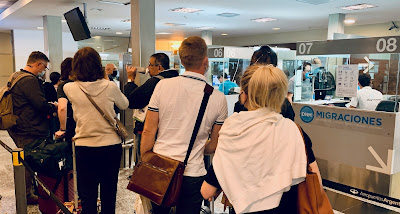
The lines at immigration were long, but moved surprisingly quickly.


The flight was reasonably comfortable if crowded, and I was one of few coach passengers wearing a mask (those in first and business seemed to take it more seriously). On deplaning and arriving at immigration, though, we were faced with the longest lines I’ve ever seen at any airport. We also saw a warning for monkeypox—Chile continues to take contagion seriously—but the lines moved surprisingly quickly. So did the customs and agricultural checkpoint, so I was finally officially in the country.

Is monkeypox the next big thing?


Now to get to the city, and I purchased a seat on a shared TransVIP shuttle and was surprised to find a 5.5 percent surcharge on my foreign credit card. This has also been the case on some restaurant meals, but not on a purchase I made at a downtown department store. I had arrived with a small amount of Chilean cash but, at the new international terminal, the exchange houses were offering very poor rates and there was no functional ATM anywhere to be seen.


I rested most of Monday, other than a fine Peruvian dinner at with my host Marializ Maldonado at Del Carajo, across from the Hipódromo (racetrack) in the untouristed neighborhood of Independencia. The next day, I found a BancoEstado ATM and learned that their once-free ATMs now charge Ch$5500 (roughly US$6.50) for any withdrawal from a foreign account. Yesterday I made the maximum withdrawal of Ch$200,000 (about US$230) with the private Banco Itaú at a cost of Ch$6,000 (US$7). I haven’t yet tried to change US cash in the city, because I’m saving most of that for unpredictable Argentina.

With luck, my so far trusty Suzuki will be back on the road soon.


In preparation for upcoming Patagonian road trip, I’m now awaiting replacement of the catalytic converter on my 2005 Suzuki Grand Nomade, which failed its most recent revision. The most worrisome part of this, at present, is the availability of a replacement part, though my trusted mechanic Mauricio Donoso sounds reasonably optimistic.


Another issue I’ve had to deal with is cell phone service. My US carrier provides phone and data coverage here, but with limits—not exactly clear—on how much, and I’ll be in Chile and Argentina for three months. Because my new iPhone 12 uses an E-SIM rather than a physical chip, I cannot use a pay-as-you-go option here and, without legal residence in the country, nor can I open an account with a monthly plan. Yesterday, though, my host Marializ added me to her plan (and I’ll reimburse her), but that’s not an option for the overwhelming majority of visitors. Some will be limited to WiFi.

Wednesday, March 9, 2022

Is Purgatory Real? SFO to DFW to EZE on American Airlines

I’m not Catholic—in fact, I’m an atheist—but after completing my first flight in two years, I think I finally understand the concept of Purgatory. Early Sunday morning I started the initial leg of an odyssey that took me from San Francisco to Dallas Fort Worth to Buenos Aires and, except at the very beginning and the very end, it was a disagreeable experience that I felt might never end.

First the good—after my wife dropped me off at SFO, the counter attendant who did my check-in was a simpático Uruguayan who did his best to promote his homeland, though it’s unlikely I’ll cross the Río de la Plata to Montevideo or any other port in the Banda Oriental on this trip. After checking my vaccination card and PCR test (no more than 72 hours prior to departure for Argentina), he also snagged me aisle seats for both legs of the journey (In theory I still prefer window seats to enjoy the landscape from 35,000 feet, but my prolonged recovery from last year’s ankle surgery has made ease of access more important than it used to be).


Things quickly deteriorated from there and that, of course, meant security theater from the so-called “Department of Homeland Security.” On my body scan, they saw things they didn’t like—one of which was a money belt that included the US cash I was carrying to Argentina because the official exchange rate is so disadvantageous. That was fairly easy to explain, but they also detected a “suspicious” elastic knee support I was wearing because of recent soreness and, even worse, a support sock apparently set off their metal detectors (I’ve been wearing one ever since my surgery, and it contains trace amounts of copper). In both cases I rolled up my trousers to invite a direct inspection, but the individual who detained me felt obliged to call in a superior who eventually authorized me to continue.

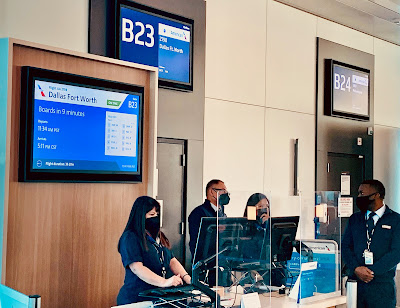
SFO to DFW left on time from Gate B23.

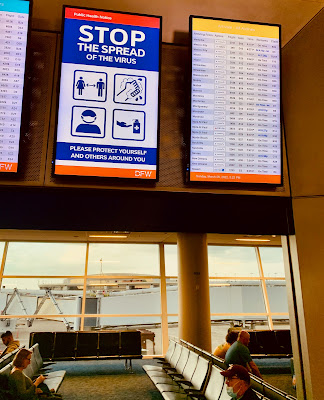
At DFW, prominent signs didn't necessarily mean compliance.

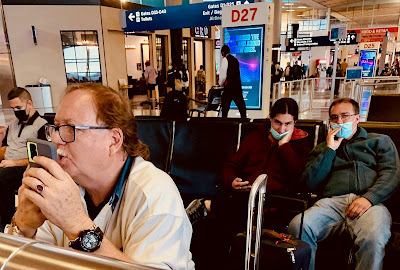
Gathering my belongings and putting my shoes back on, I proceeded to the gate and, surprise of surprises, the flight to DFW (Dallas Fort Worth) left on time and even arrived a few minutes early, with no anti-masker incidents on board. Immediately I noticed, though, that in COVID-friendly Texas many people were disregarding CDC masking regulations despite numerous posted signs. At SFO, mask compliance appeared to be 100 percent, while at DFW I would estimate that some 30 percent were ignoring the regulations in one way or another. The worst case that I observed was a 60-something porteño loudmouth on his phone at a charging station; when I gently suggested he should use his mask, he went ballistic.

The loudest scofflaw was an Argentine shouting into his cell phone.

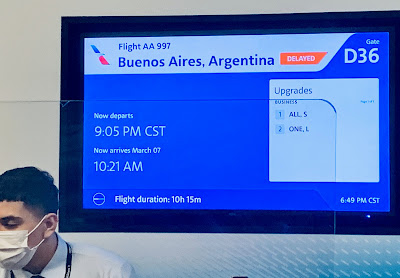
DFW recently made No. 8 on a list of the country’s ten-worst airports. That’s partly because of frequent delays and, indeed, our departure for Buenos Aires was more than two hours after the scheduled time. It got worse, though, as the gritón mentioned above was just one seat away and, for most of the flight, couldn’t be bothered to wear his mask. He was not the only one, though, and even some of the flight attendants couldn’t be bothered on a plane that was nearly full. There was also one of the worst shrieking toddlers ever to keep me from even attempting to sleep.

AA 997 left more than two hours late from Gate D36.

I passed on both dinner and breakfast—life’s too short to dine on airplane food, and I eaten had a decent prosciutto sandwich while waiting for takeoff. I did sample a glass of a Pinot Grigio on board (American has been one of the last airlines to resume alcoholic beverage service), but it was almost undrinkable. My only regret is that I hadn’t realized that my video screen included a window-seat view camera which, though not so good as an actual window seat, at least provides a rough view of the landscapes below.

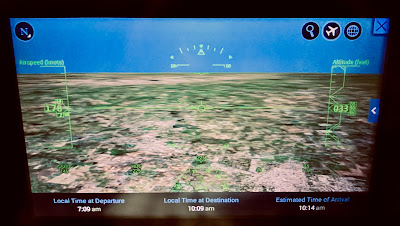
Unfortunately, I only discovered the window-seat camera view shortly before we landed in Buenos Aires.

Immigration was fairly quick and efficient at Ezeiza.

Once we deplaned on Monday morning, things got better. Immigration lines weren’t long, and the official who processed me asked only to see my declaración jurada (affidavit) for evidence of vaccination and other info (it’s obligatory to fill out the declaration 48 hours prior to departure for Argentina). I quickly showed him the PDF on my phone, and then he put the first stamp in my brand-new passport. I then went to the office of Transfer Express for a cab, for which I had to pay the official exchange rate via credit card because I fell just short of enough Argentine pesos acquired at the so-called “blue rate” on my last visit.

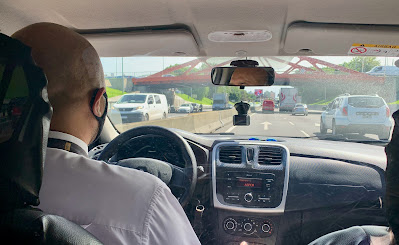
A glass partition separated me from my Venezuelan driver, but didn't inhibit conversation.

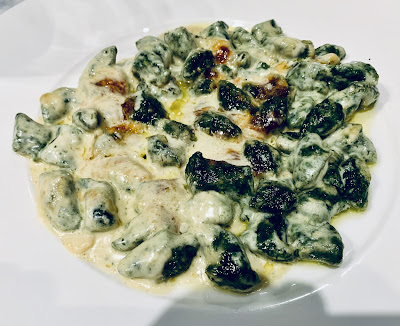
Traffic into town wasn’t bad, and my cabbie was an agreeable Venezuelan with whom I could talk baseball—a pleasant coda to perhaps the worst flight I’ve ever endured—despite the glass partition that now minimizes driver-passenger contact in the pandemic world. At home in our Palermo apartment, after a refreshing nap to make up for lost sleep, I enjoyed a plate of spinach gnocchi at Bella Italia Café, just down the block, before retiring for the night.

I ended the day with a plate of spinach gnocchi at Bella Italia.

Support Southern Cone Travel

If you've found this essay amusing, interesting or otherwise useful, feel free to click on an ad to earn me a few pennies. Thanks for your attention.


Thursday, April 15, 2021

A Long Petal of the Sea (Book Review)

In 1939, as the Spanish Civil War wound down, thousands of refugees fled across the border into France—which then confined tens of thousands in a deplorable detention camp at d'Argelès-sur-Mer. In partial response, poet Pablo Neruda—also a diplomat—chartered the French cargo vessel Winnipeg to carry 2,200 Spanish refugees across the Atlantic and through the Panama Canal to his homeland of Chile where, despite isolated episodes of xenophobia, they integrated themselves into local society.

Chartered by Pablo Neruda, the French freighter Winnipeg carried Spanish refugees to Chile.

That’s the historical background for Isabel Allende’s latest novel, A Long Petal of the Sea, which becomes a tale of exile and adaptation that includes several larger-than-life figures, most notably Neruda himself but also the late President Salvador Allende (Isabel’s father’s cousin) and the notorious Augusto Pinochet (mentioned only in passing). Some characters are fictionalized versions of historical figures, such as pianist Roser Bruguera, clearly based on the painter Roser Bru (who turned 98 in February).

Isabel Allende's novel focuses on one exceptional refugee family.

Bruguera is one focus of a complex family story that melds with an equally complex political history that involves her going into exile, with her husband Víctor Dalmau, from Pinochet’s dictatorship. Allende is especially good at depicting the intrigues and obstacles her characters must navigate, including neighborhood informants, imprisonment, intra-familiar conflicts that tore many Chileans apart, and the disruptions of exile.

The first Spanish refugees would have passed through Arica's customs house (now a cultural center).

Being a geographer, I try to be alert to people and place, and I found one unfortunate error. I expected that, after the Winnipeg passed through the Panama Canal, it would go directly to Valparaíso, whence the refugees would proceed to Santiago and elsewhere in the densely populated heartland. As it happened, though, the ship made a stop in the northern port of Arica, a city I know well, where Chilean officials met the vessel and some of the passengers came ashore to stay.

The nitrate port of Pisagua was the northernmost point on Chile's contiguous rail network.

Allende, though, claims the officials arrived by train, but the northern Chilean railroad network, developed to help exploit the Atacama Desert’s nitrate deposits, never reached Arica—the most northerly major station was in the port of Iquique, roughly 200 km to the south (though there was a smaller station in the nitrate port of Pisagua, only about 125 km to the south). It might have been possible to reach Arica by rail at this time, but that would have involved a roundabout route via Buenos Aires and slow trains to northwestern Argentina and then Bolivia, where the Ferrocarril Arica-La Paz connected the two countries. Given the time, distances, and often contentious relations between Bolivia and Chile, it’s unlikely that anyone would have taken this route and, as it happens, there were flights from Santiago to Arica as early as 1929.

Oficina Chacabuco was the camp where Víctor Dalmau was presumably imprisoned. 

Allende describes, but does not specifically identify, the location where her protagonist Dalmau “ended up at a camp for saltpeter miners in the north that had been abandoned for decades and was now converted into a prison.” That description fits Oficina Chacabuco, about 100 km northeast of the port city of Antofagasta, which is now a national monument and in situ museum that I’ve visited several times. She also offers a plausible description of the Dalmaus’ ostensible rural retreat, outside Santiago, when they return from exile in Venezuela.


All in all, Allende’s novel is a rewarding read that provides an insider’s view of refugees, immigrants, and the contributions they make to their new countries—with lessons for countries still including Chile and, of course, the United States (where Allende now makes her home).


Sunday, February 24, 2019

The Haitian Connection?

In 1978, when I first visited Chile, the default choice for coffee junkies was semi-soluble Nescafé, and that’s still common here. It didn’t bother me personally, because I don’t drink coffee—how can something that smells so wonderful taste so awful?—but my fellow travelers often searched desperately for espresso or even a freshly brewed cup from grounds.
Café Haití was Santiago's original café con piernas, but more drinkable than Nescafé.
At that time, just about the only place to do so was Santiago’s Café Haití, a chain of standup coffee bars that was notorious for its café con piernas ("coffee with legs"), served by attractive young women in micro-skirts and other form-fitting clothing. The clientele was overwhelming male (and machista) but, on occasion, female clients couldn’t resist what appeared to be the best available caffeine fix. My own wife, given her Italo-Argentine background, reluctantly became one of them.
Taken last year, this screenshot summarizes the size of Chile's immigrant communities.
Why the chain’s founder chose that specific name is unclear—the source of his coffee seems likeliest to have been Brazil or Colombia—but in recent years Chile has become the country of choice for emigrants from the impoverished Caribbean country, and Haitians are a visible presence in the capital and elsewhere. For what it’s worth, Chile was the second country in the Americas to abolish slavery, after Haiti itself.
Caleta Camarones is an historically Afro-Chilean community.
Even though I have a background in colonial Latin American history, I’d never seen much evidence of the Afro-Chilean heritage. The only precise location I can identify is the coastal village of Caleta Camarones, midway between the Atacama desert cities of Arica and Iquique, whose four-time mayor Sonia Salgado once stated that “Our ancestors arrived here together with the conquerors.”
My Haitian immigrant waiter at Ostras Azócar
The Haitian presence is something different, though, and it’s increasing. The first Haitian I ever encountered personally was a waiter at the classic seafood restaurant Ostras Azócar, who told me more than a decade ago that he learned his fluent Spanish through listening to radio broadcasts from the neighboring Dominican Republic. He now has a family here, and has recently opened his own small business.

I see many Haitians in the Renca neighborhood where I’m staying at present and, at best I can tell, most of them are speaking Haitian Creole (I certainly don’t recognize it as standard French, of which my knowledge is admittedly limited). At a downtown Santiago gas station, I recently had a conversational exchange with a Haitian janitor whose Spanish was likewise limited but was clearly making an effort to communicate.
Haitian options are becoming part of Santiago's fast-food scene.
Most Haitians appear to occupy menial jobs, but there are some indications of entrepreneurship as well. Not far from my Renca accommodations, there’s a sandwich shop that offers Haitian dishes alongside the standard completos (hot dogs) and churrascos (grilled beef). That suggests, at least, a hopeful foothold in the dominant Chilean culture, though there’s certainly been some anti-immigrant sentiment here. I’ve not yet sampled the food there, and it’s unlikely ever to match the impact Peruvian cuisine has had.

Support Southern Cone Travel
If you've found this item informative or otherwise useful, please consider earning me a few pennies by clicking on an ad here.

Tuesday, September 11, 2018

Argentina's Heroic Forger

Late last year, I briefly noted the publication of Sarah Kaminsky’s Adolfo Kaminsky, A Forger’s Life, the tale of her father’s service in the French Resistance of World War II. That interested me, partly because Kaminsky is an Argentine, and partly because the Resistance provided forged identification that helped my 94-year-old uncle, who lives in Los Angeles, escape the Nazis after being shot down over France in November of 1943. His own account of traveling across France and into Switzerland is positively cinematic.
The English and Spanish-language versions of Kaminsky's story
I received a copy of Kaminsky’s book from the US publisher but, on my recent trip to Buenos Aires, I purchased a copy of the Spanish-language edition Adolfo Kaminsky El Falsificador, primarily because it includes a prologue about Kaminsky’s boyhood in the Argentine capital. Though he spent only five years there before his parents returned to Europe, he offers surprisingly vivid memories of a free-range boyhood in an immigrant neighborhood that sounds like the edge of Barrio Norte (he mentions living on Calle Ecuador, apparently near Avenida Córdoba, but is not more specific than that). 
The intersection of Ecuador and Paraguay is roughly where the Kaminskys lived in Buenos Aires.
Kaminsky’s mother, born in Tbilisi, married his Russian-born father in Paris during World War I. Given the disorder in Europe, heightened by the Bolshevik Revolution, the family had moved to Buenos Aires, where Adolfo was born in 1925. Interestingly, when the family returned to France, what struck him was the contrast with Buenos Aires, the noise from the cars, trams and trucks that crowded Parisian streets—“It was so different from Calle Ecuador!” In the ensuing century, Buenos Aires has more than caught up.

The return to Europe didn’t go as expected because the French would not grant the family immediate residence, and they spent two years in Turkey waiting for permission to return. The lack of papers, Kaminsky implies, may have inspired his interest in falsifying documents: “Nothing destined me to become a forger but, however, those papers that my family needed when I was a child were going to govern my life.”

Only 14 when World War II broke out, Kaminsky (and his Jewish family) survived the earliest years of the German occupation because of their nationality—Argentina remained a neutral country until nearly the end of the conflict. Adolfo, meanwhile, had acquired skills in printing, dyeing and photography that allowed him to produce passports and other papers that saved as many as 3,000 Jews from the Nazis.

Eventually, the Kaminskys themselves had to scatter and hide—with the help of Adolfo’s bogus documents—but after the liberation of Paris he provided Allied forces with new forgeries that helped them infiltrate German lines. After the war, he assisted European Jews in reaching Palestine—though he deplored Zionism—and then helped figures in the Algerian independence movement move between North Africa and Europe. He prided himself in never charging for his services—everything was pro bono for causes that he either supported or saw as a better alternative to the status quo.

Kaminsky did his last forgery in 1971 and lived in Algeria for a decade, marrying a Tuareg woman, before finally returning to France in the early 1990s. His daughter’s persistent inquiry into her father’s murky history eventually resulted in this book, presented as a memoir from a hero who, accustomed to staying in the background, refrained from boastfulness.

Friday, April 27, 2018

From SCL to LAX and Out...

Last weekend, I began the end of my six-week excursion to Chile with a Sunday afternoon shuttle from Renca to Aeropuerto Internacional Comodoro Arturo Merino Benítez. There, to my surprise, I found absolutely nobody in line for the 8:30 p.m. flight to Lima, where I would transfer for the overnight flight to Los Angeles International Airport (LAX) and then continue to my Oakland home.
The airport shuttle line at SCL
Though I wondered, at first, whether there had been some cancellation issues, I was merely early—airport shuttles err on the side of caution and the Sunday traffic was especially light. That said, the early arrival may have worked to my advantage in another way—the single ticket agent at the LATAM counter asked whether I would prefer a later nonstop flight which would, however, get me to LAX at least an hour earlier.
It's not Peruvian, but it's still a pisco sour.
I had my own reading material, but was still disappointed to find the  SCL
The only downside would be a lost opportunity for a Peruvian pisco sour at Lima but, after the agent reissued my ticket, I passed quickly through immigration and airport security and did find a perfectly good Chilean sour (and a rather less perfect prosciutto on a baguette—on Sunday evenings, apparently, the best dining options run short). I was also disappointed with the fact that the airport’s new book exchange was empty, and that the cheapest by the glass option at the Vinum Chile wine bar was 7500 pesos (about US$12.50)—about twice what I had paid for my sour. Just a few months earlier, it had been notably cheaper.

The 11-hour flight was uneventful (I managed to sleep about half the time), but the worst part of coming home—especially since January of 2017—is going through US Customs and Immigration. In January, when I returned home from Buenos Aires, for the first time I faced the Customs and Border Protection (CBP) machines that demand a mugshot selfie from the passport bearer. It was a slow and cumbersome process and, as I have since learned through the efforts of my friend Edward Hasbrouck, it is not obligatory.

This time, having read Edward’s advice as linked above, I informed the line-minder that I would opt out of the machine entry, and got an immediate bypass to a human being. I estimate that I saved at least half an hour, and the Guatemalan-born immigration officer who stamped my passport treated it as utterly routine. US citizens and green-card holders can avoid the invasive hassle of what Edward calls the “selfie kiosks,” but non-resident foreign arrivals are still subject to the CBP’s “digital webcam-type” surveillance.
Ceviche and chips at La Cosecha, Paso Robles
When returning from South America to LAX, I prefer to avoid additional hassles from US “airport security” and, instead, I often choose to rent a car. It’s an all-day drive back to the Bay Area but, given the possibility of delays on a long international flight, I would still need some flexibility in scheduling a connecting flight north. Thus, I prefer a leisurely drive via US 101, normally with lunch in the Central Coast wine capital of Paso Robles, where I enjoyed a fine ceviche at La Cosecha, facing a central plaza that resembles some of Latin America’s finest. And with my family and dogs to greet me on arrival in Oakland, just a couple hours later than a connecting flight would have been.

Wednesday, April 20, 2016

Welcome Back! Argentina Ends "Reciprocity," Forever?

When US president Barack Obama arrived in Buenos Aires last month, it wasn’t for a Patagonia vacation – though he did manage to take some time in the Andean lakeside resort of Bariloche – but he accomplished something that many travelers thinking of a Patagonia cruise or other similar holiday have reason to be grateful for.
In 2009, the government of Argentine president Cristina Fernández de Kirchner imposed a so-called “reciprocity fee” of US$160 on US visitors to Argentina – equivalent to the charge that Argentines pay to apply for a US visa. Leaving aside the question of fairness, the fee and its awkward bureaucracy created a disincentive for foreign visitors, including Australians and Canadians (who pay US$100 each). At a time when Argentina needed hard currency (as it still does, to help pay off its debts), this was a curious and counter-productive policy decision.

During Obama’s visit, though, the government of recently inaugurated President Mauricio Macri announced the fee’s suspension - pending progress on incorporating Argentina into the Visa Waiver Program that allows certain nationalities to enter the United States for tourism or business without an advance visa. The Obama administration responded by eliminating consular interviews for some but not all visa-seeking Argentines, but the presumably there will be additional progress sooner rather than later. It’s worth adding that Chile once collected a similar fee, but eliminated it in 2013, after being accepted into the Visa Waiver Program.
Recently, when I passed through immigration at Buenos Aires’ international airport (pictured above), I still carried proof of having paid the fee six years ago (pictured below, it was valid for ten years), just in case, since I wasn’t sure when the suspension would take effect. Other US citizens in line had no concerns, but Australians and Canadians are still on the hook, as I confirmed with telephone calls to their consulates. With luck and some official dedication, the measure will become permanent for US citizens and soon be extended to their Australian and Canadian counterparts.

Wednesday, December 30, 2015

Border Bother? The Last Time for a While, at Least

Once again, yesterday, I crossed the border from Chile into Argentina and, again, there were no glitches as I passed through Chilean immigration and customs at the Dorotea border post, a short distance from Puerto Natales. The Chilean side was brightly lighted, orderly and efficient, with short lines and quick service – certainly none of the hassle that I experienced in crossing over to Mendoza last month.
On the Argentine side, things were not quite so efficient, to say the least. The Argentine border post (pictured below) is larger but dingy and, though there were two immigration officials at a tiny window, the line – such as it was – never seemed to move. When I finally reached the front, I reminded the young woman there that the receipt for my so-called “reciprocity fee” was in my previous passport, which I also provided her, but that appears to continue to confuse Argentine immigration everywhere except for the international airport at Ezeiza, where I originally paid it.
Perhaps that’s because it’s no longer possible to pay on the spot as I did in March of 2010, eight months before that passport expired. The fee is valid for ten years from the time of payment, but at present it’s only possible to pay online, and arriving Australian, Canadian and US visitors must show a printout of their payment.
I might guess that this young woman is a newer employee who might never have seen a receipt like mine (pictured above), but that didn’t explain the half-hour or more that it took for her to examine every page in my passports – including two trips for apparent back-room consultations and a request to wait alongside the window while she attended another customer – but I eventually got the stamp that admitted me to Argentina. This should be the last time until I fly from California to Buenos Aires in mid-April.


After that, and refilling the tank at the coal town of Río Turbio - where gasoline is cheaper than in southernmost Chile - I made my way to El Calafate, where the weather has turned summery. Meanwhile, I’ve written an op-ed on why Argentina’s government should eliminate the “reciprocity fee” – urgently and unilaterally – that’s due to published in the Buenos Aires Herald. Whenever that happens, I’ll post links here, and on my Facebook and Twitter accounts.
Custom Search