Showing posts with label Juan Domingo Perón. Show all posts

Thursday, February 24, 2022

Post-WWII Argentina - Fact or (Detective) Fiction?

In my previous post, I reviewed one of my favorite streaming series with a link to southernmost South America but, while I’ve been unable to travel there (spoiler—I’m scheduled to fly to Buenos Aires on March 6th), I haven’t been purely a video couch potato. I’ve also been reading and, while I love detective stories, I’ve been doing it in a way that has more content than just potboilers.

In A Quiet Flame, German detective Bernie Gunther investigates a possible serial killer in Argentina.

Over most of the last year, I’ve been recovering from ankle surgery that requires me to do rehabilitation exercises three times daily, followed by elevating the joint to reduce the swelling for 15 minutes at a time. I use that time to read and, recently, I read the late Philip Kerr’s novel The One from the Other, in which Bernie Gunther—a former Berlin detective and anti-Nazi drafted into the Schutzstaffel (SS) during WWII—tries to track down war criminals and finds himself unjustly incriminated. Kerr’s plotline is so complex that I won’t go into more detail here, except to add that, in the end, Bernie has to flee to South America in the company of some pretty notorious “comrades.”
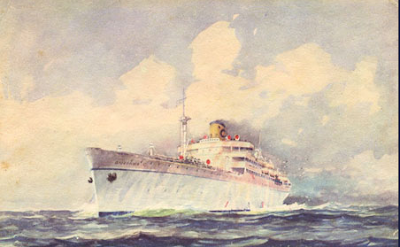
In real life and the novel, the Giovanna C carried both refugees and war criminals from Italy to Argentina.

That, of course, aroused my interest—especially so when the edition I read included the first chapter of A Quiet Flame, which describes Bernie’s 1950 arrival in Buenos Aires on the steamship Giovanna C in the awkward company of two notorious Nazis, including Adolf Eichmann. As in Germany, Gunther doesn’t hesitate to make fun of his companions, and Kerr gives provides him dialogue no less acerbic than Raymond Chandler gave Philip Marlowe and Dashiel Hammett gave Sam Spade. In one case, Bernie remarks that he repels an opponent with a punch that he compares to legendary Argentine boxer Luis Ángel Firpo.
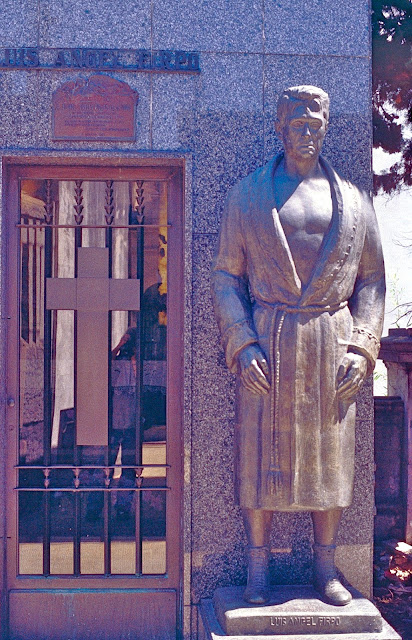
Bernie Gunther claims to pack a punch like the legendary Argentine heavyweight Luis Ángel Firpo, who once knocked Jack Dempsey onto the canvas (Firpo now resides in Recoleta Cemetery).

Like his companions, Bernie arrives under an alias but, in a meeting with then-President Juan Domingo Perón (and Perón's poodles), he has to reveal his true identity and, under pressure, he’s persuaded—forced, rather—to investigate a murder and another disappearance with links to a German-speaking community in Buenos Aires and the northern province of Tucumán (with additional links to a cold case he failed to solve in pre-war Germany).


Unlike Marlowe and Spade, Gunther had worked as a private detective when employment under the Nazi regime became untenable—a situation that may well have contemporary parallels (He had also served in Ukraine, for what that's worth). Parenthetically, Bernie manages to make some blatantly sexist comments about Evita Perón’s appearance, but also sympathizes with the health problems that killed her just a few years later.
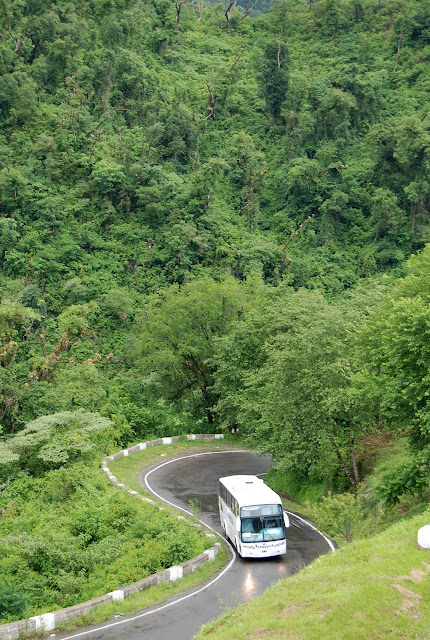
Bernie's investigation leads him to a sinister site in the subtropical sierras of Tucumán Province.

More significantly, Bernie learns of the notorious Directive 11, by which the Argentine government denied Jewish refugees entry into the country. Through him, Kerr speculates as to the existence of a Directive 12, which would have established a concentration camp in Tucumán’s subtropical forests.


According to a 2009 interview with The Wall Street Journal, Kerr (who died in 2018) decided against visiting Argentina because “I thought about it and decided that what I wanted was a historic picture, rather than the Argentina of today.” In my opinion, though, even allowing for poetic license, this novel would have benefitted from a visit to the country. In one instance, for example, Kerr appears to confuse the Argentine capital’s central shopping district of Florida with a neighborhood in the town of Vicente López, in the city’s northern suburbs—where the Nazi refugees had a safe house and Eichmann later resided for many years. Through Bernie, he's also unnecessarily harsh on a Tucumán he never saw (though it's clearly a different place today). At the very least, the publisher should have hired a proofreader familiar with Argentina—the airport city of Ezeiza, a southern Buenos Aires suburb, is consistently misspelled “Ezeira.”

Uki Goñi's book details the Perón government's complicity with the Nazis. 

At the risk of being labeled a pedant, I’ll still recommend both these novels and others by Kerr, who manages to convey the complexities of surviving in an authoritarian or even totalitarian ambience while still seeking truth and justice—even for a flawed figure like Bernie Gunther. What I'd really like to see is somebody turn all 14 novels into a streaming series.


In the course of writing A Quiet Flame, the novelist relied on Uki Goñi’s The Real Odessa, an historical account of the Nazi presence in post-war Argentina, including documentation of the Perón government’s complicity (Full disclosure: Goñi is a personal acquaintance).


Addendum

Another personal acquaintance of mine, the late geographer Dan Gade, had direct contact with another ex-Nazi, the SS officer and ethnobotanist Heinz Brücher, but it was only after Brücher’s murder in 1991 that Gade unearthed the extent of Brücher’s role in WWII and continued adherence to Nazi ideology. Questioning the impartiality of Brücher’s South American research—he also worked in Paraguay—Gade’s article might suggest that Goñi’s extensive and incisive research was only a starting point for a continued assessment of the post-war German presence.


Support Southern Cone Travel

If you’ve found this entry informative and/or useful, please consider earning me a few pennies by clicking on an ad—always presuming, of course, that it’s relevant to your interests.

Sunday, December 16, 2018

Operation Finale - a Film Review

In my youth, it was a stereotype that South America—especially Argentina—was crawling with Nazis in the aftermath of World War II. That wasn’t entirely false, given the presence of monsters like Josef Mengele in Argentina, Paraguay and Brazil—but it was also self-serving when the United States itself allowed many Nazis and their collaborators into North America after the war.

For South America, the best account of this history may be Uki Goñi’s The Real Odessa, which details the manner in which the government of Juan Domingo Perón—colluding with the Vatican in so-called “ratlines”—admitted escapees from European justice immediately after the war. If many such stories are prone to exaggeration and even fabrication—a cottage industry of “Hitler in Argentina” publishing still exists—there’s concrete truth in the tales of individuals such as Mengele, Erich Priebke, and especially Adolf Eichmann.
This selection of titles at the 2016 Buenos Aires book fair suggests the worst of "Nazis in Argentina"  publishing.
Eichmann, of course, made international headlines when Israel tried, convicted and executed him for crimes against humanity in the early 1960s. His story has recently reached the big screen in director Chris Weitz’s Operation Finale, about the Nazi functionary’s capture and abduction by Israeli agents in the “Zona Norte” sector of Buenos Aires suburbs. It’s also available for streaming, for a charge (below is a trailer; I watched on iTunes).
As an Obersturmbahnführer (Lieutenant colonel) during the war, Eichmann organized Jewish deportations to various death camps but, after the war, he evaded capture and eventually reached Argentina with false documents. There, living under the pseudonym “Ricardo Klement” in the northwestern suburb of San Fernando, he kept a low profile.

Played by Ben Kingsley, Eichmann is a creature of habit and, after the Israelis stake out his home and observe his commuting routine—taking the same bus at the same time every day—they manage to spirit him away to an apparently nearby safe house (Weitz filmed in the western suburb of Hurlingham, but I’ve no idea where the actual house was).

First denying his identity, Eichmann presents himself as a simple bookkeeper and family man before eventually, under interrogation, admitting who he is. Even then, he refuses to sign an Israeli-drafted agreement to stand trial in Israel, spurring arguments among his captors about forcing him to do so. Eventually, though, Israeli agent Peter Malkin (portrayed by the Guatemalan-American actor Oscar Isaac) persuades Eichmann to sign, with a promise that he will again be able to see his wife and family.

It’s worth stressing here that, for all the espionage and skullduggery, this is not an action thriller, but rather a psychological drama. After signing, Eichmann delivers a snarling justification of his role in the Holocaust, but there remains the task of spiriting him aboard an El Al jet to return to Israel—a task which, despite some apparent over-dramatization here, goes off without a hitch.

The following year Eichmann went on trial in Jerusalem and, after he exhausted his appeals, the Israelis executed him by hanging in mid-1962. Before his execution, though, the Israelis honored Eichmann’s request to see his wife.

Monday, November 27, 2017

¿Peronismo Vegetariano?

Some time ago, I wrote a post that touched on the topic of so-called Peronist cuisine, which almost seems an oxymoron—the working-class followers of Argentina’s legendary strongman Juan Domingo Perón were not exactly known for their culinary sophistication. Still, there’s a stereotypical roster of basic dishes that appeal to the so-called descamisados (shirtless ones) who comprise(d) the Peronist base (perhaps as Kentucky coal miners might appreciate Donald Trump’s overcooked steak with ketchup).
Last week, I decided to try the fare at Palermo Hollywood’s Perón Perón, in an area that’s not home to many descamisados, and is walking distance from our own Palermo apartment. One might argue that it’s an Argentine analogue to Tom Wolfe’s “radical chic,” with middle-class diners indulging themselves with somewhat more sophisticated versions of working-class comfort food. When I arrived around 7:30 pm, relatively early by Argentine standards, a BBC film crew was interviewing chef Gonzalo Alderete Pagés, who spoke more than passable English.
The BBC speaks to the chef.
I was pleasantly surprised with the food. The menu does feature a lot of heavy comfort food such as guiso de mondongo (tripe stew) and various incarnations of milanesa (chicken-fried steak), but I chose to go vegetarian with canelones de acelga (chard cannelloni; I really like chard, and my late mother-in-law made terrific chard pie even though she wasn’t much of a cook otherwise).
I was pleased with my chard cannelloni.

Never before had I seen an asparagus empanada.
The oddest item was an asparagus empanada, which aroused my curiosity as I’d never heard of such a thing before; it was fried but not too heavy, though I would have preferred a bit more asparagus in it. My glass of Domingo Hermanos Malbec came chilled, which is how my late father-in-law took red wine (as do many other Argentines). The wine list focuses on vintages from the Andean Northwest. For dessert, I had a satisfying rich dark chocolate mousse.
The dining area is full of Peronist iconography.
I should add that the service was surprising good, which is not something you anticipate from a movement that prides itself on labor militancy (spoiler: they were all wearing shirts). The décor, of course is a shrine to Perón and Evita (and their would-be successors Néstor Kirchner and Cristina Fernández de Kirchner), and thus more than a bit kitschy. I’d happily go back, but I think I might prefer winter when I could order something like locro, a northern Andean stew whose warm heaviness would be welcome in cooler weather (though this spring has been mild in town).
Peronist sloganeering is part of the décor.

Sunday, March 27, 2016

Holiday or Not? US Presidents in Argentina

When Air Force One landed outside Buenos Aires on Wednesday, Barack Obama became the sixth US president to visit Argentina – technically speaking, that is, for reasons to be explained below. In the last year of his presidency, Obama’s schedule-makers arranged a trip to follow his path-breaking visit to Cuba this week, but that caused something of a kerfuffle because the date of his visit to Buenos Aires – March 24 – coincided with the 40th anniversary of the coup that toppled the government of President Isabel Martínez de Perón in 1976 and started a reign of terror that became known as the Guerra Sucia (Dirty War) – for which many Argentines have blamed the United States.
With that as background, it could be helpful to provide a short chronology of those presidential visits – the first of which was Theodore Roosevelt in 1913 – or was he? By that time, Roosevelt was an ex-president whose term had expired in 1909, and he had lost as a third-party candidate in 1912. He did visit Buenos Aires, but his heart was in Patagonia, where he met the pioneer Argentine conservationist Francisco P. Moreno in Bariloche (in the photo above Moreno, dressed in white, stands to Roosevelt’s left).
In truth, then, the first US president to visit Argentina officially was Dwight D. Eisenhower, who spent four days in Buenos Aires, Mar del Plata and Bariloche in February of 1960. Hosted by then President Arturo Frondizi, he even addressed the Argentine Congress but, at the same time, police tear-gassed demonstrators loyal to the exiled Juan Domingo Perón. In Bariloche, though, Eisenhower fished and golfed while staying at the classic Hotel Llao Llao (pictured above).
It was another 30 years before President George H.W. Bush’s visit coincided with a military uprising by so-called carapintadas, rogue junior officers who had staged several rebellious incidents in previous years. Bush, to his credit, did not cancel or postpone his trip at a time when many still considered Argentine democracy a fragile flower.  He did, however, play tennis with then President Carlos Menem (pictured above).
President Bill Clinton’s October 1997 visit included a breakfast with Menem, where (in retrospect) he overstated the success of Argentine economic reforms that ended in the economic collapse of 2001 and their reversal under the populism of Presidents Néstor Kirchner and his successor/wife Cristina Fernández de Kirchner. Clinton also met with Jewish leaders concerned about Buenos Aires terrorist bombings in 1992 and 1994 – neither of which has been solved – and participated in a televised town hall. Like Eisenhower, he stayed at the Llao Llao, indulged himself in golf there, and also went for an excursion on Lago Nahuel Huapi  (pictured above) and spoke about global warming.
All those visits were congenial, but the 2005 visit of George W. Bush – for the fourth Summit of the Americas in the seaside resort of Mar del Plata (pictured above) – was a disaster. It may not have been so catastrophic as his Iraq invasion but, as the New York Times editorialized,  "he and his delegation failed to get even a minimally face-saving outcome at the collapsed trade talks and allowed a loudmouthed opportunist like [President Hugo Chávez] of Venezuela to steal the show." There was no thought of a recreational breather - the widely despised Bush Jr. left with his tail between his legs.
Most recently, last week, President Obama received a warm welcome from newly elected Mauricio Macri, who succeeded Fernández de Kirchner (whose relations with the US were tense at best). Obama’s arrival put the conservative Macri in the awkward position of having to acknowledge “Dirty War” crimes of a period he’d probably rather ignore. One stop was the riverside Parque de la Memoria, dedicated to victims of the dictatorship, where the US president tossed a wreath into the water. The wall depicted above registers names of the victims, one of whom was my brother-in-law’s first wife.

Obama took some flack for his arrival at this sensitive time – in fairness, presidential itineraries are not easy to arrange – but he responded by announcing the release of confidential documents about US encouragement of the 1976 coup. That was not enough for large crowds of the previous president’s supporters, who seemed to think he was a coup-mongering second coming of George W. Bush.
Obama had made some untimely public criticisms of Fernández de Kirchner, but the visit still seems to mark the end of her administration’s international isolationism. Following the meetings with Macri, the Obamas headed for Bariloche – now the traditional destination of US presidents in the country – where they stayed at the Llao Llao, took a boat trip on Nahuel Huapi, and Obama himself sipped a brew at the Cervecería Berlina (pictured above).

Tuesday, September 10, 2013

Braniff's "Beautiful Buenos Aires," in the 1950s


More than 30 years ago, the first time I ever went to Buenos Aires, I flew from Santiago with the now defunct Braniff. That was barely a year before the company closed in 1982 but, at one time, Braniff was a prestige airline that pioneered many South American routes and even called itself the “Conquistador del Cielo” (Conqueror of the Skies).
Memories of my own first visit resurfaced when I stumbled upon Braniff’s video of “Beautiful Buenos Aires,” dating from the 1950s. Given the orderly optimism that pervades it, I’m guessing it’s the early 1950s, certainly prior to the so-called “Revolución Libertadora” that overthrew president Juan Domingo Perón in September of 1955.
In the eight-minute film, streetcars still operate downtown, private automobiles occupy parking spots directly in front of the Casa Rosada presidential palace, and architectural landmarks such as the Obelisco, the Bank of Boston, the Edificio Kavanagh, the Plaza Hotel and the US Embassy (now the ambassador’s residence) are conspicuous. Astonishingly, though, the narrator (presumably reading a scriptwriter’s words) misidentifies the Palacio de las Aguas Corrientes (the waterworks popularly known as “Obras Sanitarias”) as the Correo Central, the central post office that's now being recycled as a cultural center. As my photographs above and below show, the two don’t look much alike.
Braniff tried, though, to attract its clients with promises of premium shopping on Florida street – like “the featured street in a block party” with “practically everything the civilized world has for sale” after its closure to automobile traffic at 3 p.m. every afternoon. Today, of course, Florida and several other downtown streets are permanent pedestrian malls, but it’s no longer the elite shopping paradise it once was – partly but not exclusively because of Argentina’s current import restrictions.

To escape the crowded central city, of course, Buenos Aires had the open spaces of Palermo and the world’s largest man-made swimming pool for 100,000 bathers (something I had never heard of, though La Salada and Ezeiza are possible candidates).

One segment that shocked me, though, was that Buenos Aires was said to be the world’s only large city without traffic lights, “as pedestrians considered that to be violation of their civil rights and “heaven help the driver of a vehicle who claims right of way over them…” Instead, police on elevated pedestals directed traffic.

Once, about 20 years ago in the northern city of San Miguel de Tucumán, I had to talk my way out of a ticket for unintentionally disobeying one of those elevated traffic cops, who were an anachronism even then. Today, anybody who accepted at face value Braniff’s assertion that Buenos Aires drivers would respect pedestrians would, like Braniff itself, probably not survive to catch the flight home.
Custom Search