Showing posts with label Brazil. Show all posts

Tuesday, June 28, 2022

Tuesday Topics: Patagonia, Reopening Chile, Vaccines, Masks & Linguistics, and Falklands Flights

When I arrived in Santiago de Chile in late February of 2020, to begin updating Moon Handbooks Patagonia for the upcoming sixth edition, what we now recognize as the COVID pandemic had barely begun and few of us appreciate what was a transformative event it would be. A couple weeks later, after I had crossed into northern Argentine Patagonia, its significance had become apparent and I managed to return to Chile before the border shut down and then, after various delays, to home in California.

When I landed in Santiago during the pandemic's earliest days, there were only the most basic temperature checks for airport arrivals.

After that lengthy delay, I’m once again planning—tentatively—to return to Chile in November. While I did travel to Buenos Aires and surroundings in March and April, I didn’t even consider a detour into Chile because its government had been slow to acknowledge foreign-administered vaccinations—an approval that’s necessary to obtain a pase de movilidad (mobility pass) permitting access to museums, restaurants, and other sites of interest to non-resident visitors.

Chile's acceptable vaccines list, according to Minsal (Health Ministry)

At that time, it was taking weeks to obtain the obligatory homologación, requiring an extended quarantine that made tourist travel inconvenient at best. Under pressure from the tourism sector, though, it has now instituted a process that should take no more than 48 hours through the Health Ministry’s vaccination website. Unfortunately, this does not (yet?) appear in English or any other foreign language but, since the policy in question is barely a week old, perhaps that’s just a short-term glitch? For those of us competent in Spanish that’s not an issue, but for the upcoming season it would seem essential.


What Is a Mask? A Linguistic Digression

A Chilean mascarilla

Ever since the pandemic started, we’ve been wearing masks and, when out in public, I still wear one (Alameda County, where I live, has only just rescinded its indoor mask mandate). I was in Chile when the pandemic started but before the mandate but, after I returned home quickly, the mascarilla soon became universal there and is still obligatory indoors and in outdoor spaces where it’s not possible to maintain one meter of distance between individuals. Mascarilla, by the way, is a diminutive of máscara, but I think the latter implies something that covers the entire face. In English, of course, we have just one term that covers both, though there qualifiers—“surgical mask,” for instance.

Instructions for your barbijo.

In Argentina, where I recently spent a month-plus, there are no mascarillas—rather, there are barbijos and tapabocas, two words that seem etymologically or otherwise curious. Barbijo derives from barba (beard), which feels odd since both men and women wear them, so perhaps it should be “barbijx” in interest of inclusive language?

This tapabocas covers more than just the mouth.

Alternatively, Argentines use tapabocas, which literally means “mouth covering”—oddly inappropriate, one would think, when masks are supposed to cover both the mouth and nose. Nevertheless, during my time there, Argentines were pretty conscientious about wearing their masks properly—both indoors and outdoors.


SCL to PUQ to MPN

Mount Pleasant International Airport (MPN) in the Falklands

Meanwhile, flights from the South American continent to the Falkland Islands will resume this coming Saturday, July 2nd. Since the Islands—insular Patagonia, if you will—form an important entry in the book, I’m very keen to return. Also, having lived there for more than a year in 1986-7 and revisited half a dozen times, I have many friends and acquaintances whom I am keen to revisit.

The Offices of International Tours and Travel (LAN has since been rebranded as LATAM)

According to an email I received from Sally Ellis, of Stanley’s International Tours and Travel, “The LATAM airlink with Chile will resume on 02 July with its normal route of Santiago - Punta Arenas - Falklands roundtrip, and a roundtrip possible from [the Argentine provincial capital of] Rio Gallegos if you travel to the Falklands on the second Saturday of each month and return on the third Saturday of each month.” It’s worth noting here that anyone flying from Punta Arenas to the Falklands and disembarking in Río Gallegos on return could run afoul of Argentine immigration—since Argentina consider the Falklands to be theirs, they may not give you an entry stamp at the airport and, when you try to leave at another border post, officials there might say you entered the country illegally.


Before the pandemic hit, there was an alternative route via Brazil and the central Argentine city of Córdoba but, according to Sally, “The Brazil route has no resumption date yet but will not be before the summer - maybe November?” I’ve never taken this route, but I wouldn’t rule it out at some point—especially since it would give me a chance to revisit one of Argentina’s most historic provincial capitals and its nearby Sierras.

Thursday, November 5, 2020

Should the Borders Open?

In March, after the COVID pandemic drove me back to California, I put aside thoughts of returning to Argentina and Chile for the foreseeable future. It didn’t help, of course, that my passport expired in September and, amidst evidence that the US Government was slow-walking renewals, I couldn’t even find the document in question—making its renewal a moot point. Somehow, in the process of self-quarantining on my return, it had gone astray.

We thought we’d searched everywhere possible, with no luck whatsoever. But then, in the process of finding a Hawai’i guidebook for my daughter, who was flying there for a ten-day holiday, my wife stumbled upon the document in a basement bookshelf. I had no memory of putting it there, but I’m relieved that it’s still in my possession.


In theory, I could now apply for a renewal right now, but to what end? Historically speaking, a US passport has opened doors to the world, but the current administration’s mismanagement of the greatest public health crisis in a century has rapidly devalued our citizenship. Ideally, the current election will reverse the process but, even so, it’s not likely to happen overnight. We will need a major U-turn.


Desperately Premature?

In the meantime, how are things looking beyond the Equator? Just a few days ago, the government of Argentine President Alberto Fernández made the surprising decision to open its borders to neighboring countries—Uruguay, Brazil, Paraguay, Bolivia and Chile—in the interest of reactivating its economy for the approaching summer. There will be no quarantine, but some limitations: there will be no overland entry points—only by air or river (in the case of Uruguay)—and and a negative COVID test in the country of origin will be obligatory.

Are the immigration lines at Buenos Aires's international airport likely to match this any time soon?

This leaves some questions unanswered, though. Uruguay, which has been the continent’s most successful country in controlling the COVID crisis, has announced that it will not reciprocate, keeping its borders closed to foreign tourists. It may be most concerned with its porous northern border—the Uruguayan city of Chuy and its Brazilian neighbor Chui, for instance, share a main avenue that marks the limit between the countries. Still, even if Uruguay allows its citizens to cross the river to Buenos Aires, it’s not likely to reciprocate toward Argentines heading the other direction.

Argentina may be counting on the passenger ferries from Uruguay, but will Uruguay reciprocate?

The statement issued by Argentina’s tourism minister, Matías Lammens, left some things unsaid. While citizens of neighboring countries are presumably clear to cross the border, what about resident non-citizens—say, a US citizen living permanently in Chile? What about legal tourists to bordering countries, such as Brazil, which still allows US citizens to enter by air? Can they cross into Argentina as well?


Who’ll Go, and How’ll They Get Around?

One question, of course, is whether anybody will want to go. After an early lockdown seemed successful, Argentina’s per capita COVID stats are a bit better than Chile’s but worse than Brazil’s in terms of total cases, though not quite so bad as Peru’s. Another question is the practicality of logistics in a country that now requires special permission for inter-provincial travel, with internal checkpoints at every provincial border.

Argentina's current COVID-19 statistics are not encouraging (https://ncov2019.live/data/southamerica)

In the course of writing a magazine article on coastal Patagonia, which I submitted last weekend, I heard from one operator that “transportation between cities is restricted, except for emergencies, flights are resuming but only for medical issues and special cases, not for tourists, and I think it will be difficult to open again before the end of the year. All our 2020 reservations were canceled, but there’s a ray of light toward the season’s end, in February or March, if the situation improves, but there’s lots of uncertainty at present.” Another eco-resort was unable to open on October 1st, its usual date—“We have all our hygiene and security protocols in place, but the outlook is uncertain and far from encouraging. Hopefully we’ll be able to open when summer starts, at least!”


It’s worth adding that Chile is also considering reopening its border to tourists. One eco-lodge operation in northern Patagonia just wrote me that “I think we’ll open in early December, right now we’re looking at the security protocols, we’ll also offering a half-price deal if a group wants to take over the whole lodge for a minimum of four days without additional services except for lodging and kitchen access.”


In Tentative Conclusion…

For my part, in search of normality, I’ll take it step by step. In that sense, I actually enjoyed having my teeth cleaned yesterday—my dentist’s reopening is, hopefully, an early indicator that things in California have begun to return to normal (Joe Biden’s victory should make it even more so!). Before we started, the hygienist required me to cleanse my mouth with a wash of iodine and mint (not hydrochloroquine!) and they refrained from polishing the teeth, as that could spread aerosols.


That said, this will be the first winter in recent memory that I will spend entirely in the Northern Hemisphere. Though I miss South America, I’m personally not confident enough to plan my return for another year or so.

Friday, September 11, 2020

The Tango War (a Book Review)

It's been a while since I've posted but, given the pandemic disruption of global travel, especially in my favored region of southernmost South America, I've been distracted with other matters. We're not dead yet, though, and I notice that, in recently commemorating the 75th anniversary of World War II's conclusion, the New York Times Book Review included just one minor item in the Western Hemisphere beyond the Río Grande—a children's book set in Cuba.

In that context I'll note that for every other Western Hemisphere country, the United States is not “America” but, rather, part of the Americas (In the end, we are all Americans). So, here's a book that  addresses the Times's lacuna.

The Tango War covers the conflict from a southerly perspective.

In The Tango War, US journalist Mary Jo McConahay demonstrates that the Allied Forces and Axis powers tangled (pun intended) away from the European and Asian spotlights both before and during the actual conflict. She focuses primarily on the United States and Germany, and their involvement in Mexico, Peru, Brazil and Argentina, though her title misleadingly suggests the centrality of Buenos Aires. There is less coverage of other countries, though Chile and Uruguay also figure into the story.


South of the Border… 

Being closest to the United States, Mexico was a priority because of Germany’s need for petroleum and President Lázaro Cárdenas‘s nationalization of the oil industry. In the runup to the actual war, there was a domestic turf war between FBI Director J. Edgar Hoover and Colonel William “Wild Bill” Donovan, head of what became the Office of Strategic Services (OSS) and, after the war, the Central Intelligence Agency (CIA).


Hoover was a publicity hound who tried to intimidate his opponents, but Donovan preferred to work behind the scenes. While Hoover often sent ill-prepared agents into the field, primarily in Mexico, Donovan employed professionals—one of whom was the late Woodrow Borah, a colonial Mexican history specialist who was also my own outside dissertation adviser at Berkeley. Borah, a fairly conservative man whose job involved working directly under a Soviet informant supervisor, told me that his main Research and Analysis (R&A) task was tracing the movement of German money south of the border.


Beyond the Equator

Farther south, the scenario was more complex. On the Pacific Coast, the issue was Japan and, in a regrettable development, legitimate concern took an illegitimate form—with little or no evidence, Peruvian authorities collaborated to expel nearly 2,000 Japanese-Peruvians to so-called “relocation centers” in North America, where US citizens of Japanese descent were already confined. Some of these Nikkei were, in effect, held hostage for prisoner exchanges during the war, though others remained in the United States after the conflict ended.


Brazil gave off ambiguous signals, as dictator Getúlio Vargas had strong economic ties with Germany and Italy, and large German and Italian immigrant communities abounded with Nazi and Fascist sympathizers. Brazil also had its own homegrown Fascist movement, the Integralists, but Vargas’s response to Franklin Delano Roosevelt’s “Good Neighbor Policy” tipped the balance. In fact, in support of the famous 10th Mountain Division, Brazilian troops played a key role in the Allied campaign that brought down Italy’s Benito Mussolini.

British agents watched the Graf Spee from atop Montevideo's Palacio Salvo.


Outright combat was rare in the Americas, but the Battle of the River Plate was an exception. In 1939, damaged in battle with three British vessels, the German battleship Graf Spee took refuge in neutral Uruguay—as permitted by international law—where British agents observed it from the upper stories of Montevideo’s Palacio Salvo and the Royal Navy bluffed Captain Hans Langdorff into scuttling it. Langsdorff later committed suicide in the Centro Naval in Buenos Aires; in Argentina, Juan Domingo Perón had sympathized with the Germans, who had suggested they would support his country’s longstanding claim to the British-governed Falkland Islands (Islas Malvinas).

The Graf Spee's captain killed himself at Buenos Aires's Centro Naval.

That said, the United States laid the grounds for Argentina’s belated entry into the war, at least partially, through the exercise of “soft power” in the form of–wait for it—Walt Disney! As part of the Good Neighbor Policy, Disney and a crew of assistants known as “El Grupo” produced an animated film that depicted positive stereotypes of Brazil and Argentina, including the legendary “Gaucho Goofy.” Later, Argentine gaucho caricaturist Florencio Molina Campos worked on several Disney projects.

El Gaucho Goofy was part of a longer animated film called Saludos, ¡Amigos!

While Argentina came around opportunistically at war’s end, the country became a prime destination for ex-Nazis who, with Vatican collusion, used so-called “ratlines” to escape Europe and reach South America. Some of the most notorious war criminals, such as Adolf Eichmann and Erich Priebke, became long-term Argentine residents, but others, such as Klaus Barbie,  Joseph Mengele and Walter Rauff, ended up in Bolivia, Paraguay, and Brazil. A low-level Nazi, Paul Schäfer, headed the cultish Colonia Dignidad  in southern mainland Chile and cooperated with the Pinochet dictatorship before escaping to Argentina to avoid prosecution as a pedophile. Eventually extradited, he died in prison in Santiago.


The Cold War and Its Aftermath

All this constitutes a readable account that fills a notable gap in the World War II saga, but in my opinion McConahay (whom I have met) stretches it a bit to attribute Argentina’s “Dirty War” too directly to World War II. She cites Uki Goñi and Patricia Bernardi, both of whom I know, on the parallels between Nazi tactics and those practiced by their own country’s 1976-83 dictatorship (Patricia’s sister Claudia, who also works with the Equipo Argentino de Antropología Forense (Argentine Forensic Anthropology Team) is a frequent houseguest of ours in California).

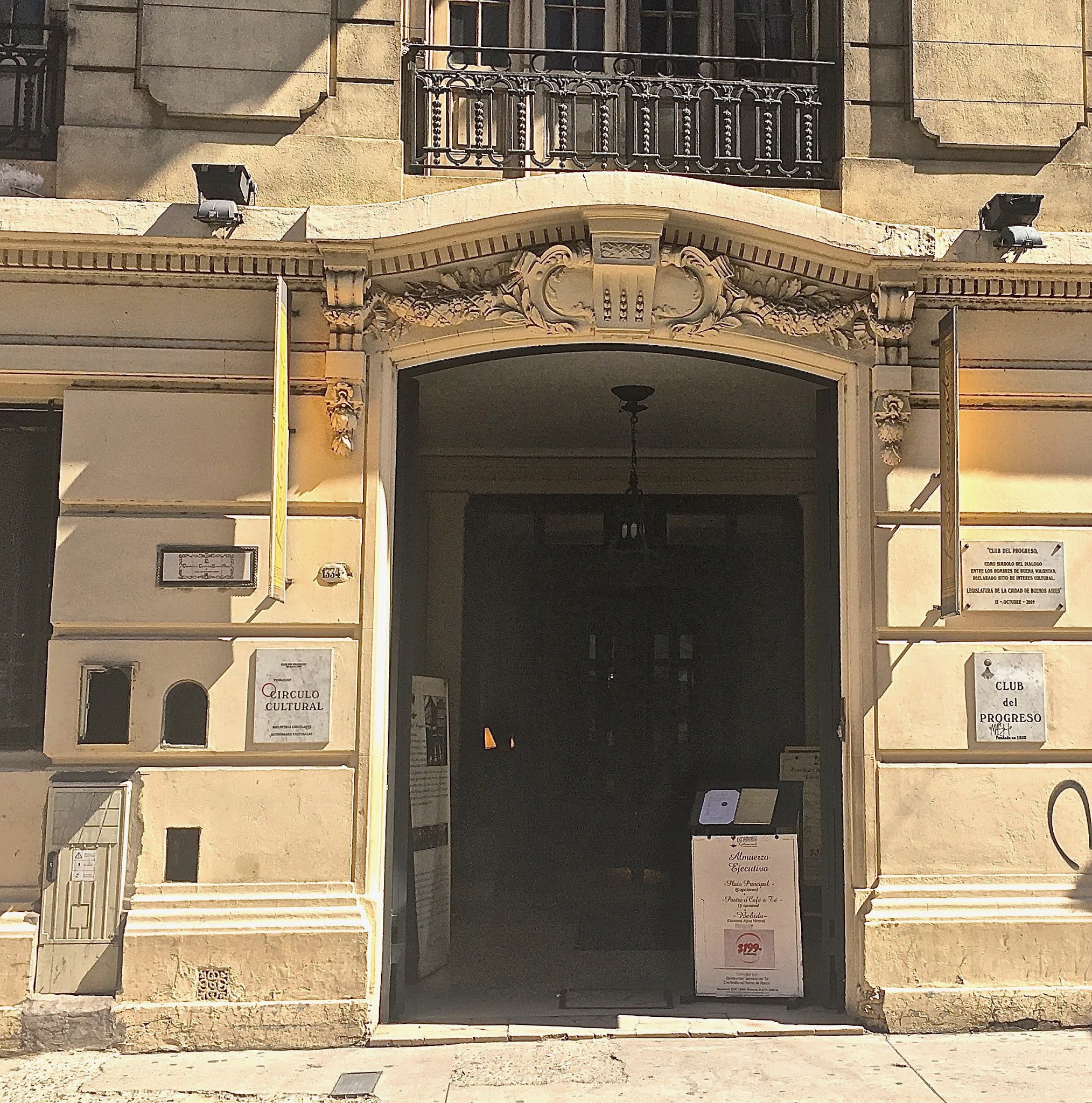
Intending to dine at the Club del Progreso, in 2002, we were startled to see a dining salon outfitted for an apparent Nazi event.

Certainly the Argentine military had extreme right-wing, often anti-Semitic elements. Anecdotally, I can’t forget the time in Buenos Aires that my wife, her brother, and I were startled to see an entire dining salon at the classic Club del Progreso restaurant outfitted for an apparent private event with swastika flags and other questionable artifacts. Preparing to leave in disgust, we nevertheless asked about the décor, and learned that it was a set for a scene in the 2003 film of Imagining Argentina, with Antonio Banderas and Emma Thompson. That relieved our misgivings for the moment, but the fact that even a period film would depict Nazi nostalgia in Argentina has left a lingering impact—especially since the United States government was not guiltless in the so-called Proceso.


Support Southern Cone Travel

If you've found this article useful and informative, please consider earning me a few pennies by clicking on an ad.

Saturday, February 2, 2019

Carnaval sem Cachaça?

I visit Brazil only infrequently these days but, when I've done so it’s usually the border town of Foz do Iguaçu because it’s been part of my beat when writing guidebooks about Argentina. After foreigners see the Argentine side of the famous falls, they almost always cross the Tancredo Neves bridge to see them from the Brazilian side.
The Brazilian side of the Cataratas do Iguaçu (Iguazú Falls)
I once took an intensive summer course in Portuguese—the equivalent of a full year at university level—but it’s only my fourth-best language after English, Spanish and German. Brazilians have been remarkably patient when I lapse into Spanish cognates, though I don’t always understand their responses.
In Buenos Aires, Carnaval is a decentralized neighborhood phenomenon.
Montevideo's Museo del Carnaval depicts the origins of Uruguay's tradition.
I’ve traveled a bit in northern Brazil—Porto VelhoManausSalvador (Bahia) and Belém—but know the megacities of São Paulo and Rio de Janeiro only through their airports. That means I’ve missed the signature event of Brazilian Carnaval, though I’ve seen its counterpart in Argentina (where it’s experienced a neighborhood-oriented revival) and Uruguay (where it’s seriously under-appreciated by foreigners).
Moqueca de peixe is a flavorful fish dish.
I enjoy Brazilian food—particularly moqueca de peixe—and really appreciate the refreshing cachaça-based cocktail known as the caipirinha, made of cane liquor, lime and sugar. Brazilians themselves, though, probably consume far larger amounts of beer, especially during Carnaval.
Care for a caipirinha, Mr Mayor?
That is, unless Rio mayor Marcelo Crivella has his way. Somehow, Brazil’s liveliest party town elected this evangelical bishop to its highest office in 2017, and he has just asked that cariocas (Rio residents) refrain from drinking alcohol during Carnaval celebrations. He also embraces creationism, and objects to homosexuality and abortion rights.

If Mayor Crivella truly trusts in what he preaches, though, perhaps he could just pray that his constituents refrain from drinking during the festivities. Then again, his for-profit Universal Church of the Kingdom of God may well take a cut from alcohol sales.

Support Southern Cone Travel
If you've found this article entertaining and/or useful, please consider earning me a few pennies by clicking on a (hopefully appropriate) advertisement here.

Friday, February 23, 2018

And Then There Was One...

In a Eurocentric travel industry, South America often gets short shrift. It’s quite a distance for most Northern Hemisphere visitors, airfares are relatively high, and the continent’s stereotyped reputation for crime and disorder is a deterrent for some—even though, at present, Venezuela is the only real basket case in that regard.
On arrival at Santiago's international airport, Australians may feel singled out.
That said, some countries have also made it harder for themselves because of arbitrary visa rules, but there are fewer holdouts now. Argentina has eliminated the onerous “reciprocity fee” instituted by its previous government and Chile’s similar measure now applies only to Australians—as Aussie arrivals to Santiago’s international airport quickly learn (Chile does not inflict this fee at other airports and land borders, however).
Visiting the Cataratas do Iguaçu (the Brazilian side) has become less expensive for several nationalities.
The big news, though, is the breakthrough in Brazil. Every time I’ve visited the country—only infrequently—entering has been a hassle. That’s because Brazil has taken the “reciprocity” issue a step farther, requiring an advance visa from US citizens even for a day trip from the Argentine side of Iguazú Falls. The last time I did it, the Brazilian consulate in Buenos Aires told me to get the visa in Puerto Iguazú, where that consulate required me to change my US cash into Argentine pesos (in a local exchange house, at a disadvantageous rate).

The worst is over, though. Last month, the country announced that citizens of Australia, Canada, Japan and the United States may now apply for their visas online, at a cost of US$40, rather than in person or by mail at a cost of US$160. The idea, apparently, is to encourage tourism and, if so, it’s a good start—but even better would be eliminating visas entirely. That said, the United States will probably continue to require Brazilians to pay that same US$160 fee simply for a privilege of applying for a visa, with no guarantee (and no refund if no visa is granted). Still, it’s an encouraging measure on Brazil’s part (Brazil, by the way, will return your fee if it refuses you a visa).


Bolivia is now the outlier. Following the example of Argentina’s previous government, it instituted a visa requirement that requires any US citizen to pay US$160 at any Bolivian consulate (that’s even more restrictive than Venezuela, despite that country’s notoriously contentious relations with the US). Again, in fairness, Bolivians must go through the same process to enter the United States, with no guarantee that the request will be successful.
Custom Search