Showing posts with label San Martín de los Andes. Show all posts

Sunday, December 13, 2020

Corona v. Corona? Virus Meets Eclipse in South America

In mid-2019, Chileans and many foreigners flocked to the coastline, about 500 km north of Santiago, to see a major solar eclipse—a once-in-a-lifetime opportunity for most people. Tomorrow, though, there’s yet another chance, but this year’s event has complications for eclipse-chasers in Argentine Patagonia or southern mainland Chile, the path on which the moon will blot out the sun for a little over two minutes. Those complications have to do with COVID-19, of course, but also the weather.

The path of Monday's eclipse

While people flocked to the 2019 event, that comes with risks this year. A friend in Pucón, who until very recently worked in hotel administration, tells me that the city “is living as if this wave won’t arrive here. There are lots of people who’ve come to see the eclipse, many of whom surely are carrying the virus that will force us to shut down again, perhaps all summer…”

Monday's forecast shows a 90 percent chance of rain at the hour of totality,


Ironically enough, they may be risking their lives—and those of others—for nothing. A few years ago, I and some friends had to cancel an overflight of nearby Volcán Villarrica because heavy cloud cover set in the morning of our departure, and tomorrow’s forecast shows rain throughout the day (the marine west coast climate resembles that of Seattle). In the path of totality, the sky will get darker at 1 p.m., but no one there is likely to see the startling sight of the solar corona (spoiler—it’s nothing to do with the virus!) when the moon blocks the sun.


In theory, visibility should be better on the Argentine side of the border, in the rain shadow of the Andes, but rain is also possible at San Martín de Los Andes, a prime tourist destination that lies barely outside totality. Conditions should be better in the city of Neuquén, a bit farther from the path of totality, but I would expect heavy southbound traffic towards the hamlet of Picún Leufú, which lies within. A 20-something friend of ours in the city (which is not really a tourist destination) at first sounded indifferent when I asked him if he were going to watch it, but now it seems he’ll at least step outside the office to glimpse the partial eclipse.


For those of us unable to reach Chile or Argentina for the event, the National Aeronautics and Space Administration (NASA) will follow it online starting at 9:40 a.m. Eastern Standard Time. There will also be a live show in Spanish starting at 10:30 a.m. EST.

Saturday, May 23, 2020

Walled Out? Walled In? Or Both?

Having received an advance from my publisher, I am theoretically updating the current edition of Moon Patagonia, but it’s not quite that simple. When I flew to Chile in late February, after a few days in Santiago I drove south to the volcanic highlands of the Araucanía region and across the Argentine border to San Martín de los Andes and San Carlos de Bariloche. I abruptly returned to Chile, though, when Santiago announced the impending closure of the borders between the two countries.
In mid-March, Chile was about to close the border with Argentina because of the Coronavirus crisis.
I had double-checked and acquired quite a bit of material in the process but, when I left to return to California in late March, I told my Chilean friends—one of whom is storing my car in Santiago—that I hoped to return in November, but couldn’t guarantee that would be the case. February or March of next year sounded a bit more realistic. Even now, that’s far from certain because of the Coronavirus crisis, which is worsening in Chile—though it’s not yet reached the levels of misgoverned countries like Brazil, the United Kingdom and, of course, the United States.
COVID-19 trends are worsening in Argentina and Chile, but still not close to those in the United States, Brazil, or the UK. 
Many people are without work these days, but my own is simply in limbo even if, in theory, I could be working on the book in question. In past years, spending the summer at home in Oakland before heading south after the World Series, I would revise background material such as government and politics. Still, even before I arrived in Chile earlier this year, that was full of uncertainty with the pending plebiscite on a new Constitution—now rescheduled for October 25th—and whether the accompanying political unrest might affect the travel and tourism sector.

The public health crisis, of course, put that issue on the back burner—almost literally, as the Chilean government decided (rightly, in my opinion) that holding an election in the midst of a pandemic was risky. For what it’s worth, the country does not allow absentee voting, so vote-by-mail is not an option; voting was once obligatory, but that is no longer the case. Interestingly, Chile does allow resident non-citizens to vote in its elections.
Open-air dining space at Pucón's Loretano
Besides background material, though, there’s equal uncertainty about tourist services. In my short time in South America, I discovered new restaurants, such as the Peruvian Loretano which, at present, continues serving takeout meals in Pucón. Still, in the aftermath of the public health crisis, many restaurants, accommodations and other services are sure to fail or, at least, change dramatically. It’s too early to say whether Loretano, or even established accommodations and restaurants with a solid track record over the decades, will necessarily survive.
I'd love to try the Peruvian-style ceviche at Loretano again.
Even if the travel and tourism sector re-opens, there’s another obstacle for me (and many other US citizens). Everybody knows, of course, about the notorious vanity wall under construction at the Mexican border, but now the current White House occupant’s minions are taking it to another level entirely. My US passport expires in early September, and I recently learned that the State Department is not processing either new or renewal applications so that, even if Argentina and Chile open up for tourism, it's uncertain (at best) when we'll be able to return.
In early March, when I entered Argentina from the Chilean side, I saw this camper van with Washington State plates. What their status might be at present, I can only guess, but the immediate outlook is not promising for US travelers.
The United States, of course, always used to criticize the Soviet Union and its allies for confining their citizens within their borders—most notably after the erection of the Berlin Wall. Now, it seems, any supposed “reopening” of the US has its limits, as its citizens must contend with walls—not just to keep foreigners out, but also to keep us in.

Monday, November 30, 2015

At the Border: An Encounter with Officialdom

In the course of doing what I do, traveling in South America to update my guidebooks and other projects, I often come in contact with government officials – especially when crossing borders (most often between Argentina and Chile). Latin America still has something of a reputation for official intransigence but, for the most part, my experiences have been cordial and routine. In one recent instance, the exchange was memorably positive.
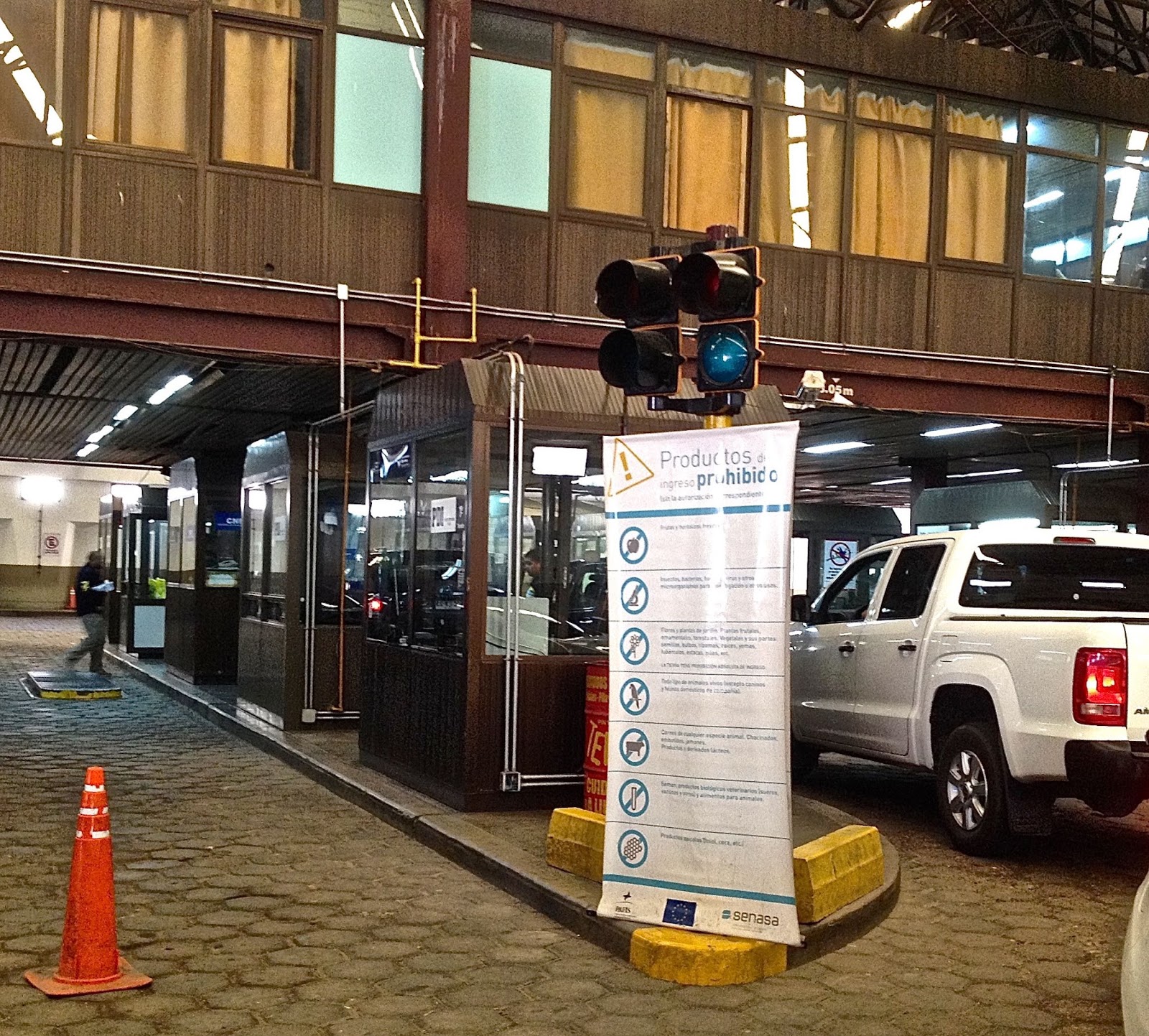
Last week was not one of those, though. En route to visiting the Argentine wine capital of Mendoza – which I had not seen since early 2010 – I had the most disagreeable experience in recent memory while crossing the border at Las Cuevas (eastbound, Argentina and Chile share a border complex on the Argentine side, pictured above; westbound, the shared complex is on the Chilean side, near Portillo).

Crossing the border, with my Chilean car, has almost always been routine but this time it was not. I had everything in order – as in many previous crossings - but the Chilean customs official who handled my paperwork didn’t think so. He was upset that I had no Chilean ID card – I can’t have one because I’m neither a citizen nor a resident – though I do have a RUT (the Chilean tax ID that allows me to pay my annual vehicle registration fees). To the best of memory, no official has ever asked to see any documentation other than the official ownership title and my passport.

This gentleman, though, was adamant that, without a Chilean cédula, I could not leave the country with my own vehicle. Routinely, Chilean customs has given me 90 days to return to Chile but, when he finally relented – I never expressed anger, though I was a bit bewildered - he was only willing to grant me four days to travel to the Patagonian city of Punta Arenas, a distance of roughly 3,000 km that would have required me to spend almost every waking hour on the road.

There followed a sort of dialogue – not exactly a negotiation – in which he extended my stay to 10 days and then 20, but not a second longer. Given what I had planned, to explore much of the Argentine side of the Andean front range and coastal wildlife destinations, even that gives me minimal flexibility to visit anything outside the main cities and off the principal highways.


Eight of my allotted 20 days are already gone, as I prepare to leave the city of Neuquén and continue to the Andean resort town of San Martín de los Andes. From there, I am considering returning to the Chilean side of the border in hopes of re-crossing with a clean slate that would let me resume my Argentine travels at a more leisurely pace. My reliable Santiago customs agent has informed that this shouldn’t raise any red flags the next time I try to cross, and that’s calmed some of my worries.

Saturday, January 18, 2014

My Bulging Wallet? Accommodating Argentine Currency

Last May, when Argentina’s informal exchange rate for the “blue dollar” rose above ten pesos for the first time, it quickly acquired the nickname “Messi dollar” from the number of the country’s Barcelona-based soccer star, widely considered the best in his sport. After a respite, it recently rose above ten again, leading me to wonder whether the government’s inept attempts at currency manipulation might instead lead to a “Spinal Tap dollar.” In fact, it's done all that and more, with President Cristina Fernández de Kirchner and Economy Minister Axel Kicillof arguably standing in for Nigel Tufnel (who appears in the video below).
Since January 8th, when I crossed into Argentina from Chile, I’ve had to deal with the issue from a practical standpoint – with a limited budget, not wanting to extract pesos from ATMs at the official rate, I’ve had to seek money-changing alternatives. This has also raised an internal editorial conflict, as I have to decide whether to calculate prices at the official exchange rate (6.8 pesos as of yesterday) or the blue rate of 11.9 (a breach of 75 percent between the two) in the upcoming fourth edition of Moon Handbooks Patagonia.

Reluctantly, I’ve decided to go with the official rate, even though matters could look quite different by the time the book appears in print later this year. Though this might make Argentina look costlier that it really is (for me, at least), I’ve decided to take the position that many if not most short-term visitors won’t feel comfortable using what is euphemistically called the “parallel market.” Having said that, I’ll describe how I’ve gone about it, and leave it up to readers whether or not they wish to do so.
I arrived at Villa La Angostura (pictured above) with just 80 Argentine pesos, which I had obtained for a ten-dollar bill at an exchange window at Chile’s Paso Cardenal Samoré border post. That allowed me to enjoy a small dish of ice cream with a bit of change left over, but the rate was obviously not optimum. I had to go looking for another place to be able to pay for a room for the night and beyond.

Last year, in Buenos Aires, I had a regular purchaser for my dollars at a downtown business, which was less convenient than the corner ATM but paid me substantially more. I usually made a morning phone call, and they would check the daily rate (now available at sites like Precio Dólar Blue and also as an app for the iPhone in addition to Android systems).

The app, though, didn’t help me find a purchaser in VLA, so I walked into the first inmobiliaria (real estate broker) I saw on the main drag and asked if he would be interested in purchasing dollars. Argentine real estate transactions typically take place in dollars, so they’re often needed. He couldn’t help me himself, but did direct me to another broker who happily handed over 3,000 pesos in exchange for the 300 dollars I had on me.

Still, I found evidence of variable rates around town – the exchange house Cambio Andina, ostensibly limited to paying the official rate, was willing to go to 9.6, and the Tinto Bistro (owned by the brother of Holland’s Queen Máxima) said they’d offer 8.6 to nine to pay for a meal. A few days later, in San Martín de los Andes, another branch of Cambio Andina offered me ten pesos per dollar, but only for bills of US$50 or US$100 – they would only pay the official rate for smaller bills.

Certainly Cambio Andina, which also has a branch in San Carlos de Bariloche, is a low-risk choice to change dollars even if their rate may not be the best available. Still, potential visitors have to consider carrying larger bills even though stateside ATMs rarely dispense anything larger than US$20 banknotes. One business owner whose clients are almost all foreigners expressed concern that her guests often paid in twenties, which she cannot easily exchange on the informal market.
Having to track down a new money-changer in every town is a nuisance, but it’s not the only one. In Argentina’s inflationary economy, the largest available bill is a 100-peso note, now worth less than US$10 at the informal rate – a government that denies inflation refuses to print any larger denominations (non-governmental analysts estimate inflation at about 25 percent). After changing US$700 for friends in Neuquén, I have more 70 of them on hand, and they don’t fit easily in my wallet, but I don’t care to leave them elsewhere and my leg pouch is still full of my remaining dollars.

And Now For Something Not Quite Completely Different?

While we're talking about shortages, I have seen long lines for gasoline in many cities that I’ve visited so far, but most notably in Villa La Angostura, where I waited in a line of 50 cars to fill the tank.

Sunday, December 22, 2013

For the New Year: An Argentina-Chile Exchange Rate Update

For the past month or so, as I’ve been traveling in Chile (not counting a week in the Falkland Islands), the exchange rate has remained stable at roughly 530 pesos to the dollar – there have been minor fluctuations in either direction but, essentially, there have been no surprises. In the same period, across the Argentine border (which I haven’t yet visited on this trip), the official dollar has steadily deteriorated by about five percent from 6.06 to 6.42, while the unofficial “blue dollar” has fluctuated – it hasn’t quite reached the ten-peso plateau again and now stands around 9.65, for a roughly 50 percent “breach” with the official dollar.
Here in Pucón, just across the border from the Argentine resort of San Martín de los Andes, I was a little surprised to find that local exchange houses are handling the volatile Argentine currency at all, though I have come across a handful of Argentine tourists paying everything with credit cards (despite a punitive 35 percent tax imposed by their own government) because they have been unable to purchase dollars legally. I was less surprised to learn, from a friend who operates a travel agency here, that Argentina-bound Israeli backpackers have been “raiding” local banks and other sources to purchase dollars with Chilean pesos.

For many years, Argentine ATMs dispensed US dollars alongside pesos, but that was in and just after the decade of dollar-peso parity that ended with the economic collapse of 2001-2. To the best of my memory, Chilean ATMs have never dispensed US dollars, but it’s not difficult to buy dollars with Chilean pesos even though, in this case, the Israelis normally have to do it during regular banking hours. Otherwise, they have to seek out options like the exchange houses and my friend’s agency, where they’ll have to pay a little more for their dollars.

When I checked in at a Pucón exchange house the other day, I was told I could purchase Argentine pesos at 8.1 per dollar, which is lower than the blue rate but still significantly higher than the official rate. For somebody uncomfortable with the idea of risking an “illegal” exchange on the other side of the Andes, it’s not really a bad rate, though I have a friend in Bariloche who provides me better suggestions (which I am not comfortable with passing on here). The parallel market in the Patagonian provinces is not quite so vigorous as it is in Buenos Aires, but I’ll probably be able to provide a further update some time after New Year’s, when I expect to cross the border.

AN UNFORTUNATE BUT VERY SPECIFIC WARNING
Usually, in the course of updating my guidebooks, I will not include a negative review of a hotel or restaurant, but rather just exclude it. Today, though, I will make an exception after an attempted dinner at Pucón’s Fiorentini (formerly Fiore), an Italian restaurant on Avenida O’Higgins, the town’s main commercial thoroughfare.

Fiore appears in my Patagonia and Chile books, but last night was one of the worst dining experiences of my life. Ordering crab-filled cannelloni, I waited over an hour in a lightly crowded restaurant as other parties took their tables, were served and even finished their meals with no indication when my own order might arrive. Finally, after telling the waitress I’d been waiting for some time, I received a dish of three cannelloni that looked (and tasted) as if they’d just been removed from the freezer and insufficiently microwaved. I sent them back, paid for my pisco sour aperitif, and went to bed without dinner.


I have already deleted Fiore/Fiorentini from my working text for the new edition of Patagonia but, for those who might visit Pucón in the interim, I recommend eating elsewhere.
Custom Search