Showing posts with label Che Guevara. Show all posts

Tuesday, April 16, 2013

On the Road...or on the Screen?


It’s been a slow week as, recovering from my bicycle accident, I can’t sit at the desk more than a few minutes at a time before my broken ribs start aching. Nevertheless, I did manage to get out on Saturday to see On the Road, the Kerouac saga that’s recently been adapted to the screen after being filmed, in part, in Argentina. Having grown up after the Beats, I certainly read On the Road, but I can’t compare my own experiences with the flamboyant Bohemianism of Sal Paradise (Kerouac’s fictional persona), his friend and idol Jack Cassady (“Dean Moriarty” in the book and film), Allen Ginsberg (“Carlo Marx”), and William Burroughs (“Old Bull Lee,” played by honorary Argentine Viggo Mortensen, who grew up on the Pampas).
Partly, in seeing the film, I was hoping to be able to identify specific Argentine landscapes that so closely resemble parts of the western United States (such as the steppe of Neuquén province, in the photograph above). Brazilian director Walter Salles, though, was astute enough not to leave any obvious clues, especially given his experience in filming the Che Guevara epic The Motorcycle Diaries a few years ago.

Argentina, though, has its own history of road movies. I don’t pretend to have an encyclopedic knowledge of the country’s cinema, but there are a couple Patagonian road movies that, in addition to The Motorcycle Diaries, I would recommend. The first is director Carlos Sorín’s Historias Mínimas (Intimate Stories, 2002), three intertwined tales set in the coastal city of Puerto San Julián, in Patagonia’s Santa Cruz province. It’s more a slice-of-life film, available streaming on Netflix in the United States.

The second, director Marcelo Piñeyro’s Caballos Salvajes (Wild Horses, 1995) is a Robin Hood/Bonnie and Clyde bank-robber caper that begins in Buenos Aires but ends in the robbers’ fleeing to Patagonia to avoid both the police and the Mafia. It features two of Argentina’s finest actors, Héctor Alterio and Federico Luppi; while not apparently available on streaming video, it’s worth seeking out on DVD.

In Other News
On Saturday, I did a short radio interview on off-season travel to Chilean Patagonia for Rudy Maxa’s World, a syndicated travel program that is now available on streaming audio at the link indicated. Also, for anyone planning travel to Chile this fall (southern spring), I will be serving as a guest lecturer aboard the Navimag ferry shuttle between Puerto Montt and Puerto Natales between November 11 and 18. This covers the southbound segment to Natales and, after a day in port, the northbound return to Puerto Montt. If all goes well, we may do an encore in March.

Friday, March 8, 2013

¿Adios Hugo?


Normally, in this blog, I don’t venture outside the Southern Cone countries, but the week’s biggest event has taken place in the only South American country I have never visited – Venezuela, where the charismatic president Hugo Chávez died on Tuesday. Some Venezuelans might disagree that I have never set foot in the country, because I have visited parts of neighboring Guyana over which Venezuela has an irredentist claim, but I can assert that I’ve never had a Venezuelan stamp in my passport.

Chávez, of course, was a controversial and polemical figure. Like Chile’s Augusto Pinochet, he was a military golpista (coupmonger) although, unlike Pinochet, his attempt to overthrow Venezuela’s constitutional government failed. When he finally did ascend to the presidency, through legitimate elections, he went about concentrating power through patronage politics, largely financed by oil revenues. Despite his ability to communicate with his country’s dispossessed, Chávez did them a great disservice – with his hyper-personalized politics and short attention span toward policy, he undermined the country’s institutions. Though he was not personally murderous (unlike Pinochet), his de facto neglect helped make Venezuela one of the world’s most violent countries – the capital of Caracas averages two homicides per hour.

In a recent edition of The New Yorker, journalist Jon Lee Anderson (biographer of Che Guevara) described Chávez as the “Slumlord of Caracas” in an article that would discourage just about anyone else thinking of visiting the city. On Tuesday, Anderson published an incisive post-mortem follow-up that characterized the former colonel as one of the world’s “most flamboyantly provocative leaders.” Anderson’s nuanced assessment of Chávez avoids demonizing him, but does point out his contradictions and weaknesses; the late Christopher Hitchens was not so generous in writing about his own personal encounter with the Venezuelan caudillo.
Chávez is gone, but will Chavismo survive? Oddly, the Caracas caretaker government prohibited mourners from snapping photographs of the autocrat in his open casket but, according to his designated successor Nicolás Maduro (pending elections), Venezuela will mummify the corpse for public display in a monument worthy of Lenin or Mao. This would make a great supplementary chapter for Heather Pringle’s remarkable study The Mummy Congress, but the Venezuelans could look for precedents closer to home – the Chinchorro mummies of Chile, for instance, or Evita Perón in Recoleta (though Evita’s cadaver is not on public view, the crypt is).
None of Chávez’s strongest ideological allies, most notably Rafael Correa of Ecuador, Evo Morales of Bolivia, and Cristina Fernández of Argentina, has the charisma to assume his role on the global or even the regional stage. More than that, none of them has the petro-dollars that Chávez used to buy his way onto the scene (Ecuador is an oil exporter, and OPEC member, but a relatively small one). President Fernández, for her part, believes just as strongly in patronage politics but has even fewer options – not only has she had to undertake emergency measures to keep dollars from fleeing the country, but she was also in hock to Hugo – as the conspicuous presence of his "Bolivarian" PDVSA, in the Buenos Aires barrio of Retiro, would indicate. Not so long ago, Argentina was self-sufficient in oil but, after decades of mismanagement, it now has to import.

Saturday, January 26, 2013

Kerouac's Patagonia? On the Road, on the Screen


Every summer, more decades past than I care to recall, my parents would use their vacation to drive from our home in Tacoma, Washington, to Moorhead, Minnesota – the figurative birthplace of A Prairie Home Companion – where my grandparents lived. As they alternated behind the wheel – I was far too young to drive - we crossed the steppes of Eastern Washington, the mountains of Idaho and western Montana, and the prairies of eastern Montana and North Dakota before crossing the Red River to arrive at Moorhead, the end point of a non-stop road trip.
That was a little later, and not quite so epic, as Jack Kerouac’s fictionalized odyssey across the United States in On the Road, but it recalls the landscapes of two-lane blacktop and occasional gravel roads in the days before the Interstate Highway System. In the course of updating my Moon Handbooks to Argentina and Patagonia, in particular, I’ve often had the experience of driving through wild, sparsely populated landscapes that recall my childhood journeys.

In southernmost South America, those routes are usually north-south rather than east-west, but I’m not the only person to equate them with the North American West. In fact, Brazilian director Walter Salles chose northern Argentine Patagonia to film scenes for On the Road which, unfortunately, has not yet hit Bay Area cinemas, but I do plan to see it.

Salles, who knew Argentine landscapes from directing the acclaimed Che Guevara road trip adaptation of The Motorcycle Diaries, may have had suggestions from Viggo Mortensen, who plays the role of Old Bull Lee, Kerouac’s fictionalized figure based on William Burroughs. Mortensen, who speaks fluent Spanish, attended school in the more northerly northern Argentine provinces of Buenos Aires, Chaco and Córdoba, and follows Argentine soccer closely.

In fact, Argentina has long been a favorite site for foreign film crews – a couple years ago, for instance, a friend of mine who has dual US citizenship participated in a shoot in which Argentine kids – including his son – dressed as Little Leaguers for a commercial staged at the national baseball stadium. The American-run company San Telmo Productions, in fact, exists primarily to help foreign filmmakers who wish use Argentina for location shooting.
Nobody, unfortunately, has yet been able to tell me precisely where Salles shot the scenes in Argentina, though the crew was apparently based in San Carlos de Bariloche; certainly the scenery along two-lane Ruta Nacional 237 (pictured above), which leads northeast out of Bariloche, could serve as a stand-in for large parts of the American West. Some cast members apparently stayed in Villa La Angostura, which appears to be recovering from the ashfall of the Puyehue-Cordón Caulle eruption of 2011.

Interestingly, a legal battle over the Kerouac estate meant that it took years before On the Road could reach the screen; coincidentally, the intellectual property rights attorney for Kerouac’s executor was also my attorney in a disagreement with a previous publisher whose name I will refrain from mentioning here. The attorney, whom I will also refrain from naming here, lost the Kerouac case but pulled out a win for me.

An Oscar Nomination for No
In other Southern Cone cinema news, Chilean director Pablo Larraín’s film No, about the 1988 campaign against General Augusto Pinochet’s plebiscite to continue as Chile’s de facto president, is one of five nominees for Best Foreign Film in the upcoming Oscars. It stars well-known Mexican actor Gael García Bernal.

Friday, May 28, 2010

Chasing Che Guevara

My friend and colleague Chris Baker, author of several guidebooks for Moon and other publishers, has recently noted that Argentina, Bolivia and Cuba have recently collaborated to create a route called "Los Caminos del Che," to follow the travels of the legendary Argentine born revolutionary Ernesto Guevara. While my first-hand knowledge of Cuba is nil and I’ve spent only a limited time in Bolivia (and none in the area where Che met his fate), I’ve written about his Argentine youth in the course of my own travels in the country, and have visited several Argentine sites recently.

Argentina’s portion of the Guevara saga, created under the auspices of the Secretaría de Turismo de la Nación, includes destinations including his birthplace city of Rosario, the northeastern Misiones province town of Colonia Caraguatay, the city of Córdoba (capital of its namesake province) and the nearby town of Alta Gracia, and the Patagonian resort town of San Martín de los Andes.

Guevara always was always more than a little mysterious, and the mystery started with his origins. According to biographer Jon Lee Anderson, Che’s registered birthdate of June 14, 1928, was a deception, as he had been born a month earlier - his mother, Celia de la Serna, was pregnant at the time of her marriage and Che’s father Ernesto Guevara Lynch moved them immediately to remote Misiones, where the pregnancy could be kept secret.

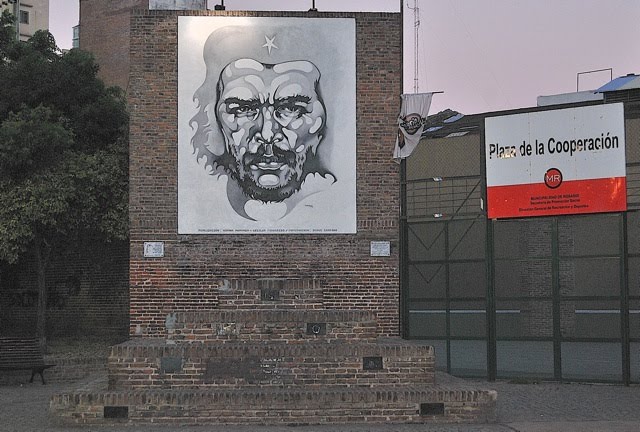
In reality, Che’s presence in Rosario was fleeting - the Guevaras returned to Caraguatay after a brief visit to family in Buenos Aires - but that doesn’t mean it’s gone unnoted. His Rosario residence, a handsome apartment building at Entre Ríos 480, has long been a minor pilgrimage site, and the Plaza de la Cooperación (pictured above), two blocks northwest, features a scowling portrait on a brick wall. Most recently, in 2008, Argentine and Cuban architects collaborated to create the Plaza Ernesto Che Guevara (pictured here), a drab open space with an equally undistinguished statue.

In fact, rather than Rosario, Che-chasers would be better advised to go to Córdoba, where young Ernesto went to school, and Alta Gracia, where his parents moved for the dry, mild climate that would be easier on his chronic asthma. Normally he made the 35-km commute by local bus but, for a time, he boarded in an annex of the Colegio Deán Funes (which no longer occupies its original downtown site). That annex is now the Azur Real Hotel Boutique, the city’s first hotel of its type, and probably the only Argentine hotel that can say “Che Guevara slept here” - on his travels in Patagonia and elsewhere, Che normally crashed wherever he could without paying.

Visitors will learn more about Che by going to Alta Gracia, a charming colonial town that’s home to the Museo Ernesto Che Guevara, which occupies one of several houses that the Guevara family rented in town. Then known as Villa Nydia, it’s the least polemical of any Guevara memorial. In fact, it does such a good job of reconstructing Che’s boyhood - through a photographic history of Ernesto and his family, his school report cards, and memories by his classmates, cook Rosario González (whom I met briefly several years ago), and others - that it doesn’t really place it in any greater context. This may not be the place for a full biography but, from its contents, one would hardly know that Che was a controversial figure, nor have any idea why Villa Nydia was converted into a museum, nor why so many neighbors opposed the conversion - nor even why Fidel Castro and Venezuela’s leftist president Hugo Chávez visited in 2006.

Alta Gracia’s prize exhibits include a bicycle and a motorcycle of the same models that the youthful Che used in his trips around South America. Part of that history is covered in San Martín’s Museo La Pastera Che Guevara, which I covered in detail in another post a little over a year ago. Anyone who wants to follow Che’s South American travels, though, would be better off picking up Patrick Symmes’s Chasing Che, which tells of the author’s adventures in search of the Guevara legend in 1996 (when I met him on Chile’s Carretera Austral).

Monday, March 30, 2009

Che Guevara Slept Here!

For four nights, in 1952, Ernesto Guevara Lynch and his buddy Alberto Granados crashed on hay bales in the national parks barn in the city of San Martín de los Andes, in Neuquén province. This was the trip that led to the book now immortalized in the film The Motorcycle Diaries, during which Guevara and Granados traveled as gasoleros - a modern Argentine slang term that means doing as much as possible as cheaply as possible. The term derives from “gas-oil,” as Argentines call diesel fuel, which is much cheaper than gasoline here.

And that, apparently, is reason enough to turn the barn into an interactive museum, with assistance from Cuba’s Instituto de Estudios Che Guevara, complete with video footage of Che’s career and a shop at which it’s possible to purchase Che souvenirs, including his books and those of his admirers. The museum opened last June, and I visited it just this last Thursday.

In fact, the Museo La Pastera Che Guevara is more a shrine than a museum; neutral biographers, such as Jon Lee Anderson and Jorge Castañeda, are nowhere to be found on the shop’s shelves (you’d be about as likely to find books by Richard Dawkins alongside the Bible at an evangelical church). In fact, if there’s a museum to be founded everywhere Guevara and Granados crashed for the night, we should be prepared for a near infinity of Guevara shrines throughout the Americas. The only really credible museum of Che's life in Argentina occupies his boyhood home at Alta Gracia, in Córdoba province.

Friday, May 30, 2008

Branding Che

At this week's Cannes Film Festival, the main event was US director Steven Soderbergh's two-part biography of Ernesto "Che" Guevara. The first part, tentatively titled "The Argentine," deals with his role in the Cuban revolution, which took power in 1959, while the second ("The Guerrilla") covers his failed attempt to foment revolution in Bolivia, which led to his execution in 1967 and, ironically, made him an icon. Puerto Rican actor Benicio del Toro plays the role of Guevara in the four-hour-plus epic.

Its length, and slow-moving narrative, led film critic John Powers to call it “almost unreleasable in its current form in any country in the world,” while the New York Times's A.O. Scott wrote that Guevara's "brutal role in turning a revolutionary movement into a dictatorship goes virtually unmentioned" and that Del Toro's romanticized portrayal of Guevara was "naïve and incomplete, at worst sentimental and dishonest. More to the point, perhaps, it is not very interesting."

Predictably, perhaps, the Argentine press had a different take. In the Buenos Aires daily Clarín, Diego Lere suggested that
"the film may lack emotion and dramatic force..but Soderbergh certainly manages to make the life of an iconic personality, difficult to relate on film, credible. It's a 'Che' that takes the personality from the poster and returns him to the sphere of a revolutionary's daily labor." In La Nación, Diego Batlle wrote that it was "well narrated and carefully produced, avoiding historical errors and the artistic license of so many Hollywood biopics." In all likelihood, then, the full epic will find at least a niche audience in Buenos Aires if not elsewhere.

Meanwhile, Che made a reappearance on the streets of Buenos Aires the other day as a four-meter statue en route to his legal birthplace in the city of Rosario (Jon Lee Anderson, a consultant to Soderbergh whose biography of the revolutionary is the gold standard in Che studies, says the birth was registered in Rosario but actually took place in the province of Misiones). The statue takes its cue from Alberto Korda's famous photograph of Che, which appears on Cuban currency and in many other places.

Argentines, of course, have tried to make Che into a tourist attraction, especially in the Córdoba province town of Alta Gracia where he spent his formative years. One of his former homes (despite elite family connections, the financially struggling Guevaras always rented) is now the Museo Ernesto Che Guevara, which focuses on Che's youth; when I attended the Feria Internacional de Turismo in Buenos Aires a couple years ago, Alta Gracia used a Che impersonator to staff its booth (see the photo to the right).

Of course, that's not so different from what Soderbergh publicity people did to promote the movie. In a break between the two halves, they passed out bags of sandwiches, mineral water, and other goodies that included Kit Kat Bars (produced by the multinational Nestlé, which Guevara would have despised). According to Clarín, this came to be called "McChe," while La Nación dubbed it "Che's happy meal."

Following up, Ben Ehrenreich has a new article on Che's status as a style icon in The Los Angeles Times, and the separation of the man from the image - according to one cyclist on Venice Beach, Che was "the guy who invented those mojitos." Even Argentina isn't immune to that, though; last year, in the Misiones town of Puerto Iguazú, I saw a twenty-something with a Che/Korda tee-shirt that read "I don't know who he is, but I know he's fashionable."
Custom Search