Showing posts with label Climate. Show all posts

Wednesday, January 19, 2022

Mendocino is Cooler Than Buenos Aires (Literally)

At the end of last month, I wrote that my wife and I had postponed a planned trip to Buenos Aires because of the spread of the Omicron variant of the COVID-19 virus there. In addition, our route would have taken us through COVID-friendly Texas and, given the frequency of flight cancellations by American Airlines, it was possible we might have had an unwelcome delay of a day or more in Dallas/Fort Worth.

Mapping the heat wave, from Argentina's Servicio Meteorológico (in degrees C)

Very tentatively, we’re hoping to try again in March, but early January provided us yet another reason to justify our decision—a brutal heat wave that struck the Argentine capital and much of the rest of the country. In summer, of course, we would expect warm and even hot temperatures, but last week the mercury soared to 106° F (41° C) in the city and, in the north-central city of Córdoba, it reached 108.5° F (42.5° C). The western desert city of San Juan was a near-furnace at 111° F (44° C).


A few years ago, we reluctantly installed air-conditioning in our Palermo apartment, but we’ve never used it during our time there—our idea was that it would appeal to short-term rentals. Even that mightn’t have mitigated this heat wave, though, as there were power outages in much of the city. Global warming, anybody?
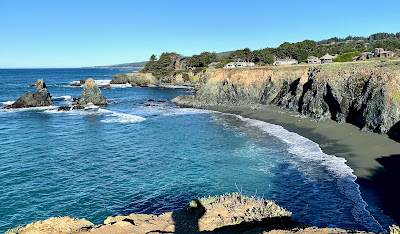
A typical landscape at Sea Ranch (note the houses in the background)

The town of Gualala (as seen from Sea Ranch)

With that in mind, we took a mini-vacation with our daughter, her boyfriend, and our two dogs, up the Sonoma County coast to Sea Ranch—an ostensibly eco-friendly development that I’m personally ambivalent about. The scenery resembles coastal Chile, the night skies sparkle, and there’s almost total silence except for occasional gobbles from wild turkeys outside your windows and waves crashing on the beach. Still, I find the supposedly cutting-edge architecture monotonous and the absence of any urban amenities bothersome—there’s no alternative to the automobile for transportation to the town of Gualala, some miles north, for essential shopping. In effect, Sea Ranch is a de facto “gated community” even though the State of California requires obligatory coastal access for non-residents.

The village of Mendocino, as seen from the nearby headlands
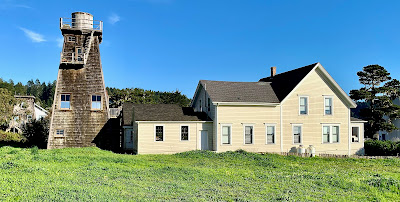
Some Mendocino water towers have been repurposed for residential use.

We spent four nights in a short-term rental house, arriving on a Friday afternoon and leaving the following Tuesday morning. Two full days is about my limit there but, given the late Friday arrival, Saturday and Sunday were dedicated to extended dog walks on the coastal trails (significantly cooler than Buenos Aires). On the Monday, though, we escaped north to the truly picturesque seaside town of Mendocino (population 855), where we walked along the coastal cliffs and explored its quaint architecture, including numerous water towers—some of them since converted to housing.


In popular culture, Mendocino has been a location for numerous films and TV series, but I recall it best for the 1968 hit song “Mendocino” by the Sir Douglas Quintet (Texas transplants to California whose producer chose the name to try to capitalize on the Beatles-inspired “British invasion” craze; the above video is a version by Sahm's later band, the Texas Tornados). Interestingly, my wife knew the song even before we met, as it was also a big hit in Argentina; though neither she nor her friends really understood the lyrics except for the title, they could dance to it.


Even more interestingly, the group leader Doug Sahm (born in San Antonio) was of German extraction and, I recently learned, Michael Holm (above) recorded a German-language version that became a chart-topper in then West Germany the following year. Does this explain the fact that the German real-estate firm Engel & Völkers maintains an office in Mendocino, and that all its window listings there are bilingual in English and German? Perhaps it does, as the comments on Holm's YouTube video include one by a German whose wife insisted he take her to visit there (German used to be my second language, but it’s now a distant third to Spanish and I couldn’t catch much of Helm’s lyrics).


Mendocino seems idyllic, but it’s not immune to the rest of the country’s problems. Almost everyone we saw in town was masked up but, not that long ago, the anti-vax owner of Fiddleheads Café posted notices that he would collect a surcharge for any client wearing a mask, and an additional charge for anyone who bragged about being vaccinated. He’s since gone out of business, but might still be welcome in Texas (in fairness, the state has great food and music despite its COVID-friendly politics).

Friday, November 1, 2019

Patagonia's Adventure Connect(ion) in San Francisco

Last week, I attended a promotional event for Chilean Patagonia in the Adventure Connect series, organized by the Adventure Travel and Trade Association (ATTA). At a time when Chile’s undergoing political upheaval, the occasion brought the Magallanes regional representative of Sernatur, the national tourism secretariat, and representatives of several different operators to San Francisco as part of a national promotional tour.
The setup at San Francisco's Hotel Zetta
The event took place in the lobby of Hotel Zetta, where eight different operators were to discuss their services with Bay Area travel companies and invited writers (of whom I was one). The format was a sort of musical chairs in which each operator met with one or more attendees for eight minutes before a timer sounded to move elsewhere. This went on for 2-1/2 hours, with a coffee break that included a giveaway raffle, before adjourning to a conference room for a presentation by Sernatur’s regional director Ximena Castro that was probably most useful to those with less experience than mine in the region. Later, there was a Chilean social hour that included snacks and one of the finest Sauvignon Blancs I’ve ever tasted—especially welcome on an unusually hot San Francisco day.

Ximena Castro addresses the attendees.


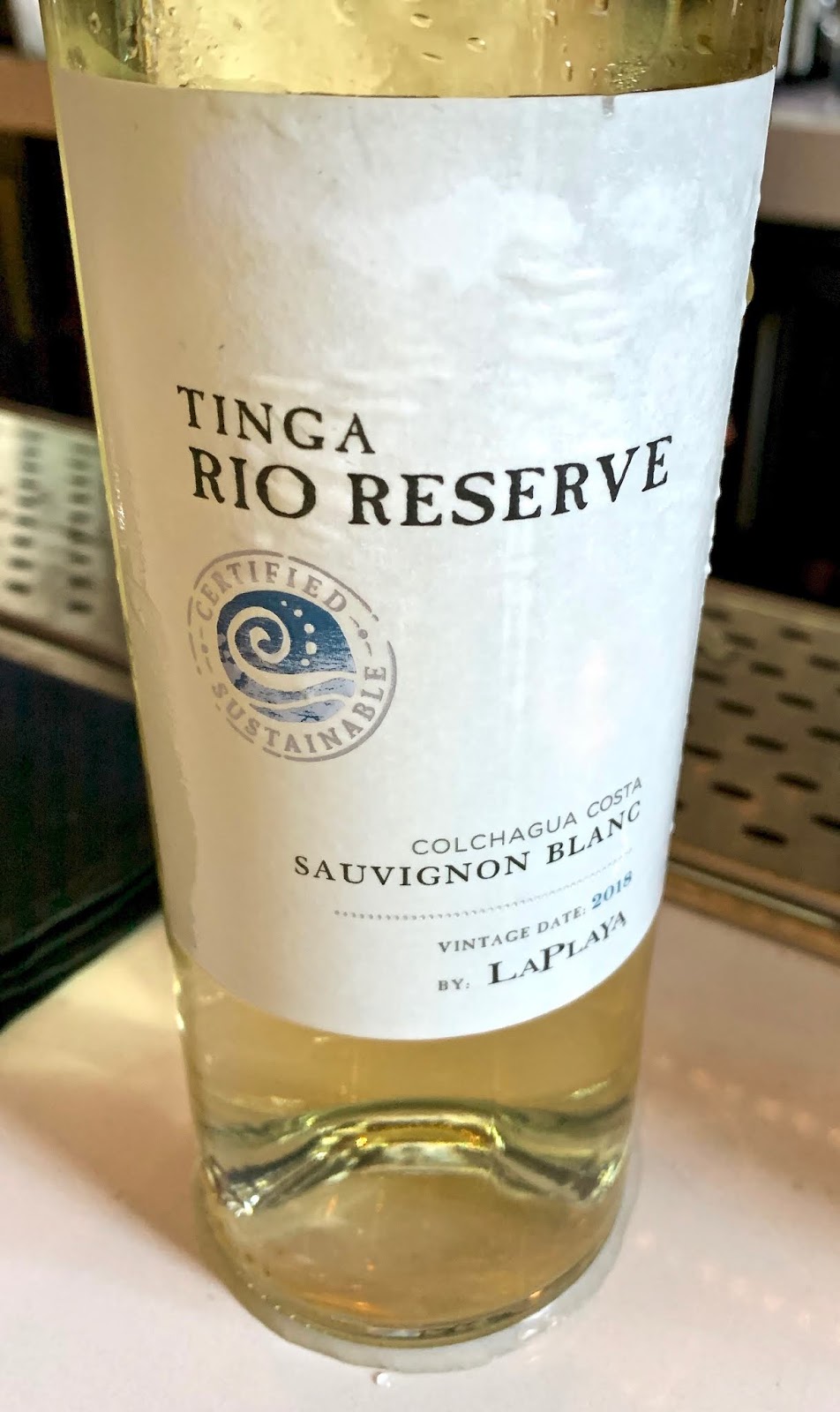
The Chileans brought this Sauvignon Blanc along with them and, so far, I've been unsuccessful in finding it stateside.
Originally, eight different operators—some of whom I already knew—were to attend the event. In the aftermath of the recent upheavals in Santiago, though, the representatives of Antarctic Airways—with whom I would have liked to discuss their updated services—and Lago Grey - Experience Hotel were unable to get flights out of Santiago. I already knew the owners of Big Foot Patagonia Adventure and the representative of Vértice Patagonia (operator of mountain huts on the famed Paine Circuit, plus a new boutique hotel in Puerto Natales), and was familiar with Antártica 21  and Australis Cape Horn & Patagonia (both of whom sent US-based representatives). New to me were the Chile Nativo adventure operator and HD Hotel Natales (the rebranded Hotel Cisne de Cuello Negro) in Puerto Bories.

The not quite unspoken topic that permeated the meeting was what effect Chile’s recent political disruptions and disorder might have on the upcoming season. There was certainly concern, but also consensus that the Región Metropolitana de Santiago and the coastal region of Valparaíso would be more directly hit than remote Magallanes. That said, cruise ship and hotel cancellations would certainly affect a city like the regional capital of Punta Arenas, which has seen some demonstrations. I recently saw an online story—can’t find the link now—whose headline spoke of “80 percent cancellations” in Chile, but what the story actually said was that 80 percent of hotels and other services had experienced cancellations (which could have been just a single cancellation each for some).

That’s not to dismiss the issue of vandalism and disorder by a destructive fringe, even as the great majority of demonstrations have been peaceful, but President Sebastián Piñera’s embattled government has cancelled the upcoming COP climate conference (at which Swedish activist icon Greta Thunberg was due to appear and also the Asia-Pacific Economic Cooperation summit.

Personally, I would not hesitate to travel to Santiago, Valparaíso or elsewhere in Chile at present, even though I’d advise those with little or no experience of the country to be on alert. In a recent newsletter, the private Federación de Turismo de Chile cited the Subsecretaría de Turismo to the effect that  “our tourism continues to function throughout the country and the most popular destinations visited by international tourists, such as San Pedro de AtacamaElqui Valley, the islands of Rapa Nui [Easter Island] and Juan Fernández [Robinson Crusoe], the Chilean Patagonia and Torres del Paine National Park, are operating with normality.” Aeropuerto Internacional Arturo Merino Benítez is back to normal, but visitors would still do well to have travel insurance in case of disruption.

And the Money?
For foreign visitors, there may be a bright side to all this. About two months ago, the last time I wrote about exchange rates, both the Argentine and Chilean pesos were slipping against the US dollar, and that has continued with the upheaval in Chile and the recent election in Argentina, when the Peronist Alberto Fernández defeated the incumbent president Mauricio Macri.
The Dólar Blue Hoy app is a useful addition to one's smartphone.
The so-called “markets” (and many individual Argentines) have little confidence in Peronism and, consequently, Argentina’s Banco Central (Central Bank) has reinstituted a cepo cambiario (“currency clamp”) that restricts Argentines’ overseas ATM advances to US$50 per transaction (oddly, it puts no restrictions on the number of transactions per day, but those ATM charges could really add up. Meanwhile, individual Argentines can now officially purchase no more than US$200 per month, a measure that seems to be encouraging the informal dólar blue (visitors to Argentina might consider downloading the Dólar Blue Hoy app, pictured here, on their smartphones). Exactly this will develop as the Macri administration gives way to Fernández remains to be seen, but it seems likely that the informal exchange rate will benefit tourists in the short to medium term.
Chile's peso has also slipped against the US dollar and some other currencies.
In Chile, meanwhile, the peso has dipped to 740 per dollar, a fall of roughly three percent since August. This may affect prices slightly, but if foreign visitors avoid the country because of the perception of instability, services such as hotels and tour operators may drop their prices. In any event, matters are less predictable than they seemed even a few months ago.


Friday, September 21, 2018

At the Awa

Some seven decades ago, the Hotel Antumalal broke the mold of classic Chilean “Lakes District” hotels with a Bauhaus-style structure on a hill overlooking Lago Villarrica, on the western outskirts of Pucón. In the interim, it’s become a landmark that’s drawn famous clientele including Queen Elizabeth II, King Leopold of Belgium, Barry Goldwater and Jimmy Stewart (and me?).
Pucón's Hotel Antumalal introduced Bauhaus-style architecture into Chile's lakes region.
In fact, I’ve stayed several times at the Antumalal, most recently in March. A few days later, though, I had the pleasure of spending two nights at the recently opened Hotel Awa, whose bold contemporary design comparably contrasts with the Mitteleuropa style of nearby Puerto Varas’s emblematic architecture. The Awa occupies a similar lakeside setting to the Antumalal, but its multi-story concrete, glass and girder exterior is more conspicuous—perhaps, in part, because the Antumalal’s had so many decades to cultivate its elaborate gardens.
Hotel Awa, as seen from the lakeshore
View of Lago Lago Llanquihue, when I finally got the curtains to rise
While the Awa’s exterior is imposing, its interior is cozy, with regional woods and other local decorative touches, but also large picture windows looking onto Lago Llanquihue. The rooms are also contemporary, with more electrical outlets than I’ve ever seen despite rustic touches that include hiding the flat-screen TV—accessed by opening the lid of a leather trunk. For me, the room’s most confusing aspect was the remote control that raised and lowered the curtains—I never quite got it right, and I recommended that the manager leave written instructions for using it.
An old steamer trunk hides the flat-screen TV at the foot of the bed.
While the Awa is happy to entertain overnight guests with bed and breakfast, it also offers excursions in the area and all-inclusive packages, including meals in its restaurant. On my first full day, when it was pouring rain in a Marine West Coast climate that resembles the Pacific Northwest—“Awa” means water in Mapudungun—I took a guided hike to Laguna Cayutué, on the southern edge of Parque Nacional Vicente Pérez Rosales. The trail, through dense Andean forest, often resembled a stream, so it took extra effort to avoid muddying boots and clothing and, at the end of the day, I returned soaked.
The weather doesn't always cooperate with hikes in the area.
Diners at the Awa's restaurant
The truffled pork loin ended the day more than satisfactorily.
So, I decided to take a soak in the spacious Jacuzzi before descending to the Awa’s restaurant for a truffled pork loin complemented by a barley-based risotto from its own vegetable garden and garnished with a hazelnut sauce. And, of course, there were a pisco sour and a glass of Carménère to accompany the main course, before a white and dark chocolate parfait. The next morning, I awoke to clearer weather with views across Lago Llanquihue—after I somehow managed to raise the curtains.

Saturday, January 27, 2018

Three Flights Home...

Only a couple days earlier, this sign in the Buenos Aires barrio of Barracas had pointed me in the opposite direction.
It’s been a week now since I left Buenos Aires, and a busy one as things piled up in my absence, but my 24-hour odyssey from the Argentine capital to my home in California was a memorable one—good in some ways, and not so good in others. Going from mid-summer to mid-winter wasn’t that great a shock—I can’t say I miss the River Plate’s hot, wet and sticky January and the Bay Area’s cool damp climate is nothing like the brutal “bomb cyclone” that hit the eastern US not so long ago. Still, there were ups and downs (figuratively as well as literally) en route.
Aeroparque Jorge Newbery is Buenos Aires's domestic airport, but also has flights to neighboring countries.
For the first time, my return trip started from Aeroparque Jorge Newbery, Buenos Aires’s city airport that’s just a ten-minute taxi ride from our Palermo apartment—as opposed to the more distant Aeropuerto Internacional Ministro Pistarini, in the provincial suburb of Ezeiza. One attraction was the fare: only A$100 (about US$5) door-to-door, while a comparable service to Ezeiza costs A$950 (about US$50). A taxi-bus combination to Ezeiza would have cost about A$350 (US$18), but it would have taken considerably longer.
Argentines and others trying to leave the country at Aeroparque immigration.
That convenience came at a price that I hadn’t quite anticipated, though. I had flown out of Aeroparque before, but never on an international flight. The security line moved pretty well but, once I reached the immigration line, there was a lengthy backup. While the only international flights are to neighboring countries—my first leg was to Santiago de Chile—there simply weren’t enough posts, and enough personnel, to handle everybody expeditiously, at least on a Friday afternoon in high season.

On top of that, there weren’t enough gates for all the flights, so passengers were milling about waiting for the announcements and, then, most of us had to board buses to the planes parked on the tarmac. Eventually, we departed about half an hour late, which caused me some concern as I had a relatively short window for my connecting flight to Lima. I wondered, and still wonder, whether Ezeiza—accustomed to dealing with large crowds and many more planes—would have been a better option.
The secondary security checkpoint at Santiago's international terminal
That said, the LATAM flight over the Andes was comfortable enough, with limited food service that I declined—I’d already eaten a good lunch, so I didn’t feel like a savory medialuna (croissant) with ham and cheese. On landing in Santiago, I was surprised to find a secondary security line in the international terminal that slowed matters down some more, and equally surprised to find that I had to place my daypack and computer bag in trays rather than sending them through as is.
It was indeed the last pisco sour (at least until I return to Chile in March).
That said, I did manage to grab a pisco sour before boarding my flight north. I was disappointed, though, not to see the airport’s new free book exchange, but there simply wasn’t time to walk past every gate. I did notice, however, that Australians are now the only foreign visitors who remain subject to Chile’s “reciprocity fee.”
Only Australians now pay Chile's "reciprocity fee" to visit the country.
From there to Lima, the flight was uneventful, though I was pleased to find that LATAM is now offering Chile’s own emblematic Carménère varietal to accompany meal service, rather than some generic Cabernet. To my mind this was long overdue, even if this particular vintage was not an elite version. Switching planes again at Lima, we went through yet another secondary security line—which I had experienced before here—before continuing to Los Angeles.
Chile's signature varietal is now available on LATAM flights out of Santiago.
The connection was tight, so there was no time for a Peruvian pisco sour, but on board we had a surprisingly good choice of meals, and the first time I ever recall receiving a printed menu in clase económica (coach class). It was also rewarding to see Peruvian touches on the grilled chicken, though the huancaína sauce was far less “spicy” than the English translation might suggest. The only downside to the flight was tropical turbulence that interrupted my hard-earned sleep.
The flight from Lima to LAX offered diverse dinner and breakfast options, even in coach.
The immigration lines at LAX were long, but they moved much faster than those at Aeroparque.
Arriving early at LAX, I breezed through immigration and headed to my rental car—even though it’s only a one-hour flight home, I prefer driving to the indignities of the Transportation Security Administration, and it also helps me unwind. The only downside here was that, given the recent Montecito mudslide, I could not take US 101 to Santa Barbara and, instead, drove north on Interstate 5 until I intersected California SR 46, leading past Cholame—marking the spot where James Dean met his death in 1955—to intersect 101 at Paso Robles.
The memorial to James Dean at Cholame

In recent years, I’ve grown to enjoy Paso Robles as an ideal lunch break between Southern California and the Bay Area, all the more so because it has an appealing central plaza like so many cities south of the Río Grande. At La Cosecha, I ordered a shrimp and scallop ceviche, plus a lemonade squeezed fresh on the spot—almost exactly 24 hours after I boarded the plane at Aeroparque—before continuing home.
Ceviche and chips at La Cosecha, Paso Robles

Monday, April 21, 2014

Valparaíso Cleans Up, Seeks Relief

The flames have subsided, but Valparaíso will be sweeping out the ashes for a while more. According to the most recent figures, the April 12th fire that started on the city’s outskirts destroyed some 2,500 homes and left more than 11,000 Chileans homeless (aerial photo by NASA).
It’s not totally clear what started the fire, but the Chilean police claim to have located the focal point at Fundo Los Perales, an agricultural property adjoining the Vertedero Los Molles, a municipal trash dump. According to their account, sparks ignited by two electrocuted birds were the cause, though that explanation sounds incomplete at best.

Still, disaster relief is the important issue here. While autumn weather is normally mild in this Mediterranean climate and little or no rain is forecast the rest of the month, the rainy season is approaching – this makes relief more urgent than in the recent earthquake in Iquique (where it almost never rains) or the massive February 2010 quake (which gave authorities more late summer leeway).
A couple days ago, I received an email from my friend Janak Jani, owner of the Hostal Luna Sonrisa hostel/B&B on Valparaíso’s Cerro Alegre, who filled in details on some issues I previously mentioned – for instance, the fact that many of the fire victims lived in precarious conditions (photo above by Gobierno de Chile). I’ll take the liberty of quoting from his note, which amplifies my own description of the fire zone and points out complexities in the relief effort. I have made minor edits:

“Although the authorities have set up shelters for victims and donations of food and clothes have come in from all over the country, only some of those affected are receiving aid. Many of those who live(d) right at the top of the town had built on common land to which they have no title. They are refusing to leave the burned-out remains of their homes as they fear tha,t if they do, then their land could be taken by someone else. These people (numbering in the thousands) are sleeping in unsanitary conditions with no shelter and little if any means to prepare food. So far no official help has arrived for them.”

Janak notes that he’s working with a local organization, the Centro Cultural Trafón“to provide direct aid to those that need it most” with Chile. For non-Chilean residents, he’s also accepting direct donations to purchase “food, medical supplies, tents, mattresses, blankets, sleeping bags, pots and pans, flash-lights, tools etc.” I wouldn’t normally solicit money on this blog but, given my trust in Janak and the worthiness of the cause, I’ll include his information here.

Janak is British, and those with Sterling accounts can transfer money to his Barclays account:

Sort Code 20-17-19
Account No. 50110523
Account Holder: JD Jani


Those without Sterling accounts can donate to his Paypal account, janak@vtr.net.
Custom Search