Showing posts with label Salta. Show all posts

Sunday, November 6, 2016

SSAD (Seasonal Sports Affective Disorder)

For more than a quarter century now, I’ve been writing and updating guidebooks on southernmost South America for several different publishers. In general, most of my work takes place from autumn (the austral spring) to the northern spring (austral autumn), so I’ve often joked that I leave California after the World Series and return in time for Opening Day. It’s not such a joke, though, that as the days shorten and the baseball draws to an end, seasonal affective disorder becomes an overlapping issue (with “sports affective disorder,” as baseball is the only spectator sport I find worthwhile).
Fortunately the longer days, filled with work, help me get through the winter - unlike the late Hall of Famer Rogers Hornsby who famously said that "People ask me what I do in winter when there's no baseball. I'll tell you what I do. I stare out the window and wait for spring."

Generally, I consider South America a sports desert, but there was a South American link to the end of the baseball season, though it didn’t turn quite as I had hoped. Last year, reserve outfielder Paulo Orlando became the first Brazilian ever to play on a World Series, as his Kansas City Royals defeated the New York Mets in five games (for non-baseball fans, I’ll state here that the first team to win four games out of a maximum seven becomes the champion). This year, reserve catcher Yan Gomes could have become the second player to do so, but his Cleveland Indians lost Game Seven in extra innings to the Chicago Cubs (Gomes began the season as Cleveland’s starting catcher, but a separated shoulder forced him onto the disabled list for an extended time).
Anyway, that’s enough baseball for a while, as I fly south to Santiago de Chile this coming Wednesday. I’ve seen baseball fields in Santiago, in northernmost Chile’s Atacama Desert (pictured at top), in the subtropical heights of Argentina’s Salta province (pictured above), in Buenos Aires (where I’ve played recreational baseball and softball), and even in steamy Paraguay (pictured below). I recently learned that there is baseball in Chile’s southerly university city of Concepción and also in the more southerly agricultural city of Los Ángeles (37° 28’ S latitude), whose team nickname is not the Dodgers but rather the Pumas.
It had never occurred to me to try to locate the world’s southernmost baseball diamond, but I’m guessing it might be in Christchurch, New Zealand (latitude 43° 33’ S). I’ll be asking, this time, as I drive south from Santiago, in hopes of finding one nearer the South Pole, on either the Chilean or Argentine side.


Before then, though, I’ll be flying farther south to Punta Arenas and then to the Falkland Islands, where I have seen locals with cricket bats. There, in the capital of Stanley, I once played catch with crewmen from a Japanese fishing vessel who were stunned that somebody in the Islands could throw them a curveball. I don’t expect that to happen again, but the memory will serve until I return home in February, when the days get longer and spring training starts. Pitchers and catchers report on February 13th.

Saturday, January 10, 2015

Does Gold Always Glitter? Plus, More on Buenos Aires Wines

In a lifetime of travel, mostly in Latin America, I’ve usually considered accommodations as a utilitarian service that permitted proximity to the sights I was interested in seeing. A quiet and tidy place with a reasonably firm bed, clean toilets and a hot shower usually satisfies me although, during nearly a quarter-century of writing and updating guidebooks, I’ve felt the need – the obligation, actually – to provide information about more elaborate options.
Even though my own tastes may have evolved as I’ve gotten older – for purely practical reasons, it’s hard to imagine a place without WiFi – I rarely stay at truly upscale places such as those mentioned annually in Condé Nast Traveler’s Gold List (full disclosure: though I subscribe to Condé Nast, I have never written for them, and I would never consider purchasing the magazine at its over-the-counter price). That provides me occasional pleasures – I was agreeably surprised by their article on El Bolsón a couple years ago – and some insight on where the one percent stay when they travel to the Southern Cone countries.

From My Point of View
This year Condé Nast is doing something slightly different. Instead of a routine summary for each hotel – barely varying from one year to the next in what is already a repetitive list – they’ve chosen to focus on distinctive features of those hotels. Of one classic, for instance, they say that “The most glamorous place to get a drink in Buenos Aires is the Lobby Bar at the Alvear Palace” (pictured above and below).
I’m not so sure of that. While there’s no denying the Alvear’s elegance, its Francophile ambience recalls Argentina’s old guard conservatism rather than the glamor of a star-struck contemporary society. I’ve never stayed at the Alvear (though I’ve had tea and attended events there) and I would suggest that Condé Nast has overstated its case to justify a safe choice.
On the other hand, its endorsement of Home Hotel Buenos Aires (pictured above and below) is a more daring inclusion and, arguably, more glamorous – here, you might get invited to U2’s pool party. The article describes Home as “a small boutique outpost in Palermo Hollywood that was doing mismatched wallpaper and slightly ironic shag rugs long before design duo Roman and Williams.”
Since I own an apartment in Palermo, I rarely stay in Buenos Aires hotels, but I have spent a night at Home, and have occasionally eaten or had a drink in the bar/restaurant (full disclosure: co-owner Patricia O’Shea was my unpaid “shopping consultant” on an article I wrote for National Geographic Traveler a few years ago). Though the hotel gets celebrity guests, informality is also a strong selling point – there are several truly affordable rooms for guests of modest means - and it even provides guests its own mini-guidebook of the neighborhood.
Condé Nast’s only other Argentine entry is the House of Jasmines (pictured above and below), on the outskirts of the northwestern city of Salta, gateway to the Andean highlands and the wine country of Cafayate. According to the magazine’s description, “Everything smells deliciously of, yes, flowering jasmine, and there are roses in every room.”
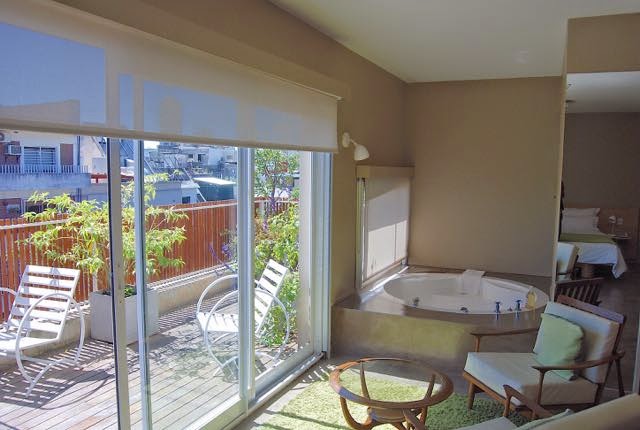
I stayed here several years ago, before the famous actor and noted Argentinophile Robert Duvall sold it, but I’ve not been able to return since it reopened under new ownership. From the photographs on the website, it hasn’t changed dramatically – that’s probably a good thing – but it’s now affiliated with the Relais & Chateaux group of luxury accommodations. Other things being equal, I would probably choose to stay in Salta itself, a walkable city with interesting architecture, excellent museums, and very good restaurants. The House of Jasmines isn’t that far away, though, and is undoubtedly more peaceful.

Argentine Coastal Wines?

And now for something completely different: my longtime Argentine friend Nicolás Kugler and Pablo (a commentator on my previous post) have provided some additional information on vineyards and wines near Buenos Aires. As it happens, the county of Berisso, only 57 km southeast of Buenos Aires on the route to provincial capital of La Plata, holds an annual Vinos de la Costa festival. In the middle decades of the 20th century, this area produced up to a million liters of wine per annum, but now it’s only about 50,000 liters from 25 hectares of vineyards. Nobody suggests the quality comes close to matching that of Mendoza or Cafayate, though.

Friday, February 8, 2013

Floods & Mud: Summer Storms Hit the Andes


In the early 1980s, I hitched a lift on a flatbed truck from the Chilean mining town of Calama to San Pedro de Atacama and, about halfway there, we found ourselves in near whiteout conditions – in the arid Atacama desert, not just rain, but snow. Fortunately, I arrived safely but now, whenever I think of the world’s driest climate, that still comes to mind.
Last April, while spending several days in San Pedro, I did not experience any rainfall, but storms in the Andes caused flash floods that washed away segments of roads in the Quebrada de Quitor, briefly closing access to my accommodations at the Hotel Alto Atacama. Today, though, it’s much worse, as the online Santiago Times reports that heavy rains have left nearly 5,000 people in San Pedro without running water and electricity. Highway damage has also closed the Paso de Jama border crossing (pictured above) to the Argentine provinces of Jujuy and Salta.
Some similar has happened in Argentina, where mudslides caused by heavy rains in the upper drainage of the Río Mendoza (as seen in the video above) have closed the international highway to Chileaccording to the Buenos Aires daily Clarín, the road has been cut in more than 20 places. This is the most important border crossing between the two countries, as international trade relies on the route; its timing is particularly unfortunate for the tourism industry, as cross-border traffic is abundant at this season. Mendoza’s annual wine harvest party, the Fiesta Naiconal de la Vendimia, begins the first week of March.

To make things even tougher for border-crossers, repairs of the international highway on the Chilean side presently require one-way traffic: westbound vehicles from Argentina may travel during daylight hours (8 a.m. to 7 p.m.), while eastbound vehicles from Chile must travel at night (8 p.m. to 7 a.m.). Until the Argentines manage to clear the road on their side, though, this is a moot question, and it remains to be seen how it affects the summer season.
Meanwhile, any Argentines vacationing in Viña del Mar who need to be back to work on Monday will have find an alternate route, and the road over the Agua Negra pass (pictured above), east of La Serena and Vicuña, has also been closed. The next closest crossing is the Paso Vergara (pictured below), east of the city of Curicó, but that involves a detour of more than 200 km south of Santiago and, once across the border, several hundred km more north to Mendoza.
What with all the currency controls, it was already difficult for Argentines to travel outside their own borders, but this is making it difficult for those who could to return. The rest of the summer could be a real challenge.

Saturday, January 7, 2012

Book Review: Malbec Conquers the Wine World

Over three decades ago, as a peso-pinching backpacker in South America, I first tasted Argentine wine. In the Bizarro world of an Argentine economy where prices sometimes rose 50 percent in a month, it astonished me that a bottle of wine could cost less than a liter of a sugary soft drink that I will refrain from naming, since it needs no more global publicity.
Now, after reading Ian Mount’s The Vineyard at the End of the World, I realize that many if not most Argentine wines of that era probably were worth less than a plastic bottle of colored, carbonated, artificially sweetened water. In this entertaining analysis of vines, wines, egos and intrigues, from colonial times to the present, the Buenos Aires-based writer points out that Argentines primarily consumed cheap table wines by producers who valued quantity over quality. Under the 1976-83 military dictatorship, which took over managing the bodegas of the shadowy dealer Héctor Greco (it’s hard to call him a producer), domestic bulk wine prices fell by more than 80 percent.

In retrospect, though, hitting bottom was the best thing that could have happened. The rest of Mount’s story builds on the eye-opening experience of Nicolás Catena, one of the few winemakers who managed to survive the crash of the 1980s, who visited the Napa Valley while on sabbatical in Berkeley. His experience there gave Catena (whose daughter Laura wrote the Vino Argentino guide that I reviewed a little over a year ago) the idea that, like Napa, his Mendoza homeland could produce New World wines to challenge the hegemony of European producers.

Catena started with traditional French varietals like Chardonnay and Cabernet Sauvignon and had success with those, aided by consultants such as the American Paul Hobbs. Technological innovations included drip irrigation instead of flooding the fields, stainless steel tanks in place of epoxy-lined vats, and oaken barrels in lieu of picturesque but useless casks. They took advantage of Mendoza’s unique micro-climates, where high-altitude vineyards favorably altered the balance between sugars and tannins.

Sooner than anyone expected, Argentine wines were drawing attention from figures like Robert Parker, but they did not gain their real identity until a group of adventurous Tuscans rescued the overlooked Malbec grape from obscurity. Nearly extinct in its southwestern French homeland, it had survived as old-growth vines in Mendoza, and the Italians turned it into gold – in fact, the book’s subtitle is “Maverick Winemakers and the Rebirth of Malbec.”

Malbec’s become such a success that even French vintners have turned their attention back to the grape that Michel Aimé Pouget had brought to Mendoza in the 1850s. It’s worth adding that other European consultants, most notably Michel Rolland, have played key roles in the Mendoza boom, which has made the western desert city a destination for tourists as well. So many wineries are open for tours and tasting, it’s hard to keep track of them, and that’s without even mentioning underrated areas like the northern province of Salta, renowned for its fruity white Torrontés.

Three decades ago, when I first tasted Argentine wine, I didn’t really know what to think about it. Now, with the help of this rewarding read, I can put the changes since then in context. Wine aficionados, those who enjoy the occasional glass, those who know Mendoza, and those who want to know it better should find it equally rewarding. On another level, it’s also a case study of how an industry recovers and flourishes in a challenging economic environment.
Custom Search