Showing posts with label Patagonia. Show all posts

Saturday, December 10, 2022

Returning to Santiago (and all that entails)

At very long last, this past Monday, I arrived back in Chile for the first time since March of 2020, when I abruptly flew home to California as the seriousness of the COVID-19 pandemic became obvious. I was originally to arrive on the previous Saturday but, late that week, LATAM suddenly canceled my nonstop Friday flight from Los Angeles International Airport (LAX) to Aeropuerto Arturo Merino Benítez (SCL).

Thanks to my heroic travel agent—there are still such things!—I was able get rescheduled for Sunday even though not without trepidation that the new flight might also be canceled. Analía Rupar-Przebieda (an Argentine resident of Southern California) first tried to reschedule me on Delta (a LATAM partner) via Atlanta, but Delta refused (even though the SFO-LAX leg of my flight was with them). That would have gotten me to SCL on Saturday as planned, but the rescheduled LATAM left on Sunday and didn’t get me here until early Monday morning.

The lines at immigration were long, but moved surprisingly quickly.


The flight was reasonably comfortable if crowded, and I was one of few coach passengers wearing a mask (those in first and business seemed to take it more seriously). On deplaning and arriving at immigration, though, we were faced with the longest lines I’ve ever seen at any airport. We also saw a warning for monkeypox—Chile continues to take contagion seriously—but the lines moved surprisingly quickly. So did the customs and agricultural checkpoint, so I was finally officially in the country.

Is monkeypox the next big thing?


Now to get to the city, and I purchased a seat on a shared TransVIP shuttle and was surprised to find a 5.5 percent surcharge on my foreign credit card. This has also been the case on some restaurant meals, but not on a purchase I made at a downtown department store. I had arrived with a small amount of Chilean cash but, at the new international terminal, the exchange houses were offering very poor rates and there was no functional ATM anywhere to be seen.


I rested most of Monday, other than a fine Peruvian dinner at with my host Marializ Maldonado at Del Carajo, across from the Hipódromo (racetrack) in the untouristed neighborhood of Independencia. The next day, I found a BancoEstado ATM and learned that their once-free ATMs now charge Ch$5500 (roughly US$6.50) for any withdrawal from a foreign account. Yesterday I made the maximum withdrawal of Ch$200,000 (about US$230) with the private Banco Itaú at a cost of Ch$6,000 (US$7). I haven’t yet tried to change US cash in the city, because I’m saving most of that for unpredictable Argentina.

With luck, my so far trusty Suzuki will be back on the road soon.


In preparation for upcoming Patagonian road trip, I’m now awaiting replacement of the catalytic converter on my 2005 Suzuki Grand Nomade, which failed its most recent revision. The most worrisome part of this, at present, is the availability of a replacement part, though my trusted mechanic Mauricio Donoso sounds reasonably optimistic.


Another issue I’ve had to deal with is cell phone service. My US carrier provides phone and data coverage here, but with limits—not exactly clear—on how much, and I’ll be in Chile and Argentina for three months. Because my new iPhone 12 uses an E-SIM rather than a physical chip, I cannot use a pay-as-you-go option here and, without legal residence in the country, nor can I open an account with a monthly plan. Yesterday, though, my host Marializ added me to her plan (and I’ll reimburse her), but that’s not an option for the overwhelming majority of visitors. Some will be limited to WiFi.

Friday, March 19, 2021

After the Jabs? Post-Pandemic Patagonia's Not Quite There

Proof of life?

On February 24th, I received my second dose of Moderna’s COVID-19 vaccine and, two weeks later, I undertook a full-scale grocery mission to Berkeley Bowl West for the first time in a year (my wife—also fully vaccinated now—was doing the shopping in that time, while I had only made occasional brief sorties to a neighborhood grocery). It felt like a milestone, one of the first, perhaps, in my quest to return to southernmost South America (even if, for now, I may have to settle for the pears on display here).

The aisles at Berkeley Bowl, on my first visit in a year

A nice pair?

I have yet to renew my passport—having waited purposefully until a new and competent administration took over the reins of government in Washington—but, in any event, I won’t be heading south until November at the earliest. That said, I couldn’t help but notice that LATAM Airlines was offering flights from Los Angeles to Santiago for as little as US$500 r/t. For some time after I returned from Chile to LAX last March 27th, the pandemic had closed the border to all but Chilean citizens and permanent residents but now, it appears, times may be changing.


Is Chile Winning the Arms Race?

Part of the reason, surely, is Chile’s success in vaccinating its population. According to Latin America Reports, five million Chileans may have already received their inoculations, and the government has agreements with China (Sinovac), Pfizer, Johnson & Johnson, and AstraZeneca to acquire 36 million doses (the country’s population is roughly 19 million). While President Sebastián Piñera’s second term has been shaky, there’s no doubt that his administration has been proactive in protecting the population (though there’ve been conflicting data on the Chinese vaccine’s effectiveness). Quarantines, curfews, and other sanitary measures also remain in force.


What does this mean for intending for potential foreign visitors (like myself and my readers)? Because of the previous US administration’s malfeasance and negligence, it’s been worrisome that US passports may have lost the cachet they once had but, as LATAM’s promotional fare would suggest, that’s not an issue at present. That said, any trip to Chile will run into various restrictions: there are several COVID requirements, including a negative PCR test, a sworn pre-boarding statement, a health insurance policy, an electronic tracking form on arrival, and an obligatory ten-day quarantine. Santiago’s Aeropuerto Internacional Arturo Merino Benítez is the only authorized entry point, and there are additional requirements for traveling beyond Santiago, especially to Patagonia, which may entail additional PCR tests.


How Hard is the Border?

These are Argentina's open border crossings - but with restrictions

In my case, the need to cross the Argentine border complicates matters even further, but I’m probably better placed than most. At present, the only non-Argentines permitted to enter must be relatives of Argentines and, being married to one for nearly 40 years, I technically qualify—but only if there’s a family-related issue at stake. There are just a handful of open crossings, the most convenient of which is Aeropuerto Internacional Ministro Pistarini, commonly known as “Ezeiza,” in suburban Buenos Aires. The only option in Patagonia is Paso San Sebastián, shared by Argentina and Chile, in Tierra del Fuego, but if I somehow managed to enter Argentina, a patchwork of local and provincial travel restrictions could make any such achievement a pyrrhic victory. Instead, I’ll wait.


Saturday, May 23, 2020

Walled Out? Walled In? Or Both?

Having received an advance from my publisher, I am theoretically updating the current edition of Moon Patagonia, but it’s not quite that simple. When I flew to Chile in late February, after a few days in Santiago I drove south to the volcanic highlands of the Araucanía region and across the Argentine border to San Martín de los Andes and San Carlos de Bariloche. I abruptly returned to Chile, though, when Santiago announced the impending closure of the borders between the two countries.
In mid-March, Chile was about to close the border with Argentina because of the Coronavirus crisis.
I had double-checked and acquired quite a bit of material in the process but, when I left to return to California in late March, I told my Chilean friends—one of whom is storing my car in Santiago—that I hoped to return in November, but couldn’t guarantee that would be the case. February or March of next year sounded a bit more realistic. Even now, that’s far from certain because of the Coronavirus crisis, which is worsening in Chile—though it’s not yet reached the levels of misgoverned countries like Brazil, the United Kingdom and, of course, the United States.
COVID-19 trends are worsening in Argentina and Chile, but still not close to those in the United States, Brazil, or the UK. 
Many people are without work these days, but my own is simply in limbo even if, in theory, I could be working on the book in question. In past years, spending the summer at home in Oakland before heading south after the World Series, I would revise background material such as government and politics. Still, even before I arrived in Chile earlier this year, that was full of uncertainty with the pending plebiscite on a new Constitution—now rescheduled for October 25th—and whether the accompanying political unrest might affect the travel and tourism sector.

The public health crisis, of course, put that issue on the back burner—almost literally, as the Chilean government decided (rightly, in my opinion) that holding an election in the midst of a pandemic was risky. For what it’s worth, the country does not allow absentee voting, so vote-by-mail is not an option; voting was once obligatory, but that is no longer the case. Interestingly, Chile does allow resident non-citizens to vote in its elections.
Open-air dining space at Pucón's Loretano
Besides background material, though, there’s equal uncertainty about tourist services. In my short time in South America, I discovered new restaurants, such as the Peruvian Loretano which, at present, continues serving takeout meals in Pucón. Still, in the aftermath of the public health crisis, many restaurants, accommodations and other services are sure to fail or, at least, change dramatically. It’s too early to say whether Loretano, or even established accommodations and restaurants with a solid track record over the decades, will necessarily survive.
I'd love to try the Peruvian-style ceviche at Loretano again.
Even if the travel and tourism sector re-opens, there’s another obstacle for me (and many other US citizens). Everybody knows, of course, about the notorious vanity wall under construction at the Mexican border, but now the current White House occupant’s minions are taking it to another level entirely. My US passport expires in early September, and I recently learned that the State Department is not processing either new or renewal applications so that, even if Argentina and Chile open up for tourism, it's uncertain (at best) when we'll be able to return.
In early March, when I entered Argentina from the Chilean side, I saw this camper van with Washington State plates. What their status might be at present, I can only guess, but the immediate outlook is not promising for US travelers.
The United States, of course, always used to criticize the Soviet Union and its allies for confining their citizens within their borders—most notably after the erection of the Berlin Wall. Now, it seems, any supposed “reopening” of the US has its limits, as its citizens must contend with walls—not just to keep foreigners out, but also to keep us in.

Monday, April 27, 2020

The Erosion of Lonely Planet

Guidebook writing has been my occupation for three decades, though the digital revolution has put pressure on the print sector for at least two-thirds of that time. In the context of the coronavirus crisis, it drew renewed attention last week when Lonely Planet, my first publisher, announced the closure of its Australian flagship in Melbourne and its London editorial office. It is also shutting down its namesake magazine. This will leave it with a reduced presence in the Nashville suburb of Franklin, Tennessee (!) and Dublin, where it’s presumably cheaper to operate. The Tennessee office replaced its former US headquarters in my hometown of Oakland, California.
The skeletal 1989 edition of LP's Argentina prominently featured the author's name.
I’ve always had misgivings about digital travel content, especially crowd-sourced sites like TripAdvisor. They are vulnerable to anonymous and pseudonymous comments—especially by competitors—but not everything about them is necessarily untrustworthy. I would never even consider a restaurant on the basis of a TripAdvisor recommendation, for example, but if somebody reports claims to have eaten there three days ago, I’ll have reasonable confidence that the business in question still exists (except, perhaps, in times of coronavirus).

While the proliferation of digital content is certainly a factor in the decline of print guidebooks, LP’s corporate culture has also devolved from what it once was. In the beginning, the company gave its authors an autonomy to explore and make decisions on the content of their titles. Developing regional expertise over the years, those authors held copyright to their work, and received generous royalties—enough, in some cases to result in six-figure annual incomes.

Arguably, LP’s decline coincided with the devaluation of the on-the-ground regional expertise that first made them credible. In this context, Paula Hardy’s quasi-obituary in the Guardian (linked above) is a blend of naiveté and misinformation, not to mention gaping lacunae. About the time she came on board, in 1999LP was morphing from an author-friendly company to one that dispensed with experienced authors, eliminating their copyrights and royalty contracts.Some were told that (I’m paraphrasing here) “You’re getting a reputation as difficult to work with.”

After the company warned that it might start titles from scratch with new writers, longtime authors learned that continuing with LP would involve fixed-fee contracts for a third or less of their previous income, with no certainty of future employment. Several whom I know opted out—choosing to sell their copyrights to the company, which seemed to conclude that destinations and authors were fungible (in fairness, the copyright buyouts could be generous).
Nothing in Santiago de Chile remotely resembles the Cathedral of Santiago de Compostela, but an LP editor wanted it as a cover shot.
New editions and titles became the product of multiple writers, some with doubtful qualifications—if an author had collaborated on a guide to, say, Sweden, he or she could just as easily draw an assignment for Myanmar, academic preparation and language skills notwithstanding. Many incoming authors and editorial personnel were neophytes whose geographical ignorance was palpable—in one case that I know of, an editor chose a photograph of Spain’s Santiago de Compostela (population about 96,000) to represent the capital of Chile (population five million-plus).
My first LP guide (left) omitted our names from the cover, but the licensed Spanish-language version  acknowledged us.
In that context, it’s noteworthy that LP stopped putting authors’ names on the covers of their books in the late 1980s, as best I can figure. After signing my first LP contract in 1990, I never had my name on the cover with a single exception—when Barcelona’s Editorial Kairós licensed my Argentina, Uruguay & Paraguay title, it featured both my wife’s and mine (María Laura was also the translator).

I spent ten years with LP, producing titles on Argentina, Chile, Buenos Aires, Santiago, Baja California and The Rocky Mountain States, but was never so fortunate as to have a royalty contract. That said, the flat fees seemed reasonable at the time and, in one instance, LP provided me a supplement when Argentina dollarized its economy, which made it a very expensive destination for several years.

Meanwhile, Hardy’s assertion that LP is the only guidebook publisher to send authors into the field is laughable. I  can contradict that on the basis of my own experience, in part after returning, earlier than I had hoped, from fieldwork in Argentina and Chile to update my Patagonia title. Because of the public health crisis, I have no idea when (or even if) Imay be able to resume the work, but I still hope to do so. A friend, also an ex-LP author, recently informed me that a different publisher has commissioned him to update two of his titles, and I am confident that other publishers will do the same.

The Independent’s Simon Calder seems to share Hardy’s romanticism about the publisher’s struggles: “When this wretched crisis is over, we may begin a new era where travellers will be hungry for resources they can trust, in particular guides researched and written by professionals, which don’t require batteries or an internet connection, and which feed our sense of adventure.

I too would like to think so, but LP seems unlikely to carry that torch forward. After two ownership changes since my time, it is wearing down; the current contraction is part of a process that began decades ago when it jettisoned its most credible and dedicated authors. In both the physical and the publishing world, erosion is a slow but inexorable process.

Saturday, March 21, 2020

White Line Fever? Travel in the Time of Coronavirus

Last Monday, having heard that Chilean land borders would close on Wednesday the 18th because of the coronavirus crisis, I drove from San Carlos de Bariloche to Argentina’s Paso Cardenal Samoré border post—where mine was the only vehicle in sight. At a roadside booth, as a young Argentine gendarme (border guard) handed me a ticket to present at immigration and customs, he asked me whether I was suffering any symptoms and, then, he himself sneezed!

With all due respect to Merle and Gabo..
In fairness to him, he averted his face and blew into his elbow. When I remarked that he, instead, might have been showing symptoms, he smiled sheepishly and I continued to what might have been the quickest departure ever at what is normally the second-busiest border crossing between the two countries (only the Los Libertadores crossing between Santiago and Mendoza gets more traffic).
Argentina's border post at Paso Cardenal Samoré
The actual borderline between Argentine and Chile
Chile's tentative tactic to deal with coronavirus at the border
On Chile’s side of the border, a handful of vehicles made the process—which included filling out a brief epidemiological questionnaire—slightly slower, but the stroll through immigration, customs and agricultural inspection was still expeditious. Oddly, no official even glanced at the questionnaire, which we had to deposit in a box for presumed data collection. Then I was on my way into Chile, a tale I’ll continue below.
Welcome to Chile!
How It All Started
This trip has changed dramatically since it began in late February, when I arrived in Santiago with the goal of updating the current 5th edition of Moon Patagonia. On arrival in the capital, my biggest concern was the estallido social (social explosion) protests that—whatever their inconsistencies—have brought decades of social and economic inequality into focus. For the few days I was in town, things were relatively quiet, but there was plenty of evidence of the fierce demonstrations that left several Metro stations and other services in near-ruin (the previous link here reports what stations may be closed at any given time).
Information screens let Metro riders know which stations are closed or with limited access.
I was staying in the house of Marializ Maldonado, a long-time friend who is working for the constitutional referendum to replace the one drawn by pro-Pinochet ideologue Jaime Guzmán. Guzmán’s custom constitution disproportionately favors Chile’s more conservative elements—rather as gerrymandering favors Republicans in the United States.
Protestors have defaced monuments such as Plaza Baquedano (informally renamed Plaza de la Dignidad).  This site has since been cleaned up.
Marializ hosted several meetings of activists favoring a new constitution, the vote for which was scheduled for April 26th, but has since been postponed until October 25th because of the Coronavirus crisis. Her Revolución Democrática party considers the rowdier elements who’ve gotten the most publicity in the estallido as outsiders (a term they’ve adapted from English).
The Plaza de Armas at Lonquimay features native Araucarias and a knitted tree apparently left over from Xmas.
When I arrived, the coronavirus issue was not yet critical, and I drove south with the idea that I’d spend two months in Chilean and Argentine Patagonia. That would put me on track to submit a new manuscript toward year’s end, and I began with a long drive that took me to Curacautín, at the northern approach to Parque Nacional Conguillío, where I spent a night at the Bavarian-run guest house Andenrose. The next morning I circled the park via the town of Lonquimay and thence to Melipeuco, the park’s southern gateway but, on this occasion, I decided I couldn’t make the detour into the park.
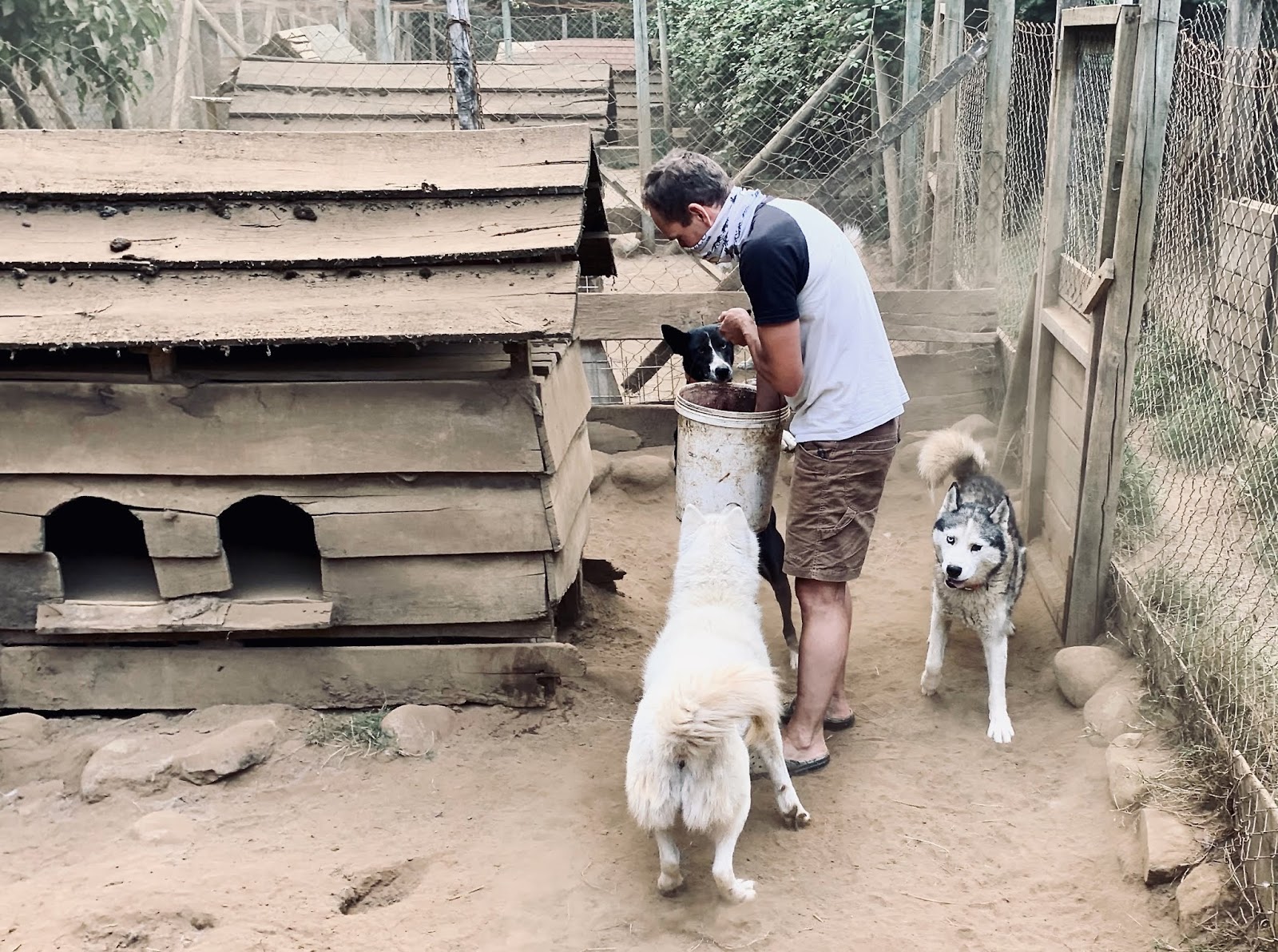
Feeding time at Aurora Austral, for just three of Konrad's 55 huskies
Instead, I continued to the lakeside town of Villarrica and, after a brief reconnoiter of the town, on to the Aurora Austral husky farm, where another Bavarian expat, Konrad Jakob, offers sledding trips in winter and carting trips in summer with his kennel of 55 huskies and a handful of mixes (full disclosure: I’m a devotee of northern dogs and have recently adopted a rescue husky, after four malamutes and one Akita). I spent two nights in one of Konrad’s cabañas, commuting to Villarrica to update practical information on the city. I only regret that I’ve never seen the area in winter, when I’d love to go mushing.
My cabaña accommodations at Aurora Austral
On the third day, I headed to Pucón, at the east end of Lago Villarrica, where I stayed at my long-time favorite Hostería Ecole, but there was an issue that aroused anxiety even before coronavirus entered the conversation. Some years ago, Chile fiddled with the regulations for non-residents crossing the border with their own Chilean vehicles. Were I unable to cross with my vehicle, it would be disastrous for my work.
Template for the declaración jurada that let me cross the border.
Fortunately, Hans and Verónica Liechti of Pucón’s Travel Aid agency had put me in touch with an American couple who own a house outside town and were in much the same non-resident situation. That couple had found an apparent loophole that allows such vehicle owners to leave the country so long as they obtain a notarized declaración jurada (“sworn declaration”) that they intend to return the vehicle to Chile. They’d done it several times and sent me a template for the document that I completed, printed out, and took to Pucón’s only notary public for verification.

When I Get to the Border…
Loretano is a worthy new Peruvian addition to Pucón's dining scene.
After three nights in Pucón, where I really enjoyed the new Peruvian restaurant Loretano (presently closed for the virus emergency), I headed east to the border at Mamuil Malal; I couldn’t completely contain my apprehension until, when I produced the declaración jurada, the Chilean customs official gave me a smiling thumbs-up. Entering Argentina was similarly routine, despite the presence of a list of various nationals subject to coronavirus quarantine but not—yet—US citizens. I got in under the wire, as that would happen a couple days later.
At the Mamuil Malal border crossing, Araucarias line the road, which passes through Parque Nacional Lanín.
Parque Nacional Los Arrayanes was presumably closed to hikers, but there was no  visible enforcement at Villa La Angostura.
The next few days were relatively routine, as I spent a night at Estancia Huechahue, two in San Martín de los Andes, and one in Villa La Angostura, where Argentina’s budding coronavirus precautions became more obvious. En route there had been evidence for concern, as I saw Argentines from a tour bus still sharing yerba mate, and many still greeting each other with kisses on the cheek—men as well as women. Argentina had closed all its national parks, though, and Parque Nacional Los Arrayanes—a popular hiking destination with an entrance in town, was supposedly off-limits (there were still people crossing the line into the park).
Probably now closed because of Argentina's widespread quarantine, the Bariloche tourist office was keeping  distance between its personnel and visitors.
Then I was headed to Bariloche—arguably Argentine Patagonia’s de facto capital, with the notion of continuing south to El Bolsón and Esquel, and then across the broad steppe to Puerto Madryn and Península Valdés. It was not to be, however, as I heard the next morning that Chile was about to close it land borders and, if I did not return before Wednesday, I would be unable to leave (and potentially unable to comply with my declaración jurada).

That information I heard second-hand but, for confirmation, I walked to the Chilean consulate—which was closed. Nevertheless, I rang the bell and, after a middling wait, was assured that US citizens like myself would be able to cross. I left almost immediately, returning via Villa La Angostura and thence to the border crossing described above. Before leaving, though, I managed to visit the new locale of Helados Jauja, arguably Patagonia's best ice creamery (the mother ship is in El Bolsón).
Helados Jauja has new quarters in Bariloche, with a secluded patio in the back.
When in Chile…
My accommodations at Zapato Amarillo were picturesque, comfortable and - in the current situation - socially remote.
After crossing the border, I headed to Puerto Octay’s Zapato Amarillo guesthouse, where the Swiss-Chilean couple Armin and Nadia Dübendorfer have hosted me many times over the years. On the outskirts of town, its stylishly rustic cabins were also an ideal place for self-quarantine, with nobody else about. I had considered staying several days, and perhaps even continuing to Puerto Varas, but after Armin and Nadia told me that international flights were being drastically reduced, I took their suggestion to drive to the city of Osorno and reschedule my April 29th departure for California. Otherwise, I would be spending nearly six weeks in Chile in virtual seclusion.
LATAM'S Osorno office switched my flight. It's a nice touch both the agent and the client can watch the computer screen.
Osorno’s about an hour away, but I was fortunate enough to find parking in the densely built downtown area, barely a block from the surprisingly small LATAM office (Osorno has an airport, but flights are fairly few). There were also few clients, so I quickly got seated and, though my preferred departure date from Santiago on Monday the 23rd was not available, the agent found me space for Tuesday the 24th. She first suggested the route via New York City, then with Delta to SFO, but having heard of huge delays at JFK immigration I chose to fly from Santiago to Mexico City, thence to SFO with Aeroméxico. Time will tell whether I’ve made the right decision, but I’m due home by 1 pm on Wednesday the 25th.

Then there remained the issue of getting back to Santiago, amid rumors there would be a toque de queda (curfew) at midnight. I returned to Puerto Octay immediately and packed my bags for the Chilean capital, a distance of roughly 970 km (about 600 miles) that I covered in 10-1/2 hours, with just two stops to fill the tank (plus some slowdowns for construction). I got to Marializ’s house at 11:30 p.m., just half an hour before the supposed curfew (that’s still not happened, though authorities are encouraging people to stay home). By then, with all apologies to Merle, I'd seen enough white lines for the day.

Here, until Wednesday, I’m in modified self-quarantine, taking short walks around the neighborhood  but avoiding contact with anybody—and making minimal purchases from the nearby shop. And writing stuff like this as, for the foreseeable future, we’ve had to suspend work on the new edition of Patagonia.

Saturday, December 21, 2019

Returning - to This Blog and Aeroparque

First of all, apologies to my readers for an unavoidable absence - though I’ve been in Argentina for more than two weeks now, computer issues have prevented my posting details of my time in Buenos Aires and parts of coastal Patagonia, from which I just returned late Friday night. At the moment, and for the foreseeable future, I’m working on a tablet, which makes inserting links and photos more awkward, so you may have to bear with me for the time being.

That said, I’ll offer a short account of my return to Aeroparque, Buenos Aires’s main domestic airport (though it does have some international flights). My flight from the southern city of Comodoro Rivadavia was late but, given that I had only carry-on luggage, I was hopeful of getting home quickly, but it wasn’t quite that simple.
My ticket to Palermo 

I walked quickly to the taxi stands and lined up, but then I spotted a sign telling me I should have a ticket to be in line, and realized that I would have to re-enter the terminal and line up again to get a ticket indicating my destination from a touch-screen machine. This was more difficult than it sounds, as I couldn’t find my reading glasses to decipher the small print in dim light.

Finally succeeding, I lined up again outside and finally grabbed a cab to my Palermo apartment. En route, I spoke to the driver about the absurdity of lining up twice to get a ride and, while he agreed with me on one level, he added that this new system - which began last April - has reduced abuses by the taxi mafias that once controlled Aeroparque access. He once avoided the airport, but now it’s a regular part of his routine, and the passenger knows the fare in advance.

While my first impression was negative, I’ll admit to having had unpleasant experiences in previous Aeroparque visits, and this now seems like a step forward - notwithstanding the need to line up twice.

Monday, November 18, 2019

Monday Musings - Mar del Plata, Money and Baseball

Today’s entry will be a potpourri about Argentina and sports. It ranges from the serious (the effect of Argentina’s Dirty War on my wife’s family) to the utilitarian (money and exchange rates) to the whimsical (my own tenuous link between baseball and Patagonia).

Southward Bound
Maru Sanllorenti's hometown of Tandil
As I prepare to head to Buenos Aires, early next month, my wife María Laura Massolo and our daughter Clío are already there (but will return to California before I leave). Their trip is partly vacation but also a family mission, as the remains of my brother-in-law’s first wife—a victim of Argentina’s 1976-83 military dictatorship—have been transferred from her hometown of Tandil to a new Panteón de la Memoria (Pantheon of Memory) in the Cementerio de La Loma in the coastal resort city of Mar del Plata.
My brother-in-law's first wife disappeared shortly after giving birth in 1976.
Maru's mother Eva and son Manuel at Mar del Plata's Panteón de la Memoria (photo by María Laura Massolo)
Abducted on the street in the Buenos Aires Province capital of La Plata in 1976, Maru Sanllorenti is survived by family members that include her mother Eva (now aged 94) and her son (my nephew) Manuel (now 43), who was an infant when she disappeared. My wife accompanied her brother Carlos (Manuel’s father) to Mardel for the ceremony there, then returned almost immediately to Buenos Aires, where Clío arrived on Friday. Yesterday, both of them attended a talk that Manuel regularly gives to visiting tour groups at the city’s Parque de la Memoria, which includes a commemorative plaque with his mother’s name.
Manuel Massolo (right) recounts his mother's story to visiting US tourists at the Parque de la  Memoria.
Money Matters
I haven’t been to Argentina since last year and, consequently, my recent information on exchange rates, prices, and transactions has been mostly second-hand. Since last month’s elections, though, exchange rates have remained relatively stable, and my wife informs me that a fine Peruvian dinner for three at downtown’s Chan Chan cost about US$10 per person, including three entrees plus a beer per person. It’s not an elite restaurant by Buenos Aires standards, but that’s still excellent value.
Our neighborhood cueva, on Palermo's Cabello street, was closed on the weekend.
Changing money, though, always requires reorientation. Bank lines are long, exchange houses are mostly downtown, and there’s still a difference between formal and blue (informal) rates. The difference isn’t huge, though, and the informal exchange houses known as cuevas are fewer than they once were. My wife has used the one near our apartment in Palermo, which remains open, but Dan Perlman of Casa Saltshaker informs me that street changers have taken over the business near his apartment (including the weekend’s Plaza Francia crafts fair outside the Cementerio de la Recoleta). Street-changing, of course, holds potential risk for the inexperienced—not the least of which is counterfeit currency.

It’s possible to change at ATMs, but that has its own issues—on the weekend, when our neighborhood cueva was closed, my wife paid a bank charge of US$10 to withdraw approximately US$50 from the machine. I’m not sure what the maximum withdrawal is at the moment, but it’s almost certainly low by international standards. In Chile, I regularly withdraw the equivalent of US$300 per transaction, but Argentina has been roughly half that—making the service charge a true burden.

Baseball and Patagonia
I love baseball and, for decades now, I’ve enjoyed saying that I leave for South America after the World Series and return in time for Opening Day. This year, I’m still stateside, through two weeks without baseball, but I’m looking forward to being back in Buenos Aires (where I’ve played the game myself) in another fortnight.

Actually, the month of October was a big disappointment, as my own Los Angeles Dodgers fell to the mild card (sic) Washington Nationals in the National League Division Series, and I didn’t pay a lot of attention the subsequent rounds or the World Series itself. The Dodgers were clearly the NL’s best but, as they say, anything can happen in a short series. Of all major sports, baseball is probably the likeliest for a lesser team to prevail—there’s really no such thing as an upset.
The top three finishers in the National League's Most Valuable Player voting
Last week, though, the post-season individual awards drew my attention because of a friendly rivalry with my Wisconsin-born but Chile-based friend Todd Temkin, who’s a diehard Milwaukee Brewers fan (his Cerveceros lost to Washington in a one-game playoff for the right to meet the Dodgers). Todd (who splits his time between Valparaíso/Viña del Mar and a farm in Futaleufú) and I disagree on who’s the NL’s best player; his choice is Milwaukee outfielder Christian Yelich, while mine is LA’s versatile outfielder/first baseman Cody Bellinger.
Dinner will probably take place at Futaleufú's Martín Pescador.
Hand-written menu at Martín Pescador
On one level, that’s a subjective judgement, as they’re both elite players, but Todd suggested that we place a bet on the Most Valuable Player award, “given to a player in each league who has contributed the most to the success of a player’s team,” according to the Baseball Writers Association of America. Depending on which player scored most highly in that poll, the loser would treat the winner to dinner—probably at Futaleufú’s Martín Pescador, with its frequently changing menu.
On my last visit, I enjoyed gnocchi with morels...
and a cheesecake for dessert.
As it happened, Bellinger edged out Yelich for the award, while Anthony Rendón of the champion Nationals came in a respectable third (the vote takes place at the end of the regular season, so the Nationals' playoff success was not a factor here). I’m looking forward to that meal, probably in March, when I’ll be updating Moon Handbooks Patagonia there. If Todd’s not around at that time, though, it could happen in Valparaíso or nearby Viña.
Custom Search