Showing posts with label Peru. Show all posts

Friday, September 11, 2020

The Tango War (a Book Review)

It's been a while since I've posted but, given the pandemic disruption of global travel, especially in my favored region of southernmost South America, I've been distracted with other matters. We're not dead yet, though, and I notice that, in recently commemorating the 75th anniversary of World War II's conclusion, the New York Times Book Review included just one minor item in the Western Hemisphere beyond the Río Grande—a children's book set in Cuba.

In that context I'll note that for every other Western Hemisphere country, the United States is not “America” but, rather, part of the Americas (In the end, we are all Americans). So, here's a book that  addresses the Times's lacuna.

The Tango War covers the conflict from a southerly perspective.

In The Tango War, US journalist Mary Jo McConahay demonstrates that the Allied Forces and Axis powers tangled (pun intended) away from the European and Asian spotlights both before and during the actual conflict. She focuses primarily on the United States and Germany, and their involvement in Mexico, Peru, Brazil and Argentina, though her title misleadingly suggests the centrality of Buenos Aires. There is less coverage of other countries, though Chile and Uruguay also figure into the story.


South of the Border… 

Being closest to the United States, Mexico was a priority because of Germany’s need for petroleum and President Lázaro Cárdenas‘s nationalization of the oil industry. In the runup to the actual war, there was a domestic turf war between FBI Director J. Edgar Hoover and Colonel William “Wild Bill” Donovan, head of what became the Office of Strategic Services (OSS) and, after the war, the Central Intelligence Agency (CIA).


Hoover was a publicity hound who tried to intimidate his opponents, but Donovan preferred to work behind the scenes. While Hoover often sent ill-prepared agents into the field, primarily in Mexico, Donovan employed professionals—one of whom was the late Woodrow Borah, a colonial Mexican history specialist who was also my own outside dissertation adviser at Berkeley. Borah, a fairly conservative man whose job involved working directly under a Soviet informant supervisor, told me that his main Research and Analysis (R&A) task was tracing the movement of German money south of the border.


Beyond the Equator

Farther south, the scenario was more complex. On the Pacific Coast, the issue was Japan and, in a regrettable development, legitimate concern took an illegitimate form—with little or no evidence, Peruvian authorities collaborated to expel nearly 2,000 Japanese-Peruvians to so-called “relocation centers” in North America, where US citizens of Japanese descent were already confined. Some of these Nikkei were, in effect, held hostage for prisoner exchanges during the war, though others remained in the United States after the conflict ended.


Brazil gave off ambiguous signals, as dictator Getúlio Vargas had strong economic ties with Germany and Italy, and large German and Italian immigrant communities abounded with Nazi and Fascist sympathizers. Brazil also had its own homegrown Fascist movement, the Integralists, but Vargas’s response to Franklin Delano Roosevelt’s “Good Neighbor Policy” tipped the balance. In fact, in support of the famous 10th Mountain Division, Brazilian troops played a key role in the Allied campaign that brought down Italy’s Benito Mussolini.

British agents watched the Graf Spee from atop Montevideo's Palacio Salvo.


Outright combat was rare in the Americas, but the Battle of the River Plate was an exception. In 1939, damaged in battle with three British vessels, the German battleship Graf Spee took refuge in neutral Uruguay—as permitted by international law—where British agents observed it from the upper stories of Montevideo’s Palacio Salvo and the Royal Navy bluffed Captain Hans Langdorff into scuttling it. Langsdorff later committed suicide in the Centro Naval in Buenos Aires; in Argentina, Juan Domingo Perón had sympathized with the Germans, who had suggested they would support his country’s longstanding claim to the British-governed Falkland Islands (Islas Malvinas).

The Graf Spee's captain killed himself at Buenos Aires's Centro Naval.

That said, the United States laid the grounds for Argentina’s belated entry into the war, at least partially, through the exercise of “soft power” in the form of–wait for it—Walt Disney! As part of the Good Neighbor Policy, Disney and a crew of assistants known as “El Grupo” produced an animated film that depicted positive stereotypes of Brazil and Argentina, including the legendary “Gaucho Goofy.” Later, Argentine gaucho caricaturist Florencio Molina Campos worked on several Disney projects.

El Gaucho Goofy was part of a longer animated film called Saludos, ¡Amigos!

While Argentina came around opportunistically at war’s end, the country became a prime destination for ex-Nazis who, with Vatican collusion, used so-called “ratlines” to escape Europe and reach South America. Some of the most notorious war criminals, such as Adolf Eichmann and Erich Priebke, became long-term Argentine residents, but others, such as Klaus Barbie,  Joseph Mengele and Walter Rauff, ended up in Bolivia, Paraguay, and Brazil. A low-level Nazi, Paul Schäfer, headed the cultish Colonia Dignidad  in southern mainland Chile and cooperated with the Pinochet dictatorship before escaping to Argentina to avoid prosecution as a pedophile. Eventually extradited, he died in prison in Santiago.


The Cold War and Its Aftermath

All this constitutes a readable account that fills a notable gap in the World War II saga, but in my opinion McConahay (whom I have met) stretches it a bit to attribute Argentina’s “Dirty War” too directly to World War II. She cites Uki Goñi and Patricia Bernardi, both of whom I know, on the parallels between Nazi tactics and those practiced by their own country’s 1976-83 dictatorship (Patricia’s sister Claudia, who also works with the Equipo Argentino de Antropología Forense (Argentine Forensic Anthropology Team) is a frequent houseguest of ours in California).
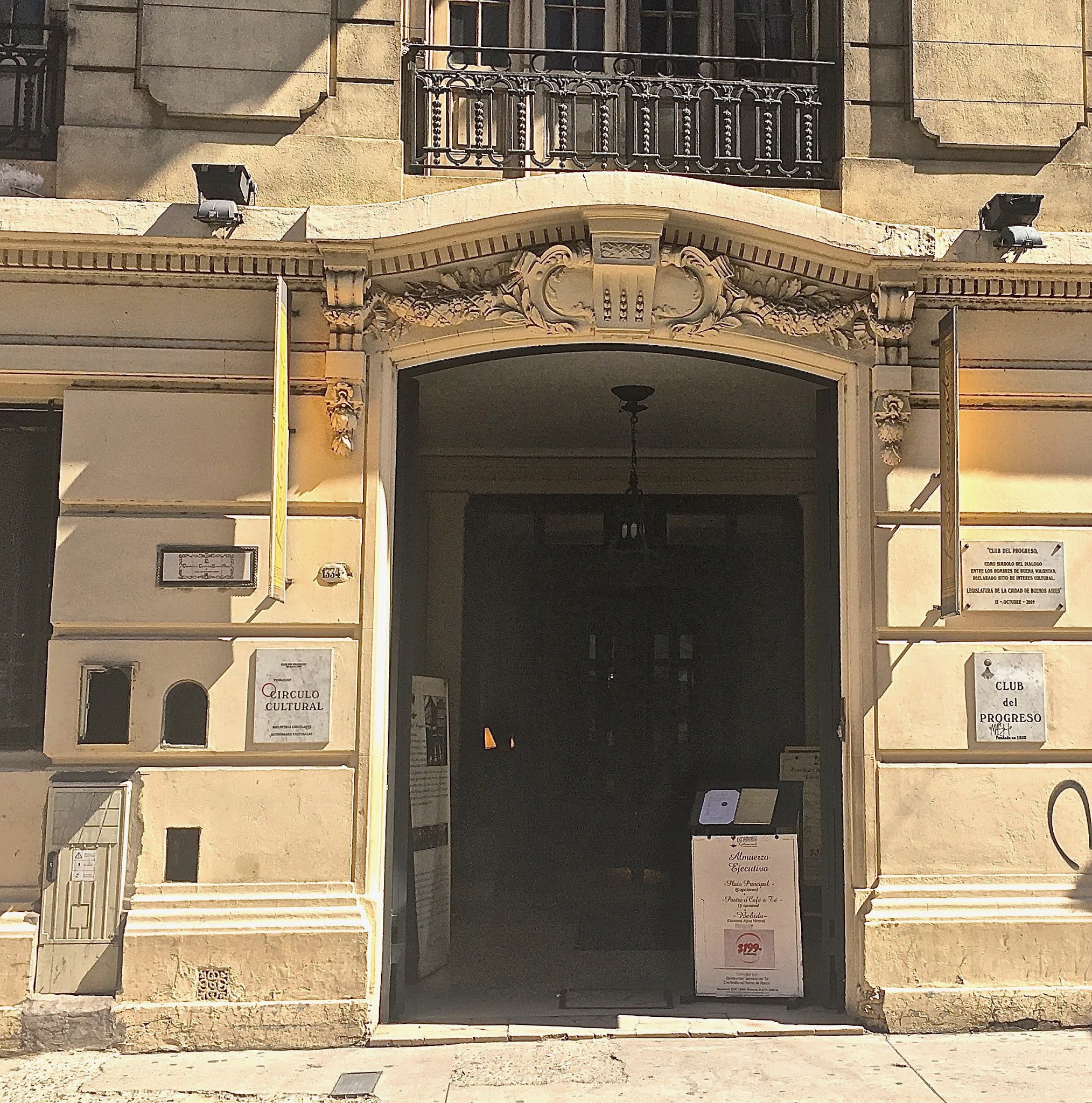
Intending to dine at the Club del Progreso, in 2002, we were startled to see a dining salon outfitted for an apparent Nazi event.

Certainly the Argentine military had extreme right-wing, often anti-Semitic elements. Anecdotally, I can’t forget the time in Buenos Aires that my wife, her brother, and I were startled to see an entire dining salon at the classic Club del Progreso restaurant outfitted for an apparent private event with swastika flags and other questionable artifacts. Preparing to leave in disgust, we nevertheless asked about the décor, and learned that it was a set for a scene in the 2003 film of Imagining Argentina, with Antonio Banderas and Emma Thompson. That relieved our misgivings for the moment, but the fact that even a period film would depict Nazi nostalgia in Argentina has left a lingering impact—especially since the United States government was not guiltless in the so-called Proceso.


Support Southern Cone Travel

If you've found this article useful and informative, please consider earning me a few pennies by clicking on an ad.

Tuesday, May 29, 2018

In and After Europe; Money Matters in the Deep South (Argentina & Chile)

This has been a busy spring, what with my return from six weeks in Chile and then, following a brief interregnum in California, nearly three weeks in the Netherlands, Belgium, and Sweden. Europe’s not an area I normally write about, except when it bears some relation to my interest in South America. I’d intended to write on this blog while in Europe, but the ten-hour time difference and short-stay cities worked against me.
Willem descends the from the 4,900-meter (15,901-foot) mountain pass of Abra Choquetacarpo (scanned from a Kodachrome slide)
I did, however, did meet up with my longtime Dutch friend Willem Oosterberg, with whom I explored Peru’s Cordillera Vilcabamba in 1979—a time when that area, near Machu Picchu, was off-limits to visitors without special permission, which I managed to obtain from government officials in Cuzco. We managed to see many unique archaeological sites, such as Yurac Rumi, on a week-long trek that we somehow managed without detailed maps.
Open only since November, Amsterdam's Not Only Tinto is an Argentine wine shop that will also offer tastings and empanadas.
The previous time my wife and I visited Amsterdam, in 1985, I recall seeing Argentine and Uruguayan parrillas—grill restaurants—across the street from each other, just as Argentine and Uruguay face each other across the Río de la Plata. This time, I estimate we saw at least ten Argentine parrillas in town (though none that claimed to be Uruguayan) and even an Argentine wine shop. On the other hand, in Rotterdam, we spotted a Brazilian rodízio just about ready to compete with a nearby Argentine grill. That said, we didn’t try any of them on this trip.
We saw no Uruguayan restaurants in the Netherlands, but this Brazilian grill is about to open in  Rotterdam.
In Bruges we did spot one Argentine grill and, in Brussels, a Peruvian food truck outside the Central Station—unfortunately, it wasn’t open when we went looking for lunch. We did enjoy a Peruvian meal in Stockholm’s trendy Södermalm district, but the most notable South American item we saw came from the city’s Nobel Museum, which displayed the “Report on Argentina” that helped earn Amnesty International a Peace Prize in 1977.
Amnesty International's 1977 report on human rights abuses in Argentina.
Money Matters in Chile (and Argentina)
Last month, before I left Chile, the US dollar had been weakening and, by extension, my travel costs had been rising. At the beginning of last year, when I was updating Moon Handbooks Patagonia, the rate was pushing 700 pesos to the dollar, which made the country a relative bargain. That didn’t hold and, when I returned in early March for a brief research trip, it had fallen to 600 pesos, making prices higher in dollar terms.
Toward the end of my stay in Chile, the dollar slipped below 600 pesos.
Over the course my six-week stay in the country the rate remained relatively stable until, just before my departure, it dipped below the 600-peso level and seemed headed farther south (so to speak). It continued to drop and then, almost as suddenly rose as high as 634. Since then it’s slipped back into the mid-620s, but that’s still a significant recovery for the dollar.
Today's official exchange rates
Historically, the International Monetary Fund has drawn lots of fire in Argentina.
I won’t go into the macroeconomics of the issue but it’s worth noting that, across the Andes, the Argentine peso is reaching new lows against the dollar. When I arrived in Argentina in mid-November, the rate was about 17.5 per dollar but now it’s at nearly 25, and then reached the point where President Mauricio Macri has asked the International Monetary Fund—long considered an ideological pariah in Argentina—for assistance in propping up the currency. On the informal “blue dollar” market, which persists despite the liberation of the formerly fixed exchange rate, it has reached nearly 26.
The informal "blue dollar" persists in Argentina, but the differential is far smaller than it used to be.
That doesn’t necessarily mean Argentina’s getting any cheaper—unlike Chile, the country still has serious inflation issues. At present, it’s about 25 percent per annum, down from 2017’s 40 percent, but this is still a fragile economy. At best, prices may remain relatively stable in dollar terms, but keep an eye on things.

Saturday, March 31, 2018

¿Un Burrito Peruano?

Two of my favorite cuisines are Mexican and Peruvian—arguably the best of their respective North and South American continents. I rarely visit Mexico any more and haven’t been to Peru (except for Lima’s international airport) in nearly as long, but Mexican food is common throughout the United States and especially California, and Peruvian gastronomy is expanding rapidly out of its homeland. There are only limited choices in my hometown of Oakland, but it’s abundant in Argentina and Chile, the two countries where I travel most.
The Buenos Aires branch of La Mar Cebichería is one of Gastón Acurio's several upscale restaurants.
The evangelist for Peruvian cuisine has been Gastón Acurio, whose Astrid y Gastón and La Mar Cebichería now have branches throughout North and South America. I’ve eaten at La Mar in Buenos Aires, Santiago and San Francisco, and at Astrid y Gastón in Buenos Aires (where La Mar eventually replaced it) and Santiago (where’s it temporarily closed pending a move to new quarters). Both of those, however, are so pricey as to make them an occasional treat as best.
Santiago's Pantaleón II is more modest than La Mar, 
but its excellent mixed ceviche costs a fraction of La Mar's.
Instead, I usually resort to modest but still excellent options such as Buenos Aires’s Status and Santiago’s Pantaleón II. Recently, I dined at La Casita de Barreales, in the Colchagua valley wine capital of Santa Cruz but, in the surfing mecca of Pichilemu, I encountered something completely different in the food trucks at Punta de Lobos.
The Morros at Punta de Lobos mark one of Pichilemu's top surf breaks.
El Burrito Pe overlooks the Morros.
I rarely eat burritos any more but, though some people dismiss their authenticity, I’ve long considered them a form of fusion cooking that we might describe as comida fronteriza—food from the porous US-Mexico border. I wasn’t quite prepared, though, to see an offering of “Peruvian burritos” at El Burrito Pe, on the road just above the landmark Morros (promontories) near the beach’s best breaks.
I can only wait for my next chance.
Unfortunately, when I stopped there I had already eaten lunch, but I spoke with the Peruvian owner and planned to return the next day, before leaving town. Unfortunately, though he said he would open at 1 p.m., there may have been circumstances beyond his control and I finally decided could wait only so long. My double-hybrid burrito with huancaína or rocoto will have to wait until my next visit to Pichi.

Sunday, November 12, 2017

Two Days to LA and BA

Last weekend was a travel marathon as, on Saturday morning, I left the Bay Area for Los Angeles in a rental car, en route to Buenos Aires. Obviously, I was not driving to Buenos Aires, but I was flying there Saturday night and the rental car gave me the opportunity to visit my 93-year-old uncle, at the historic Village Green in Baldwin Hills. As Veteran's Day approached, his World War II record sounded like  something out of Hollywood—shot down over France in late 1943, he first avoided German troops and then, with lots of help from the French Resistance, made it over the border into Switzerland.
My uncle's ground-floor apartment in the wooded Village Green complex is part of a national historic landmark.
I’ve seen the fake ID the Resistance fabricated for him but, unfortunately, he was unable to locate it on Saturday. He has a harelip, and that birth defect led the French forger to include “deaf-mute” in his description—something that fooled the Germans as the Resistance led him across France by car, train and on foot. If caught, he would have been executed as a spy.
Sarah Kaminsky wrote this biography of her Argentine-born forger father, Adolfo Kaminsky, but I've not yet read it.
It’s worth mentioning that one of the Resistance’s heroes was Argentine-born Adolfo Kaminsky, who forged thousands of documents—free of charge—to help Jews and others persecuted by the Nazis. After my uncle crossed the border, the neutral Swiss confined him to a ski resort where, one late spring morning, he awoke to unexpected shouts of celebration from his comrades. His first thought was that, “My birthday’s not that big a deal!” but it was June 6, 1944—the date of the Allies’ D-Day invasion. Only after the war ended, though, would the Swiss release him to US authorities.

After the meeting, I dropped my car off at LAX and had a few hours to kill before departing for Lima’s Aeropuerto Internacional Jorge Chávez and Buenos Aires’s Aeropuerto Internacional Ministro Pistarini. Fortunately, check-in and security went quickly, and I was pleased to learn that LATAM (ex-LAN) now had access to a convenient regular gate at LAX rather than a remote gate served by bus shuttle (I’m hoping, given LAX’s major renovation, this is a permanent change).
I'm disappointed that LATAM doesn't offer more typical Southern Cone wines like Argentine Torrontés (I wasn't in business or first class, though).
Though I was in coach, the seats on our Boeing 787-B were comfortable enough, though it also helped that there was an empty seat between me and an Argentine woman from Rosario.  I was also pleased that the USB power outlets were strong enough to charge my tablet—unlike my recent Hawaiian Airlines flight, where the outlets could only charge phones. My only quarrel with the service is that LATAM’s wine options includes only pretty generic Cabernet and Chardonnay, when they could serve more distinctive Southern Cone varietals such as Argentine Malbec and Torrontés, or Chilean Carménère.
Chilean Carménère would also be superior option to more standard wines.

I had a four-hour layover in Lima where, unfortunately, I simply couldn’t justify ordering a pisco sour at 8 a.m. Lima, unfortunately, still has WiFi issues—no more than half an hour of free connection, though our new cell contract gives me good and reasonably priced coverage on the phone (but not the tablet). Our plane to Buenos Aires was an older one, as the photo above shows, but four hours feels like a short hop to me on this route. Still, I didn’t reach our apartment until nearly 8 p.m. Sunday, after which I had a plate of spinach gnocchi at Bella Italia Café before collapsing into bed.
Our plane from Lima to Buenos Aires was old enough that it still had ashtrays.

Sunday, February 1, 2015

Tales of Airport Security: SFO-LAX-LIM-SCL

I’ve grown to dread flying, not because I fear a random crash or even the notion that a suicidal terrorist might sneak explosives aboard. Rather, I dread the processes of ticketing, security and boarding, which make me glad that I fly so infrequently. I may fly long distances but, more often than not, I only have to endure the process once.

That was why last Wednesday, when I faced a flight to Santiago that required me to board in San Francisco and repeat the process in Los Angeles, I felt apprehension. In the first instance, the SFO-LAX flight was with American Airlines, whose long lines and normally indifferent customer service I loathe.

That said, I was pleasantly surprised. At 3:30 p.m., American’s ticket counter was almost empty, and I was able to check my bags through to Santiago (American and LAN have a code-share agreement). The only glitch was that the counter personnel told me that I wouldn’t need to go through security again at LAX, and they were wrong (I had my doubts, in any event).

It was an equally pleasant surprise to find security lines not much longer than those at the ticket counter, and I breezed through both in barely ten minutes – the way it used to be, before all the security hysteria took hold in the US. Thus, I had a couple hours to kill at SFO, where there’s free WiFi and comfortable workstations with outlets for charging your devices.

The American flight was a cramped AirBus, but at least it only takes an hour to Los Angeles. Given the normally long lines at LAX’s Tom Bradley International Terminal, but there was another pleasant surprise: with new scanning equipment, we didn’t have to remove shoes or belts, nor even remove the computer from the bag. It wasn’t quite so quick as SFO, but it was a definite improvement.
The downside of LAX was the fact that, although it has free WiFi, there’s almost no place to sit and recharge your devices, and people were sitting on the floor or standing around the few accessible outlets. LAX is still undergoing a major remodel, so maybe that will improve in the coming years. The concessions could also use improvement, as I didn’t much like the food selection compared to SFO’s (which is also cheaper).
The plane left LAX a bit late because of some on-the-ground problems, but I managed to sleep most of the way to Lima’s Aeropuerto Internacional Jorge Chávez (pictured above), arriving in plenty of time to make the connection to Santiago (but lacking time for a Peruvian pisco sour). Lima, though, rechecks the hand baggage of connecting fliers, even within the international terminal, which is only a minor annoyance as they’re pretty quick.
The three-hours to Santiago was another cramped Airbus, but I did have one pleasant surprise on arrival. I’ve written many times about the so-called “reciprocity fee” that Argentina and Chile collect from some arriving passengers; Chile eliminated the fee for US citizens last year and, since then, on both Albanians (!) and Canadians. The sign below is dated, as only Australians and Mexicans now pay the fee at SCL (overland travelers or arrivals at other Chilean airports do not pay).
By the way, I stole the title of this post from a regular feature on Harry Shearer’s weekly radio program Le Show, which often ridicules the absurdity of contemporary air travel.


Custom Search