Showing posts with label Chile. Show all posts

Thursday, December 22, 2022

Where's the Money? The Latest in Chile and Argentina

Since arriving in Chile, I’ve had four occasions to change money—thrice at ATMs and once over the counter at a casa de cambio (exchange house). Normally in Chile I use an ATM but, in the latter case, I had to pay my mechanic for auto repair that exceeded the Ch$200,000 (about US$225) withdrawal limit for a single transaction.

A casa de cambio in Pucón, Chile

A BancoEstado ATM (also in Pucón)

Using the ATM here still makes sense, but there are drawbacks as well. In the past, the public BancoEstado made no charge for any withdrawal, but now it collects Ch$5500 (about US$6) per transaction, amounting to a 2.75 percent fee. Later, out of curiosity (and necessity), I made a similar withdrawal from the private Banco Itaú and incurred a charge of CH$6000 (almost US$7, or 3 percent). I rather assumed that would be the private bank standard but I was mistaken—at a Banco de Chile machine, I paid Ch$8500 (nearly US$10, 4.25 percent).


Thus, BancoEstado remains my default option but, in most places, private bank machines are far more abundant. The exception is very small towns, where BancoEstado is often the only option, and that’s fine with me.


Meanwhile, there’s been another development in Chilean travel, and that has to do with credit card surcharges. Since I arrived in the country, I have experienced multiple purchases with a small additional charge for paying with a foreign credit card. Yesterday morning, for instance, my Ch$9000 breakfast (about US$10) came with a surcharge of Ch$328 (3.6 percent). There seems to be no consistency on this, however, and at least half my purchases have had no additional charge whatsoever. Still, visitors should be prepared for this.


Meanwhile, in Argentina…

The Dólar Blue is nearly double the official rate.

For several years now, one of the hassles of traveling in Argentina has been the multiplicity of exchange rates, and the necessity to carry large amounts of US cash to exchange at the “blue dollar” rate (that’s a euphemism for black market, which is widely accepted). Even with the more favorable blue rate, visitors have to carry large numbers of Argentine banknotes, because the highest value is just 1000 pesos (about US$3 at the blue rate).


Now, however, there’s been a step in the right direction, as the government recently instituted the “Dólar MEP,” which stands for Mercado Electrónico de Pagos (Electronic Payment Market). What this means is that visitors, when paying for good or services with a foreign credit card, will benefit from the blue rate rather than the official exchange rate but, according to a Bariloche friend who operates an adventure tourism agency, the situation isn’t perfect.

A cueva near our apartment in Palermo, Buenos Aires

That’s because many Argentine businesses still prefer to deal in cash, and that means visiting so-called cuevas, informal exchange houses that operate with official tolerance (though not approval). It’s also because, as yet, it’s not clear whether or not the the Dólar MEP applies to ATM transactions—will visitors still get the official and disadvangeous exchange rate when withdrawing cash from local banks? Stay tuned.

This Western Union office also serves as a cueva, and you go to the front of the line.


Saturday, December 10, 2022

Returning to Santiago (and all that entails)

At very long last, this past Monday, I arrived back in Chile for the first time since March of 2020, when I abruptly flew home to California as the seriousness of the COVID-19 pandemic became obvious. I was originally to arrive on the previous Saturday but, late that week, LATAM suddenly canceled my nonstop Friday flight from Los Angeles International Airport (LAX) to Aeropuerto Arturo Merino Benítez (SCL).

Thanks to my heroic travel agent—there are still such things!—I was able get rescheduled for Sunday even though not without trepidation that the new flight might also be canceled. Analía Rupar-Przebieda (an Argentine resident of Southern California) first tried to reschedule me on Delta (a LATAM partner) via Atlanta, but Delta refused (even though the SFO-LAX leg of my flight was with them). That would have gotten me to SCL on Saturday as planned, but the rescheduled LATAM left on Sunday and didn’t get me here until early Monday morning.

The lines at immigration were long, but moved surprisingly quickly.


The flight was reasonably comfortable if crowded, and I was one of few coach passengers wearing a mask (those in first and business seemed to take it more seriously). On deplaning and arriving at immigration, though, we were faced with the longest lines I’ve ever seen at any airport. We also saw a warning for monkeypox—Chile continues to take contagion seriously—but the lines moved surprisingly quickly. So did the customs and agricultural checkpoint, so I was finally officially in the country.

Is monkeypox the next big thing?


Now to get to the city, and I purchased a seat on a shared TransVIP shuttle and was surprised to find a 5.5 percent surcharge on my foreign credit card. This has also been the case on some restaurant meals, but not on a purchase I made at a downtown department store. I had arrived with a small amount of Chilean cash but, at the new international terminal, the exchange houses were offering very poor rates and there was no functional ATM anywhere to be seen.


I rested most of Monday, other than a fine Peruvian dinner at with my host Marializ Maldonado at Del Carajo, across from the Hipódromo (racetrack) in the untouristed neighborhood of Independencia. The next day, I found a BancoEstado ATM and learned that their once-free ATMs now charge Ch$5500 (roughly US$6.50) for any withdrawal from a foreign account. Yesterday I made the maximum withdrawal of Ch$200,000 (about US$230) with the private Banco Itaú at a cost of Ch$6,000 (US$7). I haven’t yet tried to change US cash in the city, because I’m saving most of that for unpredictable Argentina.

With luck, my so far trusty Suzuki will be back on the road soon.


In preparation for upcoming Patagonian road trip, I’m now awaiting replacement of the catalytic converter on my 2005 Suzuki Grand Nomade, which failed its most recent revision. The most worrisome part of this, at present, is the availability of a replacement part, though my trusted mechanic Mauricio Donoso sounds reasonably optimistic.


Another issue I’ve had to deal with is cell phone service. My US carrier provides phone and data coverage here, but with limits—not exactly clear—on how much, and I’ll be in Chile and Argentina for three months. Because my new iPhone 12 uses an E-SIM rather than a physical chip, I cannot use a pay-as-you-go option here and, without legal residence in the country, nor can I open an account with a monthly plan. Yesterday, though, my host Marializ added me to her plan (and I’ll reimburse her), but that’s not an option for the overwhelming majority of visitors. Some will be limited to WiFi.

Monday, December 5, 2022

Ushuaia's "Prison without Walls:" A Book Review

Over more than four decades, I’ve visited the city of Ushuaia at least a dozen times—first, in 1979, when Argentina had nearly provoked a potentially ruinous war with Chile over three small islands in the Beagle Channel. At the tip of the South American continent, Tierra del Fuego had long had a reputation as the “uttermost part of the Earth” but, with only about 11,000 people, Ushuaia then was nothing like the Antarctic cruise ship capital it is today.

At that time, about to enter grad school at Berkeley, I had only a general understanding of the area’s lengthy penal history and, given Argentina’s brutal military dictatorship, poking around places like the former Presidio Nacional (National Prison)—then under naval control—was inadvisable. It’s this history, and related developments, that Ryan C. Edwards explores in A Carceral Ecology: Ushuaia and the History of Landscape and Punishment in Argentina, recently published by the University of California Press.

Ushuaia has always enjoyed an imposing setting, but it was once a  rugged frontier outpost.


In 1884 Argentina initially established a lighthouse and military prison at Isla de los Estados (Staten Island), a rugged offshore island at the eastern tip of Tierra del Fuego, but the extreme climate—incessant winds, rain, and snow—dictated its abandonment for a site on the big island’s southern shore in 1902. What is now the city of Ushuaia had been a rather less rugged encampment of British missionaries and Argentine gold-seekers for decades before that.

There's now a national park footpath to the Chilean border (though it's formally illegal to cross).

By some accounts, Ushuaia was nevertheless a “natural prison” from which escape was nearly impossible. The Isla Grande de Tierra was then a roadless wilderness—even though the Chilean border was technically within walking distance—surrounded by violent seas (Anarchist Simón Radowitzky, who assassinated Buenos Aires police chief Ramón Falcón 1909, did make a valiant escape attempt). Still, the Argentine government built a solid prison to confine its convicts—or did it?

Cellblocks of the former prison (now the Museo Marítimo)

The prison, which closed in 1947 but reopened as a museum 50 years later, took its architectural inspiration from Philadelphia's Eastern State Penitentiary. Of an initial plan of eight radial cellblocks, only five were completed and it was, in fact, a “prison without walls,” many of whose inmates worked in and for the community. There were violent criminals, such as the serial killer Cayetano Santos Godino, who were confined to small cells, but many others worked on outside projects—some of them dangerous, such as logging in the forests that would eventually become Parque Nacional Tierra del Fuego. Others were confinados (political prisoners), such as journalist Ricardo Rojas, who enjoyed “off-campus” housing and could meet with his colleagues away from penal supervision, could purchase better rations, and could even publish accounts of their internal exile in the “Siberia of Argentina.”

Inside the cellblocks


Originally built for timber extraction, the restored railway is now a tourist attraction at the national park.

The prison closed when a consensus developed that Ushuaia’s extreme environment, in a thinly populated area, was not conducive to reintegrating prisoners into society. That said, it was the prisoners whose labor, including building a short-line railway for timber extraction, laid the foundation for what is now the national park in a city that has also become the gateway to Antarctica for a growing fleet of international cruise ships.

The port of Ushuaia is now the gateway to Antarctica for cruise ships.

The prison facilities themselves became a naval base but, as a museum, they’re a visible part of what’s become known internationally as “dark tourism” that also includes similar sights/sites as California’s Alcatraz Island and South Africa’s Robben Island. Again, when I first visited in 1979, this was still to come. The story of how it came to be is engrossing.

This mural of prisoners in Ushuaia is a reality check on what it was like in penal days.

If I have one quibble about this book it’s that, despite the fact that the author was an undergraduate in the Department of Geography at Berkeley, he seems unaware that the author of this review (a Berkeley PhD) had written about Ushuaia in a multitude of guidebooks for various publishers over the last four decades. While I wouldn’t suggest that I have greater insights on the city and its history than his exhaustive research in both primary and secondary sources, an analysis of guidebooks (not just mine) might have added something to the topic of tourism.

Tuesday, June 28, 2022

Tuesday Topics: Patagonia, Reopening Chile, Vaccines, Masks & Linguistics, and Falklands Flights

When I arrived in Santiago de Chile in late February of 2020, to begin updating Moon Handbooks Patagonia for the upcoming sixth edition, what we now recognize as the COVID pandemic had barely begun and few of us appreciate what was a transformative event it would be. A couple weeks later, after I had crossed into northern Argentine Patagonia, its significance had become apparent and I managed to return to Chile before the border shut down and then, after various delays, to home in California.

When I landed in Santiago during the pandemic's earliest days, there were only the most basic temperature checks for airport arrivals.

After that lengthy delay, I’m once again planning—tentatively—to return to Chile in November. While I did travel to Buenos Aires and surroundings in March and April, I didn’t even consider a detour into Chile because its government had been slow to acknowledge foreign-administered vaccinations—an approval that’s necessary to obtain a pase de movilidad (mobility pass) permitting access to museums, restaurants, and other sites of interest to non-resident visitors.

Chile's acceptable vaccines list, according to Minsal (Health Ministry)

At that time, it was taking weeks to obtain the obligatory homologación, requiring an extended quarantine that made tourist travel inconvenient at best. Under pressure from the tourism sector, though, it has now instituted a process that should take no more than 48 hours through the Health Ministry’s vaccination website. Unfortunately, this does not (yet?) appear in English or any other foreign language but, since the policy in question is barely a week old, perhaps that’s just a short-term glitch? For those of us competent in Spanish that’s not an issue, but for the upcoming season it would seem essential.


What Is a Mask? A Linguistic Digression

A Chilean mascarilla

Ever since the pandemic started, we’ve been wearing masks and, when out in public, I still wear one (Alameda County, where I live, has only just rescinded its indoor mask mandate). I was in Chile when the pandemic started but before the mandate but, after I returned home quickly, the mascarilla soon became universal there and is still obligatory indoors and in outdoor spaces where it’s not possible to maintain one meter of distance between individuals. Mascarilla, by the way, is a diminutive of máscara, but I think the latter implies something that covers the entire face. In English, of course, we have just one term that covers both, though there qualifiers—“surgical mask,” for instance.

Instructions for your barbijo.

In Argentina, where I recently spent a month-plus, there are no mascarillas—rather, there are barbijos and tapabocas, two words that seem etymologically or otherwise curious. Barbijo derives from barba (beard), which feels odd since both men and women wear them, so perhaps it should be “barbijx” in interest of inclusive language?

This tapabocas covers more than just the mouth.

Alternatively, Argentines use tapabocas, which literally means “mouth covering”—oddly inappropriate, one would think, when masks are supposed to cover both the mouth and nose. Nevertheless, during my time there, Argentines were pretty conscientious about wearing their masks properly—both indoors and outdoors.


SCL to PUQ to MPN

Mount Pleasant International Airport (MPN) in the Falklands

Meanwhile, flights from the South American continent to the Falkland Islands will resume this coming Saturday, July 2nd. Since the Islands—insular Patagonia, if you will—form an important entry in the book, I’m very keen to return. Also, having lived there for more than a year in 1986-7 and revisited half a dozen times, I have many friends and acquaintances whom I am keen to revisit.

The Offices of International Tours and Travel (LAN has since been rebranded as LATAM)

According to an email I received from Sally Ellis, of Stanley’s International Tours and Travel, “The LATAM airlink with Chile will resume on 02 July with its normal route of Santiago - Punta Arenas - Falklands roundtrip, and a roundtrip possible from [the Argentine provincial capital of] Rio Gallegos if you travel to the Falklands on the second Saturday of each month and return on the third Saturday of each month.” It’s worth noting here that anyone flying from Punta Arenas to the Falklands and disembarking in Río Gallegos on return could run afoul of Argentine immigration—since Argentina consider the Falklands to be theirs, they may not give you an entry stamp at the airport and, when you try to leave at another border post, officials there might say you entered the country illegally.


Before the pandemic hit, there was an alternative route via Brazil and the central Argentine city of Córdoba but, according to Sally, “The Brazil route has no resumption date yet but will not be before the summer - maybe November?” I’ve never taken this route, but I wouldn’t rule it out at some point—especially since it would give me a chance to revisit one of Argentina’s most historic provincial capitals and its nearby Sierras.

Monday, May 23, 2022

Mayhem Among the Moai? It's Fiction, Fortunately.

A few weeks ago, while walking the dog, I rifled through a nearby Little Free Library and stumbled upon an intriguing title by the late Lyn Hamilton, a Toronto-based author of archaeological mysteries. The Moai Murders, as you might guess, is not about the destruction of iconic statues on Rapa Nui (Easter Island), but rather about events at a fictional “Rapa Nui Moai Congress,” where academic disagreements appear to escalate into mayhem. I enjoy whodunits, so I took it home and have finally finished it.

The Moai Murders is one of a series of archaeological mysteries.

Hamilton’s protagonist, Lara McClintoch, is a Canadian antiques dealer who chances upon violent death everywhere she goes (there are 11 books in the series, in destinations including Mexico, Perú, Italy and China as well). According to her website, Hamilton made a point of doing fieldwork in the destinations she wrote about, and traveled to Rapa Nui in 2004.


Lara is an archaeological amateur, and that’s apparent from her (and Hamilton’s) infatuation with Thor Heyerdahl, whose legacy there is more notoriety than scholarship (Heyerdahl proved it was possible to raft from South America to Rapa Nui, but not that it happened that way; the overwhelming consensus is that the island was settled from the Western Pacific rather than the continent to the east). Could bitter differences of opinion result in multiple deaths at the Congress, however?  

Do not embrace the moai at Abu Tongariki (or elsewhere).

I’m not going to offer any plot spoilers, but I will quote the late Georgia Lee, founder of the Rapa Nui Journal (for which I have written in a somewhat more academic vein) to the effect that “The Moai Murders would be a good book to take along on the flight home from a visit to Rapa Nui; the reading time is just about the same as the flight time” (back to Santiago, at least). I will note, however, that Lara’s friend and companion Moira’s impulse to embrace a moai would probably, at present, be enough to get you expelled from the island, and that the Rapanui people—as Georgia Lee emphasizes—are barely noticeable in the book.

Flights have resumed to Rapa Nui's Aeropuerto Mataveri, but restrictions remain and schedules could change.

For my part, though I’ve been to Rapa Nui half a dozen times or so, I haven’t visited since 2012. Because I’m not presently writing a guidebook to Chile, I’m not likely to return any time soon but I will note that, in the hopefully waning days of the pandemic, flights from the mainland have resumed. The island has been highly dependent on the tourist economy and, while there’s only one weekly flight at this time, there will be two or three per week after August 1st. These will be subject to restrictions, including vaccination records, PCR tests and other requirements. These requirements could also change, depending on public health developments.

Sunday, January 30, 2022

"Good Behavior," Argentine Style? (A Streaming Review)

Since March of 2020, when I fled Argentina and Chile with the onslaught of the COVID-19 virus, I’ve been not quite housebound, but have only managed scattered day trips in the Bay Area and the couple short road trips to California’s Central Coast and the Sonoma/Mendocino County shorelines. Like many others, I’ve spent more time than I might care to admit in front of the TV screen, streaming whodunits and other dramas before retiring early enough to let me walk the dog at daybreak. I've avoided travel shows, because they remind me of what I can’t do until the pandemic recedes (very tentatively, my wife and I plan to return to Buenos Aires in early March for a month).

Meanwhile, in the course of exploring streaming services, I stumbled across an oddball series, a sort of black comedy, set in North Carolina but with links to Argentina. In Good Behavior, which first showed on TNT in 2016 and 2017, English actress Michelle Dockery plays the role of Letty Raines, a resourceful thief and scammer with addiction issues, who’s out on parole and trying to regain custody of her pre-teen son. This rather differs from Dockery’s role as the aristocratic Lady Mary Talbot in the PBS historical series Downton Abbey (disclaimer: I am not a fan of British costume dramas, and have not watched more than a few minutes of that one, to which my wife is addicted).


Shortly after her release from prison, Letty stumbles upon a contract killing and does her utmost to stop it (albeit unsuccessfully). In the process, she becomes involved with Javier Pereira (Juan Diego Botto), an Argentine hitman with a conscience of sorts (Botto is in fact an Argentine who spent part of his youth in the US). The Pereira character is also a chef who sometimes works in the Argentine-style parrilla (grill restaurant) owned by his sister Ava (played by Botto’s real-life sister María in a sort of meta-role).

This Javier, in Oakland, is not a contract killer.

Javier is not a Hannibal Lecter wannabe, but he does have issues with his father Oscar (played by the Argentine-American Daniel Faraldo), who has a dark past of his own. There’s an additional complication in Ava’s ex-boyfriend Teo (played by Canadian actor Juan Riedinger), but there’s plenty of comic relief as well.


Unfortunately, TNT cancelled the show after two seasons, but it remains available on Hulu (no endorsement here, but there are 30-day free trials).


Support Southern Cone Travel

If you've found this blog informative and/or useful, please click a (hopefully appropriate) ad to earn me a few pennies.

Thursday, December 30, 2021

Why We're Not Going to Buenos Aires Now, and Other Miscellanea

Recently I dreamt that, having arrived at Buenos Aires’s Aeropuerto Internacional Ministro Pistarini (commonly called “Ezeiza”), I was in a taxi to our apartment in the barrio of Palermo—where my wife and I had been longing to go ever since the pandemic began. En route, though, I realized I’d left the keys at our California home—and then I awoke wondering whether that was a metaphor for the times we’re in. In fact, we’d planned to fly to Argentina this New Year’s Eve, and were eager to see friends and family in and around the Argentine capital, but I’d begun to have my doubts as news of the Omicron variant hit the country especially hard.

We might have hired a taxi here...

Uki Goñi's Twitter account is a good up-to-date source on many Argentine topics.

In fact, I’d contemplated postponing the trip a few days earlier, but María Laura was still committed to going until Monday, when she first expressed doubts and then consulted with siblings, nephews, nieces, and friends (some of whom are directly involved in the healthcare system there). Everyone concurred that the situation was worsening, and expressed doubts about the trip despite their eagerness to see us.

Argentina's vax rollout has actually been pretty good, but I couldn't resist posting this photo from my nephew's Parque Patricios neighborhood.

For our part, we are fully vaccinated and boostered, and live in an area where people take vaccinations and masking seriously, so we were never panic-stricken. That said, we could still theoretically be carriers, and we didn’t want to risk a breakthrough case that could put others at risk. We also worried, however, that flight cancellations and layovers might disrupt the trip—partly because San Francisco International Airport (SFO) is notorious for weather delays and also with respect to our connecting flight in COVID-friendly Texas. That state has great food and music, but deplorable government.


That said, we look forward to trying again in March or so. I might stay a bit longer than the month we originally planned on, as I’m starting to work on the upcoming sixth edition of Moon Patagonia—perhaps an excursion to Ushuaia is in order.


Meanwhile, in Chile…

Chile, of course, will be a key part of the Patagonia update, and its high vaccination rates have made it an example to emulate in handling the pandemic. It’s been circumspect about the entry of non-resident foreigners, though, and that seems likely to complicate the upcoming tourist season, even though more border crossings are opening with Argentina and its other neighbors. Still, there are fairly stringent requirements, including quarantine, and the Chilean bureaucracy has also been slow to acknowledge intending visitors’ vaccination status—according to a friend of mine who’s a permanent resident, a friend of his spent two weeks stranded in Lima because LATAM Airlines would not let him board a connecting flight.

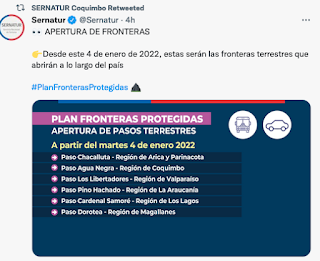
Chile's border are reopening, at least in theory.

For me, as an independent traveler having to cross the border multiple times while updating my book, frequent retesting and quarantines would mean significant delays and expense. As the attached screenshot shows, that situation may be improving), but requirements are likely to change even more so that southern spring—October or November—seems more agreeable.


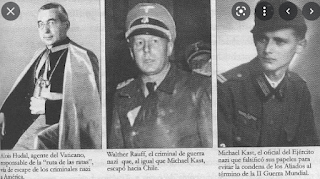
Of course, Chile’s made international headlines for its recent presidential election in which the left-leaning (but hardly extreme) Gabriel Boric defeated right-wing extremist José Antonio Kast (a Pinochet worshipper whose German-born father was literally a Nazi). Though Kast finished first in the multi-candidate primary (there were seven options), the 35-year-old Boric won the runoff handily and, to Kast’s credit, he quickly conceded and congratulated the winner. It’s worth noting that Boric’s final margin was almost identical to that of the 1988 plebiscite that ended Pinochet’s “presidency,” and that Communist candidate Eduardo Artés received only 1.46 percent of the primary vote.

The losing candidate's late father, at right, was literally a Nazi.

Even so, Kast partisans’ accusations of extremism have continued, the “markets” were not pleased with the result, and the peso has slipped against the US dollar (any visitor so inclined could now eat a Weißwurst more cheaply at the Bavaria restaurant chain that is the basis of the Kast family fortune). Still, as Chile proceeds with a Convención Constitucional to draft a new constitution to replace the Pinochet-friendly document authored by the late rightist lawyer Jaime Guzmán, the challenges to a long overdue reform won’t disappear. The new charter must be approved by plebiscite but until then and even after, governing could be a challenge.


In Other News…

My Patagonia title also includes the Falkland Islands, where I once spent an entire year and have revisited at least half a dozen times. Except for my initial trip, when I flew from and back to the United Kingdom (with a memorable stopover on Ascension Island), I’ve always arrived via the southern Chilean city of Punta Arenas but, since the start of the pandemic, there’ve been no flights on that route, which requires overflying Argentine airspace.

The passenger terminal at the Falklands' Mount Pleasant Airport

Next year, hopefully, these flights will resume, but the Argentine government (which claims the Islands as the “Malvinas”) has recently stonewalled humanitarian charter flights that would have allowed the Islands’ Chilean residents (there are roughly 200 of them) to return home for the holidays. That’s not an auspicious development.

Alex Olmedo's Waterfront Café is a Chilean-owned business in Stanley.

For an incisive account of the Islands and their current prosperity, read Larissa MacFarquhar’s outstanding piece in The New Yorker, researched immediately before the pandemic.


Tuesday, April 27, 2021

Geriatric Espionage? (Reviewing Chile's Oscar Nominee)

In 1970, Chilean filmmaker Alejandro Jodorowsky released El Topo, a surrealist movie that seemingly created the Acid Western genre and was a Mexican entry for the Oscars (it was filmed in Mexico, but ultimately not nominated). This year, Chilean director Maite Alberdi’s El Agente Topo (The Mole Agent) is most emphatically not a sequel, but this rather differently offbeat picture earned a nomination for best documentary, even though it didn’t take home the prize last Sunday.

On one level, The Mole Agent is a real-life spy movie in which a private detective recruits Sergio Chamy, a charming 80-something widower, to infiltrate a nursing home where the detective’s client suspects her mother has been subject to elder abuse. This involves a crash course in surveillance techniques and technology for Chamy, whose sociability swiftly inserts him into a milieu where women outnumber men by ten to one.


Alberdi’s production crew filmed the entire work, with permission (but perhaps some deception), at the Hogar de Ancianos San Francisco in the Santiago suburb of El Monte, in an area I’ve visited as a lesser-known wine region.  The finished film is an outgrowth of what was originally a more general focus on Chile’s aging population—by the end of this decade, it could be Latin America’s fastest-aging country, but that’s not what foreign tourists see.


With some minor shortcomings, the Hogar de Ancianos appears to be a well-kept facility, with comfortable accommodations and pleasant gardens, that provides attentive services to its residents. Chamy eventually frustrates his handler by insisting that there is no abuse but, in the end, he concludes that loneliness and familial neglect are major issues that don’t get the attention they deserve. When the popular Chamy finally departs the home, the result is more like a feel-good comedy than an exposé.  In fact, it hardly feels like a documentary at all, and Alberti has stated that there’s interest in doing a fictional version—which she herself won’t do because she’s too invested in the one she’s just finished.

El Agente Topo is available for streaming on Hulu (with English-language subtitles, free trial available). 

Thursday, April 15, 2021

A Long Petal of the Sea (Book Review)

In 1939, as the Spanish Civil War wound down, thousands of refugees fled across the border into France—which then confined tens of thousands in a deplorable detention camp at d'Argelès-sur-Mer. In partial response, poet Pablo Neruda—also a diplomat—chartered the French cargo vessel Winnipeg to carry 2,200 Spanish refugees across the Atlantic and through the Panama Canal to his homeland of Chile where, despite isolated episodes of xenophobia, they integrated themselves into local society.

Chartered by Pablo Neruda, the French freighter Winnipeg carried Spanish refugees to Chile.

That’s the historical background for Isabel Allende’s latest novel, A Long Petal of the Sea, which becomes a tale of exile and adaptation that includes several larger-than-life figures, most notably Neruda himself but also the late President Salvador Allende (Isabel’s father’s cousin) and the notorious Augusto Pinochet (mentioned only in passing). Some characters are fictionalized versions of historical figures, such as pianist Roser Bruguera, clearly based on the painter Roser Bru (who turned 98 in February).

Isabel Allende's novel focuses on one exceptional refugee family.

Bruguera is one focus of a complex family story that melds with an equally complex political history that involves her going into exile, with her husband Víctor Dalmau, from Pinochet’s dictatorship. Allende is especially good at depicting the intrigues and obstacles her characters must navigate, including neighborhood informants, imprisonment, intra-familiar conflicts that tore many Chileans apart, and the disruptions of exile.

The first Spanish refugees would have passed through Arica's customs house (now a cultural center).

Being a geographer, I try to be alert to people and place, and I found one unfortunate error. I expected that, after the Winnipeg passed through the Panama Canal, it would go directly to Valparaíso, whence the refugees would proceed to Santiago and elsewhere in the densely populated heartland. As it happened, though, the ship made a stop in the northern port of Arica, a city I know well, where Chilean officials met the vessel and some of the passengers came ashore to stay.

The nitrate port of Pisagua was the northernmost point on Chile's contiguous rail network.

Allende, though, claims the officials arrived by train, but the northern Chilean railroad network, developed to help exploit the Atacama Desert’s nitrate deposits, never reached Arica—the most northerly major station was in the port of Iquique, roughly 200 km to the south (though there was a smaller station in the nitrate port of Pisagua, only about 125 km to the south). It might have been possible to reach Arica by rail at this time, but that would have involved a roundabout route via Buenos Aires and slow trains to northwestern Argentina and then Bolivia, where the Ferrocarril Arica-La Paz connected the two countries. Given the time, distances, and often contentious relations between Bolivia and Chile, it’s unlikely that anyone would have taken this route and, as it happens, there were flights from Santiago to Arica as early as 1929.

Oficina Chacabuco was the camp where Víctor Dalmau was presumably imprisoned. 

Allende describes, but does not specifically identify, the location where her protagonist Dalmau “ended up at a camp for saltpeter miners in the north that had been abandoned for decades and was now converted into a prison.” That description fits Oficina Chacabuco, about 100 km northeast of the port city of Antofagasta, which is now a national monument and in situ museum that I’ve visited several times. She also offers a plausible description of the Dalmaus’ ostensible rural retreat, outside Santiago, when they return from exile in Venezuela.


All in all, Allende’s novel is a rewarding read that provides an insider’s view of refugees, immigrants, and the contributions they make to their new countries—with lessons for countries still including Chile and, of course, the United States (where Allende now makes her home).


Custom Search