Showing posts with label Literature. Show all posts

Monday, May 23, 2022

Mayhem Among the Moai? It's Fiction, Fortunately.

A few weeks ago, while walking the dog, I rifled through a nearby Little Free Library and stumbled upon an intriguing title by the late Lyn Hamilton, a Toronto-based author of archaeological mysteries. The Moai Murders, as you might guess, is not about the destruction of iconic statues on Rapa Nui (Easter Island), but rather about events at a fictional “Rapa Nui Moai Congress,” where academic disagreements appear to escalate into mayhem. I enjoy whodunits, so I took it home and have finally finished it.

The Moai Murders is one of a series of archaeological mysteries.

Hamilton’s protagonist, Lara McClintoch, is a Canadian antiques dealer who chances upon violent death everywhere she goes (there are 11 books in the series, in destinations including Mexico, Perú, Italy and China as well). According to her website, Hamilton made a point of doing fieldwork in the destinations she wrote about, and traveled to Rapa Nui in 2004.


Lara is an archaeological amateur, and that’s apparent from her (and Hamilton’s) infatuation with Thor Heyerdahl, whose legacy there is more notoriety than scholarship (Heyerdahl proved it was possible to raft from South America to Rapa Nui, but not that it happened that way; the overwhelming consensus is that the island was settled from the Western Pacific rather than the continent to the east). Could bitter differences of opinion result in multiple deaths at the Congress, however?  

Do not embrace the moai at Abu Tongariki (or elsewhere).

I’m not going to offer any plot spoilers, but I will quote the late Georgia Lee, founder of the Rapa Nui Journal (for which I have written in a somewhat more academic vein) to the effect that “The Moai Murders would be a good book to take along on the flight home from a visit to Rapa Nui; the reading time is just about the same as the flight time” (back to Santiago, at least). I will note, however, that Lara’s friend and companion Moira’s impulse to embrace a moai would probably, at present, be enough to get you expelled from the island, and that the Rapanui people—as Georgia Lee emphasizes—are barely noticeable in the book.

Flights have resumed to Rapa Nui's Aeropuerto Mataveri, but restrictions remain and schedules could change.

For my part, though I’ve been to Rapa Nui half a dozen times or so, I haven’t visited since 2012. Because I’m not presently writing a guidebook to Chile, I’m not likely to return any time soon but I will note that, in the hopefully waning days of the pandemic, flights from the mainland have resumed. The island has been highly dependent on the tourist economy and, while there’s only one weekly flight at this time, there will be two or three per week after August 1st. These will be subject to restrictions, including vaccination records, PCR tests and other requirements. These requirements could also change, depending on public health developments.

Thursday, February 24, 2022

Post-WWII Argentina - Fact or (Detective) Fiction?

In my previous post, I reviewed one of my favorite streaming series with a link to southernmost South America but, while I’ve been unable to travel there (spoiler—I’m scheduled to fly to Buenos Aires on March 6th), I haven’t been purely a video couch potato. I’ve also been reading and, while I love detective stories, I’ve been doing it in a way that has more content than just potboilers.

In A Quiet Flame, German detective Bernie Gunther investigates a possible serial killer in Argentina.

Over most of the last year, I’ve been recovering from ankle surgery that requires me to do rehabilitation exercises three times daily, followed by elevating the joint to reduce the swelling for 15 minutes at a time. I use that time to read and, recently, I read the late Philip Kerr’s novel The One from the Other, in which Bernie Gunther—a former Berlin detective and anti-Nazi drafted into the Schutzstaffel (SS) during WWII—tries to track down war criminals and finds himself unjustly incriminated. Kerr’s plotline is so complex that I won’t go into more detail here, except to add that, in the end, Bernie has to flee to South America in the company of some pretty notorious “comrades.”
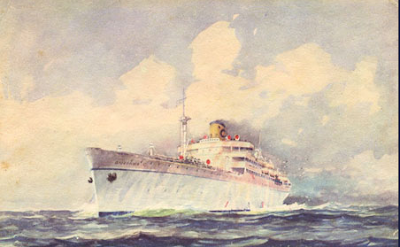
In real life and the novel, the Giovanna C carried both refugees and war criminals from Italy to Argentina.

That, of course, aroused my interest—especially so when the edition I read included the first chapter of A Quiet Flame, which describes Bernie’s 1950 arrival in Buenos Aires on the steamship Giovanna C in the awkward company of two notorious Nazis, including Adolf Eichmann. As in Germany, Gunther doesn’t hesitate to make fun of his companions, and Kerr gives provides him dialogue no less acerbic than Raymond Chandler gave Philip Marlowe and Dashiel Hammett gave Sam Spade. In one case, Bernie remarks that he repels an opponent with a punch that he compares to legendary Argentine boxer Luis Ángel Firpo.
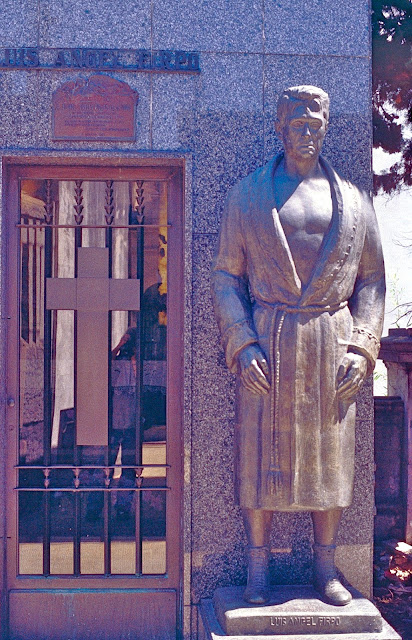
Bernie Gunther claims to pack a punch like the legendary Argentine heavyweight Luis Ángel Firpo, who once knocked Jack Dempsey onto the canvas (Firpo now resides in Recoleta Cemetery).

Like his companions, Bernie arrives under an alias but, in a meeting with then-President Juan Domingo Perón (and Perón's poodles), he has to reveal his true identity and, under pressure, he’s persuaded—forced, rather—to investigate a murder and another disappearance with links to a German-speaking community in Buenos Aires and the northern province of Tucumán (with additional links to a cold case he failed to solve in pre-war Germany).


Unlike Marlowe and Spade, Gunther had worked as a private detective when employment under the Nazi regime became untenable—a situation that may well have contemporary parallels (He had also served in Ukraine, for what that's worth). Parenthetically, Bernie manages to make some blatantly sexist comments about Evita Perón’s appearance, but also sympathizes with the health problems that killed her just a few years later.
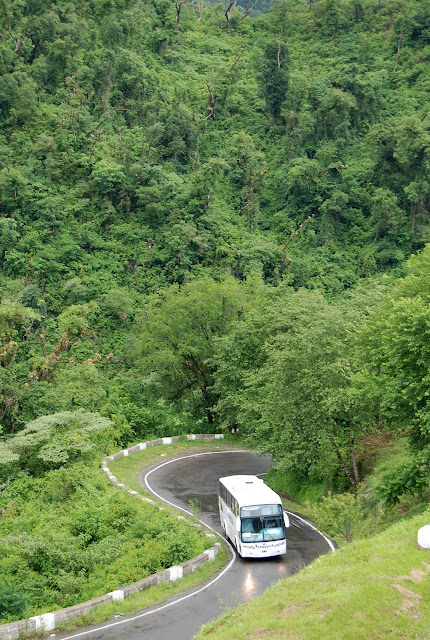
Bernie's investigation leads him to a sinister site in the subtropical sierras of Tucumán Province.

More significantly, Bernie learns of the notorious Directive 11, by which the Argentine government denied Jewish refugees entry into the country. Through him, Kerr speculates as to the existence of a Directive 12, which would have established a concentration camp in Tucumán’s subtropical forests.


According to a 2009 interview with The Wall Street Journal, Kerr (who died in 2018) decided against visiting Argentina because “I thought about it and decided that what I wanted was a historic picture, rather than the Argentina of today.” In my opinion, though, even allowing for poetic license, this novel would have benefitted from a visit to the country. In one instance, for example, Kerr appears to confuse the Argentine capital’s central shopping district of Florida with a neighborhood in the town of Vicente López, in the city’s northern suburbs—where the Nazi refugees had a safe house and Eichmann later resided for many years. Through Bernie, he's also unnecessarily harsh on a Tucumán he never saw (though it's clearly a different place today). At the very least, the publisher should have hired a proofreader familiar with Argentina—the airport city of Ezeiza, a southern Buenos Aires suburb, is consistently misspelled “Ezeira.”

Uki Goñi's book details the Perón government's complicity with the Nazis. 

At the risk of being labeled a pedant, I’ll still recommend both these novels and others by Kerr, who manages to convey the complexities of surviving in an authoritarian or even totalitarian ambience while still seeking truth and justice—even for a flawed figure like Bernie Gunther. What I'd really like to see is somebody turn all 14 novels into a streaming series.


In the course of writing A Quiet Flame, the novelist relied on Uki Goñi’s The Real Odessa, an historical account of the Nazi presence in post-war Argentina, including documentation of the Perón government’s complicity (Full disclosure: Goñi is a personal acquaintance).


Addendum

Another personal acquaintance of mine, the late geographer Dan Gade, had direct contact with another ex-Nazi, the SS officer and ethnobotanist Heinz Brücher, but it was only after Brücher’s murder in 1991 that Gade unearthed the extent of Brücher’s role in WWII and continued adherence to Nazi ideology. Questioning the impartiality of Brücher’s South American research—he also worked in Paraguay—Gade’s article might suggest that Goñi’s extensive and incisive research was only a starting point for a continued assessment of the post-war German presence.


Support Southern Cone Travel

If you’ve found this entry informative and/or useful, please consider earning me a few pennies by clicking on an ad—always presuming, of course, that it’s relevant to your interests.

Thursday, April 15, 2021

A Long Petal of the Sea (Book Review)

In 1939, as the Spanish Civil War wound down, thousands of refugees fled across the border into France—which then confined tens of thousands in a deplorable detention camp at d'Argelès-sur-Mer. In partial response, poet Pablo Neruda—also a diplomat—chartered the French cargo vessel Winnipeg to carry 2,200 Spanish refugees across the Atlantic and through the Panama Canal to his homeland of Chile where, despite isolated episodes of xenophobia, they integrated themselves into local society.

Chartered by Pablo Neruda, the French freighter Winnipeg carried Spanish refugees to Chile.

That’s the historical background for Isabel Allende’s latest novel, A Long Petal of the Sea, which becomes a tale of exile and adaptation that includes several larger-than-life figures, most notably Neruda himself but also the late President Salvador Allende (Isabel’s father’s cousin) and the notorious Augusto Pinochet (mentioned only in passing). Some characters are fictionalized versions of historical figures, such as pianist Roser Bruguera, clearly based on the painter Roser Bru (who turned 98 in February).

Isabel Allende's novel focuses on one exceptional refugee family.

Bruguera is one focus of a complex family story that melds with an equally complex political history that involves her going into exile, with her husband Víctor Dalmau, from Pinochet’s dictatorship. Allende is especially good at depicting the intrigues and obstacles her characters must navigate, including neighborhood informants, imprisonment, intra-familiar conflicts that tore many Chileans apart, and the disruptions of exile.

The first Spanish refugees would have passed through Arica's customs house (now a cultural center).

Being a geographer, I try to be alert to people and place, and I found one unfortunate error. I expected that, after the Winnipeg passed through the Panama Canal, it would go directly to Valparaíso, whence the refugees would proceed to Santiago and elsewhere in the densely populated heartland. As it happened, though, the ship made a stop in the northern port of Arica, a city I know well, where Chilean officials met the vessel and some of the passengers came ashore to stay.

The nitrate port of Pisagua was the northernmost point on Chile's contiguous rail network.

Allende, though, claims the officials arrived by train, but the northern Chilean railroad network, developed to help exploit the Atacama Desert’s nitrate deposits, never reached Arica—the most northerly major station was in the port of Iquique, roughly 200 km to the south (though there was a smaller station in the nitrate port of Pisagua, only about 125 km to the south). It might have been possible to reach Arica by rail at this time, but that would have involved a roundabout route via Buenos Aires and slow trains to northwestern Argentina and then Bolivia, where the Ferrocarril Arica-La Paz connected the two countries. Given the time, distances, and often contentious relations between Bolivia and Chile, it’s unlikely that anyone would have taken this route and, as it happens, there were flights from Santiago to Arica as early as 1929.

Oficina Chacabuco was the camp where Víctor Dalmau was presumably imprisoned. 

Allende describes, but does not specifically identify, the location where her protagonist Dalmau “ended up at a camp for saltpeter miners in the north that had been abandoned for decades and was now converted into a prison.” That description fits Oficina Chacabuco, about 100 km northeast of the port city of Antofagasta, which is now a national monument and in situ museum that I’ve visited several times. She also offers a plausible description of the Dalmaus’ ostensible rural retreat, outside Santiago, when they return from exile in Venezuela.


All in all, Allende’s novel is a rewarding read that provides an insider’s view of refugees, immigrants, and the contributions they make to their new countries—with lessons for countries still including Chile and, of course, the United States (where Allende now makes her home).


Monday, September 30, 2019

Surrealistic Roadie

When I read Latin American literature, I usually do so in English—partly because my own Spanish, though fluent, is more academic than idiomatic, and partly because English is, presumably, the native language of most readers of this blog. I also want to provide an idea of the availability of Latin American literature—mostly Argentine and Chilean—to an English-speaking audience.
Trabucco's novel won the Man Booker International Prize.
Even that is a challenge with Alia Trabucco Zerán’s novel The Remainder which, for lack of a more inspired description, I’ll call a Chilean millennial version of Gabriel García Márquez’s magical realism. Trabucco Zerán is part of the generation whose parents supported Salvador Allende’s “Chilean way to socialism” and suffered (or died) under the lengthy dictatorship of General Augusto Pinochet.

Trabucco’s protagonists are three young Chileans, two women and a man, one of whose parents has recently died in German exile but expressed her desire to be interred in her South American homeland. When a mysterious ash storm halts flights into Santiago, the three have to cross the Andes into Argentina—in a loaner hearse—to fetch the mother’s casket at the airport in Mendoza.
Trabucco's characters don't see the same landscape I do when crossing the Andes to Argentina.
Having crossed this border many times—though never in a hearse—I found the stream-of-consciousness narration hard to follow, perhaps because I view the crossing from the viewpoint spectacular landscapes rather than as part of a surrealistic mission that gets even more so when the three amigos have trouble locating the body and, then, getting it released into their custody. The narrators take such liberties with geography that I found it difficult to follow, even as I could sympathize with their quest (I lived in Chile during part of the Pinochet dictatorship, and can still recall measures like Santiago’s 11 p.m. curfew, though I never personally felt any threat there).
Maybe I’ll have to reread this, at a more leisurely pace, to get as much out of it as Chilean millennials dealing with their parental hangover traumas would. On the other hand, I might prefer to see it as a black comedy, perhaps in the hands of nonagenarian film-maker Alejandro Jodorowsky (the trailer above is from his cult classic El Topo). Whatever the result, I’d have to say “Don’t try this at home.”

Monday, January 21, 2019

Betrayed by Rita Hayworth? Or Hollywood? (A Film Review, of Sorts)

While I’ve always enjoyed movies, it’s not an obsession so that, on occasion, something comes to my attention that I hadn’t noticed (or only barely knew of) before. That was the case on Saturday night, when our local PBS station showed director Charles Vidor’s Gilda, the film that made Rita Hayworth a star.
Filmed in late 1945 and released in 1946, Gilda is a noirish drama that aroused my interest because its ostensible setting is Buenos Aires, where small-time gambler Johnny Farrell (Glenn Ford) becomes the right-hand man of corrupt casino owner Ballin Mundson (George Macready), newly married to the stunning Gilda (Hayworth) who—unbeknownst to Mundson—has an ambivalent history with his new employee.
Palermo's Hipódromo offers casino slots today, but probably not in the 1940s.
I won’t comment further on the plot, because I want to focus on the movie’s presentation of Argentina and its capital. In the first instance, it’s worth noting that, when Mundson first invites Farrell to his casino, he provides him a “key” because casinos were not legal in the city. This rings true because that’s still the case—there are casinos in the provincial suburbs, but not in the capital except for the floating Casino Buenos Aires (two vessels docked at Puerto Madero) and some slot machines in the Hipódromo Argentino de Palermo, where betting on horse races is legal (I doubt that the Hipódromo had slots in 1945). Other than that, there are only a few bingo parlors.
As the Hotel Centenario, the Palacio Vera was an ostensible location in Gilda (photo by Julieta Sol Narganes, Creative Commons)
Most of the film’s action takes place in building interiors—there’s a brief soundtrack moment of tango and a nod to Carnaval—with almost nothing to suggest the streetscapes of Argentina’s capital (so far as I can tell, the entire film was shot in Hollywood in just three months). One ostensible location is the Hotel Centenario, which then occupied the Palacio Vera, an Art Nouveau structure on the central Avenida de Mayo that dates from 1910. Again, though, the movie does not even offer an image of the building's exterior.

Though the Brooklyn-born Hayworth herself was a Hispanic woman (her father was a Spaniard), she does not play one in this movie. At one point she flees to Montevideo, across the river, but again the only scenes of Uruguay’s capital are interiors.
Argentina Brunetti was one of two Argentines with bit parts in Gilda.
The Hungarian-born Vidor introduces the theme of Argentina’s World War II dark side in the person of two German mining cartel members who frequent the casino. The ostensible Argentines are few, including a police detective played by the Maltese actor Joseph Calleia and another policeman played by Manhattan-born Gerald Mohr, and a washroom attendant played by the Ukrainian Steven Geray. Two Argentines play bit parts: the Buenos Aires-born Argentina Brunetti, who appeared in many Hollywood movies in the 1950s and 1960s, and Jack del Río, best known as the fourth husband of pop singer Peggy Lee.
The late Argentine novelist was a movie geek.
That’s not to dismiss Gilda as a film, but I suspect it could have been even better had it been filmed on location (a remake might be interesting). Who knows, could that be one reason that the late Manuel Puig titled his first novel Betrayed by Rita Hayworth?

Gilda is available on several streaming services.

Support Southern Cone Travel!
If you've found this article interesting or useful, please consider earning me a few pennies by clicking on an ad (ideally, one that might be of interest to you).

Sunday, November 25, 2018

Ghost Towns of Patagonia? A Review of "False Calm"

When the great Charles Darwin looked back on his travels, he displayed a surprising affection for Patagonia’s endless plains: “"In calling up images of the past, I find that the plains of Patagonia frequently cross before my eyes; yet these plains are pronounced by all wretched and useless.  They can be described only by negative characters; without habitations, without water, without mountains, they support merely a few dwarf plants.  Why then, and the case is not peculiar to myself, have these arid wastes taken so firm a hold on my memory?  I can scarcely analyse these feelings; but it must be partly owing to the free scope given to the imagination."
A crossroads on the Patagonian steppe
Darwin’s focus was natural history, but he also observed Patagonia’s peoples and cultural landscapes, as he did in his description of the ruins of “Port Desire” (now known as Puerto Deseado): “It was formerly attempted to make a settlement here; but it quite failed from the want of water in the summer, and the Indians in the winter. — The buildings were begun in very good style, and remain a proof of the strong hand of old Spain.” He thought the area almost uninhabitable, though, “As the fate of all the Spanish establishments on the coast of Patagonia, with the exception of the Río Negro, has been miserable.”
María Sonia Cristoff—herself a Patagonian native—might agree with Darwin, but for different reasons. When I first saw False Calm – A Journey Through the Ghost Towns of Patagonia, the subtitle suggested something very different from what I then read about, an area I’d gotten to know pretty intimately over the course nearly 40 years. I had to check the Spanish version—“Un recorrido por pueblos fantasma de la Patagonia”—to clarify exactly what she meant. That wasn’t enough, though, as she wasn’t writing about abandoned settlements like remote Cabo Raso or the old Frigorífico Swift company town near Puerto San Julián, both of which I had visited regularly if not frequently.
Cabo Raso is a genuine ghost town on the coast of Chubut province
The Frigorífico Swift, on the outskirts of Puerto San Julián, is an industrial ghost town.
Cristoff, though, is not interested in nostalgia-laced curiosities in a region renowned for its wildlife and wild Andean backcountry. Rather, she focuses on what I would describe as semi-urban backwaters on the Patagonian steppe that begins just inland from the Atlantic and extends well beyond the limits of Darwin’s vision at Puerto Deseado, and I might call her experience a "stay" rather than a "journey."
Las Heras, one of Cristoff's "ghost towns," survives on fossil fuels.
Personally, I might also call her destinations "backwaters" instead of "ghost towns," and Cristoff is more an ethnographic participant observer of life in settlements like Cañadon Seco (population roughly 900), which is only 14 kilometers from the coastal oil town of Caleta Olivia (population 80,000 or so, which I know fairly well). Except for the inland oil town of Las Heras (population 23,000, which I’ve visited once), most other settlements are so far off the beaten track that I struggled to find them on road maps that showed only gravel tracks in the area.
Cristoff's hometown of Trelew is more prosperous than the towns she writes about.
She gets to know her destinations through residents who seem stuck where they are or, on occasion, are returnees (escapees?) on brief visits to their former homes. Her stories often tell us the darker side of small communities that we know exist but may prefer to overlook. These absorbing but taxing tales almost completely ignore prosperous places like Trelew—the author’s hometown—and nearby Puerto Madryn, which have flourished with the tourist trade, wool, and industries such as aluminum.

That said, this is a worthy counterpoint to Patagonia’s romantic image, as seen from afar or on brief sightseeing tours. I know the translator Katherine Silver slightly and, while I might still quibble with the term “ghost town” in English, it’s perhaps metaphorically appropriate to places whose inhabitants are wraiths even to their fellow citizens who pass through their communities. At the end of the day, the title “False Calm” implies aspects of Patagonian life that short-term visitors are likely to miss but are nevertheless important.

Wednesday, October 24, 2018

Neruda & His Daughter

This mosaic in Santiago's Bellavista neighborhood suggests the reverence in which Chileans hold Pablo Neruda.
As a Nobel Prize-winning poet, Pablo Neruda is revered in Chile—even by many who abhorred his outspoken Communist politics. His literary and political fame, though, overshadowed what was often a messy personal life, a topic that Dutch poet Hagar Peeters tackles in her first novel, Malva, named for the handicapped daughter that Neruda neglected during her short lifetime.
Malva is Dutch poet Hagar Peeters' first novel.
Born in Madrid in 1934 to Neruda and his first wife Marijke Antonieta Hagenaar Vogelzang (known as Maruca), whom he met while serving in a diplomatic post in the Dutch East Indies, Malva Marina Trinidad del Carmen Reyes suffered from hydrocephalus. She died in 1942, spending most of her life with a foster family in the Netherlands after Neruda ignored her and her mother took what jobs she could after their 1936 divorce. Half that time was during the Nazi occupation of Holland, when birth defects denoted genetic inferiority at best.

Peeters tells Malva’s story through a sort of magical realism, with Neruda’s daughter as an omniscient post-mortem observer who, in the afterlife, acquaints herself with the children of other creative fathers who neglected their offspring: James Joyce’s schizophrenic daughter Lucia, Arthur Miller’s son Daniel (born with Down syndrome), and, oddly, Günter Grass’s fictional dwarf Oskar Matzerath of his novel The Tin Drum.
After the 1973 coup, the Chilean military vandalized Neruda's Santiago home, which is now a museum.
Neruda may have been a neglectful parent, but there’s a bit of autobiography in Peeters’ account, as her own father spent extended periods in South America during the tumultuous 1970s (Neruda died, and may have been murdered, less than two weeks after the military coup that overthrew President Salvador Allende in 1973). Born in 1972, Peeters acknowledges using her father’s diaries in reconstructing Neruda’s last days (as told by Malva). The account of Neruda’s funeral, in the house vandalized by the military, is especially eloquent.

According to Peeters, in fact, “Any resemblances between Neruda and my father, Maruca and my mother, and Malva and myself are entirely and mischievously deliberate.” In the end, there's an ambivalent admiration for them all.

Tuesday, September 11, 2018

Argentina's Heroic Forger

Late last year, I briefly noted the publication of Sarah Kaminsky’s Adolfo Kaminsky, A Forger’s Life, the tale of her father’s service in the French Resistance of World War II. That interested me, partly because Kaminsky is an Argentine, and partly because the Resistance provided forged identification that helped my 94-year-old uncle, who lives in Los Angeles, escape the Nazis after being shot down over France in November of 1943. His own account of traveling across France and into Switzerland is positively cinematic.
The English and Spanish-language versions of Kaminsky's story
I received a copy of Kaminsky’s book from the US publisher but, on my recent trip to Buenos Aires, I purchased a copy of the Spanish-language edition Adolfo Kaminsky El Falsificador, primarily because it includes a prologue about Kaminsky’s boyhood in the Argentine capital. Though he spent only five years there before his parents returned to Europe, he offers surprisingly vivid memories of a free-range boyhood in an immigrant neighborhood that sounds like the edge of Barrio Norte (he mentions living on Calle Ecuador, apparently near Avenida Córdoba, but is not more specific than that). 
The intersection of Ecuador and Paraguay is roughly where the Kaminskys lived in Buenos Aires.
Kaminsky’s mother, born in Tbilisi, married his Russian-born father in Paris during World War I. Given the disorder in Europe, heightened by the Bolshevik Revolution, the family had moved to Buenos Aires, where Adolfo was born in 1925. Interestingly, when the family returned to France, what struck him was the contrast with Buenos Aires, the noise from the cars, trams and trucks that crowded Parisian streets—“It was so different from Calle Ecuador!” In the ensuing century, Buenos Aires has more than caught up.

The return to Europe didn’t go as expected because the French would not grant the family immediate residence, and they spent two years in Turkey waiting for permission to return. The lack of papers, Kaminsky implies, may have inspired his interest in falsifying documents: “Nothing destined me to become a forger but, however, those papers that my family needed when I was a child were going to govern my life.”

Only 14 when World War II broke out, Kaminsky (and his Jewish family) survived the earliest years of the German occupation because of their nationality—Argentina remained a neutral country until nearly the end of the conflict. Adolfo, meanwhile, had acquired skills in printing, dyeing and photography that allowed him to produce passports and other papers that saved as many as 3,000 Jews from the Nazis.

Eventually, the Kaminskys themselves had to scatter and hide—with the help of Adolfo’s bogus documents—but after the liberation of Paris he provided Allied forces with new forgeries that helped them infiltrate German lines. After the war, he assisted European Jews in reaching Palestine—though he deplored Zionism—and then helped figures in the Algerian independence movement move between North Africa and Europe. He prided himself in never charging for his services—everything was pro bono for causes that he either supported or saw as a better alternative to the status quo.

Kaminsky did his last forgery in 1971 and lived in Algeria for a decade, marrying a Tuareg woman, before finally returning to France in the early 1990s. His daughter’s persistent inquiry into her father’s murky history eventually resulted in this book, presented as a memoir from a hero who, accustomed to staying in the background, refrained from boastfulness.

Sunday, November 12, 2017

Two Days to LA and BA

Last weekend was a travel marathon as, on Saturday morning, I left the Bay Area for Los Angeles in a rental car, en route to Buenos Aires. Obviously, I was not driving to Buenos Aires, but I was flying there Saturday night and the rental car gave me the opportunity to visit my 93-year-old uncle, at the historic Village Green in Baldwin Hills. As Veteran's Day approached, his World War II record sounded like  something out of Hollywood—shot down over France in late 1943, he first avoided German troops and then, with lots of help from the French Resistance, made it over the border into Switzerland.
My uncle's ground-floor apartment in the wooded Village Green complex is part of a national historic landmark.
I’ve seen the fake ID the Resistance fabricated for him but, unfortunately, he was unable to locate it on Saturday. He has a harelip, and that birth defect led the French forger to include “deaf-mute” in his description—something that fooled the Germans as the Resistance led him across France by car, train and on foot. If caught, he would have been executed as a spy.
Sarah Kaminsky wrote this biography of her Argentine-born forger father, Adolfo Kaminsky, but I've not yet read it.
It’s worth mentioning that one of the Resistance’s heroes was Argentine-born Adolfo Kaminsky, who forged thousands of documents—free of charge—to help Jews and others persecuted by the Nazis. After my uncle crossed the border, the neutral Swiss confined him to a ski resort where, one late spring morning, he awoke to unexpected shouts of celebration from his comrades. His first thought was that, “My birthday’s not that big a deal!” but it was June 6, 1944—the date of the Allies’ D-Day invasion. Only after the war ended, though, would the Swiss release him to US authorities.

After the meeting, I dropped my car off at LAX and had a few hours to kill before departing for Lima’s Aeropuerto Internacional Jorge Chávez and Buenos Aires’s Aeropuerto Internacional Ministro Pistarini. Fortunately, check-in and security went quickly, and I was pleased to learn that LATAM (ex-LAN) now had access to a convenient regular gate at LAX rather than a remote gate served by bus shuttle (I’m hoping, given LAX’s major renovation, this is a permanent change).
I'm disappointed that LATAM doesn't offer more typical Southern Cone wines like Argentine Torrontés (I wasn't in business or first class, though).
Though I was in coach, the seats on our Boeing 787-B were comfortable enough, though it also helped that there was an empty seat between me and an Argentine woman from Rosario.  I was also pleased that the USB power outlets were strong enough to charge my tablet—unlike my recent Hawaiian Airlines flight, where the outlets could only charge phones. My only quarrel with the service is that LATAM’s wine options includes only pretty generic Cabernet and Chardonnay, when they could serve more distinctive Southern Cone varietals such as Argentine Malbec and Torrontés, or Chilean Carménère.
Chilean Carménère would also be superior option to more standard wines.

I had a four-hour layover in Lima where, unfortunately, I simply couldn’t justify ordering a pisco sour at 8 a.m. Lima, unfortunately, still has WiFi issues—no more than half an hour of free connection, though our new cell contract gives me good and reasonably priced coverage on the phone (but not the tablet). Our plane to Buenos Aires was an older one, as the photo above shows, but four hours feels like a short hop to me on this route. Still, I didn’t reach our apartment until nearly 8 p.m. Sunday, after which I had a plate of spinach gnocchi at Bella Italia Café before collapsing into bed.
Our plane from Lima to Buenos Aires was old enough that it still had ashtrays.

Custom Search