Showing posts with label Puerto Puyuhuapi. Show all posts

Sunday, March 5, 2017

Emptying the VAT? Argentina, Chile & Uruguay Offer Tourists Tax Breaks

Recent developments in tourist taxation, in the Southern Cone countries of Chile, Argentina and Uruguay, should interest readers of this blog. In the near future, though, I’ll also be addressing potential visa complications in the face of the United States’ new xenophobic government.

CHILE
For many years, I’ve advised visitors to Chile that, when paying for accommodations in US dollars or by foreign credit card, they are entitled to a 19 percent discount. That’s because foreigners on a tourist visa are exempt from the country’s Impuesto de Valor Agregado (IVA, or Value Added Tax).
Termas de Puyehue, an historic spa hotel eligible for IVA discounts
For those unfamiliar with VAT, it’s a sort of sales tax that levied on products and services within Chile, but not on those intended for export. For some reason, Chile has chosen to define accommodations and some related services as export items, though it’s always mystified me that sleeping in, say, a Puerto Natales hotel might qualify as an export. It’s a legal fiction that also applies, in some cases, to meals and even tours that are part of an all-inclusive package at destinations like Termas de Puyehue Wellness & Spa and the Puyuhuapi Lodge & Spa.
The remote Puyuhuapi Lodge & Spa can also grant IVA discounts.
It’s not quite automatic, though. In the first instance, not all hotels can take advantage of it—they must apply to Chile’s Servicio de Impuesto Internos (SII, Internal Revenue Service) for a franquicia tributaria (export permit) and, in the process, prove that a minimum percentage of their clientele comes from outside the country. In reality, this requirement excludes many modest but perfectly acceptable hostales (B&Bs) and hostels from consideration, even though such facilities could probably use the tax break more than their far wealthier counterparts.
Modest accommodations, like Puerto Natales's Hostal La Cumbre, are often ineligible for IVA discounts.
There’s a recent change in the law that merits noting. Generally, on arrival, foreign visitors receive a 90-day visa, and hotels must make a photocopy of your passport and tourist in order to provide the IVA discount. Though the immigration policy itself has not changed, however, visitors who have been in the country more than 60 days are no longer eligible for the discount.

While the great majority of visitors are unlikely to stay longer than 60 days—even a brief detour in Argentina or another country restarts the clock—it’s worth noting. If it’s more, though, you might as well be a Chilean resident. Note also that the discount depends on an exchange rate that the hotel may have set early in the season, and could be less (or perhaps more) advantageous than the current daily rate.

URUGUAY
To receive an IVA discount at Jacinto, pay with your foreign credit card.
I spend far less time in Uruguay than I do in Argentina and Chile, and only recently became aware of developments in their tourist taxation regime according to Ley 17934. Set at 18 percent, Uruguay’s IVA discount benefits tourists not only in accommodations refunds, but also services such as car rentals and meals. Last year, while dining at Jacinto in Montevideo’s Ciudad Vieja neighborhood, I was surprised to find the discount applied directly to my bill when I paid by credit card. In some cases, though, the discount appeared only when I received my credit card statement at home in California.
My receipt from Jacinto indicates the IVA discount under Ley 17934
For none of the transactions in question did I have to show proof of tourist status—merely paying with a foreign credit card was sufficient. This makes the Uruguayan policy far more convenient than its Chilean counterpart but also potentially vulnerable to abuse—in theory, I suppose, a foreigner could pay for a large dinner by credit card and be reimbursed by Uruguayan friends who would thereby receive the benefit indirectly.

It’s worth adding, though, that the IVA discount for accommodations is only 10.5 percent, and it has seasonal limits—this year, for instance, it is available only until April 21st. Still, the policy benefits everyone, or at least these able to pay with the proper card.

ARGENTINA
Stays at Camping El Bolsón - which has its own brewery - are now eligible for IVA discounts in Argentina.
Both Chile and Uruguay have been doing IVA discounts for some time, but Argentina’s a latecomer to the party. The law’s been on the books since 2001, but only this summer did the government of President Mauricio Macri declare that foreign hotel guests would not have to pay the 21 percent IVA that applies to all other products and services in the country. It’s also applicable to all accommodations, ranging from campgrounds to five-star luxury hotels, though clients will have to show their passports or other identification (visitors from neighboring countries may not need passports). The only acceptable means of payment, though, is a foreign credit or debit card, or a bank transfer. Cash is not acceptable (though Argentine hotels often provide cash discounts).
A stay at Bariloche's classic Hotel Llao Llao also means an IVA discount for foreign visitors.
As always, there’s a strange twist in Argentina’s new measure—it applies only to provinces with international borders. Thus, the interior provinces of Tucumán, Santiago del Estero, Santa Fe, Córdoba, San Luis and La Pampa will not benefit from it. All these provinces probably draw more in-country visitors than foreigners, but Córdoba, San Luis and Tucumán especially could be at a disadvantage to neighbors which do have foreign borders.
Because Córdoba province has no international border, guests at Hotel Sierras in Alta Gracia - Che Guevara's boyhood home - cannot receive IVA discounts.
One final note. The current issue of Condé Nast Traveler misleadingly says that “Argentina did away with its 21 percent hotel tax for foreigners.” This is simply wrong—there never was a hotel tax for foreigners, and Argentine tourists and residents will still be on the hook for that 21 percent IVA (presuming they’re not paying cash under the table).
This kiosk poster in Santiago de Chile promotes Argentina's new tourist tax refund.

Friday, December 25, 2015

Green Chri$tma$ in Chile

Across from Puerto Natales, on Seno Última Esperanza (“Last Hope Sound”), some of the mountainsides are still showing snow in early summer, but it’s been raining most of the day and the grass here is green – reminding me, on the most tedious day of the year, of Stan Freberg’s classic comedy spot "Green Chri$tma$." Recently everyone’s been talking about money in Argentina – most notably the end of the “currency clamp” – so let’s talk about Chile instead.
When I arrived in Natales late last February, the Chilean peso was at 618 per US dollar; a year earlier it had been at 558 per dollar. Today, though, with demand for Chilean copper slowing, the dollar is now worth nearly 700 pesos and prices are falling accordingly. 
One obvious item is that, in a country with some of the continent’s most expensive gasoline – in past years, I’ve paid well over US$6 per gallon (US$1.58 per liter) in some locations – it’s now as low as US$3.70 per gallon (US$0.98 per liter). Contrast the photo above, from Puerto Puyuhuapi in February of 2014, with the one below, taken a few days ago in Punta Arenas.
With low inflation, and no need to change surreptitiously as has been the case in Argentina, Chile is definitely more affordable at present. One thing has changed for the worse, though. In the past, I’ve always recommended using the ATMs at BancoEstado, the state-run bank that had not imposed a charge on foreign currency transactions. When I arrived in Santiago last month, though, I was surprised to learn that their ATMs would now collect a 4000-peso (US$5.72 at present) fee for each withdrawal. That’s still lower than other Chilean banks, which charge up to 6000 pesos (US$8.58) per withdrawal.
In cases like this, it pays to withdraw relatively large amounts, so today I withdrew 200,000 pesos (US$285.95) at a branch here – that’s generally the largest allowed per transaction. Withdrawing smaller amounts with greater frequency is, obviously, far more costly.

That said, I did note what I hope may be a pleasant surprise. Chilean ATMs ask your approval before collecting the fee, giving you the option to cancel the transaction. Today’s did not, though, so perhaps they never reprogrammed the machines here and I got off cheap. I can only hope.

Friday, February 15, 2013

Friday Digest: Southern Cone News


Today’s entry will cover a diversity of items, both in California and the Southern Cone itself. To start with, I will be attending tomorrow’s Bay Area Adventure and Travel Show where, from my point of view, the most intriguing presence is the Falkland Islands Tourist Board (pictured above is Stanley's Jetty Centre, where the FITB greets cruise ship passengers). I have yet to meet Tony Mason, the Board’s new general manager, and hope to be able to relay some new insights on the Islands after speaking with him. Tentatively, I will be returning to the Islands later this year or early next, in the course of updating Moon Handbooks Patagonia.

Patagonia Photo Contest
Meanwhile, the print and online magazine Patagon Journal is holding its first Patagonia Photo Contest and, looking through the entries, I’ve seen plenty of shots that would entice me to visit the region even if I weren’t already so committed to it. Unfortunately, it’s too late to enter the contest, but readers can still enjoy the gallery at the link above.

Categories of photos include nature, environment, culture and travel, and outdoor sports; the first place and runner-up in each category will win a year’s subscription to the magazine, and will have their work displayed at Mall Sport, in the Santiago borough of Las Condes. The first place winners will get gift certificates, and the overall winner gets a three-night stay for two at Puyuhuapi Lodge & Spa, in the Aisén region of Northern Patagonia. Maybe next year, I’ll submit an entry.

Chile in Saratoga/San Jose
It’s four months away, but at 7 p.m. on Monday, June 17, the Saratoga branch of the Santa Clara County Public Library will host me for a digital slide lecture on Chile, in which I will have copies of the new fourth edition of Moon Handbooks Chile and my other titles for sale as well. There may be other events at the Campbell and Los Altos branches of the library as well, but those are not yet confirmed.

Southern Cone Tweets
Against my better judgment, I have opened a Twitter account, so please feel free to follow me at @southernconetrv. At least it forces me to be succinct.

Win This App! Free for the Asking!
Soon, as the new edition of Moon Handbooks Chile comes out later this month, I will have a contest to give away some free copies on this blog. In the meantime, for those of you have an iPhone, iPad or iPod Touch, I still have some remaining free copies of my Argentina Travel Adventures and Chile Travel Adventures apps, with no strings attached.
Simply write me at southerncone (at) mac.com, and I will send a code for a free download of either Argentina or Chile, up to a total of ten (no more than one per person, please). For those of you who use Androids, I apologize that Google does not permit such promotions, so you’ll have to shell out US$2.99 (which presumably should not break your budget).

Saturday, September 10, 2011

Patagon Journal Proposing to Launch

For some time now, Puerto Varas-based journalist Jimmy Langman has been developing the bilingual website Patagon Journal, whose mission is to “build a greater appreciation, understanding and environmental stewardship of Patagonia.” Langman, whom I have known for many years, has a long resumé as South American correspondent for various US and UK media, including Newsweek, the Miami Herald, San Francisco Chronicle, The Guardian, and The Times of London - as well as a competing guidebook publisher whose name I will decline to mention.


With the intention of turning it into a bilingual print magazine, Langman has begun a fund-raising campaign through Kickstarter, which helps raise money for creative projects. Between now and October 6th, Patagon Journal needs pledges totaling $15,000 to put the project on a solid financial footing. Depending on the amount, donors will be eligible for awards ranging from simple subscriptions to a two-night stay at the Aisén region’s Puyuhuapi Hotel & Spa (pictured below).

What I particularly like about Patagon Journal is its goal to “show all facets of Patagonia’s natural and cultural landscape, and at the same time help contribute to its long-term protection.” The magazine will also be “published on FSC-certified paper as well as on the iPad with additional content such as video” and “abundant and beautiful photography on diverse environmental, cultural, scientific and other topics. In addition, a travel section provides a close look at the best destinations and excursions in the region, and top experts in Patagonia for fly fishing, trekking, mountaineering, the environment and other topics are featured through regular departments. Ten percent of its subscription revenues are to be shared with non-profits working to protect Patagonia's environment and culture.”

This is a worthwhile independent journalism project that deserves to get off the ground. Any readers with the resources to contribute, even on a modest level, would be rewarded by doing so.

Moon Handbooks Buenos Aires in Millbrae (San Mateo County)


Thursday September 29 will mark the last of four digital slide presentations on the fourth edition of Moon Handbooks Buenos Aires, at various branches of the San Mateo Public Library. This event starts at 1 p.m. at the Millbrae Library (1 Library Avenue, Millbrae, CA 94030, tel. 650/697-7607). There will be ample time for questions and answers, and books (also including Moon Argentina and Moon Chile) will be on sale (at a discount).

Next month, I will be on the road promoting the new third edition of Moon Handbooks Patagonia. Most of the events will be in the San Francisco Bay Area, but I will also be appearing in Seattle and Bellingham, Washington; Vancouver BC; Santa Fe, New Mexico; and Pasadena, California. Watch this spaces for details.

Friday, August 5, 2011

Big Water, Monumental Buildings & Mine Rescues

Today's entry touches on Argentina's Iguazú falls, Chile's remote Aisén region, and an important exhibition on the Chilean mine rescue of 2010.

Big Water Gets Bigger

In the indigenous Guaraní language, Iguazú means “big water” and, for anyone bound for Parque Nacional Iguazú and its magnificent Cataratas in this southern winter, that means good news and bad news. First the good news: temperatures are mild (upwards of 70° F for the next several days) and the falls are even more spectacular than usual. That’s because, thanks to heavy rainfall in the Río Iguazú’s upper drainage in Brazil, the falls are carrying 13,000 cubic meters of water per second, about eight times their normal flow of 1,500.

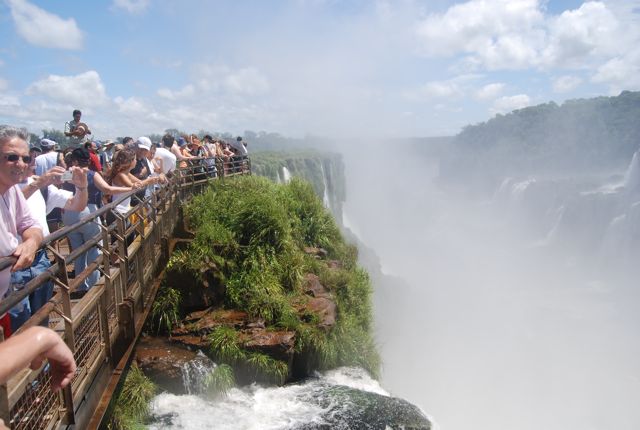
The bad news is that the flow is so heavy that national park authorities have had to close the observation deck opposite the Garganta del Diablo, the single most impressive of the nearly 300 separate falls. Even with normal runoff, the deck (pictured above) gets plenty of spray from the falls, so that visitors sometimes wear rain gear on bright sunny days.

At present, though, the increased flow makes it dangerous and slippery (nobody wants to go over the Garganta del Diablo, in a barrel or otherwise). At the same time, the excursion boats that approach the falls from below have also been suspended. With the storms ending in Brazil, Iguazú should return to normal in a few days at most.

Puerto Puyuhuapi: a Monumental Event

Much farther south, the town of Puerto Puyuhuapi, where Luisa Ludwig lives, is part of dankest Patagonia – winter gets wet and cool on the Chilean side of the Andes. August rainfall averages 401 mm (about 16 inches), but there’s a ray of sun this month - her Casa Ludwig B&B (pictured above) is the first private building to be designated a national historical monument in Chile’s southern Aisén region.

Luisa’s parents were among the 1930s Sudeten German pioneers at Puerto Puyuhuapi, which has become well-known for its custom carpet factory Alfombras de Puyuhuapi, which sends its products around the world (the photo above is one of weavers, from the island of Chiloé; the photo below is a finished product). The monument designation limits what can be done with Casa Ludwig – the exterior cannot be altered – but Luisa’s happy with the results: “Actually we asked for the declaration. We find the house beautiful as it is. And maybe it can be good publicity.”

Rescue at the Smithsonian
For those of you fortunate enough to live in Washington DC – despite the manufactured political crisis of the past several weeks, there are good things about DC, where I once spent a semester teaching at George Washington University – there’s something worth seeing starting today. With sponsorship by the Chilean embassy, the Smithsonian Institution’s Natural History Museum will host the exhibition “Against All Odds: Rescue at the Chilean Mine” as the first anniversary of the successful evacuation of the collapsed San José mine near Copiapó approaches. The Chileans, at least, can get things done; among the objects on display will be the actual rescue capsule that brought the miners to the surface (claustrophobics may want to stay away).

Help Support Southern Cone Travel
If you have found this article informative, please consider clicking on one or more of the AdSense links that accompany it - always presuming, of course, that it’s a product or service that interests you.
Custom Search