Showing posts with label Pucón. Show all posts

Sunday, December 13, 2020

Corona v. Corona? Virus Meets Eclipse in South America

In mid-2019, Chileans and many foreigners flocked to the coastline, about 500 km north of Santiago, to see a major solar eclipse—a once-in-a-lifetime opportunity for most people. Tomorrow, though, there’s yet another chance, but this year’s event has complications for eclipse-chasers in Argentine Patagonia or southern mainland Chile, the path on which the moon will blot out the sun for a little over two minutes. Those complications have to do with COVID-19, of course, but also the weather.

The path of Monday's eclipse

While people flocked to the 2019 event, that comes with risks this year. A friend in Pucón, who until very recently worked in hotel administration, tells me that the city “is living as if this wave won’t arrive here. There are lots of people who’ve come to see the eclipse, many of whom surely are carrying the virus that will force us to shut down again, perhaps all summer…”

Monday's forecast shows a 90 percent chance of rain at the hour of totality,


Ironically enough, they may be risking their lives—and those of others—for nothing. A few years ago, I and some friends had to cancel an overflight of nearby Volcán Villarrica because heavy cloud cover set in the morning of our departure, and tomorrow’s forecast shows rain throughout the day (the marine west coast climate resembles that of Seattle). In the path of totality, the sky will get darker at 1 p.m., but no one there is likely to see the startling sight of the solar corona (spoiler—it’s nothing to do with the virus!) when the moon blocks the sun.


In theory, visibility should be better on the Argentine side of the border, in the rain shadow of the Andes, but rain is also possible at San Martín de Los Andes, a prime tourist destination that lies barely outside totality. Conditions should be better in the city of Neuquén, a bit farther from the path of totality, but I would expect heavy southbound traffic towards the hamlet of Picún Leufú, which lies within. A 20-something friend of ours in the city (which is not really a tourist destination) at first sounded indifferent when I asked him if he were going to watch it, but now it seems he’ll at least step outside the office to glimpse the partial eclipse.


For those of us unable to reach Chile or Argentina for the event, the National Aeronautics and Space Administration (NASA) will follow it online starting at 9:40 a.m. Eastern Standard Time. There will also be a live show in Spanish starting at 10:30 a.m. EST.

Saturday, May 23, 2020

Walled Out? Walled In? Or Both?

Having received an advance from my publisher, I am theoretically updating the current edition of Moon Patagonia, but it’s not quite that simple. When I flew to Chile in late February, after a few days in Santiago I drove south to the volcanic highlands of the Araucanía region and across the Argentine border to San Martín de los Andes and San Carlos de Bariloche. I abruptly returned to Chile, though, when Santiago announced the impending closure of the borders between the two countries.
In mid-March, Chile was about to close the border with Argentina because of the Coronavirus crisis.
I had double-checked and acquired quite a bit of material in the process but, when I left to return to California in late March, I told my Chilean friends—one of whom is storing my car in Santiago—that I hoped to return in November, but couldn’t guarantee that would be the case. February or March of next year sounded a bit more realistic. Even now, that’s far from certain because of the Coronavirus crisis, which is worsening in Chile—though it’s not yet reached the levels of misgoverned countries like Brazil, the United Kingdom and, of course, the United States.
COVID-19 trends are worsening in Argentina and Chile, but still not close to those in the United States, Brazil, or the UK. 
Many people are without work these days, but my own is simply in limbo even if, in theory, I could be working on the book in question. In past years, spending the summer at home in Oakland before heading south after the World Series, I would revise background material such as government and politics. Still, even before I arrived in Chile earlier this year, that was full of uncertainty with the pending plebiscite on a new Constitution—now rescheduled for October 25th—and whether the accompanying political unrest might affect the travel and tourism sector.

The public health crisis, of course, put that issue on the back burner—almost literally, as the Chilean government decided (rightly, in my opinion) that holding an election in the midst of a pandemic was risky. For what it’s worth, the country does not allow absentee voting, so vote-by-mail is not an option; voting was once obligatory, but that is no longer the case. Interestingly, Chile does allow resident non-citizens to vote in its elections.
Open-air dining space at Pucón's Loretano
Besides background material, though, there’s equal uncertainty about tourist services. In my short time in South America, I discovered new restaurants, such as the Peruvian Loretano which, at present, continues serving takeout meals in Pucón. Still, in the aftermath of the public health crisis, many restaurants, accommodations and other services are sure to fail or, at least, change dramatically. It’s too early to say whether Loretano, or even established accommodations and restaurants with a solid track record over the decades, will necessarily survive.
I'd love to try the Peruvian-style ceviche at Loretano again.
Even if the travel and tourism sector re-opens, there’s another obstacle for me (and many other US citizens). Everybody knows, of course, about the notorious vanity wall under construction at the Mexican border, but now the current White House occupant’s minions are taking it to another level entirely. My US passport expires in early September, and I recently learned that the State Department is not processing either new or renewal applications so that, even if Argentina and Chile open up for tourism, it's uncertain (at best) when we'll be able to return.
In early March, when I entered Argentina from the Chilean side, I saw this camper van with Washington State plates. What their status might be at present, I can only guess, but the immediate outlook is not promising for US travelers.
The United States, of course, always used to criticize the Soviet Union and its allies for confining their citizens within their borders—most notably after the erection of the Berlin Wall. Now, it seems, any supposed “reopening” of the US has its limits, as its citizens must contend with walls—not just to keep foreigners out, but also to keep us in.

Saturday, March 21, 2020

White Line Fever? Travel in the Time of Coronavirus

Last Monday, having heard that Chilean land borders would close on Wednesday the 18th because of the coronavirus crisis, I drove from San Carlos de Bariloche to Argentina’s Paso Cardenal Samoré border post—where mine was the only vehicle in sight. At a roadside booth, as a young Argentine gendarme (border guard) handed me a ticket to present at immigration and customs, he asked me whether I was suffering any symptoms and, then, he himself sneezed!

With all due respect to Merle and Gabo..
In fairness to him, he averted his face and blew into his elbow. When I remarked that he, instead, might have been showing symptoms, he smiled sheepishly and I continued to what might have been the quickest departure ever at what is normally the second-busiest border crossing between the two countries (only the Los Libertadores crossing between Santiago and Mendoza gets more traffic).
Argentina's border post at Paso Cardenal Samoré
The actual borderline between Argentine and Chile
Chile's tentative tactic to deal with coronavirus at the border
On Chile’s side of the border, a handful of vehicles made the process—which included filling out a brief epidemiological questionnaire—slightly slower, but the stroll through immigration, customs and agricultural inspection was still expeditious. Oddly, no official even glanced at the questionnaire, which we had to deposit in a box for presumed data collection. Then I was on my way into Chile, a tale I’ll continue below.
Welcome to Chile!
How It All Started
This trip has changed dramatically since it began in late February, when I arrived in Santiago with the goal of updating the current 5th edition of Moon Patagonia. On arrival in the capital, my biggest concern was the estallido social (social explosion) protests that—whatever their inconsistencies—have brought decades of social and economic inequality into focus. For the few days I was in town, things were relatively quiet, but there was plenty of evidence of the fierce demonstrations that left several Metro stations and other services in near-ruin (the previous link here reports what stations may be closed at any given time).
Information screens let Metro riders know which stations are closed or with limited access.
I was staying in the house of Marializ Maldonado, a long-time friend who is working for the constitutional referendum to replace the one drawn by pro-Pinochet ideologue Jaime Guzmán. Guzmán’s custom constitution disproportionately favors Chile’s more conservative elements—rather as gerrymandering favors Republicans in the United States.
Protestors have defaced monuments such as Plaza Baquedano (informally renamed Plaza de la Dignidad).  This site has since been cleaned up.
Marializ hosted several meetings of activists favoring a new constitution, the vote for which was scheduled for April 26th, but has since been postponed until October 25th because of the Coronavirus crisis. Her Revolución Democrática party considers the rowdier elements who’ve gotten the most publicity in the estallido as outsiders (a term they’ve adapted from English).
The Plaza de Armas at Lonquimay features native Araucarias and a knitted tree apparently left over from Xmas.
When I arrived, the coronavirus issue was not yet critical, and I drove south with the idea that I’d spend two months in Chilean and Argentine Patagonia. That would put me on track to submit a new manuscript toward year’s end, and I began with a long drive that took me to Curacautín, at the northern approach to Parque Nacional Conguillío, where I spent a night at the Bavarian-run guest house Andenrose. The next morning I circled the park via the town of Lonquimay and thence to Melipeuco, the park’s southern gateway but, on this occasion, I decided I couldn’t make the detour into the park.
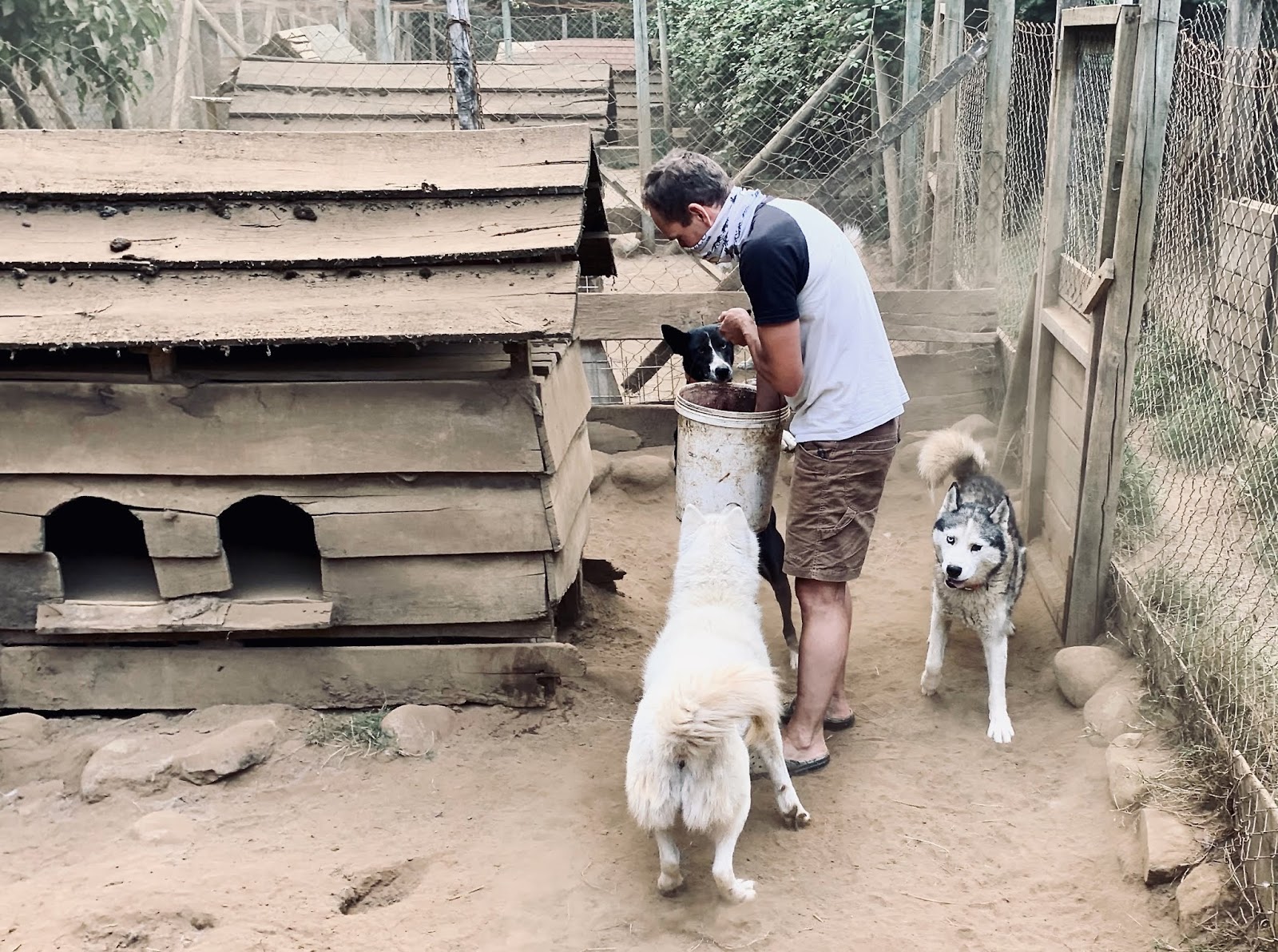
Feeding time at Aurora Austral, for just three of Konrad's 55 huskies
Instead, I continued to the lakeside town of Villarrica and, after a brief reconnoiter of the town, on to the Aurora Austral husky farm, where another Bavarian expat, Konrad Jakob, offers sledding trips in winter and carting trips in summer with his kennel of 55 huskies and a handful of mixes (full disclosure: I’m a devotee of northern dogs and have recently adopted a rescue husky, after four malamutes and one Akita). I spent two nights in one of Konrad’s cabañas, commuting to Villarrica to update practical information on the city. I only regret that I’ve never seen the area in winter, when I’d love to go mushing.
My cabaña accommodations at Aurora Austral
On the third day, I headed to Pucón, at the east end of Lago Villarrica, where I stayed at my long-time favorite Hostería Ecole, but there was an issue that aroused anxiety even before coronavirus entered the conversation. Some years ago, Chile fiddled with the regulations for non-residents crossing the border with their own Chilean vehicles. Were I unable to cross with my vehicle, it would be disastrous for my work.
Template for the declaración jurada that let me cross the border.
Fortunately, Hans and Verónica Liechti of Pucón’s Travel Aid agency had put me in touch with an American couple who own a house outside town and were in much the same non-resident situation. That couple had found an apparent loophole that allows such vehicle owners to leave the country so long as they obtain a notarized declaración jurada (“sworn declaration”) that they intend to return the vehicle to Chile. They’d done it several times and sent me a template for the document that I completed, printed out, and took to Pucón’s only notary public for verification.

When I Get to the Border…
Loretano is a worthy new Peruvian addition to Pucón's dining scene.
After three nights in Pucón, where I really enjoyed the new Peruvian restaurant Loretano (presently closed for the virus emergency), I headed east to the border at Mamuil Malal; I couldn’t completely contain my apprehension until, when I produced the declaración jurada, the Chilean customs official gave me a smiling thumbs-up. Entering Argentina was similarly routine, despite the presence of a list of various nationals subject to coronavirus quarantine but not—yet—US citizens. I got in under the wire, as that would happen a couple days later.
At the Mamuil Malal border crossing, Araucarias line the road, which passes through Parque Nacional Lanín.
Parque Nacional Los Arrayanes was presumably closed to hikers, but there was no  visible enforcement at Villa La Angostura.
The next few days were relatively routine, as I spent a night at Estancia Huechahue, two in San Martín de los Andes, and one in Villa La Angostura, where Argentina’s budding coronavirus precautions became more obvious. En route there had been evidence for concern, as I saw Argentines from a tour bus still sharing yerba mate, and many still greeting each other with kisses on the cheek—men as well as women. Argentina had closed all its national parks, though, and Parque Nacional Los Arrayanes—a popular hiking destination with an entrance in town, was supposedly off-limits (there were still people crossing the line into the park).
Probably now closed because of Argentina's widespread quarantine, the Bariloche tourist office was keeping  distance between its personnel and visitors.
Then I was headed to Bariloche—arguably Argentine Patagonia’s de facto capital, with the notion of continuing south to El Bolsón and Esquel, and then across the broad steppe to Puerto Madryn and Península Valdés. It was not to be, however, as I heard the next morning that Chile was about to close it land borders and, if I did not return before Wednesday, I would be unable to leave (and potentially unable to comply with my declaración jurada).

That information I heard second-hand but, for confirmation, I walked to the Chilean consulate—which was closed. Nevertheless, I rang the bell and, after a middling wait, was assured that US citizens like myself would be able to cross. I left almost immediately, returning via Villa La Angostura and thence to the border crossing described above. Before leaving, though, I managed to visit the new locale of Helados Jauja, arguably Patagonia's best ice creamery (the mother ship is in El Bolsón).
Helados Jauja has new quarters in Bariloche, with a secluded patio in the back.
When in Chile…
My accommodations at Zapato Amarillo were picturesque, comfortable and - in the current situation - socially remote.
After crossing the border, I headed to Puerto Octay’s Zapato Amarillo guesthouse, where the Swiss-Chilean couple Armin and Nadia Dübendorfer have hosted me many times over the years. On the outskirts of town, its stylishly rustic cabins were also an ideal place for self-quarantine, with nobody else about. I had considered staying several days, and perhaps even continuing to Puerto Varas, but after Armin and Nadia told me that international flights were being drastically reduced, I took their suggestion to drive to the city of Osorno and reschedule my April 29th departure for California. Otherwise, I would be spending nearly six weeks in Chile in virtual seclusion.
LATAM'S Osorno office switched my flight. It's a nice touch both the agent and the client can watch the computer screen.
Osorno’s about an hour away, but I was fortunate enough to find parking in the densely built downtown area, barely a block from the surprisingly small LATAM office (Osorno has an airport, but flights are fairly few). There were also few clients, so I quickly got seated and, though my preferred departure date from Santiago on Monday the 23rd was not available, the agent found me space for Tuesday the 24th. She first suggested the route via New York City, then with Delta to SFO, but having heard of huge delays at JFK immigration I chose to fly from Santiago to Mexico City, thence to SFO with Aeroméxico. Time will tell whether I’ve made the right decision, but I’m due home by 1 pm on Wednesday the 25th.

Then there remained the issue of getting back to Santiago, amid rumors there would be a toque de queda (curfew) at midnight. I returned to Puerto Octay immediately and packed my bags for the Chilean capital, a distance of roughly 970 km (about 600 miles) that I covered in 10-1/2 hours, with just two stops to fill the tank (plus some slowdowns for construction). I got to Marializ’s house at 11:30 p.m., just half an hour before the supposed curfew (that’s still not happened, though authorities are encouraging people to stay home). By then, with all apologies to Merle, I'd seen enough white lines for the day.

Here, until Wednesday, I’m in modified self-quarantine, taking short walks around the neighborhood  but avoiding contact with anybody—and making minimal purchases from the nearby shop. And writing stuff like this as, for the foreseeable future, we’ve had to suspend work on the new edition of Patagonia.

Thursday, July 11, 2019

This Year's Eclipse (and Next Year's?)

Chilean eclipse-chasers filled the beach at Caleta Los Hornos (photo by Marializ Maldonado)
I couldn’t attend last week’s solar eclipse in Chile but, indirectly at least, I had a sort of presence. When my longtime friend Marializ Maldonado, at whose house I often stay when in Santiago, asked to borrow my car to drive north to the Coquimbo region, I immediately said yes, and she was able to view the event at the beachside locale of Caleta Los Hornos, north of the city of La Serena.
In the minutes before totality, at Caleta Los Hornos (photo by Marializ Maldonado)
Partly, this was a favor to a friend, but it was also a favor to me, as it’s best not to leave a car unused for months, as I do by necessity in the outskirts of Santiago. Marializ also often does me the favor of paying my highway tolls as, for some incomprehensible reason, Chile’s online payment system does not want to accept my US credit cards (though I use them regularly when I visit Chile).
The Coquimbo region is home to major international observatories such as Cerro Tololo (CTIO), part of the US National Optical Astronomy Observatory.
Marializ arrived just five minutes before totality, which she described as “two intense and beautiful minutes” on the Pacific shoreline. The most vivid account I’ve read, though, came from the New York Times, whose “52 Places” columnist Sebastian Modak saw the event from the European Southern Observatory at La Silla—also pointing out that this was only the third eclipse to pass over a major international observatory in the last 50 years.

The eclipse turned out to be an economic bonanza for the region. According to the local daily El Observatodo, the event attracted more than 300,000 people over five days, and those visitors spent more than US$82 million. Many if not most arrived by private car, presumably from Santiago as Marializ did, but there were also numerous foreign eclipse-chasers. Plenty of people also witnessed it from the Argentine side of the border, though cloud cover obscured things in Buenos Aires.
Path of next year's eclipse
There's no guarantee of clear weather as next year's eclipse passes over Volcán Villarrica.
For Chileans and others who missed this year’s eclipse, there’ll be another chance soon enough. On December 14th of 2020, the moon will once again block the sun in the southern lakes resort district around Lago Villarrica and the town of Pucón, but that area’s marine West Coast climate—resembling Seattle’s—mean that clear skies are no sure thing. A few years ago, some friends and I planned to do a small plane flyover of Volcán Villarrica’s steaming crater but, after several days of fine clear weather, the clouds moved in the next morning and made the flight impossible. Across the Andes, where Argentina’s Patagonian steppe usually has clear skies, could be a better option.
Next year, the rain-shadow steppes of Argentina's Neuquén province might be a better place to observe totality.

Saturday, May 18, 2019

Chasing Chile's Eclipses...Across the Andes, Perhaps?

Many times I’ve visited north-central Chile’s desert regions—Coquimbo, Atacama and Antofagasta—which are home to some of the world’s most important astronomical observatories. There is also a constellation of smaller community observatories that offer visitors a chance to see the austral night skies through what, not that long ago, would have been professional telescopes.
The clear skies around Cerro Tololo Observatory (upper left here) an ideal for astronomy.
Combarbalá is one of many town and cities eagerly anticipating July's eclipse.
That said, I’ve never seen a solar eclipse there or elsewhere in South America, even though Chile (and Argentina) experienced major events in 1994 and again in 2010. There’ll be another opportunity soon, though, in the best of all possible areas—on July 2nd, the path of totality will pass directly over the city of La Serena and the Coquimbo region, home to Cerro Tololo and several other observatories. Even area beyond totality expect to take advantage of the event, as I learned last month when I visited the town of Combarbalá, which lies just south of the path.
The July eclipse's path takes it over the Coquimbo region and into Argentina's San Juan Province.
On the Argentine side, totality will pass over the Humid Pampas and just south of Buenos Aires, but winter weather could obscure the event.
From Coquimbo the path then trends southeast, crossing the Andes to the Argentine province of San Juan—another ideal viewing location for its clear desert skies—and continuing toward Buenos Aires. The eclipse will not be total in the Argentine capital, though it will be—theoretically at least—in parts of Buenos Aires province. Theoretically, I say, because that part of the Humid Pampas has a good chance of heavy cloud cover and rain in mid-winter. The skies will darken, certainly, but there’s no guarantee of seeing the moon cover the sun.

Either way, I won’t see this year’s eclipse because I’ll be in California and, in the days leading up to it, we’ll be hosting our Argentine nephew Manuel, his wife Ivana, and their son Simón. They’re flying back to Buenos Aires on July 1st, and I’m not sure whether they’ll arrive in time for the big event. I suspect that a lot of Porteños will leave the city, if just for the day, to spend some time in totality, especially if the weather seems likely to cooperate.
The map here indicates the 2019 eclipse coverage at various locations throughout Chile.
The map here indicates coverage during the 2020 eclipse. 
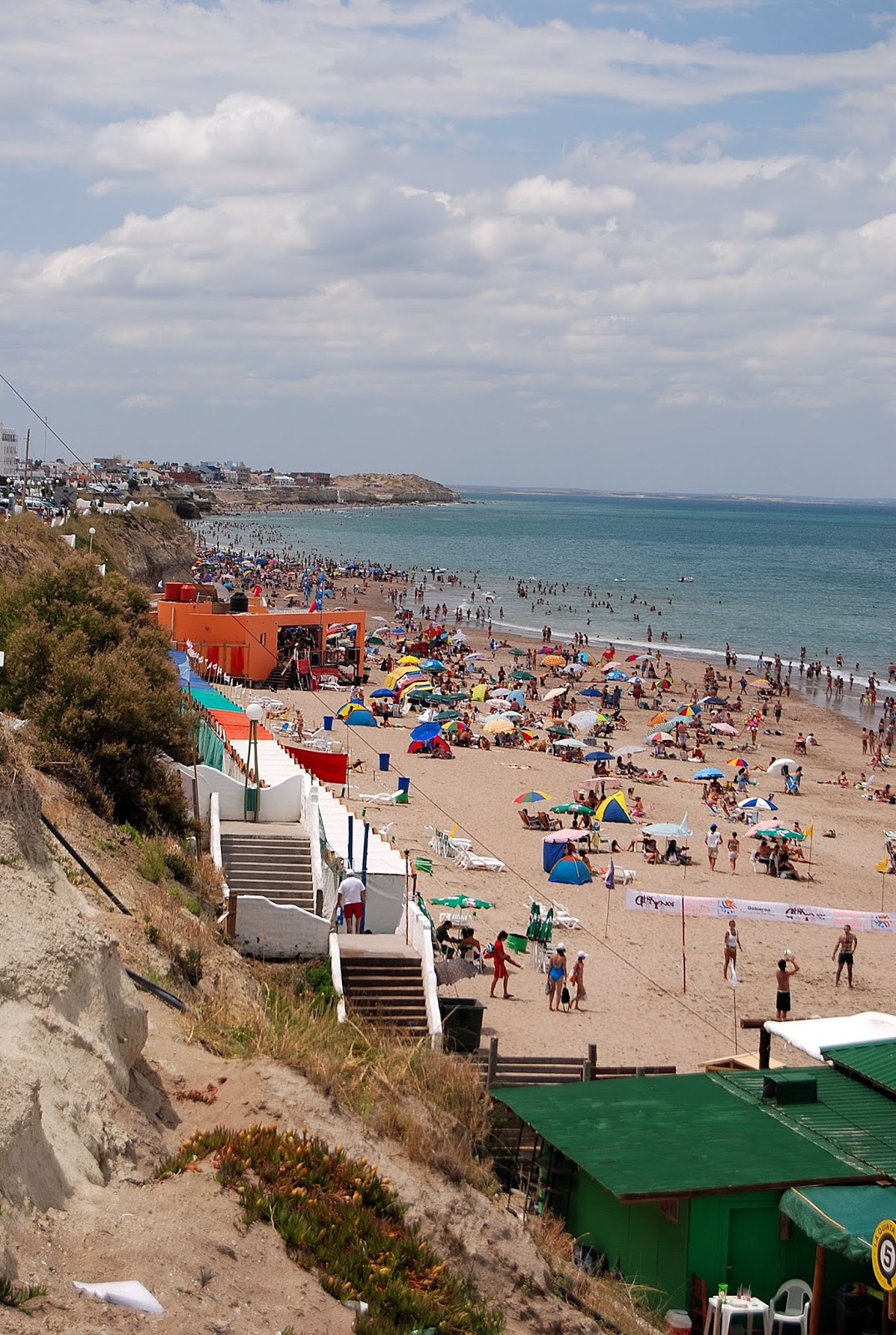
Even if you (or I) won’t see this one, there’s another upcoming opportunity. On December 14, 2020, Chile will experience another total eclipse in the southern mainland region of La Araucanía, passing over the prime tourist towns of Pucón and Villarrica. The downside is that, like the Pacific Northwest, this area enjoys a marine west coast climate that can bring cloud cover and drizzle at any time of year. It might be better seen in Argentine Patagonia, as the rain shadow of the Andes usually means clear skies on the sprawling steppes. It can get windy there, though, so the beach resort of Las Grutas might be the comfiest option.
For the 2020 eclipse, it won't quite be high season at Las Grutas.

Saturday, October 6, 2018

Backroads Lakes of Chile

Chile’s Benjamín Subercaseaux famously described his country’s territory as “a crazy geography,” just as British author Sara Wheeler recounted her experiences there in Travels in a Thin Country between the Pacific Ocean and the high Andes. For much of the country’s history, travel has been a unidirectional venture, with few alternatives by sea, train or road—rather different from Argentina, where there’ve been multiple routes suitable for road trips.
Lago Llanquihue at Puerto Varas, the southern starting point for this road trip.
This occurred to late last year, when a New York reader wrote me about an upcoming literary trip to Chile—his book club takes it on the road—and asked me for recommendations for a trip between Puerto Varas and Pucón that would avoid the Ruta 5 freeway, the quickest (but least interesting) route between the two resorts.
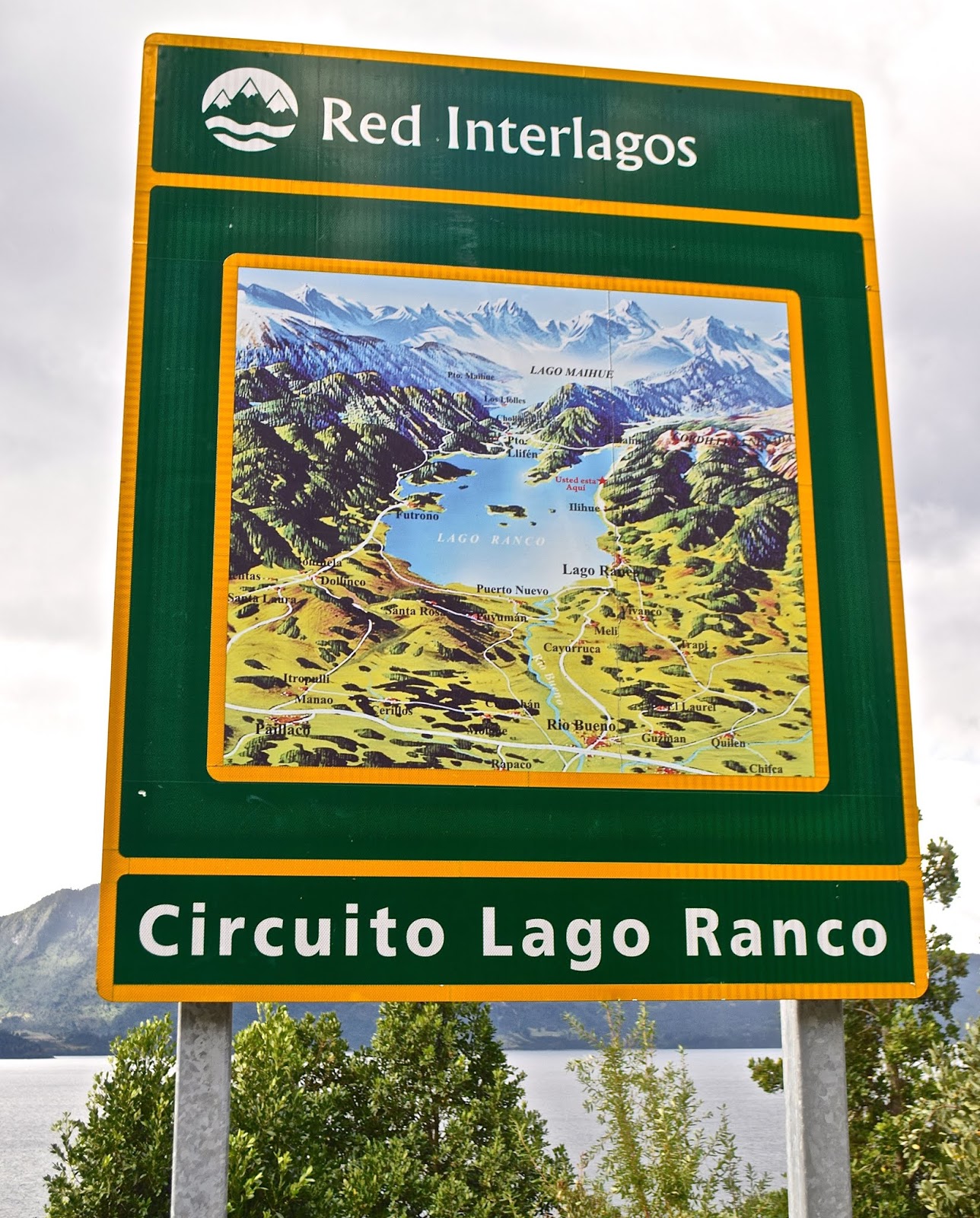
New highway signs mark the Red Interlagos.
Not so long ago, that wouldn’t have been possible but, in recent years, the Chilean government has linked and improved a series of roughly parallel easterly roads that provide a more scenic alternative along the lakes of the Andean front range. The Red Interlagos stretches from the town of Inspector Fernández, north of Temuco, south to the village of Puelo, southeast of Puerto Montt. I recommended an itinerary to my client and, when I next returned to Chile, I decided to follow the route—more or less—myself. It bears mention that the Interlagos is not a single highway, but a network of interconnected routes that pass through smaller towns and villages, not all of which are resorts, so there are multiple options.
Roadside frontage of the Hotel Awa
My client started in Puerto Varas and so did I, spending a couple nights in the new design Hotel Awa, a multi-story concrete, glass and girder structure on the city’s eastern outskirts. With views over Lago Llanquihue to the perfect cone of Volcán Osorno, it’s the area’s most technologically sophisticated hotel, but with rustic touches such as hiding the TV in an old steamer trunk at the foot of the bed. At night, I dined on truffled pork loin, complemented by a barley-based risotto from its own vegetable garden and garnished with a hazelnut sauce.
Grounds of the Museo Colonial Alemán, Frutillar
From Llanquihue’s south shore, there are two ways north, on the west side via Frutillar or the longer east side route via Ensenada. At the former, there’s the remarkable Teatro del Lago and the outstanding Museo Colonial Alemán, a tribute to German colonists that reminds me of in situ museums in Scandinavia.
A cycling event on the easterly route along Lago Llanquihue, beneath Volcán Osorno 
Puerto Octay, on Lago Llanquihue's north shore
I chose the longer route, which offers a detour up to the volcano’s ski area, which is open for hikers in summer, and then proceeded to picturesque Puerto Octay, a small north shore town with a metal-clad church and turreted houses that evoke Mitteleuropa. On Octay’s outskirts, my choice for the night is Hostal Zapato Amarillo, a Swiss-Chilean B&B with sod-roofed cabins, personalized attention, and fine dinners.
Hostal Zapato Amarillo is a cluster of sod-roofed guest rooms just outside Puerto Octay.
Hotel Termas de Puyehue is one of Patagonia's grand hotels.
For my client, though, I recommended continuing to Hotel Termas de Puyehue, a classic grand hotel at Parque Nacional Puyehue, about an hour north of Octay on the highway that runs from Villa La Angostura to Osorno. For visitors coming from Argentina, this sprawling hot springs hotel, with nearby hiking trails, makes an ideal overnight or multi-day stay in what may be the closest analogue to Bariloche’s Hotel Llao Llao. Along this highway, there’s still abundant evidence of the 2012 Puyehue-Cordón Caulle eruption that covered much of the area in ash.
Volcanic ash still covers parts of the shoulders along the highway between Argentina and Chile.
North of Entre Lagos, parts of the route are still unpaved but being improved.
I didn’t stay at the Puyehue this time, instead heading north through the town of Entre Lagos toward Lago Ranco, a lesser visited destination in the heart of Mapuche country. Along this segment, the Interlagos road signs say “Norpatagonia,” and, on a gravel surface with signs of improvement, muddy potholes splashed water onto my windshield. As I approached the south shore town of Lago Ranco, I could spot Isla Huapi, an offshore island inhabited almost exclusively by Mapuches.
The route around Lago Ranco is completely paved.
Here, in an area far more popular with Chileans than foreigners, I stopped for a sandwich before continuing east along a smooth paved road with plenty of scenic overlooks. The last time I had visited, a cable barge was the only means of crossing the Río Nilahue, but now modern bridges ease the route around the densely forested east side to the north shore town of Futrono. Here, almost opposite San Martín de los Andes, I spent the night at the Cabañas Nórdicas, a cluster of spacious and seemingly Scandinavian structures on a bluff overlooking the lake.
Sunset over Lago Ranco from my accommodations at Futrono
North of Futrono, the route’s a bit better trod, approaching the Ruta 5 town of Los Lagos but then veering northeast to Panguipulli, the entry point to a “Siete Lagos” route that resembles Argentina’s in Río Negro and Neuquén. Panguipulli fancies itself the "City of Roses" for its gardens at the east end of its namesake lake, but the area’s big attraction is its hot springs resorts. My client raved about the Zen-inspired Termas Geométricas—an isolated canyon of waterfalls, creeks and naturally heated pools linked by boardwalks near Coñaripe that’s open for day visits only—in the shadow of the fuming Volcán Villarrica.
The Termas Geométricas is a secluded hot springs venue south of Pucón.
Volcán Villarrica, as seen from Pucón, on the opposite side of Termas Geométricas
After a leisurely day at the Termas Geométricas, nearby accommodations options include the
Termas de Coñaripe—a hot springs hotel in its own right—and the town of Lican Ray, with its black sand beaches at Lago Calafquén. Termas Geométricas, though, gets many day-trippers from Pucón, the uber-resort city that’s just over the hill (mountains, that is) on Lago Villarrica. There, the place to stay is the hillside Hotel Antumalal, a Bauhaus-inspired masterpiece that, arguably, set the stage for Varas’s Awa. Still, there are many cheaper but still outstanding options here, and great hiking in spots like Parque Nacional Villarrica, Parque Nacional Huerquehue, and the Santuario Cañi, a private conservation effort aimed at protecting the area’s Araucaria forests.
Queen Elizabeth II and other big names have stayed at Pucón's Hotel Antumalal.
At Parque Nacional Huerquehue, the Sendero Quinchol leads to dense upland forests of Araucarias and southern beeches.
For visitors from Argentina, it’s easy to return by the Paso Mamuil Malal to Junín de los Andes and thence to Buenos Aires or back to Bariloche. The road goes on forever.
Custom Search