Showing posts with label Valparaíso. Show all posts

Thursday, April 15, 2021

A Long Petal of the Sea (Book Review)

In 1939, as the Spanish Civil War wound down, thousands of refugees fled across the border into France—which then confined tens of thousands in a deplorable detention camp at d'Argelès-sur-Mer. In partial response, poet Pablo Neruda—also a diplomat—chartered the French cargo vessel Winnipeg to carry 2,200 Spanish refugees across the Atlantic and through the Panama Canal to his homeland of Chile where, despite isolated episodes of xenophobia, they integrated themselves into local society.

Chartered by Pablo Neruda, the French freighter Winnipeg carried Spanish refugees to Chile.

That’s the historical background for Isabel Allende’s latest novel, A Long Petal of the Sea, which becomes a tale of exile and adaptation that includes several larger-than-life figures, most notably Neruda himself but also the late President Salvador Allende (Isabel’s father’s cousin) and the notorious Augusto Pinochet (mentioned only in passing). Some characters are fictionalized versions of historical figures, such as pianist Roser Bruguera, clearly based on the painter Roser Bru (who turned 98 in February).

Isabel Allende's novel focuses on one exceptional refugee family.

Bruguera is one focus of a complex family story that melds with an equally complex political history that involves her going into exile, with her husband Víctor Dalmau, from Pinochet’s dictatorship. Allende is especially good at depicting the intrigues and obstacles her characters must navigate, including neighborhood informants, imprisonment, intra-familiar conflicts that tore many Chileans apart, and the disruptions of exile.

The first Spanish refugees would have passed through Arica's customs house (now a cultural center).

Being a geographer, I try to be alert to people and place, and I found one unfortunate error. I expected that, after the Winnipeg passed through the Panama Canal, it would go directly to Valparaíso, whence the refugees would proceed to Santiago and elsewhere in the densely populated heartland. As it happened, though, the ship made a stop in the northern port of Arica, a city I know well, where Chilean officials met the vessel and some of the passengers came ashore to stay.

The nitrate port of Pisagua was the northernmost point on Chile's contiguous rail network.

Allende, though, claims the officials arrived by train, but the northern Chilean railroad network, developed to help exploit the Atacama Desert’s nitrate deposits, never reached Arica—the most northerly major station was in the port of Iquique, roughly 200 km to the south (though there was a smaller station in the nitrate port of Pisagua, only about 125 km to the south). It might have been possible to reach Arica by rail at this time, but that would have involved a roundabout route via Buenos Aires and slow trains to northwestern Argentina and then Bolivia, where the Ferrocarril Arica-La Paz connected the two countries. Given the time, distances, and often contentious relations between Bolivia and Chile, it’s unlikely that anyone would have taken this route and, as it happens, there were flights from Santiago to Arica as early as 1929.

Oficina Chacabuco was the camp where Víctor Dalmau was presumably imprisoned. 

Allende describes, but does not specifically identify, the location where her protagonist Dalmau “ended up at a camp for saltpeter miners in the north that had been abandoned for decades and was now converted into a prison.” That description fits Oficina Chacabuco, about 100 km northeast of the port city of Antofagasta, which is now a national monument and in situ museum that I’ve visited several times. She also offers a plausible description of the Dalmaus’ ostensible rural retreat, outside Santiago, when they return from exile in Venezuela.


All in all, Allende’s novel is a rewarding read that provides an insider’s view of refugees, immigrants, and the contributions they make to their new countries—with lessons for countries still including Chile and, of course, the United States (where Allende now makes her home).


Monday, November 18, 2019

Monday Musings - Mar del Plata, Money and Baseball

Today’s entry will be a potpourri about Argentina and sports. It ranges from the serious (the effect of Argentina’s Dirty War on my wife’s family) to the utilitarian (money and exchange rates) to the whimsical (my own tenuous link between baseball and Patagonia).

Southward Bound
Maru Sanllorenti's hometown of Tandil
As I prepare to head to Buenos Aires, early next month, my wife María Laura Massolo and our daughter Clío are already there (but will return to California before I leave). Their trip is partly vacation but also a family mission, as the remains of my brother-in-law’s first wife—a victim of Argentina’s 1976-83 military dictatorship—have been transferred from her hometown of Tandil to a new Panteón de la Memoria (Pantheon of Memory) in the Cementerio de La Loma in the coastal resort city of Mar del Plata.
My brother-in-law's first wife disappeared shortly after giving birth in 1976.
Maru's mother Eva and son Manuel at Mar del Plata's Panteón de la Memoria (photo by María Laura Massolo)
Abducted on the street in the Buenos Aires Province capital of La Plata in 1976, Maru Sanllorenti is survived by family members that include her mother Eva (now aged 94) and her son (my nephew) Manuel (now 43), who was an infant when she disappeared. My wife accompanied her brother Carlos (Manuel’s father) to Mardel for the ceremony there, then returned almost immediately to Buenos Aires, where Clío arrived on Friday. Yesterday, both of them attended a talk that Manuel regularly gives to visiting tour groups at the city’s Parque de la Memoria, which includes a commemorative plaque with his mother’s name.
Manuel Massolo (right) recounts his mother's story to visiting US tourists at the Parque de la  Memoria.
Money Matters
I haven’t been to Argentina since last year and, consequently, my recent information on exchange rates, prices, and transactions has been mostly second-hand. Since last month’s elections, though, exchange rates have remained relatively stable, and my wife informs me that a fine Peruvian dinner for three at downtown’s Chan Chan cost about US$10 per person, including three entrees plus a beer per person. It’s not an elite restaurant by Buenos Aires standards, but that’s still excellent value.
Our neighborhood cueva, on Palermo's Cabello street, was closed on the weekend.
Changing money, though, always requires reorientation. Bank lines are long, exchange houses are mostly downtown, and there’s still a difference between formal and blue (informal) rates. The difference isn’t huge, though, and the informal exchange houses known as cuevas are fewer than they once were. My wife has used the one near our apartment in Palermo, which remains open, but Dan Perlman of Casa Saltshaker informs me that street changers have taken over the business near his apartment (including the weekend’s Plaza Francia crafts fair outside the Cementerio de la Recoleta). Street-changing, of course, holds potential risk for the inexperienced—not the least of which is counterfeit currency.

It’s possible to change at ATMs, but that has its own issues—on the weekend, when our neighborhood cueva was closed, my wife paid a bank charge of US$10 to withdraw approximately US$50 from the machine. I’m not sure what the maximum withdrawal is at the moment, but it’s almost certainly low by international standards. In Chile, I regularly withdraw the equivalent of US$300 per transaction, but Argentina has been roughly half that—making the service charge a true burden.

Baseball and Patagonia
I love baseball and, for decades now, I’ve enjoyed saying that I leave for South America after the World Series and return in time for Opening Day. This year, I’m still stateside, through two weeks without baseball, but I’m looking forward to being back in Buenos Aires (where I’ve played the game myself) in another fortnight.

Actually, the month of October was a big disappointment, as my own Los Angeles Dodgers fell to the mild card (sic) Washington Nationals in the National League Division Series, and I didn’t pay a lot of attention the subsequent rounds or the World Series itself. The Dodgers were clearly the NL’s best but, as they say, anything can happen in a short series. Of all major sports, baseball is probably the likeliest for a lesser team to prevail—there’s really no such thing as an upset.
The top three finishers in the National League's Most Valuable Player voting
Last week, though, the post-season individual awards drew my attention because of a friendly rivalry with my Wisconsin-born but Chile-based friend Todd Temkin, who’s a diehard Milwaukee Brewers fan (his Cerveceros lost to Washington in a one-game playoff for the right to meet the Dodgers). Todd (who splits his time between Valparaíso/Viña del Mar and a farm in Futaleufú) and I disagree on who’s the NL’s best player; his choice is Milwaukee outfielder Christian Yelich, while mine is LA’s versatile outfielder/first baseman Cody Bellinger.
Dinner will probably take place at Futaleufú's Martín Pescador.
Hand-written menu at Martín Pescador
On one level, that’s a subjective judgement, as they’re both elite players, but Todd suggested that we place a bet on the Most Valuable Player award, “given to a player in each league who has contributed the most to the success of a player’s team,” according to the Baseball Writers Association of America. Depending on which player scored most highly in that poll, the loser would treat the winner to dinner—probably at Futaleufú’s Martín Pescador, with its frequently changing menu.
On my last visit, I enjoyed gnocchi with morels...
and a cheesecake for dessert.
As it happened, Bellinger edged out Yelich for the award, while Anthony Rendón of the champion Nationals came in a respectable third (the vote takes place at the end of the regular season, so the Nationals' playoff success was not a factor here). I’m looking forward to that meal, probably in March, when I’ll be updating Moon Handbooks Patagonia there. If Todd’s not around at that time, though, it could happen in Valparaíso or nearby Viña.

Friday, November 1, 2019

Patagonia's Adventure Connect(ion) in San Francisco

Last week, I attended a promotional event for Chilean Patagonia in the Adventure Connect series, organized by the Adventure Travel and Trade Association (ATTA). At a time when Chile’s undergoing political upheaval, the occasion brought the Magallanes regional representative of Sernatur, the national tourism secretariat, and representatives of several different operators to San Francisco as part of a national promotional tour.
The setup at San Francisco's Hotel Zetta
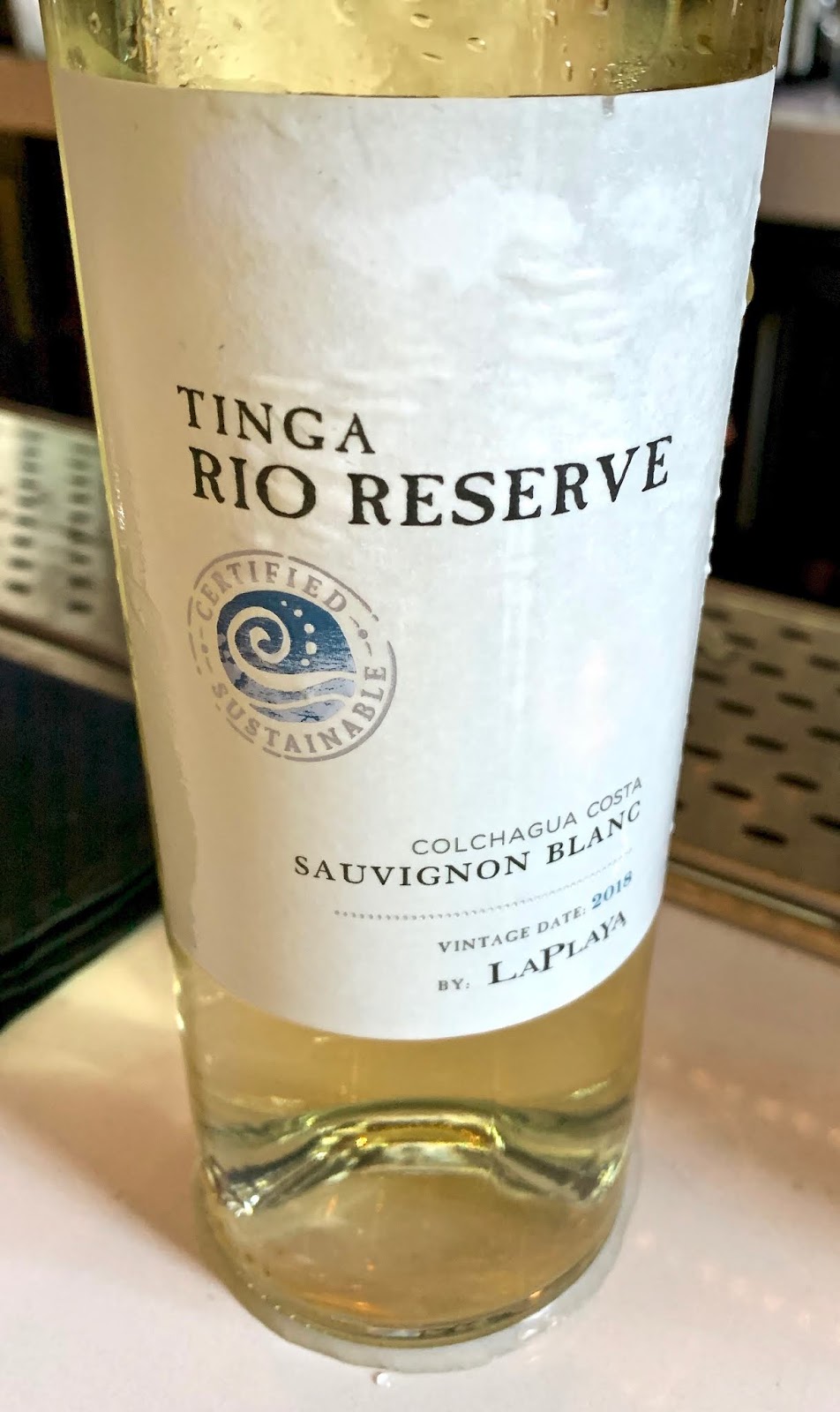
The event took place in the lobby of Hotel Zetta, where eight different operators were to discuss their services with Bay Area travel companies and invited writers (of whom I was one). The format was a sort of musical chairs in which each operator met with one or more attendees for eight minutes before a timer sounded to move elsewhere. This went on for 2-1/2 hours, with a coffee break that included a giveaway raffle, before adjourning to a conference room for a presentation by Sernatur’s regional director Ximena Castro that was probably most useful to those with less experience than mine in the region. Later, there was a Chilean social hour that included snacks and one of the finest Sauvignon Blancs I’ve ever tasted—especially welcome on an unusually hot San Francisco day.

Ximena Castro addresses the attendees.


The Chileans brought this Sauvignon Blanc along with them and, so far, I've been unsuccessful in finding it stateside.
Originally, eight different operators—some of whom I already knew—were to attend the event. In the aftermath of the recent upheavals in Santiago, though, the representatives of Antarctic Airways—with whom I would have liked to discuss their updated services—and Lago Grey - Experience Hotel were unable to get flights out of Santiago. I already knew the owners of Big Foot Patagonia Adventure and the representative of Vértice Patagonia (operator of mountain huts on the famed Paine Circuit, plus a new boutique hotel in Puerto Natales), and was familiar with Antártica 21  and Australis Cape Horn & Patagonia (both of whom sent US-based representatives). New to me were the Chile Nativo adventure operator and HD Hotel Natales (the rebranded Hotel Cisne de Cuello Negro) in Puerto Bories.

The not quite unspoken topic that permeated the meeting was what effect Chile’s recent political disruptions and disorder might have on the upcoming season. There was certainly concern, but also consensus that the Región Metropolitana de Santiago and the coastal region of Valparaíso would be more directly hit than remote Magallanes. That said, cruise ship and hotel cancellations would certainly affect a city like the regional capital of Punta Arenas, which has seen some demonstrations. I recently saw an online story—can’t find the link now—whose headline spoke of “80 percent cancellations” in Chile, but what the story actually said was that 80 percent of hotels and other services had experienced cancellations (which could have been just a single cancellation each for some).

That’s not to dismiss the issue of vandalism and disorder by a destructive fringe, even as the great majority of demonstrations have been peaceful, but President Sebastián Piñera’s embattled government has cancelled the upcoming COP climate conference (at which Swedish activist icon Greta Thunberg was due to appear and also the Asia-Pacific Economic Cooperation summit.

Personally, I would not hesitate to travel to Santiago, Valparaíso or elsewhere in Chile at present, even though I’d advise those with little or no experience of the country to be on alert. In a recent newsletter, the private Federación de Turismo de Chile cited the Subsecretaría de Turismo to the effect that  “our tourism continues to function throughout the country and the most popular destinations visited by international tourists, such as San Pedro de Atacama, Elqui Valley, the islands of Rapa Nui [Easter Island] and Juan Fernández [Robinson Crusoe], the Chilean Patagonia and Torres del Paine National Park, are operating with normality.” Aeropuerto Internacional Arturo Merino Benítez is back to normal, but visitors would still do well to have travel insurance in case of disruption.

And the Money?
For foreign visitors, there may be a bright side to all this. About two months ago, the last time I wrote about exchange rates, both the Argentine and Chilean pesos were slipping against the US dollar, and that has continued with the upheaval in Chile and the recent election in Argentina, when the Peronist Alberto Fernández defeated the incumbent president Mauricio Macri.
The Dólar Blue Hoy app is a useful addition to one's smartphone.
The so-called “markets” (and many individual Argentines) have little confidence in Peronism and, consequently, Argentina’s Banco Central (Central Bank) has reinstituted a cepo cambiario (“currency clamp”) that restricts Argentines’ overseas ATM advances to US$50 per transaction (oddly, it puts no restrictions on the number of transactions per day, but those ATM charges could really add up. Meanwhile, individual Argentines can now officially purchase no more than US$200 per month, a measure that seems to be encouraging the informal dólar blue (visitors to Argentina might consider downloading the Dólar Blue Hoy app, pictured here, on their smartphones). Exactly this will develop as the Macri administration gives way to Fernández remains to be seen, but it seems likely that the informal exchange rate will benefit tourists in the short to medium term.
Chile's peso has also slipped against the US dollar and some other currencies.
In Chile, meanwhile, the peso has dipped to 740 per dollar, a fall of roughly three percent since August. This may affect prices slightly, but if foreign visitors avoid the country because of the perception of instability, services such as hotels and tour operators may drop their prices. In any event, matters are less predictable than they seemed even a few months ago.


Monday, October 21, 2019

Chaos in Chile?

In 1978, when I first traveled to Chile—then under the dictatorship of General Augusto Pinochet Ugarte—there was an 11 p.m. curfew in the capital city of Santiago. That put a dent in the city’s commerce and nightlife—though young people adapted with parties that lasted until dawn—and, of course, its political life. Not so widespread in the provinces, the curfews gradually gave way and, since the return to democracy in 1990, Santiago’s been a 24-hour city.
Chile's capital as seen from the hills of Parque Metropolitano
Or at least until last Friday, when all hell broke loose in apparent response to a relatively modest increase in Metro subway fares. Starting as a social-media encouragement of fare evasion, it escalated into a wider disorder that involved arson, looting and then declaration of a state of emergency by President Sebastián Piñera. According to Guardian correspondent John Bartlett (a personal acquaintance of mine), “[T]he headquarters of Italian energy company Enel were engulfed in orange flames as the sounds of helicopters and wailing sirens filled the night sky.”
President Piñera's initial statement on the events in Santiago.
In truth, the discontent is far more than just transport fares, as many if not most Chileans have struggled with dictatorship’s legacy of hyper-privatization on issues like health-care and old-age pensions, even as the country has become—on paper at least—the continent’s most prosperous on a per capita basis. Income distribution, though, is wildly skewed in favor of the very wealthiest—many of them in Piñera’s cabinet.
This stenciled mural in the borough of Quinta Normal suggests the inequalities of contemporary Chile.
Certainly there was need to restore order, but the tone-deaf Piñera made it worse by stating, publicly, that “We are at war...” and sending troops and tanks into the streets. That evoked unwelcome memories of the Pinochet years, even though Piñera himself supported the plebiscite vote that ended the dictatorship in 1990. Speaking more diplomatically, the general in charge of security in Santiago seemed to contradict him in saying that “I’m not at war with anyone.”

Santiaguino friends with whom I’ve been in contact have offered useful perspective on this. Marializ Maldonado, who lives in the working-class borough of Renca, wrote me on Saturday that “We were in the Plaza de Renca, with lots of protestors everywhere. Incredible and unexpected. After a group tried to loot a supermarket, [the authorities] dispersed us with tear gas.” She then went home.

Martín Maldonado (no relation to Marializ), who lives in the middle- to upper-middle class borough of Ñuñoa and teaches at the Universidad de Santiago, forwarded me a brief video of a peaceful cacerolazo (pot-banging protest) there. He suggested that there are two separate issues: One is “a movement that rejects economic policies and claims in favor of health, utilities, salaries and transport.” There’s an incisive analysis of these issues by political scientist Patricio Navia in Americas Quarterly.
Curfews have expanded beyond Santiago.
On the other hand, says Martín, “there’s a covert movement that loots supermarkets, shops, public buildings, buses and the Metro, and then burns them.” The university is closed until at least Wednesday, and the curfew now extends from 8 p.m. to 6 a.m. According to the Metro de Santiago website, the city’s subway system has suffered some US$200 million in damages.

Friends outside Santiago tell similar stories. Christián Guntert, a German who teaches at the Universidad Católica in Valparaíso, was returning from a field trip with ecotourism students when he found the roads blocked with burning tires and had to walk into town. There he saw burning shops in the commercial downtown, with firemen and policemen attempting to restore order. Todd Temkin, an American who’s lived nearly 30 years in Valpo and Viña del Mar, said “they burned a couple of supermarkets, a car dealership, and the Cathedral. Lots of looting. Also quite a bit of looting in downtown Viña.” He was, he told me, “heartbroken.”

The Impact on Tourism?
Curfews are expanding to other cities, but I did find one exception to the chaos. Andreas La Rosé, a German who operates the Casa Azul guesthouse in tourist-friendly Puerto Varas, said “Everything is calm, just all supermarkets are closed.” Prosperous Varas may have been spared the destruction, at least to this point, but he worries about how this might affect the upcoming tourist season.

Chilean operators, of course, are hoping against hope that everything remains calm, but there’s certainly concern. While attractions like Torres del Paine are likely to remain so, getting to them through the capital and larger regional cities like Punta Arenas could be problematic. This is a matter that’s likely to come up tomorrow (Tuesday the 22nd), as I attend AdventureConnect San Francisco, an event where many operators from the Magallanes region will be present. I already know several of them, and I’m hoping they’ll be candid about the upcoming season.

Monday, July 27, 2015

Patagonia to Hollywood? The José Bohr Story

When contemplating Patagonia, not many people think of the movies – even though there’s a surprising assortment of films about the region, some of which I’ve already covered in this blog. For the moment, though, I’d like to bring up the origins of Chilean cinema, which owe a great deal to its remotest region.
In the town of Porvenir, across the Strait of Magellan from the regional capital of Punta Arenas, the renovated local museum exhibits vintage film-making equipment (pictured above) and pays tribute to German-born José Bohr (born 1901, pictured below), who came south as a child and started his career by filming local newsreels. From his first newsreel in 1919, his career spanned half a century, ranging from Tierra del Fuego to New York, Hollywood and Mexico.
Bohr’s first major effort, El Desarollo de un Pueblo (The Development of a People, 1920), also known as Magallanes Ayer y Hoy (Magallanes Yesterday and Today), coincided with the 400th anniversary of Magellan’s voyage to the Strait that now bears his name. Having ordered his cameras other gear from Valparaíso by telegram, the audaciously named “Bohr & Ivovich Patagonian Film Company” persuaded local dignitaries to subsidize the project.
In the process, he and his partner Esteban Ivovich went everywhere in the region including the “extraordinary Fuegian fjords, the glaciers, the ranches, and the mansions of the moneyed.” Among those moneyed was José Montes, who occupied an elaborate home (pictured above) – now housing municipal offices – that still adorns Punta Arenas’s central Plaza Muñoz Gamero. Bohr shot the arrival of many visiting dignitaries, including Prince Ferdinand of Bavaria representing the Spanish King Alfonso XIII. The prince was there for the dedication of the Plaza’s monument to Magellan (pictured below), and the film attracted nation-wide attention.
Bohr, though, soon went to Argentina and then Broadway to act in musicals, and then starred in Hollywood’s first Spanish-language film, Sombras de Gloria (Shadows of Glory) in 1929. In the early 1930s, he went to Mexico and then returned to Chile a decade later, where he became president of Chilefilms, a state-run company eventually privatized in the late 1980s.


Some of Bohr’s later work is available on Youtube but, unfortunately, the early newsreels are not. Still, as a composer, he wrote a hymn to the city of Punta Arenas, where the Teatro Municipal José Bohr remains a testament to his influence in Patagonia and beyond.

Monday, June 15, 2015

What Time Is It? Chile Declines To Reset Its Clocks

In less than a week, the northern hemisphere’s summer solstice will bring the longest day of the year – in Northern California, where I am spending the season, sunrise will occur at 5:47 a.m. Pacific Daylight Time and sunset at 8:34 p.m. A hemisphere away in Chile, though, things will be very different despite the current government’s measure to institute daylight savings time throughout the year – presumably to reduce energy consumption in a country that still imports nearly all of its fossil fuels.
Whether daylight savings time is actually an energy saving measure is debatable, but the general topic is interesting here. Personally, while traveling in Chile, I’ve always preferred daylight savings because I could get breakfast earlier, with more daylight to explore the cities and the countryside (some accommodations will not serve breakfast until 9 a.m.) while researching my books. Also, because of the country’s string-bean geography, it consists of a single time zone (with one notable exception), so that daylight hours vary dramatically in different parts of the country.

Traditionally, daylight savings started in December and ended in March (in time for the new school year), but it’s gradually expanded. Now, with uniform time throughout the year, this morning’s sunrise in the coastal city of Valparaíso – whose landmark clock tower the Reloj Turri appears above – was at 8:46 a.m., with sunset at 6:47 p.m. Valparaíso’s latitude is roughly comparable to that of San Francisco.
Farther north, though, it’s a rather different story because, in subtropical latitudes far closer to the Equator, the length of day varies little throughout the year. Today’s sunrise at the remote settlement of Pisagua – a tiny seaside community that was once a thriving nitrate port – was at 8:11 a.m., with sunset at 7:10 p.m. The structure above is Pisagua’s own historic clock tower, though the clock itself no longer functions.

By contrast, in the southern city of Punta Arenas, this morning’s sunrise did not take place until 9:55 a.m., with sunset at 5:33 p.m. At a latitude comparable to British Columbia’s Moresby Island, Punta Arenas enjoys long summer days but, at this time of year, children are arriving at school well before daybreak. Today, the modest clock outside the city’s Muelle Prat commercial pier is probably covered with snow.
For most visitors, Chile’s time change has one big advantage. I’ve written before on the jetlag issue when traveling to southernmost South America, and this changes things a bit, for the better. Effectively, Argentina and Chile are now in the same time zone – four hours behind GMT or UTC – which will simplify scheduling on trips that require border crossings. It also means that, when most of the United States is on daylight savings time from early March until November, Argentina and Chile will be on the same schedule at the US East Coast. Though it may still be a long overnight flight from anywhere in the US, that eliminates or at least reduces the jetlag problem.

Of course, there remains that one exception I mentioned above. Chile’s Pacific outlier of Easter Island (pictured above) is five hours and two times zones west of the South American mainland.
Custom Search