Showing posts with label Parque Nacional Puyehue. Show all posts

Saturday, October 6, 2018

Backroads Lakes of Chile

Chile’s Benjamín Subercaseaux famously described his country’s territory as “a crazy geography,” just as British author Sara Wheeler recounted her experiences there in Travels in a Thin Country between the Pacific Ocean and the high Andes. For much of the country’s history, travel has been a unidirectional venture, with few alternatives by sea, train or road—rather different from Argentina, where there’ve been multiple routes suitable for road trips.
Lago Llanquihue at Puerto Varas, the southern starting point for this road trip.
This occurred to late last year, when a New York reader wrote me about an upcoming literary trip to Chile—his book club takes it on the road—and asked me for recommendations for a trip between Puerto Varas and Pucón that would avoid the Ruta 5 freeway, the quickest (but least interesting) route between the two resorts.
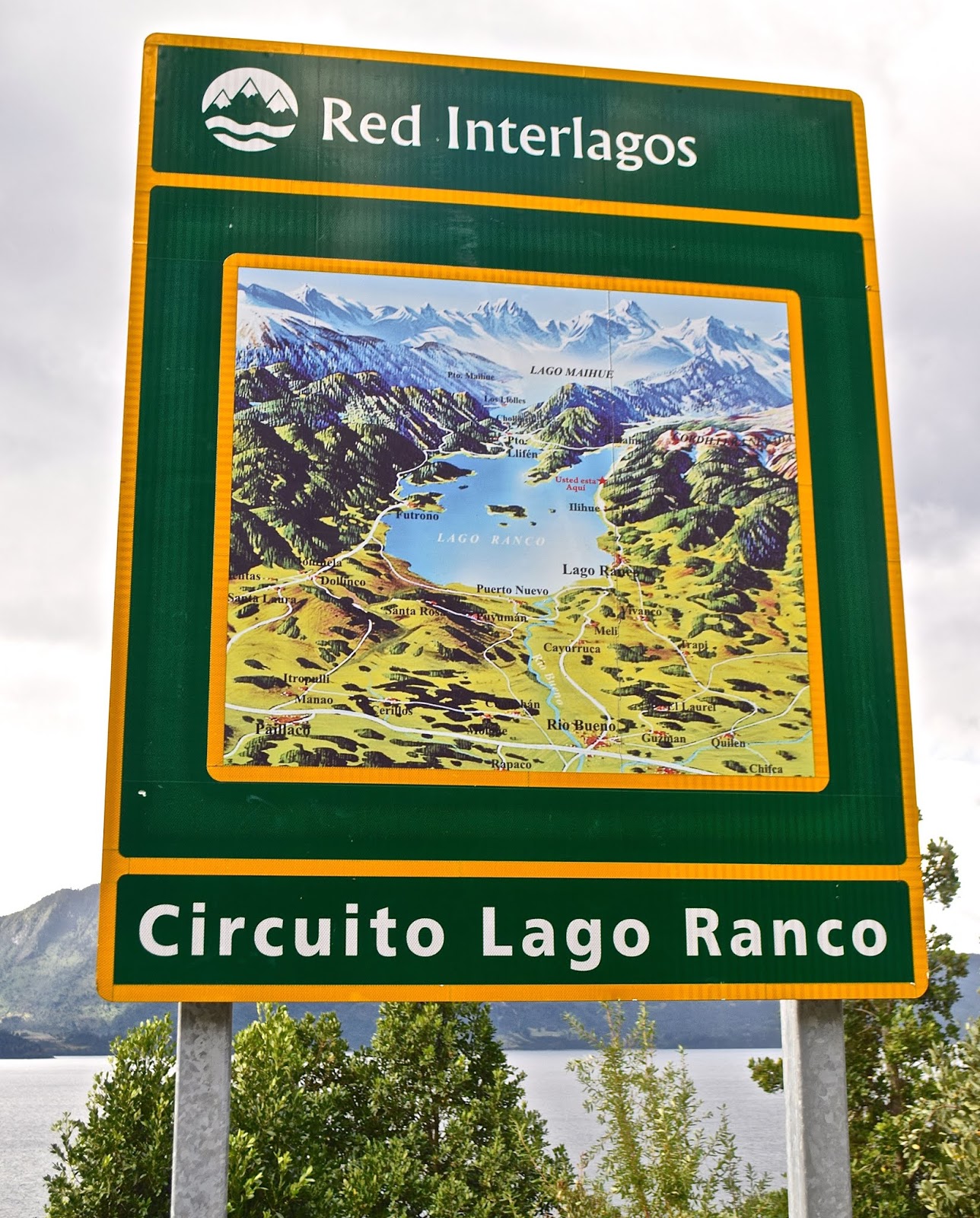
New highway signs mark the Red Interlagos.
Not so long ago, that wouldn’t have been possible but, in recent years, the Chilean government has linked and improved a series of roughly parallel easterly roads that provide a more scenic alternative along the lakes of the Andean front range. The Red Interlagos stretches from the town of Inspector Fernández, north of Temuco, south to the village of Puelo, southeast of Puerto Montt. I recommended an itinerary to my client and, when I next returned to Chile, I decided to follow the route—more or less—myself. It bears mention that the Interlagos is not a single highway, but a network of interconnected routes that pass through smaller towns and villages, not all of which are resorts, so there are multiple options.
Roadside frontage of the Hotel Awa
My client started in Puerto Varas and so did I, spending a couple nights in the new design Hotel Awa, a multi-story concrete, glass and girder structure on the city’s eastern outskirts. With views over Lago Llanquihue to the perfect cone of Volcán Osorno, it’s the area’s most technologically sophisticated hotel, but with rustic touches such as hiding the TV in an old steamer trunk at the foot of the bed. At night, I dined on truffled pork loin, complemented by a barley-based risotto from its own vegetable garden and garnished with a hazelnut sauce.
Grounds of the Museo Colonial Alemán, Frutillar
From Llanquihue’s south shore, there are two ways north, on the west side via Frutillar or the longer east side route via Ensenada. At the former, there’s the remarkable Teatro del Lago and the outstanding Museo Colonial Alemán, a tribute to German colonists that reminds me of in situ museums in Scandinavia.
A cycling event on the easterly route along Lago Llanquihue, beneath Volcán Osorno 
Puerto Octay, on Lago Llanquihue's north shore
I chose the longer route, which offers a detour up to the volcano’s ski area, which is open for hikers in summer, and then proceeded to picturesque Puerto Octay, a small north shore town with a metal-clad church and turreted houses that evoke Mitteleuropa. On Octay’s outskirts, my choice for the night is Hostal Zapato Amarillo, a Swiss-Chilean B&B with sod-roofed cabins, personalized attention, and fine dinners.
Hostal Zapato Amarillo is a cluster of sod-roofed guest rooms just outside Puerto Octay.
Hotel Termas de Puyehue is one of Patagonia's grand hotels.
For my client, though, I recommended continuing to Hotel Termas de Puyehue, a classic grand hotel at Parque Nacional Puyehue, about an hour north of Octay on the highway that runs from Villa La Angostura to Osorno. For visitors coming from Argentina, this sprawling hot springs hotel, with nearby hiking trails, makes an ideal overnight or multi-day stay in what may be the closest analogue to Bariloche’s Hotel Llao Llao. Along this highway, there’s still abundant evidence of the 2012 Puyehue-Cordón Caulle eruption that covered much of the area in ash.
Volcanic ash still covers parts of the shoulders along the highway between Argentina and Chile.
North of Entre Lagos, parts of the route are still unpaved but being improved.
I didn’t stay at the Puyehue this time, instead heading north through the town of Entre Lagos toward Lago Ranco, a lesser visited destination in the heart of Mapuche country. Along this segment, the Interlagos road signs say “Norpatagonia,” and, on a gravel surface with signs of improvement, muddy potholes splashed water onto my windshield. As I approached the south shore town of Lago Ranco, I could spot Isla Huapi, an offshore island inhabited almost exclusively by Mapuches.
The route around Lago Ranco is completely paved.
Here, in an area far more popular with Chileans than foreigners, I stopped for a sandwich before continuing east along a smooth paved road with plenty of scenic overlooks. The last time I had visited, a cable barge was the only means of crossing the Río Nilahue, but now modern bridges ease the route around the densely forested east side to the north shore town of Futrono. Here, almost opposite San Martín de los Andes, I spent the night at the Cabañas Nórdicas, a cluster of spacious and seemingly Scandinavian structures on a bluff overlooking the lake.
Sunset over Lago Ranco from my accommodations at Futrono
North of Futrono, the route’s a bit better trod, approaching the Ruta 5 town of Los Lagos but then veering northeast to Panguipulli, the entry point to a “Siete Lagos” route that resembles Argentina’s in Río Negro and Neuquén. Panguipulli fancies itself the "City of Roses" for its gardens at the east end of its namesake lake, but the area’s big attraction is its hot springs resorts. My client raved about the Zen-inspired Termas Geométricas—an isolated canyon of waterfalls, creeks and naturally heated pools linked by boardwalks near Coñaripe that’s open for day visits only—in the shadow of the fuming Volcán Villarrica.
The Termas Geométricas is a secluded hot springs venue south of Pucón.
Volcán Villarrica, as seen from Pucón, on the opposite side of Termas Geométricas
After a leisurely day at the Termas Geométricas, nearby accommodations options include the
Termas de Coñaripe—a hot springs hotel in its own right—and the town of Lican Ray, with its black sand beaches at Lago Calafquén. Termas Geométricas, though, gets many day-trippers from Pucón, the uber-resort city that’s just over the hill (mountains, that is) on Lago Villarrica. There, the place to stay is the hillside Hotel Antumalal, a Bauhaus-inspired masterpiece that, arguably, set the stage for Varas’s Awa. Still, there are many cheaper but still outstanding options here, and great hiking in spots like Parque Nacional VillarricaParque Nacional Huerquehue, and the Santuario Cañi, a private conservation effort aimed at protecting the area’s Araucaria forests.
Queen Elizabeth II and other big names have stayed at Pucón's Hotel Antumalal.
At Parque Nacional Huerquehue, the Sendero Quinchol leads to dense upland forests of Araucarias and southern beeches.
For visitors from Argentina, it’s easy to return by the Paso Mamuil Malal to Junín de los Andes and thence to Buenos Aires or back to Bariloche. The road goes on forever.

Sunday, March 5, 2017

Emptying the VAT? Argentina, Chile & Uruguay Offer Tourists Tax Breaks

Recent developments in tourist taxation, in the Southern Cone countries of Chile, Argentina and Uruguay, should interest readers of this blog. In the near future, though, I’ll also be addressing potential visa complications in the face of the United States’ new xenophobic government.

CHILE
For many years, I’ve advised visitors to Chile that, when paying for accommodations in US dollars or by foreign credit card, they are entitled to a 19 percent discount. That’s because foreigners on a tourist visa are exempt from the country’s Impuesto de Valor Agregado (IVA, or Value Added Tax).
Termas de Puyehue, an historic spa hotel eligible for IVA discounts
For those unfamiliar with VAT, it’s a sort of sales tax that levied on products and services within Chile, but not on those intended for export. For some reason, Chile has chosen to define accommodations and some related services as export items, though it’s always mystified me that sleeping in, say, a Puerto Natales hotel might qualify as an export. It’s a legal fiction that also applies, in some cases, to meals and even tours that are part of an all-inclusive package at destinations like Termas de Puyehue Wellness & Spa and the Puyuhuapi Lodge & Spa.
The remote Puyuhuapi Lodge & Spa can also grant IVA discounts.
It’s not quite automatic, though. In the first instance, not all hotels can take advantage of it—they must apply to Chile’s Servicio de Impuesto Internos (SII, Internal Revenue Service) for a franquicia tributaria (export permit) and, in the process, prove that a minimum percentage of their clientele comes from outside the country. In reality, this requirement excludes many modest but perfectly acceptable hostales (B&Bs) and hostels from consideration, even though such facilities could probably use the tax break more than their far wealthier counterparts.
Modest accommodations, like Puerto Natales's Hostal La Cumbre, are often ineligible for IVA discounts.
There’s a recent change in the law that merits noting. Generally, on arrival, foreign visitors receive a 90-day visa, and hotels must make a photocopy of your passport and tourist in order to provide the IVA discount. Though the immigration policy itself has not changed, however, visitors who have been in the country more than 60 days are no longer eligible for the discount.

While the great majority of visitors are unlikely to stay longer than 60 days—even a brief detour in Argentina or another country restarts the clock—it’s worth noting. If it’s more, though, you might as well be a Chilean resident. Note also that the discount depends on an exchange rate that the hotel may have set early in the season, and could be less (or perhaps more) advantageous than the current daily rate.

URUGUAY
To receive an IVA discount at Jacinto, pay with your foreign credit card.
I spend far less time in Uruguay than I do in Argentina and Chile, and only recently became aware of developments in their tourist taxation regime according to Ley 17934. Set at 18 percent, Uruguay’s IVA discount benefits tourists not only in accommodations refunds, but also services such as car rentals and meals. Last year, while dining at Jacinto in Montevideo’s Ciudad Vieja neighborhood, I was surprised to find the discount applied directly to my bill when I paid by credit card. In some cases, though, the discount appeared only when I received my credit card statement at home in California.
My receipt from Jacinto indicates the IVA discount under Ley 17934
For none of the transactions in question did I have to show proof of tourist status—merely paying with a foreign credit card was sufficient. This makes the Uruguayan policy far more convenient than its Chilean counterpart but also potentially vulnerable to abuse—in theory, I suppose, a foreigner could pay for a large dinner by credit card and be reimbursed by Uruguayan friends who would thereby receive the benefit indirectly.

It’s worth adding, though, that the IVA discount for accommodations is only 10.5 percent, and it has seasonal limits—this year, for instance, it is available only until April 21st. Still, the policy benefits everyone, or at least these able to pay with the proper card.

ARGENTINA
Stays at Camping El Bolsón - which has its own brewery - are now eligible for IVA discounts in Argentina.
Both Chile and Uruguay have been doing IVA discounts for some time, but Argentina’s a latecomer to the party. The law’s been on the books since 2001, but only this summer did the government of President Mauricio Macri declare that foreign hotel guests would not have to pay the 21 percent IVA that applies to all other products and services in the country. It’s also applicable to all accommodations, ranging from campgrounds to five-star luxury hotels, though clients will have to show their passports or other identification (visitors from neighboring countries may not need passports). The only acceptable means of payment, though, is a foreign credit or debit card, or a bank transfer. Cash is not acceptable (though Argentine hotels often provide cash discounts).
A stay at Bariloche's classic Hotel Llao Llao also means an IVA discount for foreign visitors.
As always, there’s a strange twist in Argentina’s new measure—it applies only to provinces with international borders. Thus, the interior provinces of Tucumán, Santiago del Estero, Santa Fe, Córdoba, San Luis and La Pampa will not benefit from it. All these provinces probably draw more in-country visitors than foreigners, but Córdoba, San Luis and Tucumán especially could be at a disadvantage to neighbors which do have foreign borders.
Because Córdoba province has no international border, guests at Hotel Sierras in Alta Gracia - Che Guevara's boyhood home - cannot receive IVA discounts.
One final note. The current issue of Condé Nast Traveler misleadingly says that “Argentina did away with its 21 percent hotel tax for foreigners.” This is simply wrong—there never was a hotel tax for foreigners, and Argentine tourists and residents will still be on the hook for that 21 percent IVA (presuming they’re not paying cash under the table).
This kiosk poster in Santiago de Chile promotes Argentina's new tourist tax refund.

Thursday, January 9, 2014

Saved by the Bureaucracy! Across the Andes to Argentina


Yesterday I crossed the Andes from Osorno (Chile) to Villa La Angostura (Argentina) for the first time since the Cordón Caulle volcano left the Argentine side of the border under a dense cap of ash that’s still visible along much of the international highway. It’s the only place in the world where I’ve seen warning signs that ice and ash may make the road surface slippery.
I almost didn’t make it, though, even if that had nothing to do with the conditions – it was a brilliant cloudless day on both sides of the cordillera. Rather, I was late leaving Chile because of a bureaucratic snafu that was, in the end, my own fault.

When I purchased my new car last month, I knew it would take some time for the title to clear – according to the notary where we completed the sale, between 20 and 25 days. It’s already been longer than that and, in any event, I left Santiago well before that time to be able to travel through the Chilean lakes district to update part of Moon Handbooks Patagonia.

Unfortunately, when we left the notary’s, I overlooked a statement that the Pedido de Inscripción (request to change the vehicle’s title) would be available in a week’s time – well after I left Santiago. Without that document, and proof that I had paid for the title transfer, I could not cross the border into Argentina.

Absent-mindedly, I had thought the bill of sale would be sufficient to get me across the border, but I was wrong. At Chilean customs, an official informed me I at least needed the title request and, briefly, I wondered whether I might have to return to Santiago or, at the very least, retreat down the mountain toward Osorno, where my cell phone would let me get in touch with the notary’s office.

Then, apparently, I was saved. The same official who refused to approve my documents said I should speak with his superior, the superintendent of the Paso Cardenal Samoré border post. Clearly, superintendent Hernán Lausen (a Danish-Chilean with whom I could joke about my Scandinavian heritage) had dealt with such issues before, and he immediately accessed the civil register website to see whether the title transfer had gone through. It hadn’t yet and, again, my heart sank a bit.

That wasn’t the end of things, though. Señor Lausen took it upon himself to phone the notary where we had done the transfer paperwork, and managed to get her on the line (fortunately, she hadn’t yet gone on summer vacation). Going beyond the call of duty, he asked her to scan the documents and send him a PDF which, in a short time, he printed out and delivered to me as I sat in the car.

In just a few minutes, I was through the border post and rolling towards Argentina. The next time anybody complains to me about bureaucratic stonewalling, I’ll bring up the case of Hernán Lausen, the hero of my day, who clearly recognizes his duty to serve the public.
Custom Search