Showing posts with label Accommodations. Show all posts

Tuesday, April 21, 2020

Ice Cream, Empanadas, and the Pandemic

It’s been more than three weeks since I “escaped” from Argentina and Chile, but I never stop thinking about them. I have many relatives in Argentina, and friends in both countries, who’ve been in touch in the coronavirus “aftermath” (obviously, it’s not over yet), but we express concern about each other and the future (short- and medium-term especially). The public health crisis seems to have hit Chile harder than Argentina, although the latter’s statistics seem incomplete according to the regional live data update at NCOV2019 (disclaimer: this site often seems to be overwhelmed with traffic).
A recent screenshot of Coronavirus stats in South America
Last week, I did receive an email from my friend Gabriel Famá, owner of the landmark ice creamery Heladería Cadore in Buenos Aires, and he’s feeling the pinch of Argentina’s near total lockdown. Though food providers such as himself can remain open for delivery, he was in hard-hit Italy when the crisis began, returning at the end of January “with no restrictions or controls, and look what. A lot of people underestimated the situation.” He comes to work “by car, with one of my sons, to avoid contact on public transportation and we operate with as few employees as possible.”
In non-virus times, Cadore can get really crowded.
Another friend, Marcelo Ferrante of Periko’s Hostel in Bariloche (where I spent a night before crossing back into Chile on my odyssey home), found himself on an RV vacation in Spain, another country devastated by the virus—“With luck I was able to get back to Bariloche, it was difficult but I managed it.” On April 8th, he wrote me, “We had to close on March 20th when the last guests left” (I had departed on the 16th). Then, he added, “I don’t think we’ll be able to open before before June 1st,” which would coincide roughly with ski season, but even that sounds optimistic to me.

That said, Argentina appears to be relaxing its strict quarantine restrictions, though the details are not yet clear. It's not been so draconian under California's "shelter-in-place" measures but, on an early Saturday supermarket run, I stocked up on Three Twins ice cream which, sadly, has folded under sustained economic pressure exacerbated by the plague.

Empanada Time!
On the bright side, here in the East Bay we have multiple options for Argentine-style empanadas, which are my favorites. There are four places within 2.1 miles (3.4 km) from our home in Oakland’s Temescal district.
9 de Julio Empanadas at the annual Temescal Street Fair on Telegraph Avenue
Unfortunately the one within easiest walking distance, the 9 de Julio Empanada Kitchen, hasn’t yet opened its new physical location in Rockridge, though it appears to be doing catering. Taking its name from the date Argentina’s independence day, it’s the creation of Erica Sanders, an Afro-American woman who moved to Buenos Aires to learn the art of the empanada. In past years, I’ve tasted her product—which features empanada styles from throughout the Americas—at street fairs in Montclair and Temescal, but the public health crisis appears to have delayed the opening.
Windows at the Wooden Table Café have fileteado flourishes.
The next closest is Uptown Oakland’s Wooden Table Café, which I’ve only sampled erratically because I usually pass it after taxiing my wife to work (she’s now telecommuting). Parking is scarce, though, so stopping is a matter of opportunity on my way back home. It’s very specifically Argentine, to the point of offering yerba mate drinks (the current crisis makes me wonder whether Argentines—and Uruguayans—will give up the custom of passing around the mate gourd, with a shared bombilla, among friends and family). It also offers a variety of sickly sweet alfajoresdulce de leche concoctions which are not to my taste. I do like the decorative fileteado on the windows, though.
Javi's Cooking is the empanadería I've most often patronized.
Nearly as close is Javi’s Cooking, in the Hoover-Foster district, whose products I first saw in the frozen food section at Berkeley Bowl West, and later sampled in Javier Sandes’s food truck during an event at Lake Merritt. It’s a place that I’ll make an occasional escapadita to when food in the fridge is scarce, and it also offers facturas (pastries) including my personal favorite medialunas (croissants, of a sort).
With its sidewalk seating, Café Buenos Aires feel more like a spot in the Argentine capital.
The most distant of the bunch is South Berkeley’s Café Buenos Aires (2.1 miles or 3.4 km), which I stumbled upon while taxiing an Argentine political scientist to a downtown event there. It has a wider menu than the others, especially with regard to pastries, but it’s not quite so convenient as the others. It’s a bit more spacious as well but, under current conditions it—like all the rest—is for takeout or delivery only.
María Laura's homemade empanadas - chard in this case - are our default choice these days.
In any event, we’ve not bought empanadas recently. The local price of roughly $5 each would appall most Argentines but, fortunately, my Argentine wife is capable of making them much more cheaply with no sacrifice in quality. Still, I look forward to revisiting all these others, so nearby, in person when our shelter-in-place restrictions relax.


Saturday, March 21, 2020

White Line Fever? Travel in the Time of Coronavirus

Last Monday, having heard that Chilean land borders would close on Wednesday the 18th because of the coronavirus crisis, I drove from San Carlos de Bariloche to Argentina’s Paso Cardenal Samoré border post—where mine was the only vehicle in sight. At a roadside booth, as a young Argentine gendarme (border guard) handed me a ticket to present at immigration and customs, he asked me whether I was suffering any symptoms and, then, he himself sneezed!

With all due respect to Merle and Gabo..
In fairness to him, he averted his face and blew into his elbow. When I remarked that he, instead, might have been showing symptoms, he smiled sheepishly and I continued to what might have been the quickest departure ever at what is normally the second-busiest border crossing between the two countries (only the Los Libertadores crossing between Santiago and Mendoza gets more traffic).
Argentina's border post at Paso Cardenal Samoré
The actual borderline between Argentine and Chile
Chile's tentative tactic to deal with coronavirus at the border
On Chile’s side of the border, a handful of vehicles made the process—which included filling out a brief epidemiological questionnaire—slightly slower, but the stroll through immigration, customs and agricultural inspection was still expeditious. Oddly, no official even glanced at the questionnaire, which we had to deposit in a box for presumed data collection. Then I was on my way into Chile, a tale I’ll continue below.
Welcome to Chile!
How It All Started
This trip has changed dramatically since it began in late February, when I arrived in Santiago with the goal of updating the current 5th edition of Moon Patagonia. On arrival in the capital, my biggest concern was the estallido social (social explosion) protests that—whatever their inconsistencies—have brought decades of social and economic inequality into focus. For the few days I was in town, things were relatively quiet, but there was plenty of evidence of the fierce demonstrations that left several Metro stations and other services in near-ruin (the previous link here reports what stations may be closed at any given time).
Information screens let Metro riders know which stations are closed or with limited access.
I was staying in the house of Marializ Maldonado, a long-time friend who is working for the constitutional referendum to replace the one drawn by pro-Pinochet ideologue Jaime Guzmán. Guzmán’s custom constitution disproportionately favors Chile’s more conservative elements—rather as gerrymandering favors Republicans in the United States.
Protestors have defaced monuments such as Plaza Baquedano (informally renamed Plaza de la Dignidad).  This site has since been cleaned up.
Marializ hosted several meetings of activists favoring a new constitution, the vote for which was scheduled for April 26th, but has since been postponed until October 25th because of the Coronavirus crisis. Her Revolución Democrática party considers the rowdier elements who’ve gotten the most publicity in the estallido as outsiders (a term they’ve adapted from English).
The Plaza de Armas at Lonquimay features native Araucarias and a knitted tree apparently left over from Xmas.
When I arrived, the coronavirus issue was not yet critical, and I drove south with the idea that I’d spend two months in Chilean and Argentine Patagonia. That would put me on track to submit a new manuscript toward year’s end, and I began with a long drive that took me to Curacautín, at the northern approach to Parque Nacional Conguillío, where I spent a night at the Bavarian-run guest house Andenrose. The next morning I circled the park via the town of Lonquimay and thence to Melipeuco, the park’s southern gateway but, on this occasion, I decided I couldn’t make the detour into the park.
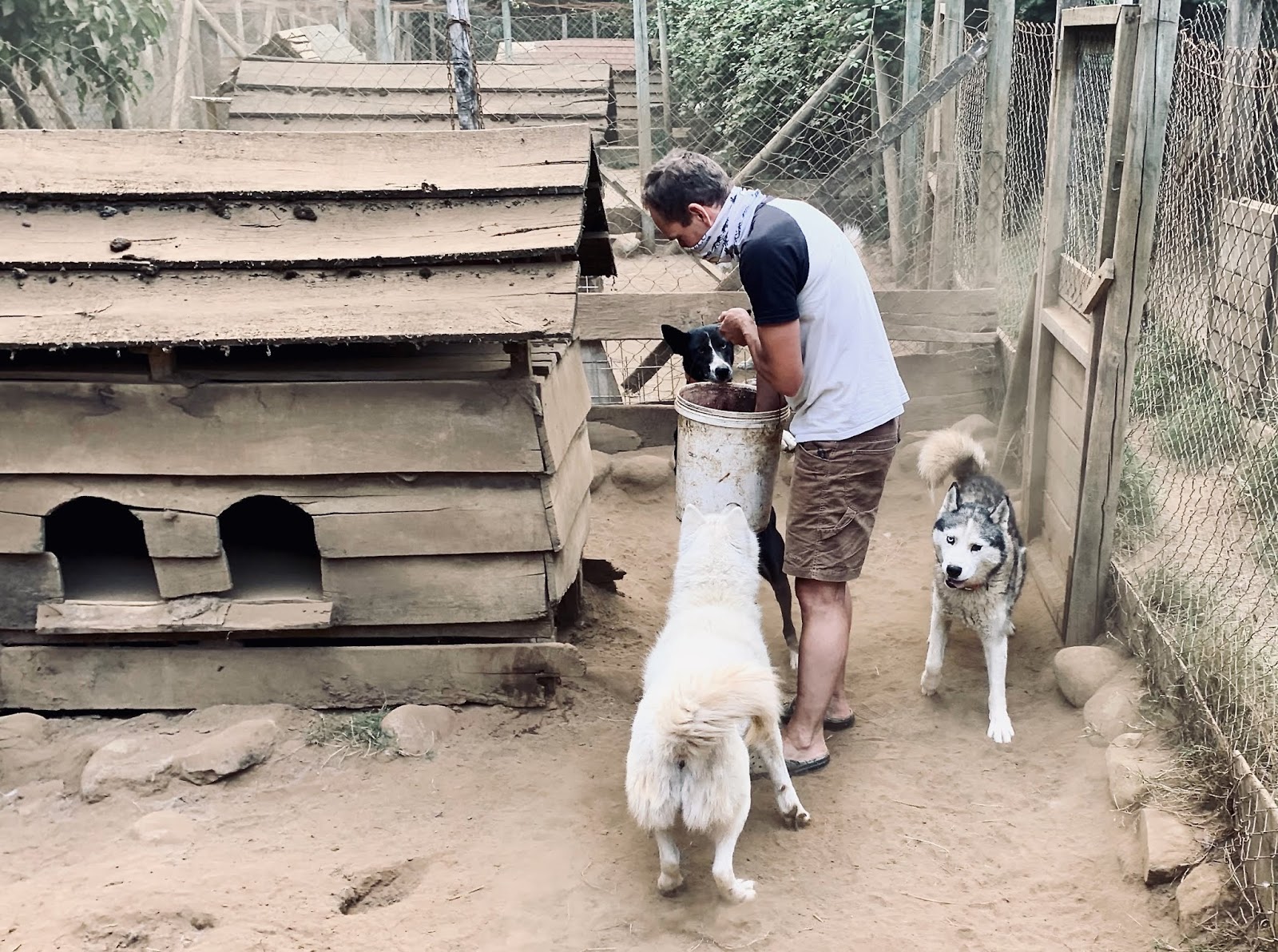
Feeding time at Aurora Austral, for just three of Konrad's 55 huskies
Instead, I continued to the lakeside town of Villarrica and, after a brief reconnoiter of the town, on to the Aurora Austral husky farm, where another Bavarian expat, Konrad Jakob, offers sledding trips in winter and carting trips in summer with his kennel of 55 huskies and a handful of mixes (full disclosure: I’m a devotee of northern dogs and have recently adopted a rescue husky, after four malamutes and one Akita). I spent two nights in one of Konrad’s cabañas, commuting to Villarrica to update practical information on the city. I only regret that I’ve never seen the area in winter, when I’d love to go mushing.
My cabaña accommodations at Aurora Austral
On the third day, I headed to Pucón, at the east end of Lago Villarrica, where I stayed at my long-time favorite Hostería Ecole, but there was an issue that aroused anxiety even before coronavirus entered the conversation. Some years ago, Chile fiddled with the regulations for non-residents crossing the border with their own Chilean vehicles. Were I unable to cross with my vehicle, it would be disastrous for my work.
Template for the declaración jurada that let me cross the border.
Fortunately, Hans and Verónica Liechti of Pucón’s Travel Aid agency had put me in touch with an American couple who own a house outside town and were in much the same non-resident situation. That couple had found an apparent loophole that allows such vehicle owners to leave the country so long as they obtain a notarized declaración jurada (“sworn declaration”) that they intend to return the vehicle to Chile. They’d done it several times and sent me a template for the document that I completed, printed out, and took to Pucón’s only notary public for verification.

When I Get to the Border…
Loretano is a worthy new Peruvian addition to Pucón's dining scene.
After three nights in Pucón, where I really enjoyed the new Peruvian restaurant Loretano (presently closed for the virus emergency), I headed east to the border at Mamuil Malal; I couldn’t completely contain my apprehension until, when I produced the declaración jurada, the Chilean customs official gave me a smiling thumbs-up. Entering Argentina was similarly routine, despite the presence of a list of various nationals subject to coronavirus quarantine but not—yet—US citizens. I got in under the wire, as that would happen a couple days later.
At the Mamuil Malal border crossing, Araucarias line the road, which passes through Parque Nacional Lanín.
Parque Nacional Los Arrayanes was presumably closed to hikers, but there was no  visible enforcement at Villa La Angostura.
The next few days were relatively routine, as I spent a night at Estancia Huechahue, two in San Martín de los Andes, and one in Villa La Angostura, where Argentina’s budding coronavirus precautions became more obvious. En route there had been evidence for concern, as I saw Argentines from a tour bus still sharing yerba mate, and many still greeting each other with kisses on the cheek—men as well as women. Argentina had closed all its national parks, though, and Parque Nacional Los Arrayanes—a popular hiking destination with an entrance in town, was supposedly off-limits (there were still people crossing the line into the park).
Probably now closed because of Argentina's widespread quarantine, the Bariloche tourist office was keeping  distance between its personnel and visitors.
Then I was headed to Bariloche—arguably Argentine Patagonia’s de facto capital, with the notion of continuing south to El Bolsón and Esquel, and then across the broad steppe to Puerto Madryn and Península Valdés. It was not to be, however, as I heard the next morning that Chile was about to close it land borders and, if I did not return before Wednesday, I would be unable to leave (and potentially unable to comply with my declaración jurada).

That information I heard second-hand but, for confirmation, I walked to the Chilean consulate—which was closed. Nevertheless, I rang the bell and, after a middling wait, was assured that US citizens like myself would be able to cross. I left almost immediately, returning via Villa La Angostura and thence to the border crossing described above. Before leaving, though, I managed to visit the new locale of Helados Jauja, arguably Patagonia's best ice creamery (the mother ship is in El Bolsón).
Helados Jauja has new quarters in Bariloche, with a secluded patio in the back.
When in Chile…
My accommodations at Zapato Amarillo were picturesque, comfortable and - in the current situation - socially remote.
After crossing the border, I headed to Puerto Octay’s Zapato Amarillo guesthouse, where the Swiss-Chilean couple Armin and Nadia Dübendorfer have hosted me many times over the years. On the outskirts of town, its stylishly rustic cabins were also an ideal place for self-quarantine, with nobody else about. I had considered staying several days, and perhaps even continuing to Puerto Varas, but after Armin and Nadia told me that international flights were being drastically reduced, I took their suggestion to drive to the city of Osorno and reschedule my April 29th departure for California. Otherwise, I would be spending nearly six weeks in Chile in virtual seclusion.
LATAM'S Osorno office switched my flight. It's a nice touch both the agent and the client can watch the computer screen.
Osorno’s about an hour away, but I was fortunate enough to find parking in the densely built downtown area, barely a block from the surprisingly small LATAM office (Osorno has an airport, but flights are fairly few). There were also few clients, so I quickly got seated and, though my preferred departure date from Santiago on Monday the 23rd was not available, the agent found me space for Tuesday the 24th. She first suggested the route via New York City, then with Delta to SFO, but having heard of huge delays at JFK immigration I chose to fly from Santiago to Mexico City, thence to SFO with Aeroméxico. Time will tell whether I’ve made the right decision, but I’m due home by 1 pm on Wednesday the 25th.

Then there remained the issue of getting back to Santiago, amid rumors there would be a toque de queda (curfew) at midnight. I returned to Puerto Octay immediately and packed my bags for the Chilean capital, a distance of roughly 970 km (about 600 miles) that I covered in 10-1/2 hours, with just two stops to fill the tank (plus some slowdowns for construction). I got to Marializ’s house at 11:30 p.m., just half an hour before the supposed curfew (that’s still not happened, though authorities are encouraging people to stay home). By then, with all apologies to Merle, I'd seen enough white lines for the day.

Here, until Wednesday, I’m in modified self-quarantine, taking short walks around the neighborhood  but avoiding contact with anybody—and making minimal purchases from the nearby shop. And writing stuff like this as, for the foreseeable future, we’ve had to suspend work on the new edition of Patagonia.

Saturday, June 15, 2019

Childish Games? In Buenos Aires?

Recently, reviewing the English translations on a Chilean hotel website, I came upon the bewildering phrase “childish games” as one of the hotel's features, and I had to refer back to the Spanish original to find the term “juegos infantiles” to realize that what they meant was “playground for kids.” They'd apparently relied on translation software—thanks, Google!—to promote themselves to English-speaking audiences.

Recently, in the New York Times travel section, Danielle Pergament offered an account of seeing Buenos Aires through her children’s rudimentary Spanish. For Pergament, who proudly proclaims that neither she nor her husband speaks a word of Spanish, this was a potential interesting conceit, but one that failed in its execution—at least in my opinion and my Argentine wife’s.

So far as I can tell, Pergament ignored what should have been visible evidence regarding the status of children in Argentina, and Buenos Aires in particular. I say that as someone who helped raise a half-Argentine daughter, with many Argentine nieces and nephews whom I’ve known since their early childhoods.

Somehow, Pergament concludes that children are peripheral to local life—she cites the example of an English-speaking waitress and a concierge who chose to address her rather her kids—but she mightn’t think that if, somehow, she had noticed that young children often accompany their parents to very late meals, often well after 9 p.m. In fact, dinner at home is often that late and even the youngest children are an integral part of the event, though if it’s a big family dinner the kids may have their own separate table.
Children watch a street performer at the Feria Plaza Francia.
She also missed a big opportunity by not having her kids—ages eight and ten—interact with their Argentine counterparts by paying more attention to parks and playgrounds. Easy walking distance from her lodgings at Recoleta’s Hotel Mío Buenos Aires, the Feria Plaza Francia (a sophisticated crafts fair that she dismisses as a “trinkets market”) often has street performers that appeal to children, and the Plaza Emilio Mitre has a fine playground.
Plaza Emilio Mitre is one of many where Porteño parents bring kids.

Freddo is a fading presence in the quality ice cream sector.
She does recognize one aspect of Buenos Aires that certainly appeals to kids, and that is ice cream. Sadly, her kids appear to have sampled only chains like the moribund Freddo (no longer the go-to choice it once was), Lucciano’s (very decent) and Rapa Nui (a chocolates specialist that originated in Bariloche but has branches here and in beach resorts). In fairness, these were conspicuous locales the Pergament and her family were likeliest to come across in their walks around the tourist-oriented northern neighborhoods, so more distinctive choices like Heladería Cadore were not on their itinerary.
Rapa Nui is primarily a chocolatier that got its start in Bariloche, in northern Argentine Patagonia.
At Palermo's Jardín Japonés, the colorfully carp-filled ponds appeal to kids.
Other child-friendly sights she suggests are the Abasto Shopping Center, the Centro Cultural Recoleta with its motto of ¡prohibido no tocar! (not touching prohibited!), Palermo’s Jardín Japonés and Planetario Galileo Galilei, and the often quirky Museo de Arte Latinoamericano Buenos Aires (MALBA). All of these are worthwhile, especially the MALBA, but I can’t stop thinking of her own childish oversights.
A young Porteña stands alongside the late León Ferrari's dark-themed "Mushroom Cloud" at the MALBA.


Tuesday, April 30, 2019

I've Never Been to Spain?

I’ve never been to Spain. Well I have been, I guess, if you count Catalonia as part of Spain, because I once spent a week in Barcelona. But I’ve been to Salamanca…oh, wait, not that Salamanca! Earlier this month, I spent two nights in the Chilean city of Salamanca, which I’d visited before, but this was an escape from Santiago after spending most of the previous two months in Patagonia.
Gregorio de la Fuente's "Abrazo de los Pueblos" still decorates the now disused passenger  terminal of Los Andes' Ferrocarril Transandino.
How did I get to Salamanca? Well, I started slow, thanks to late-rush hour traffic out of Santiago, but then headed north to the town of Los Andes, where the Ferrocarril Transandino once carried passengers and freight across the Andean divide to Mendoza. I had no intention of visiting Argentina this time, but I did want to see the mural by Gregorio de la Fuente—his "El Abrazo de los Pueblos” (Embrace of the Peoples) at the old train station is a celebration of Argentine-Chilean friendship. It was just a brief stop, though I did learn that there’s now an occasional tourist train on this route.
Vehicles pass along the old railroad route through Túnel La Grupa, near the town of Cabildo.
Symbolically, at least, trains played a role in my route to Salamanca, as I took the paved highway west to the town of San Felipe and then north through scenic Andean foothills that resemble the higher, drier parts of Southern California. There are only scattered settlements along this route E-71, which leads to the town of Cabildo; there, a traffic light controls access through the Túnel La Grupa, one of a series of tunnels that belonged to the Longino, the Ferrocarril Longitudinal that connected La Calera (west of Santiago) to the nitrate mines and ports of the northernmost Atacama Desert.
The landscape here resembles the higher, drier areas of Southern California.
I’d driven this route before, but not for several years. In the interim, authorities have either paved—or begun to pave—much of it north of the border between Region V (Valparaíso) and Region IV (Coquimbo). This is significant because most of Coquimbo’s population resides along the coast, where cities like Los Vilos and La Serena attract beachgoers from Santiago, and this is a more adventurous (if slower) alternative to lesser-known points.
Túnel Las Palmas marks the border between the Valparaíso and Coquimbo regions.
Café Quarzo is one of few roadside services here.
There are few services on this stretch of “highway” but, surprisingly, one enterprising local has opened a small café on the northbound descent from Túnel Las Palmas, which marks the regional border. She sells ground coffee drinks—in a country where Nescafé is often still the default option—as well as juices and mineral souvenirs (hence the name Café Quarzo). The road continues, passing several railroad bridges, to the enigmatically named village of Caimanes (there are no carnivorous aquatic reptiles here, though; the name apparently comes from an indigenous Mapundungun [Mapuche] word meaning “six condors”).
Carnivorous aquatic reptiles do not populate the area around Caimanes.
Túnel Las Astas is the last of three short tunnels north of Caimanes.
The foundations of the old railroad station still stand here, but there’s no more obvious evidence until a short distance north, where the road passes through three short tunnels with no traffic lights. Several years ago, in Argentina, I met two US cyclists who’d taken this road on my guidebook recommendation and loved it, but they confessed their trepidation in riding through the narrow tunnels, with little room to dodge any oncoming vehicle. That said, this route remains a potentially great ride for adventure-seeking cyclists.
The old train station at Limáhuida is now a country store.
Emerging from the Túnel Los Astas, the road continues to Limáhuida, where the old train station is now a small market and fading wooden workshops still stand below it. That’s also where a new bridge crosses the Río Choapa and leads east to Salamanca, where I spent two nights at the modern and comfortable Hotel Recanto, on the eastern outskirts of town.
Hotel Recanto is full during the week, but nearly empty on weekends.
Oddly—or not—I was virtually the only guest in contemporary accommodations with spacious rooms, solar-powered hot water, and an outstanding restaurant. That’s because it clears out on the Thursday and Friday, as mining managers—there are large copper deposits in the area—leave for the weekend.
Farm-fresh garlic spreads at Salamanca's central plaza
Salamanca's old train station is now a museum and part of a pleasant public park.
Nevertheless, the hotel was still walking distance from a handsome central plaza with a lively crafts and farmers market, a former train station turned museum and municipal park, and easy access to nearby petroglyphs. There are also wineries in the area, though I didn’t get to visit those, but Salamanca—where I’d stayed once several years earlier, still struck me as a good weekend getaway.
The pre-Columbian petroglyphs at Cerro Chalinga are walking distance from downtown Salamanca.
It’s not the area’s only attraction, though. The next day I took the paved highway north to Combarbalá, a village which, on the face of it, resembles some Mexican villages, with narrow streets lined by adobe houses and even ranchera music. To get there, I did veer northwest off the more direct but still unpaved railroad route (though, had there been tunnels, I would have taken it again).
The fountain at Combarbalá's central plaza represents indigenous Diaguita motifs.
Mexican ranchera music is popular in rural Chile, including Combarbalá.
Small-scale mines extract combarbalita for local crafts workers.
What Combarbalá does have is small-scale mining for the semi-precious gemstone combarbalita (I visited a local mine, thanks to Paola Yáñez of Inti Wasi Tour), and the community astronomical Observatorio Cruz del Sur, which offers nighttime tours in one of the best possible areas for professional and amateur astronomy. I stayed at the cozy Eco-Hostal Alto Algarrobal, one of many accommodations that will fill up in for July 2nd, when a total eclipse of the sun will pass nearby (Combarbalá will be slightly south of totality).
The approach to Observatorio Cruz del Sur, in the daylight hours.
The beginning of a nighttime tour at Observatorio Cruz del Sur
Combarbalá and other nearby towns will fill up for the July 2nd eclipse.
After a night at Combarbalá, I headed the next morning for the coast, where Los Vilos would make an ideal beach break for Santiaguinos returning to Chile’s capital. For my part, I continued along the coast to Viña del Mar and Valparaíso, which will be another story here in the near future.

Saturday, March 23, 2019

Parque Nacional Patagonia, an Update

The former Parque Patagonia is now, officially, "Parque Nacional Patagonia."
Just over two years ago, when I had last visited Parque Patagonia—now officially Parque Nacional Patagonia—the park’s new Centro de Visitantes (Visitor Center) was work-in-progress. Two weeks ago, when I revisited, the center had opened and I finally had a chance to appraise it.
Under construction two years ago, the visitor center is now open to the public.
To start, the center displays all the sophistication and attention to detail that’s typical of all the Tompkins Conservation projects in Argentina and Chile, with no expense spared. Indeed, it would be hard to think of a comparable project, in such a remote area, anywhere in the world. Clearly, both craftsmanship and technological sophistication have gone into the finished product.
The old woolshed at Valle Chacabuco, before it became part of a national park.
When I first heard of the project, I thought the foundation should preserve at least one of the original metal-clad buildings as an in situ museum that would represent the sheep-farming tradition here, but those buildings are gone now. What’s replaced them is a cluster of contemporary buildings with certain rustic style elements, including carved stone façades and wooden details—some of which mimic earlier structures in the region.

Central diorama of the Parque Nacional Patagonia landscape
Overpopulation is the central theme of "The Predicament."
The Centro, which is bilingual in Spanish and English, consists of four exhibit halls surrounding a central diorama that offers an aerial view the park’s jagged landscape. The first focuses on population and, in my opinion, oversimplifies that issue—"The Predicament”—as  the overwhelming instigator of environmental degradation. The displays themselves, though, depict a persuasively vivid correlation between rising population and the decline of wild species.
The "Nature" hall explains the park's ecosystems and their characteristic species.
The "Culture" hall chronicles the region's evolving human occupation.
The second hall categorizes the region’s natural environments—steppes, forests, mountains and wetlands—and fauna, with life-size models of iconic wildlife including guanacos (plenty of living specimens on the lawns outside), pumas, huemuls (Andean deer) and rheas. The third, entitled “Culture,” traces the human impact from pre-Columbian times to the arrival of European settlers (with an intriguing hologram presentation of the pioneer Lucas Bridges, in English with Spanish subtitles) and the gaucho heritage.
Pioneer sheep farmer Lucas Bridges appears in hologram form.
The fourth and last exhibition, entitled “Why Parque Nacional Patagonia?,” is an exhortation to activism, with a plethora of protest signs and a compact surround-sound theater with a short film on “Facing the Abyss.” In terms of the museum’s ethos, that’s pretty self-explanatory, but it’s also something that’s going to change.
Pessimism appear to be the default option.
The suggested response to that pessimism is activism.
That’s because, at the end of April, the park’s ownership will devolve from Tompkins Conservation to the Chilean state, under the Corporación Nacional Forestal (Conaf), which administers Chile’s national parks. According to a career Conaf official with whom I spoke recently, such overt official activism is unlikely.
Private concessionaires will take over the Lodge at Valle Chacabuco and other services.
On a broader scale, Conaf may lack sufficient resources to maintain such a complex of facilities—the center and museum itself, the Lodge at Valle Chacabuco, the Rincón Gaucho restaurant and bar, and the Puma Verde handicraft shop, along with support facilities, at least in the manner the Tompkins group would. Next month will begin a period of transition in which concessionaires should take charge of those, and I hear that foreign bidders may be in the running. This is also true of Parque Nacional Pumalín Douglas Tompkins, the Tompkins’s first project in Patagonia, though its installations are not quite so elaborate.

As part of Chile’s ambitious Ruta de los Parques, it will all be worth watching.

Support Southern Cone Travel!
If you've found this post entertaining and/or informative, please consider clicking on an ad to earn me a few pennies.
Custom Search