Showing posts with label Health and Safety. Show all posts

Saturday, December 10, 2022

Returning to Santiago (and all that entails)

At very long last, this past Monday, I arrived back in Chile for the first time since March of 2020, when I abruptly flew home to California as the seriousness of the COVID-19 pandemic became obvious. I was originally to arrive on the previous Saturday but, late that week, LATAM suddenly canceled my nonstop Friday flight from Los Angeles International Airport (LAX) to Aeropuerto Arturo Merino Benítez (SCL).

Thanks to my heroic travel agent—there are still such things!—I was able get rescheduled for Sunday even though not without trepidation that the new flight might also be canceled. Analía Rupar-Przebieda (an Argentine resident of Southern California) first tried to reschedule me on Delta (a LATAM partner) via Atlanta, but Delta refused (even though the SFO-LAX leg of my flight was with them). That would have gotten me to SCL on Saturday as planned, but the rescheduled LATAM left on Sunday and didn’t get me here until early Monday morning.

The lines at immigration were long, but moved surprisingly quickly.


The flight was reasonably comfortable if crowded, and I was one of few coach passengers wearing a mask (those in first and business seemed to take it more seriously). On deplaning and arriving at immigration, though, we were faced with the longest lines I’ve ever seen at any airport. We also saw a warning for monkeypox—Chile continues to take contagion seriously—but the lines moved surprisingly quickly. So did the customs and agricultural checkpoint, so I was finally officially in the country.

Is monkeypox the next big thing?


Now to get to the city, and I purchased a seat on a shared TransVIP shuttle and was surprised to find a 5.5 percent surcharge on my foreign credit card. This has also been the case on some restaurant meals, but not on a purchase I made at a downtown department store. I had arrived with a small amount of Chilean cash but, at the new international terminal, the exchange houses were offering very poor rates and there was no functional ATM anywhere to be seen.


I rested most of Monday, other than a fine Peruvian dinner at with my host Marializ Maldonado at Del Carajo, across from the Hipódromo (racetrack) in the untouristed neighborhood of Independencia. The next day, I found a BancoEstado ATM and learned that their once-free ATMs now charge Ch$5500 (roughly US$6.50) for any withdrawal from a foreign account. Yesterday I made the maximum withdrawal of Ch$200,000 (about US$230) with the private Banco Itaú at a cost of Ch$6,000 (US$7). I haven’t yet tried to change US cash in the city, because I’m saving most of that for unpredictable Argentina.

With luck, my so far trusty Suzuki will be back on the road soon.


In preparation for upcoming Patagonian road trip, I’m now awaiting replacement of the catalytic converter on my 2005 Suzuki Grand Nomade, which failed its most recent revision. The most worrisome part of this, at present, is the availability of a replacement part, though my trusted mechanic Mauricio Donoso sounds reasonably optimistic.


Another issue I’ve had to deal with is cell phone service. My US carrier provides phone and data coverage here, but with limits—not exactly clear—on how much, and I’ll be in Chile and Argentina for three months. Because my new iPhone 12 uses an E-SIM rather than a physical chip, I cannot use a pay-as-you-go option here and, without legal residence in the country, nor can I open an account with a monthly plan. Yesterday, though, my host Marializ added me to her plan (and I’ll reimburse her), but that’s not an option for the overwhelming majority of visitors. Some will be limited to WiFi.

Tuesday, June 28, 2022

Tuesday Topics: Patagonia, Reopening Chile, Vaccines, Masks & Linguistics, and Falklands Flights

When I arrived in Santiago de Chile in late February of 2020, to begin updating Moon Handbooks Patagonia for the upcoming sixth edition, what we now recognize as the COVID pandemic had barely begun and few of us appreciate what was a transformative event it would be. A couple weeks later, after I had crossed into northern Argentine Patagonia, its significance had become apparent and I managed to return to Chile before the border shut down and then, after various delays, to home in California.

When I landed in Santiago during the pandemic's earliest days, there were only the most basic temperature checks for airport arrivals.

After that lengthy delay, I’m once again planning—tentatively—to return to Chile in November. While I did travel to Buenos Aires and surroundings in March and April, I didn’t even consider a detour into Chile because its government had been slow to acknowledge foreign-administered vaccinations—an approval that’s necessary to obtain a pase de movilidad (mobility pass) permitting access to museums, restaurants, and other sites of interest to non-resident visitors.

Chile's acceptable vaccines list, according to Minsal (Health Ministry)

At that time, it was taking weeks to obtain the obligatory homologación, requiring an extended quarantine that made tourist travel inconvenient at best. Under pressure from the tourism sector, though, it has now instituted a process that should take no more than 48 hours through the Health Ministry’s vaccination website. Unfortunately, this does not (yet?) appear in English or any other foreign language but, since the policy in question is barely a week old, perhaps that’s just a short-term glitch? For those of us competent in Spanish that’s not an issue, but for the upcoming season it would seem essential.


What Is a Mask? A Linguistic Digression

A Chilean mascarilla

Ever since the pandemic started, we’ve been wearing masks and, when out in public, I still wear one (Alameda County, where I live, has only just rescinded its indoor mask mandate). I was in Chile when the pandemic started but before the mandate but, after I returned home quickly, the mascarilla soon became universal there and is still obligatory indoors and in outdoor spaces where it’s not possible to maintain one meter of distance between individuals. Mascarilla, by the way, is a diminutive of máscara, but I think the latter implies something that covers the entire face. In English, of course, we have just one term that covers both, though there qualifiers—“surgical mask,” for instance.

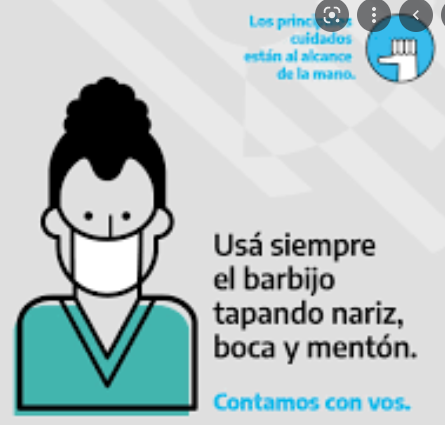
Instructions for your barbijo.

In Argentina, where I recently spent a month-plus, there are no mascarillas—rather, there are barbijos and tapabocas, two words that seem etymologically or otherwise curious. Barbijo derives from barba (beard), which feels odd since both men and women wear them, so perhaps it should be “barbijx” in interest of inclusive language?

This tapabocas covers more than just the mouth.

Alternatively, Argentines use tapabocas, which literally means “mouth covering”—oddly inappropriate, one would think, when masks are supposed to cover both the mouth and nose. Nevertheless, during my time there, Argentines were pretty conscientious about wearing their masks properly—both indoors and outdoors.


SCL to PUQ to MPN

Mount Pleasant International Airport (MPN) in the Falklands

Meanwhile, flights from the South American continent to the Falkland Islands will resume this coming Saturday, July 2nd. Since the Islands—insular Patagonia, if you will—form an important entry in the book, I’m very keen to return. Also, having lived there for more than a year in 1986-7 and revisited half a dozen times, I have many friends and acquaintances whom I am keen to revisit.

The Offices of International Tours and Travel (LAN has since been rebranded as LATAM)

According to an email I received from Sally Ellis, of Stanley’s International Tours and Travel, “The LATAM airlink with Chile will resume on 02 July with its normal route of Santiago - Punta Arenas - Falklands roundtrip, and a roundtrip possible from [the Argentine provincial capital of] Rio Gallegos if you travel to the Falklands on the second Saturday of each month and return on the third Saturday of each month.” It’s worth noting here that anyone flying from Punta Arenas to the Falklands and disembarking in Río Gallegos on return could run afoul of Argentine immigration—since Argentina consider the Falklands to be theirs, they may not give you an entry stamp at the airport and, when you try to leave at another border post, officials there might say you entered the country illegally.


Before the pandemic hit, there was an alternative route via Brazil and the central Argentine city of Córdoba but, according to Sally, “The Brazil route has no resumption date yet but will not be before the summer - maybe November?” I’ve never taken this route, but I wouldn’t rule it out at some point—especially since it would give me a chance to revisit one of Argentina’s most historic provincial capitals and its nearby Sierras.

Friday, April 22, 2022

Purgatory 2.0? EZE to DFW (and, Fortunately, Beyond)

Early last week, anticipating our flight back to California (via Dallas), we rose early and went to the closest location of CentraLab, a private medical testing company in Buenos Aires. To return to the US, being fully vaccinated against COVID-19 is still insufficient to return; it requires either a PCR or an antigen test the day before flying. It’s worth noting that this is not a 24-hour requirement; our flight was scheduled for 8 p.m. Friday evening, but any time on Thursday would have been acceptable.

Results of the antigen test (with personal info edited out)

The obligatory attestation...

We were hoping to be able to schedule the tests there, but that location did not handle COVID testing. Rather, they said, we would have to schedule an appointment online for a different venue—but one that was still only a US$2 cab ride from our apartment. If our appointment hadn’t been at 8:45 a.m., we’d have walked there but, as it was, we got there shortly after 8 and they saw us almost immediately. In just two hours we received the results and could relax. After filling out the obligatory attestation for US immigration, we finished our last full day with an Italian dinner, with my brother-in-law and his wife, at Trattoria Olivetti (its walls decorated with typewriters), just across the street from our place.

The exterior of Olivetti
And the interior...

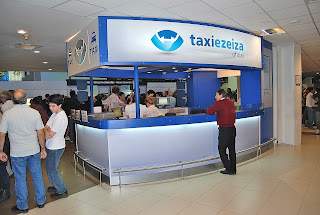
The next afternoon, getting to the airport was a bit more complex than we anticipated. Leaving the apartment, we immediately caught a cab to the central Terminal Madero in the expectation of catching a Tienda León remise (livery car) to Aeropuerto Internacional Ministro Pistarini (aka Ezeiza). Because there were two of us, this would be only marginally more expensive than taking the bus, but on arrival we learned that there were no longer any remises operating at the site. The only option was the bus, for which we would have to wait nearly an hour, so we opted for catching another taxi in the street, for which we paid Ar$6000 including tolls.


That was more than the Ar$3820 (US$35.32) I had paid for a remise from the airport a month earlier because, lacking sufficient Argentine cash, I had to use my US credit card. In this later instance, though, I paid with “blue dollar” pesos which made the cost US$34.31 for the two of us (had we taken the first taxi all the way from our apartment, it would’ve been cheaper yet).


Arriving at Ezeiza, we found a fairly long line for our American Airlines flight to DFW, where we would have a four-hour layover before connecting to San Francisco, but we got through immigration and security quickly—or did we? While I used to enjoy flying, I’ve grown to loathe airports but I have appreciated the fact that, in Buenos Aires, we don’t have to remove our shoes and all the electronics from our carry-ons.

This guy's 2008 visit to Buenos Aires didn't go over well.

I spoke too soon, though—when we lined up to board the flight, I found myself randomly (?) singled out for a secondary check that did involve removing my shoes and my electronics, and even inspecting my iPad for, apparently, traces of explosives. For this I blame the individual in the photo above who, until 2017, was the worst president in my country’s history. He and others of his party have done lasting damage both domestically and internationally.

We didn't get much flight information...

Last month’s flight from DFW to Argentina was, without question, my worst experience ever in the air, and one I didn’t care to repeat. Here, though, my initial impression was positive as the Boeing 787 sported a great-looking touch screen for entertainment, but that didn’t last long. For some time, according to the electronic in-flight map on which I normally enjoy watching the plane’s progress, we never left the ground and the hour never changed from 7:53 p.m—“distance to destination 0 km, time to destination 0 minutes.” Eventually a rotating globe appeared, but it soon showed us off the coast of West Africa, approaching the Ivory Coast port of Abidjan!


That, of course, did not inspire confidence, and things got worse as it became apparent that the overhead reading lights did not work in any section of the plane, and to read my paperback novel I had to hold my phone’s flashlight with the book in my lap. Meanwhile, the in-flight food offerings were so unappetizing that I consumed nothing but water. Mercifully, I managed to fall asleep for about a third of the ten-hour ordeal and, when we arrived in Dallas, we passed quickly through immigration and customs, with not even a perfunctory look at our baggage.


So, this flight wasn’t quite so bad as the previous one but, that said, we were now in COVID-friendly Texas where, despite the ongoing mask mandate in airports, at least a third of all passengers couldn’t be bothered about spreading a potentially deadly disease. Fasting to avoid contributing even a penny to this dysfunctional state, we waited at our gate only to learn that a last minute change would require us to sprint more than a mile through the sprawling terminal. Texas is the new Purgatory, and it was a relief to board a flight to the comfort and safety of California.


Wednesday, March 9, 2022

Is Purgatory Real? SFO to DFW to EZE on American Airlines

I’m not Catholic—in fact, I’m an atheist—but after completing my first flight in two years, I think I finally understand the concept of Purgatory. Early Sunday morning I started the initial leg of an odyssey that took me from San Francisco to Dallas Fort Worth to Buenos Aires and, except at the very beginning and the very end, it was a disagreeable experience that I felt might never end.

First the good—after my wife dropped me off at SFO, the counter attendant who did my check-in was a simpático Uruguayan who did his best to promote his homeland, though it’s unlikely I’ll cross the Río de la Plata to Montevideo or any other port in the Banda Oriental on this trip. After checking my vaccination card and PCR test (no more than 72 hours prior to departure for Argentina), he also snagged me aisle seats for both legs of the journey (In theory I still prefer window seats to enjoy the landscape from 35,000 feet, but my prolonged recovery from last year’s ankle surgery has made ease of access more important than it used to be).


Things quickly deteriorated from there and that, of course, meant security theater from the so-called “Department of Homeland Security.” On my body scan, they saw things they didn’t like—one of which was a money belt that included the US cash I was carrying to Argentina because the official exchange rate is so disadvantageous. That was fairly easy to explain, but they also detected a “suspicious” elastic knee support I was wearing because of recent soreness and, even worse, a support sock apparently set off their metal detectors (I’ve been wearing one ever since my surgery, and it contains trace amounts of copper). In both cases I rolled up my trousers to invite a direct inspection, but the individual who detained me felt obliged to call in a superior who eventually authorized me to continue.

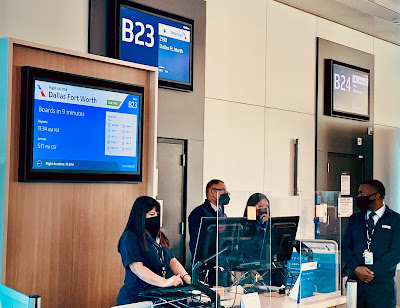
SFO to DFW left on time from Gate B23.

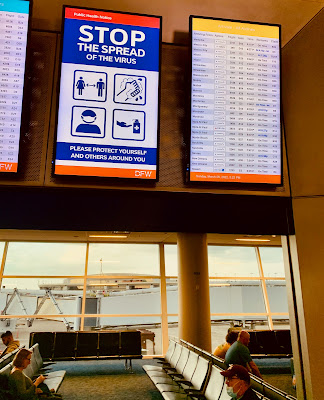
At DFW, prominent signs didn't necessarily mean compliance.

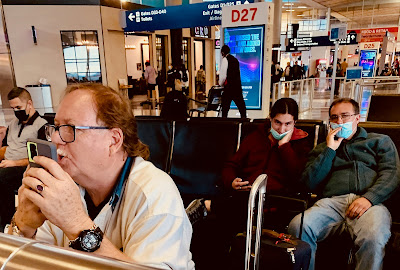
Gathering my belongings and putting my shoes back on, I proceeded to the gate and, surprise of surprises, the flight to DFW (Dallas Fort Worth) left on time and even arrived a few minutes early, with no anti-masker incidents on board. Immediately I noticed, though, that in COVID-friendly Texas many people were disregarding CDC masking regulations despite numerous posted signs. At SFO, mask compliance appeared to be 100 percent, while at DFW I would estimate that some 30 percent were ignoring the regulations in one way or another. The worst case that I observed was a 60-something porteño loudmouth on his phone at a charging station; when I gently suggested he should use his mask, he went ballistic.

The loudest scofflaw was an Argentine shouting into his cell phone.

DFW recently made No. 8 on a list of the country’s ten-worst airports. That’s partly because of frequent delays and, indeed, our departure for Buenos Aires was more than two hours after the scheduled time. It got worse, though, as the gritón mentioned above was just one seat away and, for most of the flight, couldn’t be bothered to wear his mask. He was not the only one, though, and even some of the flight attendants couldn’t be bothered on a plane that was nearly full. There was also one of the worst shrieking toddlers ever to keep me from even attempting to sleep.

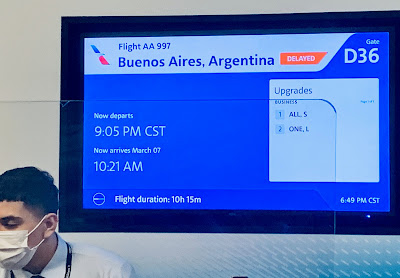
AA 997 left more than two hours late from Gate D36.

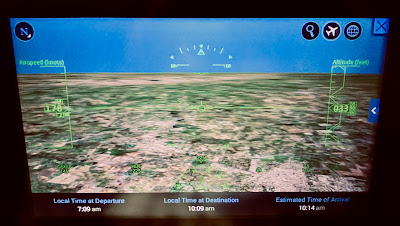
I passed on both dinner and breakfast—life’s too short to dine on airplane food, and I eaten had a decent prosciutto sandwich while waiting for takeoff. I did sample a glass of a Pinot Grigio on board (American has been one of the last airlines to resume alcoholic beverage service), but it was almost undrinkable. My only regret is that I hadn’t realized that my video screen included a window-seat view camera which, though not so good as an actual window seat, at least provides a rough view of the landscapes below.

Unfortunately, I only discovered the window-seat camera view shortly before we landed in Buenos Aires.

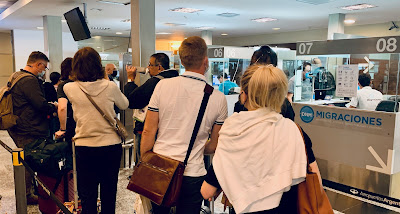
Immigration was fairly quick and efficient at Ezeiza.

Once we deplaned on Monday morning, things got better. Immigration lines weren’t long, and the official who processed me asked only to see my declaración jurada (affidavit) for evidence of vaccination and other info (it’s obligatory to fill out the declaration 48 hours prior to departure for Argentina). I quickly showed him the PDF on my phone, and then he put the first stamp in my brand-new passport. I then went to the office of Transfer Express for a cab, for which I had to pay the official exchange rate via credit card because I fell just short of enough Argentine pesos acquired at the so-called “blue rate” on my last visit.

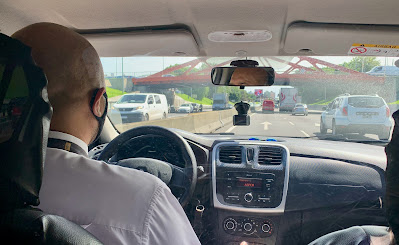
A glass partition separated me from my Venezuelan driver, but didn't inhibit conversation.

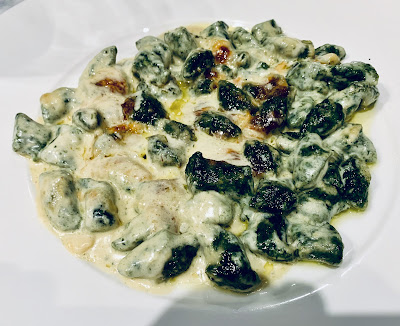
Traffic into town wasn’t bad, and my cabbie was an agreeable Venezuelan with whom I could talk baseball—a pleasant coda to perhaps the worst flight I’ve ever endured—despite the glass partition that now minimizes driver-passenger contact in the pandemic world. At home in our Palermo apartment, after a refreshing nap to make up for lost sleep, I enjoyed a plate of spinach gnocchi at Bella Italia Café, just down the block, before retiring for the night.

I ended the day with a plate of spinach gnocchi at Bella Italia.

Support Southern Cone Travel

If you've found this essay amusing, interesting or otherwise useful, feel free to click on an ad to earn me a few pennies. Thanks for your attention.


Sunday, January 30, 2022

"Good Behavior," Argentine Style? (A Streaming Review)

Since March of 2020, when I fled Argentina and Chile with the onslaught of the COVID-19 virus, I’ve been not quite housebound, but have only managed scattered day trips in the Bay Area and the couple short road trips to California’s Central Coast and the Sonoma/Mendocino County shorelines. Like many others, I’ve spent more time than I might care to admit in front of the TV screen, streaming whodunits and other dramas before retiring early enough to let me walk the dog at daybreak. I've avoided travel shows, because they remind me of what I can’t do until the pandemic recedes (very tentatively, my wife and I plan to return to Buenos Aires in early March for a month).

Meanwhile, in the course of exploring streaming services, I stumbled across an oddball series, a sort of black comedy, set in North Carolina but with links to Argentina. In Good Behavior, which first showed on TNT in 2016 and 2017, English actress Michelle Dockery plays the role of Letty Raines, a resourceful thief and scammer with addiction issues, who’s out on parole and trying to regain custody of her pre-teen son. This rather differs from Dockery’s role as the aristocratic Lady Mary Talbot in the PBS historical series Downton Abbey (disclaimer: I am not a fan of British costume dramas, and have not watched more than a few minutes of that one, to which my wife is addicted).


Shortly after her release from prison, Letty stumbles upon a contract killing and does her utmost to stop it (albeit unsuccessfully). In the process, she becomes involved with Javier Pereira (Juan Diego Botto), an Argentine hitman with a conscience of sorts (Botto is in fact an Argentine who spent part of his youth in the US). The Pereira character is also a chef who sometimes works in the Argentine-style parrilla (grill restaurant) owned by his sister Ava (played by Botto’s real-life sister María in a sort of meta-role).

This Javier, in Oakland, is not a contract killer.

Javier is not a Hannibal Lecter wannabe, but he does have issues with his father Oscar (played by the Argentine-American Daniel Faraldo), who has a dark past of his own. There’s an additional complication in Ava’s ex-boyfriend Teo (played by Canadian actor Juan Riedinger), but there’s plenty of comic relief as well.


Unfortunately, TNT cancelled the show after two seasons, but it remains available on Hulu (no endorsement here, but there are 30-day free trials).


Support Southern Cone Travel

If you've found this blog informative and/or useful, please click a (hopefully appropriate) ad to earn me a few pennies.

Wednesday, January 19, 2022

Mendocino is Cooler Than Buenos Aires (Literally)

At the end of last month, I wrote that my wife and I had postponed a planned trip to Buenos Aires because of the spread of the Omicron variant of the COVID-19 virus there. In addition, our route would have taken us through COVID-friendly Texas and, given the frequency of flight cancellations by American Airlines, it was possible we might have had an unwelcome delay of a day or more in Dallas/Fort Worth.

Mapping the heat wave, from Argentina's Servicio Meteorológico (in degrees C)

Very tentatively, we’re hoping to try again in March, but early January provided us yet another reason to justify our decision—a brutal heat wave that struck the Argentine capital and much of the rest of the country. In summer, of course, we would expect warm and even hot temperatures, but last week the mercury soared to 106° F (41° C) in the city and, in the north-central city of Córdoba, it reached 108.5° F (42.5° C). The western desert city of San Juan was a near-furnace at 111° F (44° C).


A few years ago, we reluctantly installed air-conditioning in our Palermo apartment, but we’ve never used it during our time there—our idea was that it would appeal to short-term rentals. Even that mightn’t have mitigated this heat wave, though, as there were power outages in much of the city. Global warming, anybody?

A typical landscape at Sea Ranch (note the houses in the background)

The town of Gualala (as seen from Sea Ranch)

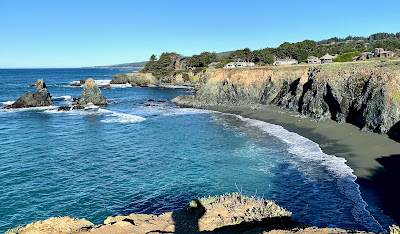
With that in mind, we took a mini-vacation with our daughter, her boyfriend, and our two dogs, up the Sonoma County coast to Sea Ranch—an ostensibly eco-friendly development that I’m personally ambivalent about. The scenery resembles coastal Chile, the night skies sparkle, and there’s almost total silence except for occasional gobbles from wild turkeys outside your windows and waves crashing on the beach. Still, I find the supposedly cutting-edge architecture monotonous and the absence of any urban amenities bothersome—there’s no alternative to the automobile for transportation to the town of Gualala, some miles north, for essential shopping. In effect, Sea Ranch is a de facto “gated community” even though the State of California requires obligatory coastal access for non-residents.

The village of Mendocino, as seen from the nearby headlands
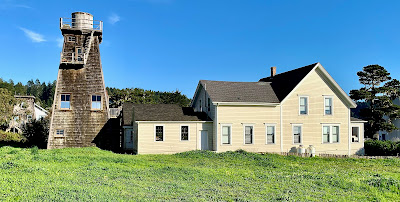
Some Mendocino water towers have been repurposed for residential use.

We spent four nights in a short-term rental house, arriving on a Friday afternoon and leaving the following Tuesday morning. Two full days is about my limit there but, given the late Friday arrival, Saturday and Sunday were dedicated to extended dog walks on the coastal trails (significantly cooler than Buenos Aires). On the Monday, though, we escaped north to the truly picturesque seaside town of Mendocino (population 855), where we walked along the coastal cliffs and explored its quaint architecture, including numerous water towers—some of them since converted to housing.


In popular culture, Mendocino has been a location for numerous films and TV series, but I recall it best for the 1968 hit song “Mendocino” by the Sir Douglas Quintet (Texas transplants to California whose producer chose the name to try to capitalize on the Beatles-inspired “British invasion” craze; the above video is a version by Sahm's later band, the Texas Tornados). Interestingly, my wife knew the song even before we met, as it was also a big hit in Argentina; though neither she nor her friends really understood the lyrics except for the title, they could dance to it.


Even more interestingly, the group leader Doug Sahm (born in San Antonio) was of German extraction and, I recently learned, Michael Holm (above) recorded a German-language version that became a chart-topper in then West Germany the following year. Does this explain the fact that the German real-estate firm Engel & Völkers maintains an office in Mendocino, and that all its window listings there are bilingual in English and German? Perhaps it does, as the comments on Holm's YouTube video include one by a German whose wife insisted he take her to visit there (German used to be my second language, but it’s now a distant third to Spanish and I couldn’t catch much of Helm’s lyrics).


Mendocino seems idyllic, but it’s not immune to the rest of the country’s problems. Almost everyone we saw in town was masked up but, not that long ago, the anti-vax owner of Fiddleheads Café posted notices that he would collect a surcharge for any client wearing a mask, and an additional charge for anyone who bragged about being vaccinated. He’s since gone out of business, but might still be welcome in Texas (in fairness, the state has great food and music despite its COVID-friendly politics).

Thursday, December 30, 2021

Why We're Not Going to Buenos Aires Now, and Other Miscellanea

Recently I dreamt that, having arrived at Buenos Aires’s Aeropuerto Internacional Ministro Pistarini (commonly called “Ezeiza”), I was in a taxi to our apartment in the barrio of Palermo—where my wife and I had been longing to go ever since the pandemic began. En route, though, I realized I’d left the keys at our California home—and then I awoke wondering whether that was a metaphor for the times we’re in. In fact, we’d planned to fly to Argentina this New Year’s Eve, and were eager to see friends and family in and around the Argentine capital, but I’d begun to have my doubts as news of the Omicron variant hit the country especially hard.

We might have hired a taxi here...

Uki Goñi's Twitter account is a good up-to-date source on many Argentine topics.

In fact, I’d contemplated postponing the trip a few days earlier, but María Laura was still committed to going until Monday, when she first expressed doubts and then consulted with siblings, nephews, nieces, and friends (some of whom are directly involved in the healthcare system there). Everyone concurred that the situation was worsening, and expressed doubts about the trip despite their eagerness to see us.

Argentina's vax rollout has actually been pretty good, but I couldn't resist posting this photo from my nephew's Parque Patricios neighborhood.

For our part, we are fully vaccinated and boostered, and live in an area where people take vaccinations and masking seriously, so we were never panic-stricken. That said, we could still theoretically be carriers, and we didn’t want to risk a breakthrough case that could put others at risk. We also worried, however, that flight cancellations and layovers might disrupt the trip—partly because San Francisco International Airport (SFO) is notorious for weather delays and also with respect to our connecting flight in COVID-friendly Texas. That state has great food and music, but deplorable government.


That said, we look forward to trying again in March or so. I might stay a bit longer than the month we originally planned on, as I’m starting to work on the upcoming sixth edition of Moon Patagonia—perhaps an excursion to Ushuaia is in order.


Meanwhile, in Chile…

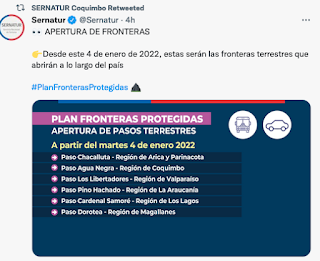
Chile, of course, will be a key part of the Patagonia update, and its high vaccination rates have made it an example to emulate in handling the pandemic. It’s been circumspect about the entry of non-resident foreigners, though, and that seems likely to complicate the upcoming tourist season, even though more border crossings are opening with Argentina and its other neighbors. Still, there are fairly stringent requirements, including quarantine, and the Chilean bureaucracy has also been slow to acknowledge intending visitors’ vaccination status—according to a friend of mine who’s a permanent resident, a friend of his spent two weeks stranded in Lima because LATAM Airlines would not let him board a connecting flight.

Chile's border are reopening, at least in theory.

For me, as an independent traveler having to cross the border multiple times while updating my book, frequent retesting and quarantines would mean significant delays and expense. As the attached screenshot shows, that situation may be improving), but requirements are likely to change even more so that southern spring—October or November—seems more agreeable.


Of course, Chile’s made international headlines for its recent presidential election in which the left-leaning (but hardly extreme) Gabriel Boric defeated right-wing extremist José Antonio Kast (a Pinochet worshipper whose German-born father was literally a Nazi). Though Kast finished first in the multi-candidate primary (there were seven options), the 35-year-old Boric won the runoff handily and, to Kast’s credit, he quickly conceded and congratulated the winner. It’s worth noting that Boric’s final margin was almost identical to that of the 1988 plebiscite that ended Pinochet’s “presidency,” and that Communist candidate Eduardo Artés received only 1.46 percent of the primary vote.

The losing candidate's late father, at right, was literally a Nazi.

Even so, Kast partisans’ accusations of extremism have continued, the “markets” were not pleased with the result, and the peso has slipped against the US dollar (any visitor so inclined could now eat a Weißwurst more cheaply at the Bavaria restaurant chain that is the basis of the Kast family fortune). Still, as Chile proceeds with a Convención Constitucional to draft a new constitution to replace the Pinochet-friendly document authored by the late rightist lawyer Jaime Guzmán, the challenges to a long overdue reform won’t disappear. The new charter must be approved by plebiscite but until then and even after, governing could be a challenge.


In Other News…

My Patagonia title also includes the Falkland Islands, where I once spent an entire year and have revisited at least half a dozen times. Except for my initial trip, when I flew from and back to the United Kingdom (with a memorable stopover on Ascension Island), I’ve always arrived via the southern Chilean city of Punta Arenas but, since the start of the pandemic, there’ve been no flights on that route, which requires overflying Argentine airspace.

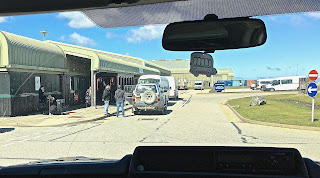
The passenger terminal at the Falklands' Mount Pleasant Airport

Next year, hopefully, these flights will resume, but the Argentine government (which claims the Islands as the “Malvinas”) has recently stonewalled humanitarian charter flights that would have allowed the Islands’ Chilean residents (there are roughly 200 of them) to return home for the holidays. That’s not an auspicious development.

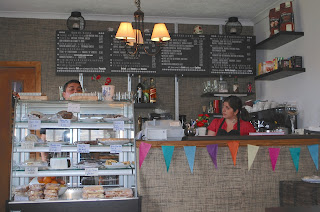
Alex Olmedo's Waterfront Café is a Chilean-owned business in Stanley.

For an incisive account of the Islands and their current prosperity, read Larissa MacFarquhar’s outstanding piece in The New Yorker, researched immediately before the pandemic.


Friday, March 19, 2021

After the Jabs? Post-Pandemic Patagonia's Not Quite There

Proof of life?

On February 24th, I received my second dose of Moderna’s COVID-19 vaccine and, two weeks later, I undertook a full-scale grocery mission to Berkeley Bowl West for the first time in a year (my wife—also fully vaccinated now—was doing the shopping in that time, while I had only made occasional brief sorties to a neighborhood grocery). It felt like a milestone, one of the first, perhaps, in my quest to return to southernmost South America (even if, for now, I may have to settle for the pears on display here).

The aisles at Berkeley Bowl, on my first visit in a year

A nice pair?

I have yet to renew my passport—having waited purposefully until a new and competent administration took over the reins of government in Washington—but, in any event, I won’t be heading south until November at the earliest. That said, I couldn’t help but notice that LATAM Airlines was offering flights from Los Angeles to Santiago for as little as US$500 r/t. For some time after I returned from Chile to LAX last March 27th, the pandemic had closed the border to all but Chilean citizens and permanent residents but now, it appears, times may be changing.


Is Chile Winning the Arms Race?

Part of the reason, surely, is Chile’s success in vaccinating its population. According to Latin America Reports, five million Chileans may have already received their inoculations, and the government has agreements with China (Sinovac), Pfizer, Johnson & Johnson, and AstraZeneca to acquire 36 million doses (the country’s population is roughly 19 million). While President Sebastián Piñera’s second term has been shaky, there’s no doubt that his administration has been proactive in protecting the population (though there’ve been conflicting data on the Chinese vaccine’s effectiveness). Quarantines, curfews, and other sanitary measures also remain in force.


What does this mean for intending for potential foreign visitors (like myself and my readers)? Because of the previous US administration’s malfeasance and negligence, it’s been worrisome that US passports may have lost the cachet they once had but, as LATAM’s promotional fare would suggest, that’s not an issue at present. That said, any trip to Chile will run into various restrictions: there are several COVID requirements, including a negative PCR test, a sworn pre-boarding statement, a health insurance policy, an electronic tracking form on arrival, and an obligatory ten-day quarantine. Santiago’s Aeropuerto Internacional Arturo Merino Benítez is the only authorized entry point, and there are additional requirements for traveling beyond Santiago, especially to Patagonia, which may entail additional PCR tests.


How Hard is the Border?

These are Argentina's open border crossings - but with restrictions

In my case, the need to cross the Argentine border complicates matters even further, but I’m probably better placed than most. At present, the only non-Argentines permitted to enter must be relatives of Argentines and, being married to one for nearly 40 years, I technically qualify—but only if there’s a family-related issue at stake. There are just a handful of open crossings, the most convenient of which is Aeropuerto Internacional Ministro Pistarini, commonly known as “Ezeiza,” in suburban Buenos Aires. The only option in Patagonia is Paso San Sebastián, shared by Argentina and Chile, in Tierra del Fuego, but if I somehow managed to enter Argentina, a patchwork of local and provincial travel restrictions could make any such achievement a pyrrhic victory. Instead, I’ll wait.


Custom Search