Showing posts with label Misiones. Show all posts

Saturday, June 18, 2011

To the North: Ash-Free Argentina & Chile

After writing three separate posts about the eruption of Volcán Puyehue, which remains on red alert, I’m suffering from volcano fatigue. Since southern Chile and Argentina are lesser winter than summer destinations anyway, I’ll use today’s post to make suggestions about ash-free travel in the northern deserts and moist forests and wetlands of the two countries, where it’s presently possible to make air connections from Buenos Aires and Santiago, where international airports are once again open. The destinations that follow are actually better in winter, when milder temperatures are the rule.

Esteros del Iberá

Perhaps the most underrated destination in all of Argentina, the Iberá marshes of Corrientes province are a cornucopia of subtropical wildlife, where it’s possible to come face-to-face with caimans, capybaras, howler monkeys, marsh deer, and perhaps even a maned wolf - not to mention nearly 350 bird species. Estancia Rincón del Socorro offers expensive luxury tours and accommodations, but nearby Colonia Pellegrini offer alternative services for every budget from shoestring backpackers up.

Cataratas del Iguazú

Unlike Iberá, the Iguazú falls are world-famous, even appearing in commercial cinema epics such as Moonraker (1979), The Mission (1986), and Indiana Jones and the Kingdom of the Crystal Skull (2008). Recent theme-park transformations have made visiting the falls a less adventurous experience than it once was, but there’s no denying the visual and aural impact of thunderous whitewater that plunges vertically over a basalt escarpment half again as high as Niagara, and more than twice as wide. It’s also a UNESCO World Heritage Site.

Quebrada de Humahuaca

Like Iguazú, the Humahuaca canyon is a UNESCO World Heritage Site, for its imposing natural landscapes, archaeological sites, and an indigenous heritage that recalls the Four Corners area of the southwestern United States. At its highest altitudes, winter nights can get cold, but July and August are warm and dry during the daytime.

Iquique

The capital of Chile’s Tarapacá region, the coastal city of Iquique has a mild dry climate all year - even as the winter solstice approaches, the forecast daytime temperatures for the coming week are in the mid-60s (around 18° C). That may not be warm enough to swim in the chilly Pacific - though wet-suited surfers enjoy big winter waves from storms at sea - but it’s warm enough to enjoy the city’s Victorian architecture, the nearby nitrate ghost towns of Humberstone and Santa Laura (another UNESCO World Heritage Site, pictured above), and the pre-Columbian geoglyphs that cover the hillsides of the Cerros Pintados.

San Pedro de Atacama

The best-known destination in the Atacama desert, San Pedro is a genuine colonial village that’s also become a magnet for travelers ranging from full-moon party-goers to the most selective of those for whom cost is no object - at the all-inclusive Hotel Awasi, for instance, the guest to guide ratio is one to one. Like Iberá, though, San Pedro also offers cheap to moderately priced alternatives for everybody to visit sights such as the frigid but flamingo-filled lakes of the altiplano, the geyser fields at El Tatio, and pre-Columbian ruins at Catarpe and Quitor.

Help Support Southern Cone Travel
If you have found this article informative, please consider clicking on one or more of the AdSense links that accompany it - always presuming, of course, that it’s a product or service that interests you.

Wednesday, August 18, 2010

Beating the Heat, Below the Equator

Published out of Los Angeles, the Huffington Post is really a news aggregator website with a diversity of opinion blogs that are mostly, but not exclusively left of center. It’s far less well-known for its travel page even though, for example, it creates entertaining features such as last month’s digital slide show of the “Top 10 Southern Hemisphere Cool-Off Spots.” Actually, that title is a little misleading, as at least the editor appears unable to count beyond “10,” as one additional destination appears in the list. Then again, that editor could be a former member of Spinal Tap (“it goes to 11,” after all), though probably not a drummer.

As the northern hemisphere summer winds down, it’s still pretty hot in parts of Europe and North America, so I though it would be worth taking a look at Huffpo’s list - especially since five of them are in Argentina and Chile, the countries I cover in my Moon Handbooks. Huffpo readers get a chance to vote on the destinations in question, ranking them from one (“No way!) to 10 (“Packing now!”). No, this scale does not go to 11.

Surprisingly, at least according to Huffpo readers, the number one attraction of the bunch is Chile’s Portillo ski area (pictured above, in summer). It’s not that Portillo isn’t a worthy destination for skiers - many downhill ski records have been set here and the lack of trees increases the skiable terrain - but rather that the hotel and other non-ski facilities lag behind newer Chilean resorts such as Valle Nevado, which has upgraded its non-skiing infrastructure. Short of adding a new wing, for instance, there’s limited possibility of improving Portillo’s classic hotel because the rooms are relatively small.

Third place in the voting went to Buenos Aires, though the editors used clichés such as the “Paris of South America” to describe Argentina’s capital. At the same time, the editor(s) showed a photo of rejuvenated Puerto Madero (with an apparently photoshopped full moon rising behind it; the photo above is mine) rather than the barrio of La Boca, with its tourist trap weaknesses.

Coming in fourth was Iguazú Falls but, astonishingly, the photo caption called it part of Brazil - in fact, it is only partly in Brazil, and the sector of the falls it stresses, the Garganta del Diablo (Devil’s Throat, pictured above), is exclusively on the Argentine side. Nor is Iguazú, as Huffpo claims, “a virgin jungle ecosystem” - to be sure, there is plenty of native forest, but the part closest to the falls is as groomed as any Disney theme park.

Huffpo readers ranked the Chilean lakes district fifth, though the editors displayed a summer shot of Volcán Osorno (pictured above) and the Río Petrohué - visiting the vicinity of Puerto Varas in the southern winter would be more like going to Seattle or Vancouver in January or February, with damp wet weather even if the temperatures are usually above freezing.

Equally surprisingly, San Carlos de Bariloche came in ninth as Huffpo published a photograph of its landmark neo-Gothic Catedral Nuestra Señora de Nahuel Huapi, designed by Alejandro Bustillo (the photo above is mine). Though I’m not myself a skier, I would rate Bariloche above Portillo, if only because it offers so many urban diversions in addition to fine skiing at Catedral Alta Patagonia, barely 15 minutes from downtown.

Meanwhile, the Buenos Aires province beach resort of Mar del Plata makes another Huffpo list of the world’s 12 most overcrowded beaches and, in summer, it’s hard to deny that, but off-season - as it is now - it makes a great escape. Its terms of crowded summer competitors, it ranks with beach resorts like New York’s Coney Island, Rio de Janeiro’s Copacabana, England’s Brighton (whose pier closely resembles the one at Mar del Plata), but Mardel only comes in seventh on a scale that ranges from “the more the merrier” to “a bad dream.” South Africa’s Golden Mile Beach comes in first.

Wednesday, August 4, 2010

Backroads of Salta (Part 1)

It’s been a frigid winter in Argentina, from the tip of Tierra del Fuego to the northern border with Bolivia - even at subtropical Iguazú, tonight’s temperature will bottom out around 41° F (5° C). Toward the end of the week, though, there’ll be a warming trend and, for the rest of the winter, the climate should be ideal for one of my favorite road trips: the roughly 500-km (300-mile) triangle from the northwestern colonial city of Salta and back via the polychrome Quebrada de Cafayate and its high desert wine country, the scenic Calchaquíes valley hamlets of Molinos and Cachi, and the vertiginous zigzag descent through the Quebrada de Escoipe.

Because it’s a circuit, this route is ideal for a rental car or, for those with more time and energy, a bicycle. Southbound from Salta, the smoothly paved road climbs slowly but steadily through the lush Lerma valley but becomes far more scenic when it crosses into the valley of the Río de las Conchas, otherwise known as the Quebrada de Cafayate. Here, the Sierra de Carahuasi reveals a series of free-standing landforms, box canyons (pictured above) and dunes reminiscent of southern Utah or northern New Mexico - not to mention “gauchos de Güemes” (pictured below) with the oversized, stiff leather chaps that protect them from the thorny backcountry brush. It’s roughly a three-hour drive to the town of Cafayate but, with stops to explore the scenery and take photographs, figure a late afternoon or early evening arrival.

With a population of about 10,000, Cafayate is the hub of one of the world’s highest wine-growing districts - at 1,660 meters (5,446 feet) above sea level, it enjoys warm days and cool nights that bring its grapes, most notably the fruity white Torrontés, to a perfect maturity. At this time of the year, of course, the vines stand leafless as pruning and other vineyard activities proceed, but by next month they’ll start leafing out - even in some nearby vineyards that are nearly a thousand meters higher.

While the vineyards may be dormant, the wineries are not, and Cafayate has more than half a dozen of them within staggering distance of each other - there is no need or excuse for a DUI here. On top of that, the traffic moves more slowly and cautiously, in town at least, than it does elsewhere in Argentina, so even slightly tipply pedestrians are safer than they might normally expect among some of South America’s worst drivers.

Calafate has seven wineries in town proper, and another three are within cycling distance; in some cases, as with Bodega Nanni and Bodega El Tránsito (pictured above), they’re literally right across the street from each other. My current favorite is the Pequeña Bodega Salvador Figueroa, a Lilliputian locale producing only 2,500 bottles of classic Malbec, 2,500 of oaked Malbec, and 600 bottles of Torrontés per annum. Most of them offer free tours and tasting though, in a few cases, there’s a token charge.

When you tire of tasting, one of Argentina’s most impressive archaeological sites is only half an hour’s drive south: the ruins of Quilmes, in Tucumán province (pictured above), are the closest thing to Machu Picchu to be found in Argentine territory. It’s best to stay in Cafayate, though; a two-night stay should suffice to visit the ruins and most if not all of the wineries. A personal favorite for accommodations is Hotel Killa Cafayate, just a couple blocks off the main plaza, but Villa Vicuña is also very fine and, for luxury, there’s the Sheraton-owned Hotel Patios de Cafayate (pictured below), on the grounds of Bodega El Esteco at the north end of town.

For those who have never dined on llama steak before, downtown’s Macacha (Avenida Güemes Norte 28) is the place to do so. Nearby Heladería Miranda offers wine-flavored ice cream - the fruity white Torrontés tops the red Cabernet (sadly, says the owner, Malbec grapes do not make good ice cream).

Within a few days, look for the rest of this backroads tour, covering the more rugged sector up the Calchaquíes valley to Molinos and Cachi, and then back to Salta.

Friday, May 28, 2010

Chasing Che Guevara

My friend and colleague Chris Baker, author of several guidebooks for Moon and other publishers, has recently noted that Argentina, Bolivia and Cuba have recently collaborated to create a route called "Los Caminos del Che," to follow the travels of the legendary Argentine born revolutionary Ernesto Guevara. While my first-hand knowledge of Cuba is nil and I’ve spent only a limited time in Bolivia (and none in the area where Che met his fate), I’ve written about his Argentine youth in the course of my own travels in the country, and have visited several Argentine sites recently.

Argentina’s portion of the Guevara saga, created under the auspices of the Secretaría de Turismo de la Nación, includes destinations including his birthplace city of Rosario, the northeastern Misiones province town of Colonia Caraguatay, the city of Córdoba (capital of its namesake province) and the nearby town of Alta Gracia, and the Patagonian resort town of San Martín de los Andes.

Guevara always was always more than a little mysterious, and the mystery started with his origins. According to biographer Jon Lee Anderson, Che’s registered birthdate of June 14, 1928, was a deception, as he had been born a month earlier - his mother, Celia de la Serna, was pregnant at the time of her marriage and Che’s father Ernesto Guevara Lynch moved them immediately to remote Misiones, where the pregnancy could be kept secret.

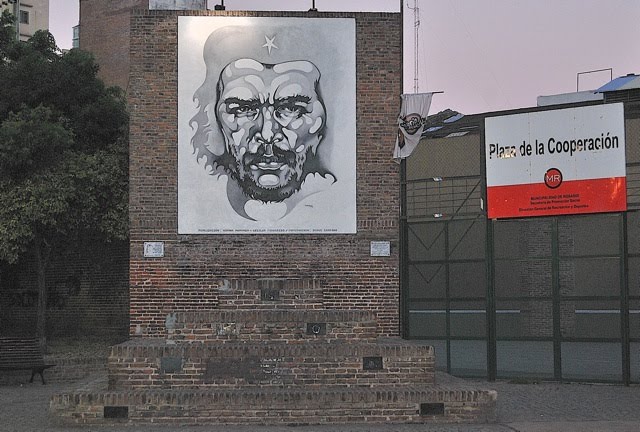
In reality, Che’s presence in Rosario was fleeting - the Guevaras returned to Caraguatay after a brief visit to family in Buenos Aires - but that doesn’t mean it’s gone unnoted. His Rosario residence, a handsome apartment building at Entre Ríos 480, has long been a minor pilgrimage site, and the Plaza de la Cooperación (pictured above), two blocks northwest, features a scowling portrait on a brick wall. Most recently, in 2008, Argentine and Cuban architects collaborated to create the Plaza Ernesto Che Guevara (pictured here), a drab open space with an equally undistinguished statue.

In fact, rather than Rosario, Che-chasers would be better advised to go to Córdoba, where young Ernesto went to school, and Alta Gracia, where his parents moved for the dry, mild climate that would be easier on his chronic asthma. Normally he made the 35-km commute by local bus but, for a time, he boarded in an annex of the Colegio Deán Funes (which no longer occupies its original downtown site). That annex is now the Azur Real Hotel Boutique, the city’s first hotel of its type, and probably the only Argentine hotel that can say “Che Guevara slept here” - on his travels in Patagonia and elsewhere, Che normally crashed wherever he could without paying.

Visitors will learn more about Che by going to Alta Gracia, a charming colonial town that’s home to the Museo Ernesto Che Guevara, which occupies one of several houses that the Guevara family rented in town. Then known as Villa Nydia, it’s the least polemical of any Guevara memorial. In fact, it does such a good job of reconstructing Che’s boyhood - through a photographic history of Ernesto and his family, his school report cards, and memories by his classmates, cook Rosario González (whom I met briefly several years ago), and others - that it doesn’t really place it in any greater context. This may not be the place for a full biography but, from its contents, one would hardly know that Che was a controversial figure, nor have any idea why Villa Nydia was converted into a museum, nor why so many neighbors opposed the conversion - nor even why Fidel Castro and Venezuela’s leftist president Hugo Chávez visited in 2006.

Alta Gracia’s prize exhibits include a bicycle and a motorcycle of the same models that the youthful Che used in his trips around South America. Part of that history is covered in San Martín’s Museo La Pastera Che Guevara, which I covered in detail in another post a little over a year ago. Anyone who wants to follow Che’s South American travels, though, would be better off picking up Patrick Symmes’s Chasing Che, which tells of the author’s adventures in search of the Guevara legend in 1996 (when I met him on Chile’s Carretera Austral).

Thursday, April 16, 2009

Tanking Up in Argentine Mesopotamia

In last week's entry, I wrote about the demise of differential fuel prices in Argentina but, as I subsequently heard from Charly Sandoval of Yacutinga Lodge, near the famous Iguazú Falls, the matter has not gone away completely in Argentine Mesopotamia, the area between the Paraná and Uruguay rivers. As petroleum prices have fallen in Chile, the Argentine government has eliminated the differentials there, but Charly writes that "Differences in fuels for foreigners and locals in Misiones province still apply. Perhaps they are going in the near future to cancel this ridiculous disposition..." but, as this photo from Puerto Iguazú shows, there are different pump prices for Argentine and foreign vehicles (full disclosure: this photo was taken last year, when prices were lower for everyone than they are today).

Still, as he says, "There are plenty of Paraguayans and Brazilians searching for better fuel prices. Being Misiones surrounded by these two countries, the situation here is delicate" as fuel prices are higher there. But, he adds, "Without this price distortion, we were unable to fuel our own transportation in the past. Fuel smuggling all kinds of crazy situations were common some time ago. The price differentiation is ridiculous but it's also ridiculous the situation of running out of diesel for our own working vehicles because foreigners deal with the advantage of the low price and the peso devaluation."

While the measure can be irritating to those of us who travel with foreign vehicles (my own car has Chilean plates), it only rarely affects overseas tourists. If you rent a car with Argentine plates, for instance, you will pay Argentine prices; on the other hand, if you rent a Brazilian vehicle and enter Argentina, you will still pay Brazilian prices for fuel. I expect, although I'm not sure, that the same is true for Uruguayan vehicles, as fuel prices are traditionally much higher there than in Argentina.

Wednesday, March 5, 2008

A Yellow Fever Scare?

Northeastern Argentina, popularly known as Mesopotamia because most of it lies between the Uruguay and Paraná rivers, is an area that boasts extensive subtropical forests and one of the country's greatest tourist attractions in Iguazu falls. Along with Buenos Aires and Patagonia's Moreno Glacier, it's one of the big three for first-time visitors. Recently, though, Argentine authorities have reported the first confirmed case of mosquito-borne yellow fever in 40 years, in the Mesopotamian province of Misiones. Bordering Paraguay and Brazil have had more cases, some of them resulting in deaths, but the Argentine victim (who was apparently unvaccinated) is recovering.

Once so widespread that an outbreak killed thousands in temperate Buenos Aires in the 1870s, yellow fever survives mostly in the humid tropics. Its presence in the region is no cause for panic, but Iguazú-bound travelers should be sure their yellow fever vaccinations are up to date. The individual in question had apparently been clearing trees in a remote area where several monkeys (presumably howler monkeys, which are common in the area) had recently been found dead.

UPDATE: As of Tuesday, March 11, there has been one yellow fever death in northeastern Argentina. Many people here in Buenos Aires are being vaccinated, but it's not really essential unless you're traveling to that region.
Custom Search