Showing posts with label Puerto Varas. Show all posts

Monday, October 21, 2019

Chaos in Chile?

In 1978, when I first traveled to Chile—then under the dictatorship of General Augusto Pinochet Ugarte—there was an 11 p.m. curfew in the capital city of Santiago. That put a dent in the city’s commerce and nightlife—though young people adapted with parties that lasted until dawn—and, of course, its political life. Not so widespread in the provinces, the curfews gradually gave way and, since the return to democracy in 1990, Santiago’s been a 24-hour city.
Chile's capital as seen from the hills of Parque Metropolitano
Or at least until last Friday, when all hell broke loose in apparent response to a relatively modest increase in Metro subway fares. Starting as a social-media encouragement of fare evasion, it escalated into a wider disorder that involved arson, looting and then declaration of a state of emergency by President Sebastián PiñeraAccording to Guardian correspondent John Bartlett (a personal acquaintance of mine), “[T]he headquarters of Italian energy company Enel were engulfed in orange flames as the sounds of helicopters and wailing sirens filled the night sky.”
President Piñera's initial statement on the events in Santiago.
In truth, the discontent is far more than just transport fares, as many if not most Chileans have struggled with dictatorship’s legacy of hyper-privatization on issues like health-care and old-age pensions, even as the country has become—on paper at least—the continent’s most prosperous on a per capita basis. Income distribution, though, is wildly skewed in favor of the very wealthiest—many of them in Piñera’s cabinet.
This stenciled mural in the borough of Quinta Normal suggests the inequalities of contemporary Chile.
Certainly there was need to restore order, but the tone-deaf Piñera made it worse by stating, publicly, that “We are at war...” and sending troops and tanks into the streets. That evoked unwelcome memories of the Pinochet years, even though Piñera himself supported the plebiscite vote that ended the dictatorship in 1990. Speaking more diplomatically, the general in charge of security in Santiago seemed to contradict him in saying that “I’m not at war with anyone.”

Santiaguino friends with whom I’ve been in contact have offered useful perspective on this. Marializ Maldonado, who lives in the working-class borough of Renca, wrote me on Saturday that “We were in the Plaza de Renca, with lots of protestors everywhere. Incredible and unexpected. After a group tried to loot a supermarket, [the authorities] dispersed us with tear gas.” She then went home.

Martín Maldonado (no relation to Marializ), who lives in the middle- to upper-middle class borough of Ñuñoa and teaches at the Universidad de Santiago, forwarded me a brief video of a peaceful cacerolazo (pot-banging protest) there. He suggested that there are two separate issues: One is “a movement that rejects economic policies and claims in favor of health, utilities, salaries and transport.” There’s an incisive analysis of these issues by political scientist Patricio Navia in Americas Quarterly.
Curfews have expanded beyond Santiago.
On the other hand, says Martín, “there’s a covert movement that loots supermarkets, shops, public buildings, buses and the Metro, and then burns them.” The university is closed until at least Wednesday, and the curfew now extends from 8 p.m. to 6 a.m. According to the Metro de Santiago website, the city’s subway system has suffered some US$200 million in damages.

Friends outside Santiago tell similar stories. Christián Guntert, a German who teaches at the Universidad Católica in Valparaíso, was returning from a field trip with ecotourism students when he found the roads blocked with burning tires and had to walk into town. There he saw burning shops in the commercial downtown, with firemen and policemen attempting to restore order. Todd Temkin, an American who’s lived nearly 30 years in Valpo and Viña del Mar, said “they burned a couple of supermarkets, a car dealership, and the Cathedral. Lots of looting. Also quite a bit of looting in downtown Viña.” He was, he told me, “heartbroken.”

The Impact on Tourism?
Curfews are expanding to other cities, but I did find one exception to the chaos. Andreas La Rosé, a German who operates the Casa Azul guesthouse in tourist-friendly Puerto Varas, said “Everything is calm, just all supermarkets are closed.” Prosperous Varas may have been spared the destruction, at least to this point, but he worries about how this might affect the upcoming tourist season.

Chilean operators, of course, are hoping against hope that everything remains calm, but there’s certainly concern. While attractions like Torres del Paine are likely to remain so, getting to them through the capital and larger regional cities like Punta Arenas could be problematic. This is a matter that’s likely to come up tomorrow (Tuesday the 22nd), as I attend AdventureConnect San Francisco, an event where many operators from the Magallanes region will be present. I already know several of them, and I’m hoping they’ll be candid about the upcoming season.

Sunday, March 31, 2019

Chile's Highway Hazards

I consider myself a prudent driver and somehow, in Argentina, I’ve managed to avoid any road accidents—an impressive record given the recklessness of so many Argentine motorists, a topic on which I’ve written at some length.
My long-ago confrontation with Buses Don Carlos on the Carretera Austral. At that time, the narrow road had steep edges, so almost everyone drove down the middle.
I’ve been less fortunate in Chile, though I generally consider it a safer place to drive. Once, on the Carretera Austral, I had a blind-curve bus confrontation that effectively demolished my own car and left me with broken ribs. A few years later, on the same route, I rolled a rented SUV when a tire blew on rough gravel (at that time, in 2001, almost the entire route was rough gravel), but I managed to avoid injury.
Not the SUV that I rolled.
Nothing quite so serious has happened since, though I later lost another car when I loaned it to a Santiago friend and an uninsured driver blasted through a stop sign, forcing her into a sidewalk telephone pole. She, fortunately, was uninjured and my own insurance company reimbursed me for the damage. That enabled me to buy my current vehicle, a Suzuki Grand Nomade with far lower mileage, so in that sense I actually came out ahead.
My current car on the southern segment of the Carretera Austral, almost none of which is yet paved.
On my current trip, there’s been nothing to match those occurrences, but other issues have manifested themselves. For one, Chile’s prosperity has meant a burgeoning fleet of modern automobiles—most notably SUVs—apparently owned by people with a great sense of self-entitlement (Yes, my own car’s an SUV, but I like to think I’m more considerate and I have pragmatic reasons for owning it). Many appear to be people from urban areas—probably Santiago—who think they can drive as fast on gravel as they can on a freeway.

That’s significant because a couple weeks, as I drove at a reasonable speed on a remaining gravel stretch of the Carretera Austral, south of Villa Cerro Castillo, one of these jerks passed me at high speed and threw a rock that hit my windshield. At first, the sound seemed worse than the actual damage but, in the following days, a crack appeared that’s now progressed almost all the way across the dash.
The windshield's due for replacement on Monday.
It doesn’t really affect my driving, because the crack does not obstruct my view of the road. When, however, the car next receives its annual revision técnica inspection, it would not pass and, therefore, I’ll now have to replace the windshield in Santiago. This will cost money and time that I’d prefer to devote to other parts of my trip, which ends on April 14th.

Another lesser issue was more easily but oddly solved. One of my tires was clearly losing air and, before leaving Puerto Varas for a nine-hour freeway drive to Talca, we pumped up the pressure (Anecdotally, it’s interesting that, even in these metric countries, the default option for measuring tire pressure is pounds per square inch). I thought a nail or broken glass would be the culprit but, on Thursday, the local Firestone store found no such thing—instead, apparently, air was leaking from a loose seal on the tire. It’s not a big deal like the windshield—remounting the tire cost only about US$5—but it’s a reminder that bad roads (like much of the Carretera Austral) can cause unanticipated problems.

Support Southern Cone Travel!
If you've found this article entertaining or otherwise useful, please consider clicking on an ad to earn me a few pennies.

Saturday, October 6, 2018

Backroads Lakes of Chile

Chile’s Benjamín Subercaseaux famously described his country’s territory as “a crazy geography,” just as British author Sara Wheeler recounted her experiences there in Travels in a Thin Country between the Pacific Ocean and the high Andes. For much of the country’s history, travel has been a unidirectional venture, with few alternatives by sea, train or road—rather different from Argentina, where there’ve been multiple routes suitable for road trips.
Lago Llanquihue at Puerto Varas, the southern starting point for this road trip.
This occurred to late last year, when a New York reader wrote me about an upcoming literary trip to Chile—his book club takes it on the road—and asked me for recommendations for a trip between Puerto Varas and Pucón that would avoid the Ruta 5 freeway, the quickest (but least interesting) route between the two resorts.
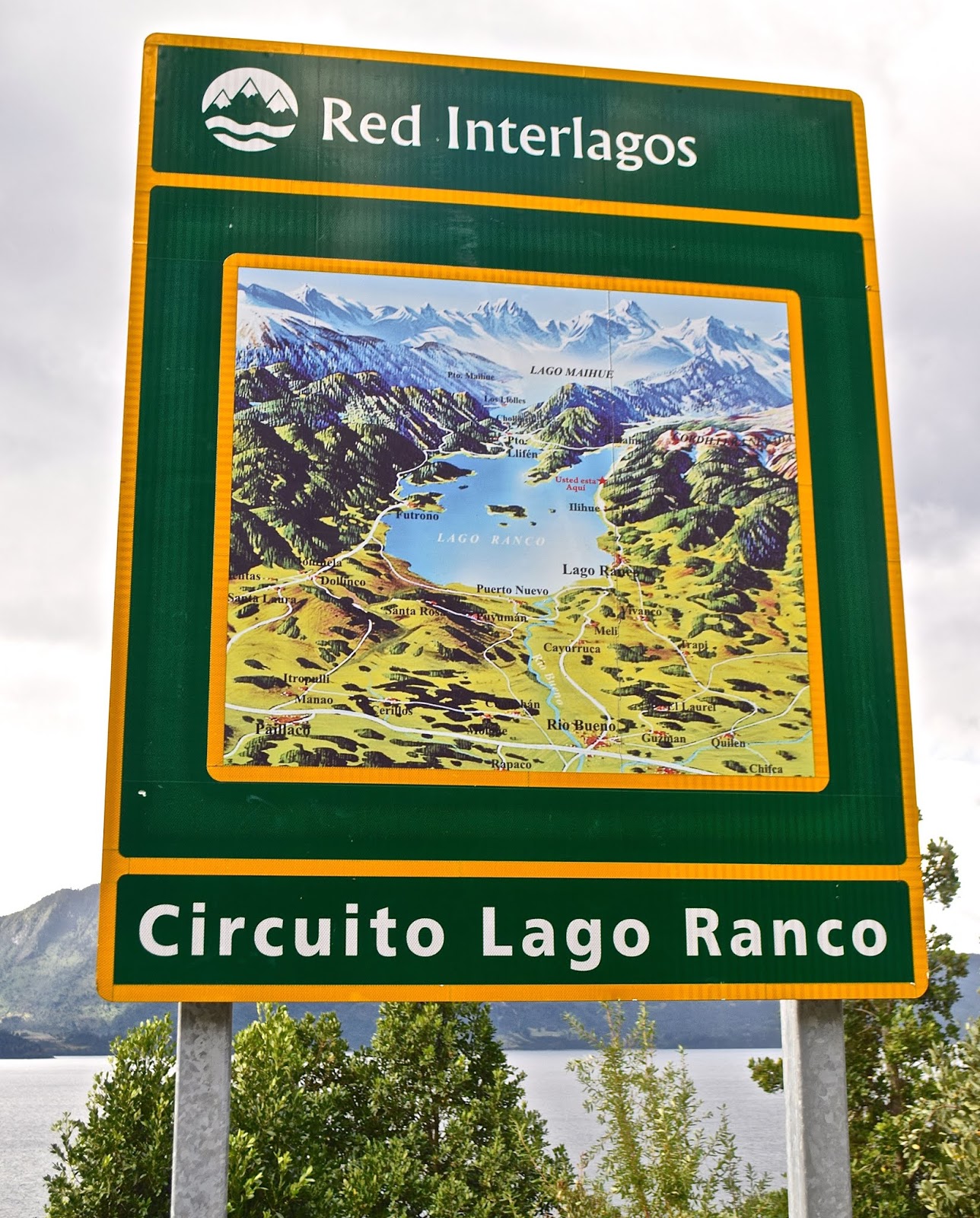
New highway signs mark the Red Interlagos.
Not so long ago, that wouldn’t have been possible but, in recent years, the Chilean government has linked and improved a series of roughly parallel easterly roads that provide a more scenic alternative along the lakes of the Andean front range. The Red Interlagos stretches from the town of Inspector Fernández, north of Temuco, south to the village of Puelo, southeast of Puerto Montt. I recommended an itinerary to my client and, when I next returned to Chile, I decided to follow the route—more or less—myself. It bears mention that the Interlagos is not a single highway, but a network of interconnected routes that pass through smaller towns and villages, not all of which are resorts, so there are multiple options.
Roadside frontage of the Hotel Awa
My client started in Puerto Varas and so did I, spending a couple nights in the new design Hotel Awa, a multi-story concrete, glass and girder structure on the city’s eastern outskirts. With views over Lago Llanquihue to the perfect cone of Volcán Osorno, it’s the area’s most technologically sophisticated hotel, but with rustic touches such as hiding the TV in an old steamer trunk at the foot of the bed. At night, I dined on truffled pork loin, complemented by a barley-based risotto from its own vegetable garden and garnished with a hazelnut sauce.
Grounds of the Museo Colonial Alemán, Frutillar
From Llanquihue’s south shore, there are two ways north, on the west side via Frutillar or the longer east side route via Ensenada. At the former, there’s the remarkable Teatro del Lago and the outstanding Museo Colonial Alemán, a tribute to German colonists that reminds me of in situ museums in Scandinavia.
A cycling event on the easterly route along Lago Llanquihue, beneath Volcán Osorno 
Puerto Octay, on Lago Llanquihue's north shore
I chose the longer route, which offers a detour up to the volcano’s ski area, which is open for hikers in summer, and then proceeded to picturesque Puerto Octay, a small north shore town with a metal-clad church and turreted houses that evoke Mitteleuropa. On Octay’s outskirts, my choice for the night is Hostal Zapato Amarillo, a Swiss-Chilean B&B with sod-roofed cabins, personalized attention, and fine dinners.
Hostal Zapato Amarillo is a cluster of sod-roofed guest rooms just outside Puerto Octay.
Hotel Termas de Puyehue is one of Patagonia's grand hotels.
For my client, though, I recommended continuing to Hotel Termas de Puyehue, a classic grand hotel at Parque Nacional Puyehue, about an hour north of Octay on the highway that runs from Villa La Angostura to Osorno. For visitors coming from Argentina, this sprawling hot springs hotel, with nearby hiking trails, makes an ideal overnight or multi-day stay in what may be the closest analogue to Bariloche’s Hotel Llao Llao. Along this highway, there’s still abundant evidence of the 2012 Puyehue-Cordón Caulle eruption that covered much of the area in ash.
Volcanic ash still covers parts of the shoulders along the highway between Argentina and Chile.
North of Entre Lagos, parts of the route are still unpaved but being improved.
I didn’t stay at the Puyehue this time, instead heading north through the town of Entre Lagos toward Lago Ranco, a lesser visited destination in the heart of Mapuche country. Along this segment, the Interlagos road signs say “Norpatagonia,” and, on a gravel surface with signs of improvement, muddy potholes splashed water onto my windshield. As I approached the south shore town of Lago Ranco, I could spot Isla Huapi, an offshore island inhabited almost exclusively by Mapuches.
The route around Lago Ranco is completely paved.
Here, in an area far more popular with Chileans than foreigners, I stopped for a sandwich before continuing east along a smooth paved road with plenty of scenic overlooks. The last time I had visited, a cable barge was the only means of crossing the Río Nilahue, but now modern bridges ease the route around the densely forested east side to the north shore town of Futrono. Here, almost opposite San Martín de los Andes, I spent the night at the Cabañas Nórdicas, a cluster of spacious and seemingly Scandinavian structures on a bluff overlooking the lake.
Sunset over Lago Ranco from my accommodations at Futrono
North of Futrono, the route’s a bit better trod, approaching the Ruta 5 town of Los Lagos but then veering northeast to Panguipulli, the entry point to a “Siete Lagos” route that resembles Argentina’s in Río Negro and Neuquén. Panguipulli fancies itself the "City of Roses" for its gardens at the east end of its namesake lake, but the area’s big attraction is its hot springs resorts. My client raved about the Zen-inspired Termas Geométricas—an isolated canyon of waterfalls, creeks and naturally heated pools linked by boardwalks near Coñaripe that’s open for day visits only—in the shadow of the fuming Volcán Villarrica.
The Termas Geométricas is a secluded hot springs venue south of Pucón.
Volcán Villarrica, as seen from Pucón, on the opposite side of Termas Geométricas
After a leisurely day at the Termas Geométricas, nearby accommodations options include the
Termas de Coñaripe—a hot springs hotel in its own right—and the town of Lican Ray, with its black sand beaches at Lago Calafquén. Termas Geométricas, though, gets many day-trippers from Pucón, the uber-resort city that’s just over the hill (mountains, that is) on Lago Villarrica. There, the place to stay is the hillside Hotel Antumalal, a Bauhaus-inspired masterpiece that, arguably, set the stage for Varas’s Awa. Still, there are many cheaper but still outstanding options here, and great hiking in spots like Parque Nacional VillarricaParque Nacional Huerquehue, and the Santuario Cañi, a private conservation effort aimed at protecting the area’s Araucaria forests.
Queen Elizabeth II and other big names have stayed at Pucón's Hotel Antumalal.
At Parque Nacional Huerquehue, the Sendero Quinchol leads to dense upland forests of Araucarias and southern beeches.
For visitors from Argentina, it’s easy to return by the Paso Mamuil Malal to Junín de los Andes and thence to Buenos Aires or back to Bariloche. The road goes on forever.

Friday, September 21, 2018

At the Awa

Some seven decades ago, the Hotel Antumalal broke the mold of classic Chilean “Lakes District” hotels with a Bauhaus-style structure on a hill overlooking Lago Villarrica, on the western outskirts of Pucón. In the interim, it’s become a landmark that’s drawn famous clientele including Queen Elizabeth II, King Leopold of Belgium, Barry Goldwater and Jimmy Stewart (and me?).
Pucón's Hotel Antumalal introduced Bauhaus-style architecture into Chile's lakes region.
In fact, I’ve stayed several times at the Antumalal, most recently in March. A few days later, though, I had the pleasure of spending two nights at the recently opened Hotel Awa, whose bold contemporary design comparably contrasts with the Mitteleuropa style of nearby Puerto Varas’s emblematic architecture. The Awa occupies a similar lakeside setting to the Antumalal, but its multi-story concrete, glass and girder exterior is more conspicuous—perhaps, in part, because the Antumalal’s had so many decades to cultivate its elaborate gardens.
Hotel Awa, as seen from the lakeshore
View of Lago Lago Llanquihue, when I finally got the curtains to rise
While the Awa’s exterior is imposing, its interior is cozy, with regional woods and other local decorative touches, but also large picture windows looking onto Lago Llanquihue. The rooms are also contemporary, with more electrical outlets than I’ve ever seen despite rustic touches that include hiding the flat-screen TV—accessed by opening the lid of a leather trunk. For me, the room’s most confusing aspect was the remote control that raised and lowered the curtains—I never quite got it right, and I recommended that the manager leave written instructions for using it.
An old steamer trunk hides the flat-screen TV at the foot of the bed.
While the Awa is happy to entertain overnight guests with bed and breakfast, it also offers excursions in the area and all-inclusive packages, including meals in its restaurant. On my first full day, when it was pouring rain in a Marine West Coast climate that resembles the Pacific Northwest—“Awa” means water in Mapudungun—I took a guided hike to Laguna Cayutué, on the southern edge of Parque Nacional Vicente Pérez Rosales. The trail, through dense Andean forest, often resembled a stream, so it took extra effort to avoid muddying boots and clothing and, at the end of the day, I returned soaked.
The weather doesn't always cooperate with hikes in the area.
Diners at the Awa's restaurant
The truffled pork loin ended the day more than satisfactorily.
So, I decided to take a soak in the spacious Jacuzzi before descending to the Awa’s restaurant for a truffled pork loin complemented by a barley-based risotto from its own vegetable garden and garnished with a hazelnut sauce. And, of course, there were a pisco sour and a glass of Carménère to accompany the main course, before a white and dark chocolate parfait. The next morning, I awoke to clearer weather with views across Lago Llanquihue—after I somehow managed to raise the curtains.

Saturday, June 9, 2018

Requiem for a Friend

Steve Anderson and his wife, Loreto Roselló, on the deck of their Panitao home
Last month, I was shocked to hear the news that a longtime friend, Steve Anderson, had died in an automobile accident near his home at Panitao, outside Puerto Montt. I first met Steve when he lived in Santiago, where he founded the online newspaper Santiago Times—still extant under a different publisher—to provide English-language news about Chile. Over the years, I often visited the Times’s offices along the Río Mapocho, and even stayed at his cul-de-sac home on the slopes of Cerro San Cristóbal—sometimes crashing in my sleeping bag on a deck that overlooked downtown.
Steve Anderson shopping for produce at the neighborhood farmers' market
Steve was a southern boy, a native of Arkansas, who had worked in the office the legendary Senator J. William Fulbright(who was indirectly responsible for funding my own graduate research through a Fulbright-Hays Doctoral Dissertation Research Abroad grant). He had come to Chile to help with the “No” campaign against the Pinochet dictatorship in 1988 and, in his new home, married a Chilean woman and fathered a now 21-year-old son who’s a student leader in Santiago.  In his home at Panitao, he had become a leading advocate—with significant local support—for preservation of strategic wetlands that were threatened by suburban sprawl.
Whenever I visited Steve at Panitao, there were unlimited blueberries on the table.
In fact, I had recently stayed at his home for four days, which let me avoid the Semana Santa (“Holy Week”) period when much of the region is overrun with Chilean tourists on a long weekend. It’s also a time when I tend to get more work done sitting at the computer than I would running around checking practical details in towns like nearby Puerto Varas. At that time, he told me, he was planning to return to the States to work on the midterm congressional elections. He loathed the current occupant of the White House.
Tributes to Steve Anderson appeared in the letters section of the local newspaper.
I don’t know the details of the accident, but Steve’s place lay about a kilometer south of the paved two-lane highway between Puerto Montt and the town of Calbuco via a dirt access road. Entering the highway from his access road involved a slight climb that was partially obscured by trees, so it’s possible he never saw the car that hit him. Whether or not that was the case, I will miss him, and so will his family and neighbors.

Friday, February 17, 2017

Finger Food for All! Eating on the Go in Argentina and Chile

Whenever I’m in southernmost South America, my end-of-the-day ritual is sitting down to a good meal—after spending most of my daylight hours in the essential task of updating formulaic text, it feels like a reward to dine well and enjoy a pisco sour and/or a glass of wine. Even though it’s still technically working—after all, I review restaurants in my guidebooks and this blog—it’s also an opportunity for indulgence.
A pisco sour at Afrigonia, a Patagonian fusion restaurant in Puerto Natales, Chile
At other hours, my eating habits can be strictly practical, and I often grab things on the run, even though I avoid fast-food chains. When I’m driving, especially for long distances, I’ll carry takeaway food such as empanadas that I can eat while on the move. Finger food becomes a way of life.
The pastry display at Café La Gringa, Puerto Varas, Chile
Argentines and Chileans don’t take quite the same approach. For instance, I love cupcakes and muffins, but they’re something to grab and eat on the run. Recently, though, at the downtown branch of La Gringa Bakery in Puerto Varas, I saw two locals eating blueberry muffins with forks. Maybe that shouldn’t have startled me but, to my mind, a muffin is something that you eat with your hands.

That said, Argentine and Chilean table manners differ from mine in many other items that I prefer to eat with the hands. My wife sometimes attributes that to my Scandinavian heritage and calls me vikingo (“Viking”) which, in Argentine Spanish, is roughly synonymous with “slob.” In the following paragraphs, though, I’ll try to explain the differences.
A plate of Argentine-style empanadas
To my mind, one of the world’s greatest finger foods is the Argentine empanada—roughly the size of the palm of your hand (I prefer it to the Chilean version, which is larger with heavier dough). So long as it’s not too warm and juicy—there’s a danger of splashing your shirt—I enjoy the feel of it before I bite in. Still, in many restaurants (not necessarily formal ones), Argentine will eat their empanadas with knife and fork.
A slice of onion-rich fugazzeta at Pizzería Güerrín, downtown Buenos Aires
Then, of course, there’s pizza. When I was a child in the Pacific Northwest—so many decades ago—pizza was a novelty and I recall hearing on the radio that “pizza is eaten with the hands.” Argentines, though, almost invariably choose to consume their thick-crusted, cheese-heavy pizza with knife and fork, and I sometimes feel conspicuous when I bite into a slice of my favorite cheese-and-onion fugazzeta while holding it in my hand. Chileans, for the most part, also use knife and fork when eating pizza.
A lomito sandwich from a stand on the Plaza de Armas, Santiago, Chile
Then there are sandwiches, which Chileans devour at outlets such as Fuente Mardoqueo (one of Santiago’s best sandwich shops). As the photograph shows, Chilean sandwiches can be stacked high or, alternatively, spread wide—some of them are so large as to resemble pizzas. Almost invariably, though, Chileans eat their sandwiches with knife and fork and, given their size and tendency to fall apart, it’s not an unreasonable thing—though I almost always try to use my hands. I do find that I often cannot finish a Chilean sandwich because of its size, and recommend that visitors order one for every two persons—you can always order another.
A Barros Luco - beef and melted cheese - available in downtown Santiago

That’s what Anthony Bourdain learned when he visited Chile and tried the completo—a caloric overload that I relished (pun intended!) when I was a backpacker on a budget but haven’t touched in many years. Bourdain’s famous for diving into everything and did so in Chile, but even he couldn’t finish the foot-long hot dog smothered in condiments including avocado and mayonnaise. At least he managed to avoid soiling his shirt with drippings from this notoriously messy item—which Chileans also eat with their hands.
Anthony Bourdain couldn't finish a foot-long completo when he went to Chile

Custom Search