Showing posts with label Tucumán. Show all posts

Thursday, February 24, 2022

Post-WWII Argentina - Fact or (Detective) Fiction?

In my previous post, I reviewed one of my favorite streaming series with a link to southernmost South America but, while I’ve been unable to travel there (spoiler—I’m scheduled to fly to Buenos Aires on March 6th), I haven’t been purely a video couch potato. I’ve also been reading and, while I love detective stories, I’ve been doing it in a way that has more content than just potboilers.

In A Quiet Flame, German detective Bernie Gunther investigates a possible serial killer in Argentina.

Over most of the last year, I’ve been recovering from ankle surgery that requires me to do rehabilitation exercises three times daily, followed by elevating the joint to reduce the swelling for 15 minutes at a time. I use that time to read and, recently, I read the late Philip Kerr’s novel The One from the Other, in which Bernie Gunther—a former Berlin detective and anti-Nazi drafted into the Schutzstaffel (SS) during WWII—tries to track down war criminals and finds himself unjustly incriminated. Kerr’s plotline is so complex that I won’t go into more detail here, except to add that, in the end, Bernie has to flee to South America in the company of some pretty notorious “comrades.”
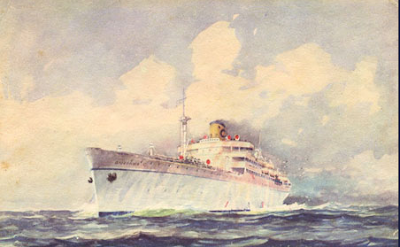
In real life and the novel, the Giovanna C carried both refugees and war criminals from Italy to Argentina.

That, of course, aroused my interest—especially so when the edition I read included the first chapter of A Quiet Flame, which describes Bernie’s 1950 arrival in Buenos Aires on the steamship Giovanna C in the awkward company of two notorious Nazis, including Adolf Eichmann. As in Germany, Gunther doesn’t hesitate to make fun of his companions, and Kerr gives provides him dialogue no less acerbic than Raymond Chandler gave Philip Marlowe and Dashiel Hammett gave Sam Spade. In one case, Bernie remarks that he repels an opponent with a punch that he compares to legendary Argentine boxer Luis Ángel Firpo.
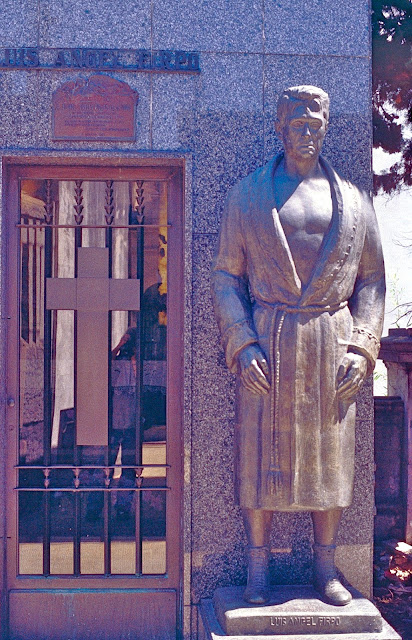
Bernie Gunther claims to pack a punch like the legendary Argentine heavyweight Luis Ángel Firpo, who once knocked Jack Dempsey onto the canvas (Firpo now resides in Recoleta Cemetery).

Like his companions, Bernie arrives under an alias but, in a meeting with then-President Juan Domingo Perón (and Perón's poodles), he has to reveal his true identity and, under pressure, he’s persuaded—forced, rather—to investigate a murder and another disappearance with links to a German-speaking community in Buenos Aires and the northern province of Tucumán (with additional links to a cold case he failed to solve in pre-war Germany).


Unlike Marlowe and Spade, Gunther had worked as a private detective when employment under the Nazi regime became untenable—a situation that may well have contemporary parallels (He had also served in Ukraine, for what that's worth). Parenthetically, Bernie manages to make some blatantly sexist comments about Evita Perón’s appearance, but also sympathizes with the health problems that killed her just a few years later.
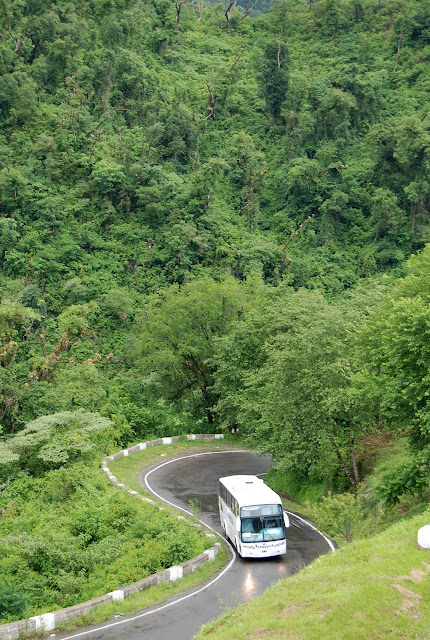
Bernie's investigation leads him to a sinister site in the subtropical sierras of Tucumán Province.

More significantly, Bernie learns of the notorious Directive 11, by which the Argentine government denied Jewish refugees entry into the country. Through him, Kerr speculates as to the existence of a Directive 12, which would have established a concentration camp in Tucumán’s subtropical forests.


According to a 2009 interview with The Wall Street Journal, Kerr (who died in 2018) decided against visiting Argentina because “I thought about it and decided that what I wanted was a historic picture, rather than the Argentina of today.” In my opinion, though, even allowing for poetic license, this novel would have benefitted from a visit to the country. In one instance, for example, Kerr appears to confuse the Argentine capital’s central shopping district of Florida with a neighborhood in the town of Vicente López, in the city’s northern suburbs—where the Nazi refugees had a safe house and Eichmann later resided for many years. Through Bernie, he's also unnecessarily harsh on a Tucumán he never saw (though it's clearly a different place today). At the very least, the publisher should have hired a proofreader familiar with Argentina—the airport city of Ezeiza, a southern Buenos Aires suburb, is consistently misspelled “Ezeira.”

Uki Goñi's book details the Perón government's complicity with the Nazis. 

At the risk of being labeled a pedant, I’ll still recommend both these novels and others by Kerr, who manages to convey the complexities of surviving in an authoritarian or even totalitarian ambience while still seeking truth and justice—even for a flawed figure like Bernie Gunther. What I'd really like to see is somebody turn all 14 novels into a streaming series.


In the course of writing A Quiet Flame, the novelist relied on Uki Goñi’s The Real Odessa, an historical account of the Nazi presence in post-war Argentina, including documentation of the Perón government’s complicity (Full disclosure: Goñi is a personal acquaintance).


Addendum

Another personal acquaintance of mine, the late geographer Dan Gade, had direct contact with another ex-Nazi, the SS officer and ethnobotanist Heinz Brücher, but it was only after Brücher’s murder in 1991 that Gade unearthed the extent of Brücher’s role in WWII and continued adherence to Nazi ideology. Questioning the impartiality of Brücher’s South American research—he also worked in Paraguay—Gade’s article might suggest that Goñi’s extensive and incisive research was only a starting point for a continued assessment of the post-war German presence.


Support Southern Cone Travel

If you’ve found this entry informative and/or useful, please consider earning me a few pennies by clicking on an ad—always presuming, of course, that it’s relevant to your interests.

Sunday, March 5, 2017

Emptying the VAT? Argentina, Chile & Uruguay Offer Tourists Tax Breaks

Recent developments in tourist taxation, in the Southern Cone countries of Chile, Argentina and Uruguay, should interest readers of this blog. In the near future, though, I’ll also be addressing potential visa complications in the face of the United States’ new xenophobic government.

CHILE
For many years, I’ve advised visitors to Chile that, when paying for accommodations in US dollars or by foreign credit card, they are entitled to a 19 percent discount. That’s because foreigners on a tourist visa are exempt from the country’s Impuesto de Valor Agregado (IVA, or Value Added Tax).
Termas de Puyehue, an historic spa hotel eligible for IVA discounts
For those unfamiliar with VAT, it’s a sort of sales tax that levied on products and services within Chile, but not on those intended for export. For some reason, Chile has chosen to define accommodations and some related services as export items, though it’s always mystified me that sleeping in, say, a Puerto Natales hotel might qualify as an export. It’s a legal fiction that also applies, in some cases, to meals and even tours that are part of an all-inclusive package at destinations like Termas de Puyehue Wellness & Spa and the Puyuhuapi Lodge & Spa.
The remote Puyuhuapi Lodge & Spa can also grant IVA discounts.
It’s not quite automatic, though. In the first instance, not all hotels can take advantage of it—they must apply to Chile’s Servicio de Impuesto Internos (SII, Internal Revenue Service) for a franquicia tributaria (export permit) and, in the process, prove that a minimum percentage of their clientele comes from outside the country. In reality, this requirement excludes many modest but perfectly acceptable hostales (B&Bs) and hostels from consideration, even though such facilities could probably use the tax break more than their far wealthier counterparts.
Modest accommodations, like Puerto Natales's Hostal La Cumbre, are often ineligible for IVA discounts.
There’s a recent change in the law that merits noting. Generally, on arrival, foreign visitors receive a 90-day visa, and hotels must make a photocopy of your passport and tourist in order to provide the IVA discount. Though the immigration policy itself has not changed, however, visitors who have been in the country more than 60 days are no longer eligible for the discount.

While the great majority of visitors are unlikely to stay longer than 60 days—even a brief detour in Argentina or another country restarts the clock—it’s worth noting. If it’s more, though, you might as well be a Chilean resident. Note also that the discount depends on an exchange rate that the hotel may have set early in the season, and could be less (or perhaps more) advantageous than the current daily rate.

URUGUAY
To receive an IVA discount at Jacinto, pay with your foreign credit card.
I spend far less time in Uruguay than I do in Argentina and Chile, and only recently became aware of developments in their tourist taxation regime according to Ley 17934. Set at 18 percent, Uruguay’s IVA discount benefits tourists not only in accommodations refunds, but also services such as car rentals and meals. Last year, while dining at Jacinto in Montevideo’s Ciudad Vieja neighborhood, I was surprised to find the discount applied directly to my bill when I paid by credit card. In some cases, though, the discount appeared only when I received my credit card statement at home in California.
My receipt from Jacinto indicates the IVA discount under Ley 17934
For none of the transactions in question did I have to show proof of tourist status—merely paying with a foreign credit card was sufficient. This makes the Uruguayan policy far more convenient than its Chilean counterpart but also potentially vulnerable to abuse—in theory, I suppose, a foreigner could pay for a large dinner by credit card and be reimbursed by Uruguayan friends who would thereby receive the benefit indirectly.

It’s worth adding, though, that the IVA discount for accommodations is only 10.5 percent, and it has seasonal limits—this year, for instance, it is available only until April 21st. Still, the policy benefits everyone, or at least these able to pay with the proper card.

ARGENTINA
Stays at Camping El Bolsón - which has its own brewery - are now eligible for IVA discounts in Argentina.
Both Chile and Uruguay have been doing IVA discounts for some time, but Argentina’s a latecomer to the party. The law’s been on the books since 2001, but only this summer did the government of President Mauricio Macri declare that foreign hotel guests would not have to pay the 21 percent IVA that applies to all other products and services in the country. It’s also applicable to all accommodations, ranging from campgrounds to five-star luxury hotels, though clients will have to show their passports or other identification (visitors from neighboring countries may not need passports). The only acceptable means of payment, though, is a foreign credit or debit card, or a bank transfer. Cash is not acceptable (though Argentine hotels often provide cash discounts).
A stay at Bariloche's classic Hotel Llao Llao also means an IVA discount for foreign visitors.
As always, there’s a strange twist in Argentina’s new measure—it applies only to provinces with international borders. Thus, the interior provinces of Tucumán, Santiago del Estero, Santa Fe, Córdoba, San Luis and La Pampa will not benefit from it. All these provinces probably draw more in-country visitors than foreigners, but Córdoba, San Luis and Tucumán especially could be at a disadvantage to neighbors which do have foreign borders.
Because Córdoba province has no international border, guests at Hotel Sierras in Alta Gracia - Che Guevara's boyhood home - cannot receive IVA discounts.
One final note. The current issue of Condé Nast Traveler misleadingly says that “Argentina did away with its 21 percent hotel tax for foreigners.” This is simply wrong—there never was a hotel tax for foreigners, and Argentine tourists and residents will still be on the hook for that 21 percent IVA (presuming they’re not paying cash under the table).
This kiosk poster in Santiago de Chile promotes Argentina's new tourist tax refund.

Tuesday, September 9, 2014

A Farewell to Soda; Plus, Buenos Aires in California

Argentine rock musician Gustavo Cerati, founder of the power trio Soda Stereo, died last week in Buenos Aires after a four-year coma. Larry Rohter, the New York Times South America bureau chief during much of the musician’s career, wrote Cerati’s obituary for the paper. The clip below shows him on stage with Shakira in the Argentine capital.
Except for tango, and the occasional folk musician such as the late Mercedes Sosa, Argentine music has had relatively little influence beyond the South American continent. Even the major figures of rock nacional, such as the brilliant but erratic Charly García, haven’t had a great impact in the English-speaking world, though Soda did record one album in New York.

I’ve seen García live, as well as Fito Páez and David Lebón, and listened to quite a few other Argentine rock musicians – I particularly enjoy the Dylanish León Gieco – but I never managed work up any interest in Cerati or Soda Stereo. Even my Argentine wife can’t recall anything memorable, and her sister’s husband – who still owns a CD shop and often provides me music – never saw fit to even mention Cerati to me.

I don’t want to belittle Cerati, but my only real memory comes from a visit to the northwestern city of Tucumán when Soda Stereo was playing there. To promote the concert, a sponsoring tobacco company was passing out free cigarettes on the central Plaza 9 de Julio – ironically (or appropriately) enough for Cerati, whose three packs a day habit undoubtedly contributed to the stroke that put him in a coma at age 51. Argentina's tobacco laws have since changed, for the better, but I don't know whether or not this type of promotion is still legal.

Buenos Aires Live! In Saratoga (California)
Next Monday night at 7 p.m., at the Saratoga Community Library (in Silicon Valley, near San Jose), I will present a digital slide lecture on travel to Buenos Aires. There will be ample time for questions and answers, and my Moon Handbooks to the Argentine capital, Argentina, Chile and Patagonia will also be available at (slightly) discounted prices.


Wednesday, September 25, 2013

P(l)aying the Blue(s)? Argentine Hotels Want Your Dollars


As I prepare to update the current edition of Moon Handbooks Patagonia, for which I will head south in November, I’ve also been doing a desk update of the current edition of my National Geographic Traveler guide to Argentina (for those who care about such things, I get royalties from the former, but only a flat fee from the latter). In the process, I’ve been making plenty of phone calls to Argentina, thankful that the price of telecommunications has dropped so dramatically over the past decade. I don’t use Skype, which I find annoying, but my own Internet provider offers exceptionally good discount rates on my landline.
Many times, on this blog, I have remarked on issues of discriminatory pricing against foreigners, most often in Argentina but occasionally in Chile as well. In one major sector, though, Chile does the opposite: bona fide foreign tourists can stay at Chilean hotels without paying the 19 percent impuesto de valor agregado (IVA, Value Added Tax or VAT in Britain and some other English-speaking countries). That means that a US$100 hotel costs only US$81, if paid in foreign cash or by non-Chilean credit card.

Chile’s rationale, which I find a little peculiar, is that hotel rooms rented to non-Chileans are “for export” and, thus, exempt from a domestic tax. While I’ve used that loophole to my own advantage on occasion – call me hypocritical if you wish – I still find it puzzlingly inappropriate. In principle, I feel that everybody should pay the same rate, just as they should for admission to museums, national parks and other attractions.

In Argentina, historically, hotels have often charged foreigners higher rates than locals or Argentines. That’s changing, though, as a function of the confusing and inept exchange controls instituted by the government of president Cristina Fernández de Kirchner. Several times, in speaking with hotels in Argentina, I’ve asked their current rates; then, I’ve asked whether they offer cash discounts, and many do – up to 20 percent. Then I ask whether there are discounts for paying in foreign currency – specifically US dollars. Some places are evasive, as the so-called “blue dollar” is technically illegal, but others will give a rate, such as eight per dollar when the official rate is 5.75. That makes a room rate of 616 pesos, which one Tucumán hotel quoted to me, US$107.15 at the official rate but only US$77 at the “blue” rate.

That’s not the best available rate, as the blue dollar reached nearly 9.5 in Buenos Aires today, but it’s still a substantial improvement over the official rate. A friend of mine who operates a B&B in the popular tourist destination of Puerto Iguazú mentioned that the rate there was somewhere between 8.5 and 9 per dollar but, even at the somewhat lower hotel rates, foreign visitors can save substantial sums this coming summer at the front desk, without having to worry about finding a "cave" to change their money.

For Argentine hotels, there’s another economic advantage in doing so, as they can report their income at the official exchange rate while earning relatively inflation-proof foreign currency. This will probably not work at traditional elite hotels like the Alvear Palace, though - such hotels invariably post their prices in dollars.
Custom Search