Showing posts with label Rosario. Show all posts

Friday, March 31, 2017

Argentina Opens Its Skies

One deterrent to travel in Argentina—the world’s eighth-largest country—has been the deplorable state of its air services. Throughout my lifetime, the state-run Aerolíneas Argentinas—occasionally under private ownership—has dominated a Buenos Aires-centric system that, with unavoidable stopovers, sometimes made flights as time-consuming as bus trips. The arrival of Chile’s LAN (now LATAM) improved the scenario, but political obstacles kept it from challenging Aerolíneas’s dominance.
State-run Aerolíneas Argentina now dominates the country air services.
At one level, there’s a logic to this pattern, as roughly a third of the country’s population lives in and around the capital, but it also re-enforces the city’s primacy. Traditionally, even important cities with upwards of a million inhabitants, such as Rosario, Córdoba and Mendoza, can only make connections to other provincial destinations via Buenos Aires. It works against the tourist industry as well, when flights between popular visitor destinations such as Mendoza and Bariloche require lengthy detours via the capital.
Many domestic flights require changing planes at Aeroparque Jorge Newbery, the Buenos Aires city airport.
It’s about to change, though. Earlier this month, the administration of President Mauricio Macri approved 135 new routes by five new or expanded airlines, including the budget carrier AirBondi. Bondi will not begin operations until September, but Neuquén-based American Jet, Córdoba-based Alas del Sur, and the capital-based Andes Líneas Aéreas may begin immediately. Tucumán-based Avian, an affiliate of Colombia’s Avianca, should soon join them.

The idea, according to Macri, is to more than increase the number of flights and more than double the number of passengers by 2019. Given that distances are so great, that long-distance trains barely exist, and that bus services are time-consuming (although the quality is generally high), there’s potential for modernizing Argentina’s transportation system and the tourism sector in particular.
In a perfect world, AirBondi would live up its name by adopting the color scheme of this classic city bus.

Whenever Argentina announces great changes, it’s always advisable to retain a certain level of skepticism, but greater competition in the transportation sector should be a welcome development—even if part of that is a budget airline likely to charge for checked baggage and other “extras.” For what it’s worth, Bondi’s name derives not from the famous Australian beach, but rather from a lunfardo (slang) term for city buses in Buenos Aires.

Saturday, December 22, 2012

Bariloche's Burning?


It’s awkward for me to write something that might discourage people from traveling to the countries where I work, especially since that might discourage them from buying my books and other products, but it would be negligent to ignore what’s gone on the last few days in Argentina. Most notably, in the Patagonian resort city of San Carlos de Bariloche, there’s been systematic looting of supermarkets and other businesses, but the problem has since spread to suburban Buenos Aires, the city of Rosario, and other localities.
While Bariloche’s reputation is that of an elite getaway, its southern suburbs – known as the “Alto” – consist of deplorable shantytowns in what has become a classic juxtaposition of haves and have-nots. As always, in this polarized and politically dysfunctional country, there is a partisan element to the disorder, though it’s not entirely clear who’s to blame and who’s to restore order. The federal government blames the political opposition and, most notably, teamster’s union leader Hugo Moyano. It has sent in 400 Gendarmes (roughly comparable to the US National Guard) to control the normally peaceful streets along the Lago Nahuel Huapi shoreline.
Moyano, who has challenged the government to arrest him if it has proof, has about as much reformist credibility as the late Jimmy Hoffa, but there are unmistakable political elements in the crisis. Moyano, a former ally of President Cristina Fernández de Kirchner, has fallen out with her and since organized a general strike and protests in Buenos Aires’s central Plaza de Mayo. The confrontational Fernández, whose popularity and power are declining despite an impressive re-election victory in late 2011, cannot run again unless there’s a constitutional amendment (which her partisans are aggressively lobbying for).

Argentine politics, for better or worse (usually worse), often plays out in the streets rather than in weak institutions such as the Congress, so it’s possible to interpret the current disorder as an early manifestation of the battle for succession even though the next presidential election is nearly three years away.

One friend of mine, who lives in Bariloche's prosperous western outskirts, observes that the looting “seems to be organized” and that a group called Primero de Mayo operates with the support of city mayor Omar Goye, who is a “Kirchnerite” but not, apparently, a supporter of the president. At the same time, Buenos Aires province governor Daniel Scioli is a conservative Peronist who, while publicly supporting the president, has taken a hard line against looters in the Greater Buenos Aires suburbs of Campana and San Fernando. The president’s close advisers mistrust Scioli, who served as vice-president under her husband, the late Néstor Kirchner, and has presidential ambitions of his own.

Another friend, from Buenos Aires, has summarized his opinion of the current crisis, emphasizing that in his opinion “This is not going to blow up. This is not 2001 [when the country suffered a complete economic and political meltdown]. The Peronists are in charge, and they’re not going to let things get out of control.”

Still, he sees serious problems that are going unaddressed: “Bariloche has more than 40 percent of its population below the poverty line…On my last trip, I saw them making houses out of produce crates.” Also, he adds, there is a culture of impunity from the top to the bottom, as “Last week a mob of 20 guys destroyed the Casa de Tucumán [the local office of the provincial government in the capital] with no arrests. Why not loot, if there are no consequences?”

On another issue, he emphasizes, “The most important factor is inflation. Cristina has said ‘If we had 25 percent inflation, the country would explode,’ and she was right.” In addition, he says, this is “a government more worried about its power struggle with Clarín [the country’s most important media conglomerate] than with the people’s real problems (inflation, unemployed youth and personal security).”

Still, as he maintains, a disorderly collapse like that of 2001 is unlikely. Even in contentious places like today’s Bariloche, this is unlikely to cause more than minor inconveniences, and the best advice is to steer clear of political demonstrations unless you really understand what’s going on. If you don’t understand what’s going on, well, you’re not alone.

Friday, May 28, 2010

Chasing Che Guevara

My friend and colleague Chris Baker, author of several guidebooks for Moon and other publishers, has recently noted that Argentina, Bolivia and Cuba have recently collaborated to create a route called "Los Caminos del Che," to follow the travels of the legendary Argentine born revolutionary Ernesto Guevara. While my first-hand knowledge of Cuba is nil and I’ve spent only a limited time in Bolivia (and none in the area where Che met his fate), I’ve written about his Argentine youth in the course of my own travels in the country, and have visited several Argentine sites recently.

Argentina’s portion of the Guevara saga, created under the auspices of the Secretaría de Turismo de la Nación, includes destinations including his birthplace city of Rosario, the northeastern Misiones province town of Colonia Caraguatay, the city of Córdoba (capital of its namesake province) and the nearby town of Alta Gracia, and the Patagonian resort town of San Martín de los Andes.

Guevara always was always more than a little mysterious, and the mystery started with his origins. According to biographer Jon Lee Anderson, Che’s registered birthdate of June 14, 1928, was a deception, as he had been born a month earlier - his mother, Celia de la Serna, was pregnant at the time of her marriage and Che’s father Ernesto Guevara Lynch moved them immediately to remote Misiones, where the pregnancy could be kept secret.

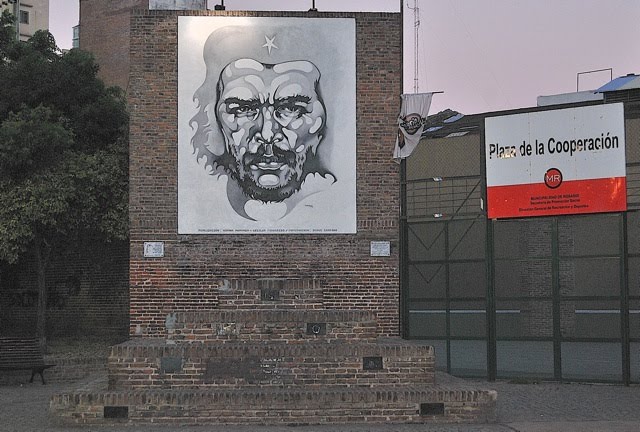
In reality, Che’s presence in Rosario was fleeting - the Guevaras returned to Caraguatay after a brief visit to family in Buenos Aires - but that doesn’t mean it’s gone unnoted. His Rosario residence, a handsome apartment building at Entre Ríos 480, has long been a minor pilgrimage site, and the Plaza de la Cooperación (pictured above), two blocks northwest, features a scowling portrait on a brick wall. Most recently, in 2008, Argentine and Cuban architects collaborated to create the Plaza Ernesto Che Guevara (pictured here), a drab open space with an equally undistinguished statue.

In fact, rather than Rosario, Che-chasers would be better advised to go to Córdoba, where young Ernesto went to school, and Alta Gracia, where his parents moved for the dry, mild climate that would be easier on his chronic asthma. Normally he made the 35-km commute by local bus but, for a time, he boarded in an annex of the Colegio Deán Funes (which no longer occupies its original downtown site). That annex is now the Azur Real Hotel Boutique, the city’s first hotel of its type, and probably the only Argentine hotel that can say “Che Guevara slept here” - on his travels in Patagonia and elsewhere, Che normally crashed wherever he could without paying.

Visitors will learn more about Che by going to Alta Gracia, a charming colonial town that’s home to the Museo Ernesto Che Guevara, which occupies one of several houses that the Guevara family rented in town. Then known as Villa Nydia, it’s the least polemical of any Guevara memorial. In fact, it does such a good job of reconstructing Che’s boyhood - through a photographic history of Ernesto and his family, his school report cards, and memories by his classmates, cook Rosario González (whom I met briefly several years ago), and others - that it doesn’t really place it in any greater context. This may not be the place for a full biography but, from its contents, one would hardly know that Che was a controversial figure, nor have any idea why Villa Nydia was converted into a museum, nor why so many neighbors opposed the conversion - nor even why Fidel Castro and Venezuela’s leftist president Hugo Chávez visited in 2006.

Alta Gracia’s prize exhibits include a bicycle and a motorcycle of the same models that the youthful Che used in his trips around South America. Part of that history is covered in San Martín’s Museo La Pastera Che Guevara, which I covered in detail in another post a little over a year ago. Anyone who wants to follow Che’s South American travels, though, would be better off picking up Patrick Symmes’s Chasing Che, which tells of the author’s adventures in search of the Guevara legend in 1996 (when I met him on Chile’s Carretera Austral).

Tuesday, April 13, 2010

The Old Argentine Anti-Express

Every once in a while, I get inquiries from people who want to travel on Argentine trains, probably because of the ironically romantic vision propagated by Paul Theroux’s overrated opus The Old Patagonian Express. Theroux's book was a self-indulgently dyspeptic rail journey through the Americas that ended on the narrow gauge train (pictured here, now exclusively a tourist attraction) from the hamlet of Ingeniero Jacobacci to the city of Esquel.

As politely as possible, I tell visiting railfans not to bother - except for serious foamers, long-distance train travel in this country is trial and tribulation. At one time, the British-built Argentine rail system was the envy of the Americas but, under the populist Perón regime in the late 1940s and early1950s, it became more important to keep fares low than to maintain service and even rolling stock. By the time I first traveled on Argentine trains in the early 1980s, the system was so decapitalized and deteriorated that we would spend hours in unexpected delays in the middle of the Pampas, with no heat in winter and no cooling in summer. Once, on the Ferrocarril San Martín line from Buenos Aires to Mendoza (a route which no longer exists), the entire train was packed with conscripts, who could travel free of charge so long as they stood - which they did for the whole 24-hour trip.

Former President Carlos Menem catches a lot of flack for the rail system’s deterioration, as he privatized so many state services in the 1990s, but in reality Argentine railroads were beyond repair - almost literally - long before then. In the interim, comfortable long-distance buses, with sleeper service that almost matches airlines’ business class - at least in comfort and spaciousness - have superseded them. They are also far faster than the remaining trains.

Still, at intervals, the resurrection of the rail system becomes a hot topic, as it did two years ago when the government presumably reached a deal with French interests to build a bullet train between Buenos Aires and Córdoba via Rosario, thus linking Argentina’s three largest and most commercially important cities. This would cut travel time to Córdoba to three hours (as opposed to nine by bus).

Nobody is holding his breath for this to happen, though. Yesterday, the Buenos Aires daily Clarín published an account of a recent rail journey from Retiro station (pictured here, with a commuter train at the platform) to Córdoba that took 15 hours - but only because it covered half the route by bus when the train broke down. Its average speed was 43 km per hour, and nowhere was there any sign of the so-called bullet train. The link above includes a film clip that sardonically contrasts today’s train services with those of yesteryear.

Friday, May 30, 2008

Branding Che

At this week's Cannes Film Festival, the main event was US director Steven Soderbergh's two-part biography of Ernesto "Che" Guevara. The first part, tentatively titled "The Argentine," deals with his role in the Cuban revolution, which took power in 1959, while the second ("The Guerrilla") covers his failed attempt to foment revolution in Bolivia, which led to his execution in 1967 and, ironically, made him an icon. Puerto Rican actor Benicio del Toro plays the role of Guevara in the four-hour-plus epic.

Its length, and slow-moving narrative, led film critic John Powers to call it “almost unreleasable in its current form in any country in the world,” while the New York Times's A.O. Scott wrote that Guevara's "brutal role in turning a revolutionary movement into a dictatorship goes virtually unmentioned" and that Del Toro's romanticized portrayal of Guevara was "naïve and incomplete, at worst sentimental and dishonest. More to the point, perhaps, it is not very interesting."

Predictably, perhaps, the Argentine press had a different take. In the Buenos Aires daily Clarín, Diego Lere suggested that
"the film may lack emotion and dramatic force..but Soderbergh certainly manages to make the life of an iconic personality, difficult to relate on film, credible. It's a 'Che' that takes the personality from the poster and returns him to the sphere of a revolutionary's daily labor." In La Nación, Diego Batlle wrote that it was "well narrated and carefully produced, avoiding historical errors and the artistic license of so many Hollywood biopics." In all likelihood, then, the full epic will find at least a niche audience in Buenos Aires if not elsewhere.

Meanwhile, Che made a reappearance on the streets of Buenos Aires the other day as a four-meter statue en route to his legal birthplace in the city of Rosario (Jon Lee Anderson, a consultant to Soderbergh whose biography of the revolutionary is the gold standard in Che studies, says the birth was registered in Rosario but actually took place in the province of Misiones). The statue takes its cue from Alberto Korda's famous photograph of Che, which appears on Cuban currency and in many other places.

Argentines, of course, have tried to make Che into a tourist attraction, especially in the Córdoba province town of Alta Gracia where he spent his formative years. One of his former homes (despite elite family connections, the financially struggling Guevaras always rented) is now the Museo Ernesto Che Guevara, which focuses on Che's youth; when I attended the Feria Internacional de Turismo in Buenos Aires a couple years ago, Alta Gracia used a Che impersonator to staff its booth (see the photo to the right).

Of course, that's not so different from what Soderbergh publicity people did to promote the movie. In a break between the two halves, they passed out bags of sandwiches, mineral water, and other goodies that included Kit Kat Bars (produced by the multinational Nestlé, which Guevara would have despised). According to Clarín, this came to be called "McChe," while La Nación dubbed it "Che's happy meal."

Following up, Ben Ehrenreich has a new article on Che's status as a style icon in The Los Angeles Times, and the separation of the man from the image - according to one cyclist on Venice Beach, Che was "the guy who invented those mojitos." Even Argentina isn't immune to that, though; last year, in the Misiones town of Puerto Iguazú, I saw a twenty-something with a Che/Korda tee-shirt that read "I don't know who he is, but I know he's fashionable."

Thursday, January 17, 2008

All Aboard? to Rosario and Córdoba?


As I mentioned in an earlier post, Argentina's passenger rail system has been disastrous for 30 years or more, but that could soon change. According to this morning's La Nación and other Buenos Aires newspapers, a French group will soon start construction on a bullet train to link BA with Córdoba via Rosario and four other cities. When the project is completed, within three years, the train will cover the 710 km to Córdoba in about three hours (compared with eight or nine hours by bus, at present). A dedicated Buenos Aires station will be built at Retiro, alongside the existing stations for the Mitre and Belgrano Norte lines (depicted in the photo above).

Argentines have an almost romantic devotion, seemingly a collective memory from their early 20th century prosperity, to their passenger rail system. It's often misplaced, as the handful of surviving lines are economically unviable without huge state subsidies, and the service is appalling. In principle, though, the new line makes economic sense, as it would link Buenos Aires with two populous metropolitan areas that both aspire to the title of Argentina's "Second City." It could also make air service from BA to Córdoba obsolete--the elimination of airport hassles would make train travel time competitive with flying--and thus free up additional planes for other domestic destinations. Until it's up and running, though, it'll be hard to say whether the results justify the promise.
Custom Search