Showing posts with label Cruise Ships. Show all posts

Friday, November 1, 2019

Patagonia's Adventure Connect(ion) in San Francisco

Last week, I attended a promotional event for Chilean Patagonia in the Adventure Connect series, organized by the Adventure Travel and Trade Association (ATTA). At a time when Chile’s undergoing political upheaval, the occasion brought the Magallanes regional representative of Sernatur, the national tourism secretariat, and representatives of several different operators to San Francisco as part of a national promotional tour.
The setup at San Francisco's Hotel Zetta
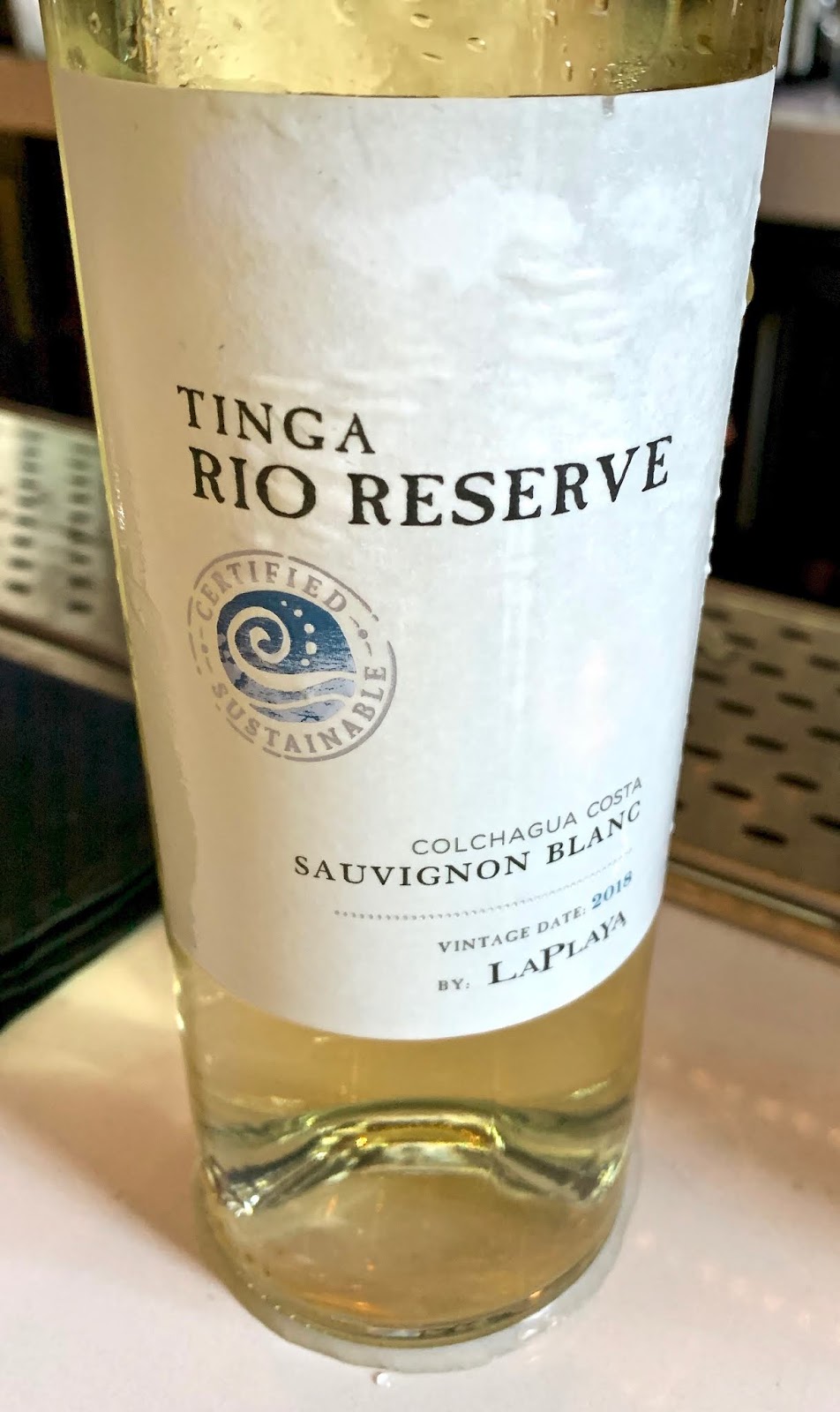
The event took place in the lobby of Hotel Zetta, where eight different operators were to discuss their services with Bay Area travel companies and invited writers (of whom I was one). The format was a sort of musical chairs in which each operator met with one or more attendees for eight minutes before a timer sounded to move elsewhere. This went on for 2-1/2 hours, with a coffee break that included a giveaway raffle, before adjourning to a conference room for a presentation by Sernatur’s regional director Ximena Castro that was probably most useful to those with less experience than mine in the region. Later, there was a Chilean social hour that included snacks and one of the finest Sauvignon Blancs I’ve ever tasted—especially welcome on an unusually hot San Francisco day.

Ximena Castro addresses the attendees.


The Chileans brought this Sauvignon Blanc along with them and, so far, I've been unsuccessful in finding it stateside.
Originally, eight different operators—some of whom I already knew—were to attend the event. In the aftermath of the recent upheavals in Santiago, though, the representatives of Antarctic Airways—with whom I would have liked to discuss their updated services—and Lago Grey - Experience Hotel were unable to get flights out of Santiago. I already knew the owners of Big Foot Patagonia Adventure and the representative of Vértice Patagonia (operator of mountain huts on the famed Paine Circuit, plus a new boutique hotel in Puerto Natales), and was familiar with Antártica 21  and Australis Cape Horn & Patagonia (both of whom sent US-based representatives). New to me were the Chile Nativo adventure operator and HD Hotel Natales (the rebranded Hotel Cisne de Cuello Negro) in Puerto Bories.

The not quite unspoken topic that permeated the meeting was what effect Chile’s recent political disruptions and disorder might have on the upcoming season. There was certainly concern, but also consensus that the Región Metropolitana de Santiago and the coastal region of Valparaíso would be more directly hit than remote Magallanes. That said, cruise ship and hotel cancellations would certainly affect a city like the regional capital of Punta Arenas, which has seen some demonstrations. I recently saw an online story—can’t find the link now—whose headline spoke of “80 percent cancellations” in Chile, but what the story actually said was that 80 percent of hotels and other services had experienced cancellations (which could have been just a single cancellation each for some).

That’s not to dismiss the issue of vandalism and disorder by a destructive fringe, even as the great majority of demonstrations have been peaceful, but President Sebastián Piñera’s embattled government has cancelled the upcoming COP climate conference (at which Swedish activist icon Greta Thunberg was due to appear and also the Asia-Pacific Economic Cooperation summit.

Personally, I would not hesitate to travel to Santiago, Valparaíso or elsewhere in Chile at present, even though I’d advise those with little or no experience of the country to be on alert. In a recent newsletter, the private Federación de Turismo de Chile cited the Subsecretaría de Turismo to the effect that  “our tourism continues to function throughout the country and the most popular destinations visited by international tourists, such as San Pedro de AtacamaElqui Valley, the islands of Rapa Nui [Easter Island] and Juan Fernández [Robinson Crusoe], the Chilean Patagonia and Torres del Paine National Park, are operating with normality.” Aeropuerto Internacional Arturo Merino Benítez is back to normal, but visitors would still do well to have travel insurance in case of disruption.

And the Money?
For foreign visitors, there may be a bright side to all this. About two months ago, the last time I wrote about exchange rates, both the Argentine and Chilean pesos were slipping against the US dollar, and that has continued with the upheaval in Chile and the recent election in Argentina, when the Peronist Alberto Fernández defeated the incumbent president Mauricio Macri.
The Dólar Blue Hoy app is a useful addition to one's smartphone.
The so-called “markets” (and many individual Argentines) have little confidence in Peronism and, consequently, Argentina’s Banco Central (Central Bank) has reinstituted a cepo cambiario (“currency clamp”) that restricts Argentines’ overseas ATM advances to US$50 per transaction (oddly, it puts no restrictions on the number of transactions per day, but those ATM charges could really add up. Meanwhile, individual Argentines can now officially purchase no more than US$200 per month, a measure that seems to be encouraging the informal dólar blue (visitors to Argentina might consider downloading the Dólar Blue Hoy app, pictured here, on their smartphones). Exactly this will develop as the Macri administration gives way to Fernández remains to be seen, but it seems likely that the informal exchange rate will benefit tourists in the short to medium term.
Chile's peso has also slipped against the US dollar and some other currencies.
In Chile, meanwhile, the peso has dipped to 740 per dollar, a fall of roughly three percent since August. This may affect prices slightly, but if foreign visitors avoid the country because of the perception of instability, services such as hotels and tour operators may drop their prices. In any event, matters are less predictable than they seemed even a few months ago.


Monday, July 29, 2019

In the Falkland Islands, a Week Is Not Enough

As a travel writer myself, I’ve long enjoyed The New York Times 52 Places Traveler, in which a single writer (now one much younger than myself) spends a year exploring the world and producing weekly dispatches from some relatively well-known destinations and other more remote ones. In my own experience, the logistics of organizing several months of travel is taxing enough in my three chosen countries—Argentina, Chile and to a lesser degree Uruguay—that I truly admire the drive and skills of the chosen individual. This year, that individual is Sebastian Modak, whose dispatches appears every Sunday (in print and online).
An aerial view of Stanley Harbour, looking east,
with the city airport at the upper left
For part of 1986-7, we resided in a house belonging to the Sheepowners' Association, at 63 Fitzroy Road.
Yesterday,  Modak’s column dealt with the Falkland Islands, a personal favorite where I spent more than a year as a Fulbright-Hays scholar in 1986-7 and have returned at least half a dozen times. He went, apparently, in early July—“a couple of weeks after the winter solstice”—and says that there were only three other tourists on the Islands (I’m skeptical of that claim). The highlight was penguins, though the only species he mentions are kings and gentoos, which are present year-round (macaronisrockhoppers and Magellanics are migratory summer residents).

Penguins in Winter 
King penguins are the biggest attraction - except for the nearby elephant seals - at Volunteer Point.
On FIGAS's "Round Robin" flights, visitors can view impressive periglacial "stone runs" from above.
To see the kings, at East Falkland’s Volunteer Point, Modak took advantage of Falklands Helicopter Services, a new enterprise that obviates the need for an all-day Land Rover tour from the capital of Stanley, but that comes at a cost of £349 (about US$430) per person, with a two-person minimum (cheaper overland options are possible, but probably not in July). I can certainly concur, however, with his recommendation of the “Round Robin Flights” by the Falkland Islands Government Air Service (FIGAS) that can give visitors a spectacular aerial overview of the entire archipelago at a fraction of that cost. He also went overland to the settlement of Darwin to see the Bodie Bridge, the world’s southernmost suspension bridge that’s apparently on its last legs (er, towers…) in the peninsula of Lafonia (while I have visited Darwin, I never made it farther south to the bridge).
Darwin from the air
Bodie Suspension Bridge, under construction in 1925 (Creative Commons)
Stranded in Stanley?
Ross Road, Stanley, as it appeared in early 1987.
The Historic Dockyard Museum is part of Stanley's renovated waterfront.
Modak, meanwhile, is almost shockingly silent on the capital of Stanley even though, of necessity, he spends several days there because weather delays his departure from the Islands. That’s not an uncommon occurrence but, for a journalist scheduled to report on 52 destinations in 52 weeks, it’s a major inconvenience. He uses the time to explore Stanley’s pub culture but, somehow, he overlooks a surprisingly creative food scene and the Historic Dockyard Museum—which might the best in the world for a town of its size (about 2,500 residents).
The Tasty Treat snackbar serves items such as St. Helenian plo - chicken and bacon with vegetables and rice in a South African curry,  topped with a fried egg.
Roast reindeer - once culled from South Georgia and now raised on West Falkland - is on the menu at Malvina House Hotel.
While the Falklands is much more than 1982 war between Britain and Argentina, the museum offers a professionally measured description of that conflict, which he says comes up with virtually everybody he meets. That’s not quite my experience, even though my wife is an Argentine who also spent a year there with me (on her US passport). He also, apparently, overlooked the multi-ethnic melting pot that the Islands have become since the war, with Chileans, Saint Helenians or "Saints," and even Argentines (there have always been some and, at one point, there was an Argentine policewoman).
During the 1982 war, Eileen Vidal kept countryside residents current on happenings in Stanley and elsewhere via radio telephone. When we lived there, she always knew where everybody was.
While Modak had some trouble getting out of the Islands he does, in my experience, overstate their inaccessibility and remoteness: “Consumed by a sense of total isolation, I leaned into the rare feeling of being off the map, stuck somewhere and part of a small community of travelers.” In fact, the Islanders themselves have always been in constant contact with the outside world—whether by mailboat, amateur radio, telephone and now Internet—and often express a sophisticated understanding of overseas events. The Internet may be slow and expensive—I can attest to that—but, as he acknowledges, there will now be a second weekly flight from the South American continent (in addition to the well-established connection with Santiago and Punta Arenas, Chile).
In the summer high season, cruise ship visits can nearly double Stanley's population - briefly.
Had he visited in January, when cruise ships can double Stanley’s population for a day, he might have adjusted his conclusion that “There’s no chance of ever being a major destination…” The Islands may be a niche experience, but one that’s likely to grow, especially as the logistics improve for those who prefer to be land-based. That’s my preference, I’ve been back at least half a dozen times, and I’ll do so again soon.

Post-Script
While the Argentine occupation left large numbers of land mines,  demining efforts have been successful and no civilian has ever been injured.
This being The New York Times, it’s worth mentioning the readers’ comments, of which there were just 17—almost all of them superficial and a couple astonishingly ignorant. One Patty Mutkoski of Ithaca lamented that there was no place for “long walks” because of “all the land mines left over from the war.” As someone who undertook multi-day treks on both East and West Falkland only four years after the conflict, and has seen the results of removal efforts since then, I can assert that there are many fine hiking opportunities around Stanley and also on the outer islands, such as PebbleSaunders and Carcass. The biggest obstacle is not land mines, but rather the almost incessant winds.
A hike along the headlands of Saunders Island passes through The Rookery, with large colonies of black-browed albatrosses, cormorants, and penguins.
Another reader, Barbara from California, bemoaned that she “didn’t understand why the USA was sending troops to the Falklands [in 1982], and I still don’t, now.” Perhaps that’s because the United States never sent a single soldier there; in fact, the Reagan Administration made every effort to appease Argentina’s military dictatorship before finally providing rhetorical support for British Prime Minister Margaret Thatcher’s counter-invasion. Another commenter, MBV from New York, dismissively proclaimed that “There’s nothing to see here, and it shows.” Just because Modak missed an opportunity doesn’t make that true.

Post-Post Script

Friday, October 18, 2013

Law(lessness?) of the Gaucho


Many years ago, while researching my doctoral dissertation on the Falkland Islands, I did extensive archival work in the Public Records Office at Kew and the Islands themselves, where I had unprecedented access of a sort that would not possible today. Some time after I left, the late Jane Cameron preserved and organized a wealth of documents to make them more usable but, at the same time, less easily available than they were to me.
One intriguing item I came across, in both places, was the tale of a renegade gaucho who remained in the Islands after 1833, when a British warship expelled most of a small Buenos Aires contingent that remained from a precarious colonization effort. As the sketch above (from the Illustrated London News of 1856) indicates, the gauchos helped capture feral cattle that provide subsistence and livelihood to the Islands’ inhabitants.

After the British vessel departed, leaving the settlement under the authority of another holdover, a Scotsman named Matthew Brisbane, who was soon murdered by the gaucho Antonio Rivero and several accomplices. It’s been nearly two centuries since the events in question, but Argentine ultra-nationalists have long invoked Rivero’s name to justify their irredentist claim to the Islands even though the murder probably had no political significance whatsoever. In all likelihood, it was a foreman-peon dispute.
Last year, though, the province of Tierra del Fuego began to enforce the so-called “Gaucho Rivero” law, preventing two British-flagged vessels from docking at Ushuaia. In a separate but not necessarily unrelated incident in Buenos Aires, political bullies even accosted cruise-ship passengers and vandalized company offices that provided support services. The bumper-sticker slogan above protests the "docking of pirate vessels" in Rivero's name.

Ushuaia businesses that depend on cruise ship visits were furious that the two vessels could not dock. In the words of local businessman Marcelo Lietti, even as he affirmed his belief in the Argentine claim to what they call the Malvinas, it was counter-productive to punish the cruise ship sector: “If the measure was intended to harm the English and the Falklands, the damage has been inflicted on all the people that were scheduled to work with the two cruises in Ushuaia.” It cost the city and its residents income, and damaged the city's reputation with the industry.

Nevertheless, the provincial government appears ready to up the ante this season, apparently unconcerned that it could have any negative effect on the tourism sector even as the tiny Chilean settlement of Puerto Williams looks toward drawing some of that traffic away. One friend of mine who operates a B&B in Ushuaia makes the following anonymous observation: “I don´t think any merchant in Ushuaia is happy with that stupid law. The only persons interested in that are politicians making politics and playing with our income.”

Wednesday, August 7, 2013

Cruising for Apps - in Central America?


Several years ago, in the southern Chilean city of Coyhaique, I encountered an elderly Englishwoman shuffling across the pentagonal Plaza de Armas. After I remarked that it was unusual to find someone of her age on her own in Patagonia, she informed me that she had come from a round-the-Horn cruise ship, recently docked at Puerto Chacabuco, and that it was her only option for traveling at this stage of her life. While she hadn’t lost her passion for seeing the world, she had come to terms with the fact that she needed support services – such as an on-board physician – if she were to continue to explore the planet.
As long as I have been involved in travel and tourism, my experience with the cruise ship industry has been limited. Most notably, I have sailed on the scenic Navimag ferry from Puerto Montt to Puerto Natales numerous times (though that’s not exactly a cruise), enjoyed the luxury Cruceros Australis expedition shuttles between Punta Arenas and Ushuaia several times, and once spent a week seeing the South Shetland Islands with Antártica XII. On Guatemala’s Lago Izabal and Río Dulce, I passed several days aboard an otherwise comfortable yacht whose sleeping quarters were best described as “tapered at the foot end.”

Despite my own skepticism of mega-cruise ships, such as those that discharge thousands of passengers that briefly overrun the Falkland Islands every austral summer, I’ve grown to appreciate that not everyone aboard them is an incurious sybarite (though it does bewilder me that, as so often happens, some passengers do not even bother going ashore in exciting ports such as Buenos Aires or Stanley).
Still, in following up my recent comments on Amazonia, I was intrigued to spend a recent flight to Denver poring through Ray Rychnovsky’s new iTunes app on Cruise Ports of Central America (also available in Android), though it has some shortcomings – in the first instance, the name is a little misleading, as it also covers Pacific Mexico and the southern Caribbean. I also found some unfortunate errors – consistently misspelling “Colombia,’ for instance - but I also learned a lot about the excursions that cruise ship passengers can enjoy out of towns like Ensenada, Puerto Quetzal (Guatemala) and my own personal favorite of Cartagena (Colombia, pictured above; I’ve never visited Cartagena as a cruise ship passenger, however).

In my opinion, Rychnovsky often errs on the side of caution, but he does stress that destinations like Ensenada, Antigua Guatemala and especially Cartagena are safe to visit. When they’re not – such as Acapulco – he’s candid even as he’s hopeful that cruise ship lines will eventually return in force there. I’m not quite ready to consign myself to the cossetted clients of cruise ship lines yet but, should I ever have to do so, I hope I’ll still have the courage of that Englishwoman in Coyhaique, and that the resources to help me do so – such as this app – will continue to improve.

Friday, June 28, 2013

Chile Now: Rocking Santiago, Political Toponymy, and Visa Waivers


Today’s entry contains several Chilean-related topics, including one of the country’s historic rock bands, the continuing street name controversy in the Santiago borough of Providencia, and Chile’s pending participation in the US Visa Waiver Program.

Chile’s Rock Royalty, in Santiago
For those of us who enjoy rock music, Argentina has an flourishing rock nacional scene with artists like Charly García, Fito Páez and Los Fabulosos Cadillacs. Chile may better better known for its folk music, thanks to the legacy of Violeta Parra, Víctor Jara, Inti-Illimani, Quilapayún and others, but it does have a contemporary rock scene, thanks to groups like Los Tres and Lucybell. The most durable presence, though, has been Los Jaivas, founded in Viña del Mar in 1963; the video above shows an hour-plus performance at the Festival Internacional de la Canción de Viña del Mar in 2011.
It’s hard to categorize Los Jaivas, but their closest counterpart in the English-speaking world might be Pink Floyd, but with strong folkloric influences. Though based in France, they tour Chile every year, and I managed to see them in 1999, when I also had the good fortune to meet keyboardist Claudio Parra (second from left in the photograph above) as I was purchasing tickets at Providencia’s Teatro Universidad de Chile. A modest and gracious person, he invited me backstage that night, where the band’s rapport with its fans was admirable – this is not a band of prima donnas. 
Now in their 50th year, Los Jaivas play this coming Sunday and Monday nights at downtown Santiago’s Teatro Municipal (pictured above), an impressive venue where I happen to have seen the only opera of my life and also a version of Man of La Mancha (semi-subversive when I saw it in the Pinochet years).  I won’t be in Santiago myself, but I encourage anyone there to see this landmark band in a landmark venue. Surprisingly, it will be the group’s first appearance on this prestigious stage.

Renaming the Streets
Recently I wrote about the pending name change in Santiago’s Avenida 11 de Septiembre, named for the date of General Augusto Pinochet’s coup against constitutional president Salvador Allende in 1973. Borough mayor Josefina Errázuriz pledged to change the name in her election campaign but, on Tuesday, her plan failed when four conservative councilmembers refused to attend a council meeting, denying her a quorum.

In the long run, the name may still change, perhaps when the politicians in question finally appreciate that even appearing to stand up for the dictatorship is toxic to their own political agenda – not just for Pinochet’s notorious human rights violations, but also for financial corruption that came to light after his arrest in London in 1998. With the four other councilmembers in favor of the change, the council will presumably meet to discuss the issue again on Tuesday, July 2. Should the dissident conservatives condescend to provide a quorum, Mayor Errázuriz could cast the deciding vote.

Visa Waiver Update
A couple weeks ago, several travel providers from southernmost Chilean Patagonia appeared at a promotional event in San Francisco: the official state agency Sernatur, the regional airline DAP Antártica, the regional cruise ship lines Cruceros Australis and Cruceros Skorpios, and Hotel Lago Grey and Hotel Remota. I also had a chance to speak with Rolando Ortega, the Chilean consul here, on the issue of his country’s participation in the Visa Waiver Program and the pending elimination of the US$160 “reciprocity fee” now required of US citizens traveling to Chile. While not at the top of the diplomatic food chain, he was able to inform me that “The topic is well underway, but there remain some administrative details. Certainly it will be ready toward year’s end or the beginning of 2014.”

Custom Search