Showing posts with label Calama. Show all posts

Wednesday, April 11, 2012

Boom and Consequences: Happenings in San Pedro de Atacama

Thirty-some years ago, when I first visited San Pedro de Atacama (pictured above), it was a sleepy Atacameño village where the Belgian Jesuit priest Gustavo Le Paige worked quietly on archaeological artifacts from the surrounding countryside, in the museum that bears his name today. Most of the buildings were, and still are, low slung adobes whose few windows offer little insight into what goes on behind them – with the major exception of those that now host a critical mass of accommodations, restaurants and travel agencies that have made it the highest-profile destination between Santiago and the Peruvian border.
At that time, San Pedro had only two accommodations options, though it now has nearly a hundred. One was the basic Residencial Florida, where I stayed and ate – there were no proper restaurants except at the still-existent Hostería San Pedro (pictured above), a full-fledged hotel that was well beyond my then backpacker budget. The only other guest at the Florida, which also survives as Hostal Florida, was a Japanese backpacker with whom I could barely converse in my then halting Spanish. I visited the museum, where Father Le Paige shuffled through the aisles and the desiccated mummy popularly known as “Miss Chile” inhabited a glass display case.
The San Pedro of 1979 had no traffic lights and little traffic of any kind – the local population could herd their sheep through the streets and into corrals behind the walls that extended from their houses. It still has no traffic lights but, in a development that some find annoying, it has increasingly strict parking laws and the Carabineros police are writing record numbers of tickets to locals and tourists alike. If you rent a car in the city of Calama, which has the nearest airport, watch for the no-parking signs here or you may find surprise charge on your credit card after you return home.
According to the last census, in 2002, San Pedro’s population was only 1,938. A new census is due to take place shortly, and most educated guesses are that the new figure will exceed 5,000. Growth has taken place not in the colonial core, but rather on the outskirts, where the new construction consists mostly of simple prefab mediaguas (one of which appears below). This is less than picturesque, but eminently practical for a growing population. The village sports a new soccer field, with artificial turf, and even an Olympic-size swimming pool.
Meanwhile, in a country where spray-paint taggers leave their mark almost everywhere, historic San Pedro remains virtually graffiti-free. At the same time, even as a relatively tasteful commercialism prevails (as suggested below, graffiti is becoming more visible beyond the roughly 12 square blocks where many of the countless tourists sleep, eat and organize their excursions into the nearby high country.
Speaking of excursions, there’s a new twist for those who take tours or head off on their own into the high country near the Bolivian border. Yesterday, when I went on a full-day trip to the famous geysers at El Tatio (pictured below), the Carabineros informed our driver and guide that from now on, all tour operators will be required to provide passport and ID numbers for all their clients, and that those clients will also have to carry identification. A clear photocopy of the passport will be sufficient.

Wednesday, September 28, 2011

Clearing the Air: Pollution in the Southern Cone

Earlier this week, the World Health Organization released a report on air pollution in 1,100 cities around the world, which it says contribute to respiratory problems and 1.34 million premature deaths per annum. Unsurprisingly, it’s cities in densely populated Asian countries, specifically Iran, India and Pakistan, that have the world’s worst air quality, due largely to dirty fuels that include firewood and coal, and poorly monitored motor vehicles.

The WHO calculates its rankings on the basis of airborne particles smaller than ten micrometers, with a recommended upper limit of 20. By that standard, the Iranian city of Ahvaz has the world’s worst air quality, at 372 grams micrograms per cubic meter. At the other extreme, Santa Fe, New Mexico, registered only six micrograms per cubic meter and Washington DC measured 18.

By these standards, Southern Cone cities, particularly those in Chile, come off not so good but less than catastrophic – at least compared with their Asian counterparts. Chile, of course, is a mining country and, on top of that, its geography is unfavorable: like Southern California, Santiago and other heartland cities lie in a basin between a coast range and the high Andes, which traps particulate matter. This gives Santiago (pictured above, after a winter storm has cleared the air) the country’s second-highest figure, with a reading of 69. Only Rancagua, about an hour south, has a higher reading, at 74; Rancagua not only has a similar geography to Santiago, but suffers from its proximity to the huge El Teniente copper mine in the Andean foothills to the east.
Most heartland cities are in a similar plight: Talca (pictured above) registered 49 and Chillán 52. Of the northern mining cities, the port of Antofagasta (pictured below) was the most polluted, with a reading of 55, while Calama measured only 50 – despite the presence of the gigantic open-pit copper mine at nearby Chuquicamata. The southern city of Temuco had a surprisingly low figure of 49, given that its residents use so much firewood for heating and cooking.
While all these figures are higher than desirable, they’re not alarmingly high like the Asian and all are below the global average of 79. The figures also can be misleading because they are not geographically specific – the air quality in Santiago’s poorer western neighborhoods, for instance, is worse than the richer eastern barrios. While that’s deplorable in terms of environmental justice, at best, it also means it will not affect most visitors. It’s those who have to live there that suffer most.
Across the Andes, things are a bit better. I’ve long argued against the clichéd depiction of Buenos Aires (pictured above) as the “Paris of the South,” but in one sense that’s true – according to the WHO, its reading of 38 is identical to the French capital. Across the Río de la Plata, Uruguay’s capital of Montevideo (pictured below) checked in only a little worse, with a reading of 39.


Moon Handbooks Buenos Aires in Millbrae (San Mateo County)


Thursday September 29 will mark the last of four digital slide presentations on the fourth edition of Moon Handbooks Buenos Aires, at various branches of the San Mateo Public Library. This event starts at 1 p.m. at the Millbrae Library (1 Library Avenue, Millbrae, CA 94030, tel. 650/697-7607). There will be ample time for questions and answers, and books (also including Moon Argentina and Moon Chile) will be on sale (at a discount).

Next month, I will be on the road promoting the new third edition of Moon Handbooks Patagonia. Most of the events will be in the San Francisco Bay Area, but I will also be appearing in Seattle and Bellingham, Washington; Vancouver BC; Santa Fe, New Mexico; and Pasadena, California. Watch this space for details.

Sunday, June 27, 2010

Ghost Towns of the Atacama

Most Northern Hemisphere residents think of the Southern Cone countries - Argentina, Chile, and Uruguay - as summer destinations. In the southern winter, of June, July and August, they tend to stay closer to home for their travels, but that means they often miss out on more distant attractions. Thus, over the next several weeks, I’m going to focus on Southern Hemisphere getaways for Northern Hemisphere residents at this time of the year.

One of those is Chile’s Atacama Desert and, like the Mojave Desert of California and Nevada, it’s often best to visit in winter even though, because of the Pacific Ocean’s cool Humboldt Current, it stays far cooler in summer than the Mojave does. Still, the mild winter is ideal for exploring the backcountry even though the nights get chilly except along the subtropical coast, where temperatures remain comfortable all year, at all hours.

Like the Mojave, the Atacama has its share of ghost towns and, to my mind, they’re one of its real highlights. Unlike the scattered settlements of the Mojave, though, the ghost towns of the Atacama were sprawling company towns that grew up in response to massive surface mining for nitrates. These oficinas operated from the mid-19th century to the mid-20th but, as the nitrate industry declined when petroleum-based fertilizers replaced nitrates for agriculture after World War I, they began to fall into disrepair. Many of them were dismantled for scrap or, infamously, robbed for their wood and other valuable building materials.

Three large oficinas, though, remain reasonably well intact and easily accessible. On the high steppe about 45 km east of the city of Iquique, Humberstone and nearby Santa Laura are a combined UNESCO World Heritage Site that displays a remarkable number of amenities for nitrate miners, including the impressive Teatro Humberstone, built of Douglas fir imported from the United States, and an enormous cast-iron swimming pool that’s now rusting and waterless.

When I first visited here, in 1979, you could actually walk around the ruins and even climb the rafters of structures like Santa Laura’s Planta de Chancado (ore-crusher, pictured here) but, today, authorities have put more of a premium on safety. Still, you can see walk inside many buildings, climb aboard rusting locomotives from the narrow-gauge rail line, and walk the wraparound porch the borders the Casa del Administrador (administrator’s house) and its tennis courts. It’s easy to spend a morning, afternoon, or even a full day at one of the most picturesque ghost towns this side of Bodie (California). With frequent buses from Iquique, access is easy.

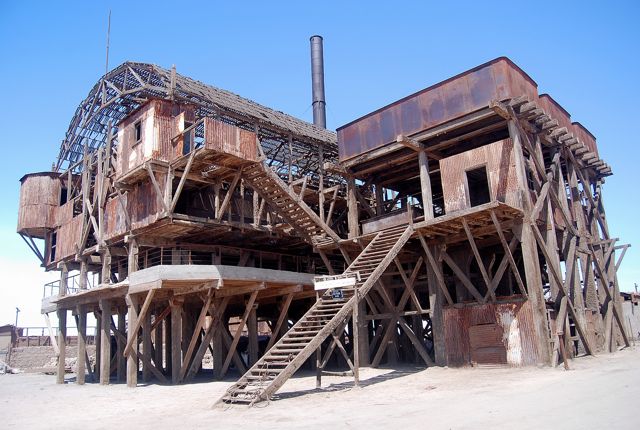
The other major ghost town, slightly less accessible than Humberstone, is Oficina Chacabuco (pictured at top), about 100 km northeast of the port city of Antofagasta. Opened in 1924 to accommodate the new Shanks system of extracting nitrate from ore, it closed its brief life in 1940. Occupying an area of 36 hectares organized in a regular grid, it included a theater larger and more elegant than Humberstone’s and, today, well-preserved frescos still overlook its stage.

Chacabuco, though, also has a darker history - after the military coup of 1973, it was used to house more than 2,200 political prisoners and, though none were executed here, it was surrounded by land mines to discourage escapees. The upper levels of the theater include a photographic display of Chacabuco’s heyday, and information about the prison camp.

Buses from Antofagasta to the city of Calama run along the highway but it’s about four km south of a major highway junction; northbound buses to the city of Arica, though less frequent, will drop you directly at the entrance road. The hop-on, hop-off tour company Pachamama by Bus includes Chacabuco on its Atacama itineraries, which continue to San Pedro de Atacama.

Monday, March 3, 2008

Me llamo Bond...Santiago Bond

According to the Santiago daily La Tercera, foreign and Chilean crews will spend 12 days later this month filming part of the new James Bond movie, Quantum of Solace, in the Atacama desert region of Antofagasta. About 1300 km north of Santiago, the producers are looking for arid open spaces where 007 (now played by Daniel Craig) can pursue his nemesis Dominic Greene.

They'll find an abundance of possible locations limited likely by the need to house and feed some 300 people involved in the project. I'd expect them to choose something pretty close to the coastal city of Antofagasta, the capital of its namesake region, which has a critical mass of hotel rooms and catering options. Calama might work if they decide to film at the imposing open pit copper mine at nearby Chuquicamata, but its travelers' services are fewer. My own preference, though, would be to see 007 challenge a Goldfinger-style villain over the fairways and "greens" of the Tocopilla Golf Club--the literal Pebble Beach--on the coast about two hours north of Antofagasta.

UPDATE: As of Tuesday, March 11, the Chilean daily La Tercera reports that the advance crews are staying at Antofagasta's waterfront Radisson, and that Daniel Craig is due to arrive in Chile Monday the 22nd, with shooting due to start two days later.
Custom Search