Showing posts with label Evita. Show all posts

Thursday, February 24, 2022

Post-WWII Argentina - Fact or (Detective) Fiction?

In my previous post, I reviewed one of my favorite streaming series with a link to southernmost South America but, while I’ve been unable to travel there (spoiler—I’m scheduled to fly to Buenos Aires on March 6th), I haven’t been purely a video couch potato. I’ve also been reading and, while I love detective stories, I’ve been doing it in a way that has more content than just potboilers.

In A Quiet Flame, German detective Bernie Gunther investigates a possible serial killer in Argentina.

Over most of the last year, I’ve been recovering from ankle surgery that requires me to do rehabilitation exercises three times daily, followed by elevating the joint to reduce the swelling for 15 minutes at a time. I use that time to read and, recently, I read the late Philip Kerr’s novel The One from the Other, in which Bernie Gunther—a former Berlin detective and anti-Nazi drafted into the Schutzstaffel (SS) during WWII—tries to track down war criminals and finds himself unjustly incriminated. Kerr’s plotline is so complex that I won’t go into more detail here, except to add that, in the end, Bernie has to flee to South America in the company of some pretty notorious “comrades.”
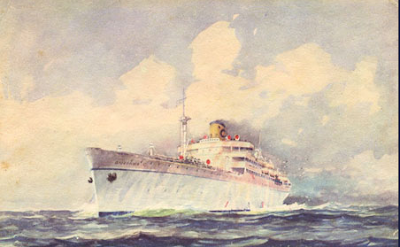
In real life and the novel, the Giovanna C carried both refugees and war criminals from Italy to Argentina.

That, of course, aroused my interest—especially so when the edition I read included the first chapter of A Quiet Flame, which describes Bernie’s 1950 arrival in Buenos Aires on the steamship Giovanna C in the awkward company of two notorious Nazis, including Adolf Eichmann. As in Germany, Gunther doesn’t hesitate to make fun of his companions, and Kerr gives provides him dialogue no less acerbic than Raymond Chandler gave Philip Marlowe and Dashiel Hammett gave Sam Spade. In one case, Bernie remarks that he repels an opponent with a punch that he compares to legendary Argentine boxer Luis Ángel Firpo.
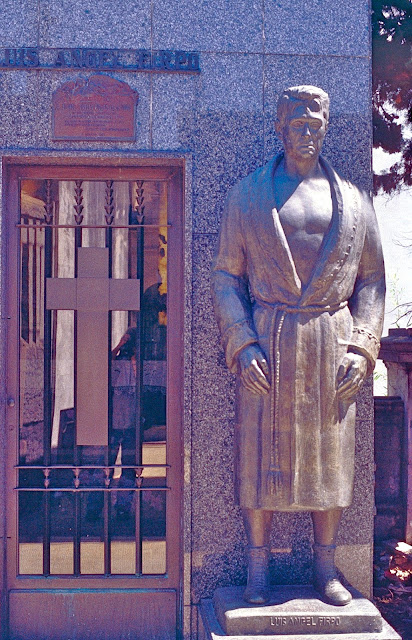
Bernie Gunther claims to pack a punch like the legendary Argentine heavyweight Luis Ángel Firpo, who once knocked Jack Dempsey onto the canvas (Firpo now resides in Recoleta Cemetery).

Like his companions, Bernie arrives under an alias but, in a meeting with then-President Juan Domingo Perón (and Perón's poodles), he has to reveal his true identity and, under pressure, he’s persuaded—forced, rather—to investigate a murder and another disappearance with links to a German-speaking community in Buenos Aires and the northern province of Tucumán (with additional links to a cold case he failed to solve in pre-war Germany).


Unlike Marlowe and Spade, Gunther had worked as a private detective when employment under the Nazi regime became untenable—a situation that may well have contemporary parallels (He had also served in Ukraine, for what that's worth). Parenthetically, Bernie manages to make some blatantly sexist comments about Evita Perón’s appearance, but also sympathizes with the health problems that killed her just a few years later.
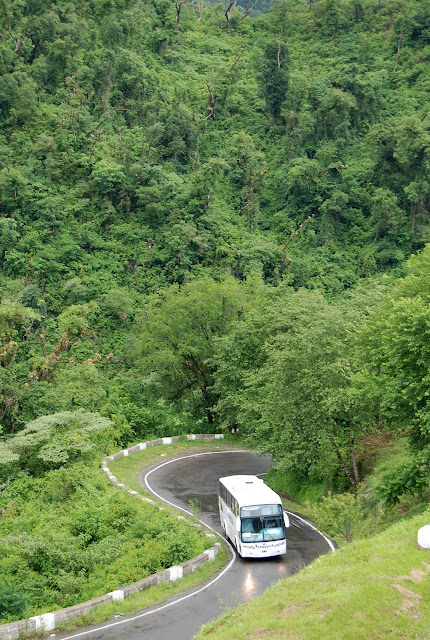
Bernie's investigation leads him to a sinister site in the subtropical sierras of Tucumán Province.

More significantly, Bernie learns of the notorious Directive 11, by which the Argentine government denied Jewish refugees entry into the country. Through him, Kerr speculates as to the existence of a Directive 12, which would have established a concentration camp in Tucumán’s subtropical forests.


According to a 2009 interview with The Wall Street Journal, Kerr (who died in 2018) decided against visiting Argentina because “I thought about it and decided that what I wanted was a historic picture, rather than the Argentina of today.” In my opinion, though, even allowing for poetic license, this novel would have benefitted from a visit to the country. In one instance, for example, Kerr appears to confuse the Argentine capital’s central shopping district of Florida with a neighborhood in the town of Vicente López, in the city’s northern suburbs—where the Nazi refugees had a safe house and Eichmann later resided for many years. Through Bernie, he's also unnecessarily harsh on a Tucumán he never saw (though it's clearly a different place today). At the very least, the publisher should have hired a proofreader familiar with Argentina—the airport city of Ezeiza, a southern Buenos Aires suburb, is consistently misspelled “Ezeira.”

Uki Goñi's book details the Perón government's complicity with the Nazis. 

At the risk of being labeled a pedant, I’ll still recommend both these novels and others by Kerr, who manages to convey the complexities of surviving in an authoritarian or even totalitarian ambience while still seeking truth and justice—even for a flawed figure like Bernie Gunther. What I'd really like to see is somebody turn all 14 novels into a streaming series.


In the course of writing A Quiet Flame, the novelist relied on Uki Goñi’s The Real Odessa, an historical account of the Nazi presence in post-war Argentina, including documentation of the Perón government’s complicity (Full disclosure: Goñi is a personal acquaintance).


Addendum

Another personal acquaintance of mine, the late geographer Dan Gade, had direct contact with another ex-Nazi, the SS officer and ethnobotanist Heinz Brücher, but it was only after Brücher’s murder in 1991 that Gade unearthed the extent of Brücher’s role in WWII and continued adherence to Nazi ideology. Questioning the impartiality of Brücher’s South American research—he also worked in Paraguay—Gade’s article might suggest that Goñi’s extensive and incisive research was only a starting point for a continued assessment of the post-war German presence.


Support Southern Cone Travel

If you’ve found this entry informative and/or useful, please consider earning me a few pennies by clicking on an ad—always presuming, of course, that it’s relevant to your interests.

Friday, November 27, 2020

Farewell, Jan Morris...and That Soccer Guy

In the early 1990s, I finished my original guidebook to Argentina for a publisher whose name I will decline to mention here. Shortly thereafter, the same publisher offered me a contract to update their existing guidebook to Chile, which I accepted, and my career as a guidebook writer seemed like destiny.

While those two assignments might sound comparable or almost identical, there were significant differences. The same author—whose name I will also decline to mention here--had done the previous editions of both books. In the case of Argentina, though, the author held copyright and, therefore, I had to start the book from scratch. Given that the book was awful—so bad that the publisher decided to do a new version shortly after the initial publication—on one level that was no big deal.


Of course, that meant more work for me (and my wife), who also wrote part of the new title. We had to avoid plagiarizing the previous author’s work but, given its shortcomings, that was never an issue. The downside was that the publisher would claim the copyright to our new book, as it was then eliminating author-friendly royalty contracts.


In the case of Chile, the publisher already owned the copyright, so plagiarism would not be an issue—or would it? That came to mind last week when I heard that Jan Morris, famed for her journalism, travel writing and personal life, died Friday at the age of 94. I had once unknowingly plagiarized her.

When Jan Morris visited Puerto Montt, in the early 1960s, it looked different than it does today.

In 1961, Morris had described the southern city of Puerto Montt as filled with “structures in the Alpine manner, all high-pitched roofs and quaint balconies.” Thirty years later, the author of the Chile guidebook wrote that “many houses are of northern-European design, faced with unpainted shingles, high-pitched roofs and quaint, ornate balconies,” without attribution.


Updating the book, I was unaware of the flagrant plagiarism until several years later, when I expanded the quotation with appropriate credit to Morris herself. Legally, the publisher would probably have been responsible but, when I was fortunate enough to meet her at the annual Book Passage Travel Writers Conference in 1999, Jan simply laughed it off. That’s a great way to remember her.


It Goes to 11, or Is It 60?

In other necrology news, soccer icon Diego Maradona has died at the age of 60. Never able to appreciate soccer’s absence of hand-eye coordination, I'm not a fan of the sport, but there’s still no underestimating the impact this addictive personality had on his native country—which was always willing to rationalize his personal shortcomings.

Maradona shares a mural with tango icon Aníbal Troilo.

Argentine President Alberto Fernández declared three days of mourning, with Maradona’s body lying in state in the Casa Rosada presidential palace, but that turned into a truncated free-for-all as many fans tried to force their way in to view the corpse; earlier, morgue employees at the autopsy site apparently took selfies of that event.


In a country where embalming is unusual—the most famous case is that of Eva Perón, whose post-mortem odyssey is a true epicMaradona apparently requested to have himself put on public display in perpetuity, but the family appears to have overruled that. “El Diego” may never enjoy Evita’s privileged position at the elite Cementerio de la Recoleta, but his tomb in suburban Buenos Aires Province seems likely to  become a pilgrimage site in its own right.


Uruguayan writer Eduardo Galeano may have summed up his legacy best: “Maradona was condemned to believe himself Maradona and obliged to be the star of every party, the baby at every baptism, and corpse at every wake. Success is even more devastating than cocaine. No analysis of urine or blood can reveal that drug.”

Monday, November 27, 2017

¿Peronismo Vegetariano?

Some time ago, I wrote a post that touched on the topic of so-called Peronist cuisine, which almost seems an oxymoron—the working-class followers of Argentina’s legendary strongman Juan Domingo Perón were not exactly known for their culinary sophistication. Still, there’s a stereotypical roster of basic dishes that appeal to the so-called descamisados (shirtless ones) who comprise(d) the Peronist base (perhaps as Kentucky coal miners might appreciate Donald Trump’s overcooked steak with ketchup).
Last week, I decided to try the fare at Palermo Hollywood’s Perón Perón, in an area that’s not home to many descamisados, and is walking distance from our own Palermo apartment. One might argue that it’s an Argentine analogue to Tom Wolfe’s “radical chic,” with middle-class diners indulging themselves with somewhat more sophisticated versions of working-class comfort food. When I arrived around 7:30 pm, relatively early by Argentine standards, a BBC film crew was interviewing chef Gonzalo Alderete Pagés, who spoke more than passable English.
The BBC speaks to the chef.
I was pleasantly surprised with the food. The menu does feature a lot of heavy comfort food such as guiso de mondongo (tripe stew) and various incarnations of milanesa (chicken-fried steak), but I chose to go vegetarian with canelones de acelga (chard cannelloni; I really like chard, and my late mother-in-law made terrific chard pie even though she wasn’t much of a cook otherwise).
I was pleased with my chard cannelloni.

Never before had I seen an asparagus empanada.
The oddest item was an asparagus empanada, which aroused my curiosity as I’d never heard of such a thing before; it was fried but not too heavy, though I would have preferred a bit more asparagus in it. My glass of Domingo Hermanos Malbec came chilled, which is how my late father-in-law took red wine (as do many other Argentines). The wine list focuses on vintages from the Andean Northwest. For dessert, I had a satisfying rich dark chocolate mousse.
The dining area is full of Peronist iconography.
I should add that the service was surprising good, which is not something you anticipate from a movement that prides itself on labor militancy (spoiler: they were all wearing shirts). The décor, of course is a shrine to Perón and Evita (and their would-be successors Néstor Kirchner and Cristina Fernández de Kirchner), and thus more than a bit kitschy. I’d happily go back, but I think I might prefer winter when I could order something like locro, a northern Andean stew whose warm heaviness would be welcome in cooler weather (though this spring has been mild in town).
Peronist sloganeering is part of the décor.

Saturday, June 22, 2013

What's in a Name? The Symbolism of South American Streets


When I first visited Buenos Aires, in 1981, my future wife and her older brother shared a small apartment, belonging to their parents, on Cangallo street in the Congreso neighborhood. When we returned three years later to spend several months of research at Archivo General de la Nación, the street signs were a surprise – we no longer lived on Cangallo, but rather on Teniente General Juan Domingo Perón, the first street in the capital to be named for Argentina’s larger-than-life caudillo.
This was not the street’s first name change, though. According to Vicente Osvaldo Cutolo’s encyclopedic Buenos Aires: historia de las calles y sus nombres, the east-west street that starts at Puerto Madero was originally “Merced,” after its namesake colonial church, and then “Sáenz Valiente” after an early city mayor. It became Cangallo in 1822, to commemorate a Bolivian village destroyed by Spanish forces during the South American wars of independence.
There were objections to renaming Cangallo, and it’s interesting to note, as Cutolo does, that even Perón apparently preferred to refer to himself as president rather than by his military rank. What’s always seemed odd to me is that, despite Perón’s towering importance in Argentina history, this nondescript and narrow downtown street (pictured above) bears his name – no matter what one thinks of his politics, a grand avenue would seem more suitable (Evita does have her own avenue in another part of the city).
This wasn’t our last experience with Argentina’s volatile toponymy. When we purchased our Palermo apartment in 2002, the street on which the buildings stands was República Árabe Siria (pictured above, from our balcony), but just a few years earlier it bore the name Malabia, after a Bolivian jurist who lived in Buenos Aires in the early independence years. After president Carlos Menem took office in 1989, though, the nine blocks between Avenida Santa Fe and Avenida del Libertador acquired their current name because of Menem’s Syrian origins (his parents were Sunni immigrants to the province of La Rioja, but Menem himself converted to Catholicism which, until 1994, was obligatory to hold the Argentine presidency).

Across the Andes, in Chile, there’s a different sort of controversy on street naming. The late geographer Homer Aschmann of UC Riverside once noted that many street names in the Paraguayan capital of Asunción bore dates of famous historical events – but, he added facetiously, none of those dates corresponded to Paraguay’s brutally hot and humid summers, when the weather made doing anything nearly impossible. In Chile, though, Santiago’s Avenida 11 de Septiembre  (pictured below, at a quiet moment) takes its name from the date of the military coup that overthrew constitutional president Salvador Allende in 1973. Formerly, this segment of the traffic artery through one of the city’s middle to upper-middle class neighborhoods was Avenida Nueva Providencia, paralleling segments of earlier Avenida Providencia.
For years since Chile’s return to democracy, in 1989, Avenida 11 de Septiembre has been a sore point and, almost every spring, it’s been the site of vigorous protests that sometimes turn destructive. That could change if, as seems likely, the street reverts to its original toponym – and the city council is due to vote on the issue this coming Tuesday, June 25.

The only noteworthy opposition to the change seems to come from Chile’s extreme right, most notably Pinochet apologist and primary presidential candidate Pablo Longueira, who has gone out of his way to state his opposition to any change, emphasizing that his UDI party considered the Pinochet regime to be “a military government” and “not a dictatorship.” Longueira’s primary opponent Andrés Allamand preferred to leave the issue in the hands of the borough of Providencia, adding that he refrains from using the world “dictatorship” because “I know that a military government is by definition a dictatorship.”

Even if he manages to get the nomination, Longueira is unlikely to defeat the popular former president Michelle Bachelet, who is seeking a second term after four years out of office; his stubbornness underscores the fact that current president Sebastián Piñera, a conservative, was electable partly because he publicly supported the “No” campaign in the 1988 referendum that rejected a continuation of the Pinochet regime. If there’s a lesson here for Longueira and his supporters, it’s that symbols are important, but not in the way they might prefer.

Sunday, August 5, 2012

Evita's Millions; Plus, Tango by the River

For a country with Argentina’s polarized politics, it’s surprising that there are so few explicitly political jokes. I’ve often heard people gripe and moan about the state of public life, but only a handful have ever told me political stories that were truly funny. In late 2001, I did hear then president Fernando de la Rúa referred as “Frenando de la Duda,” a pun suggesting his ineffectual hesitancy – a phrase that, roughly translated, means, “Just in case, keep your foot on the brakes.”
Thanks to a comment the other day, by my friend Dan Perlman of Casa Saltshaker, I became aware of another one. One of the catch phrases of Argentine history is Evita Perón’s “Volveré y seré millones” – “I’ll be back, and there will be millions of me.” There’s no proof she ever uttered these words, which are often attributed to her but come from a poem by José María Castiñeira de Dios and have become a stock phrase of Peronist populism. Their implication is that millions of Argentines would follow her ideals even after her death.

In a sense, that’s true – on a global scale, Evita long ago eclipsed her husband and, as pure symbol, she undoutbedly has an even stronger hold on Argentines, even those who profess undying fealty to “Teniente General Juan Domingo Perón” (Perón's loyalists invariably refer to him by his military rank rather than his political office, even though he was elected president three times).

In any event, the joke that Dan left in comments the other day had to do with the new 100-peso banknote that bears Evita’s image. Given the country’s high inflation rate – the government admits about 10 percent, but independent observers calculate that it’s at least twice that – Evita’s ostensible statement that “there will be millions of me” is fodder for critics who suggest that inflation is out of control. At the moment, she’s only hundreds but, if things should get worse, say the jokers, she could indeed be millions.

Tango by the River
And now for something completely different. On Friday August 17, at 6 p.m., I will give a digital slide lecture on Buenos Aires at Tango by the River in Sacramento. Limited to a maximum of 50 people, the event will also include tango performances; admission costs $10, or $8 in advance. I have spoken here several times before, and we always sell out, so plan in advance. Copies of my Moon Handbooks on Argentina, Buenos Aires, Chile and Patagonia will be available at discount prices.
Custom Search