Showing posts with label Palermo. Show all posts

Wednesday, January 19, 2022

Mendocino is Cooler Than Buenos Aires (Literally)

At the end of last month, I wrote that my wife and I had postponed a planned trip to Buenos Aires because of the spread of the Omicron variant of the COVID-19 virus there. In addition, our route would have taken us through COVID-friendly Texas and, given the frequency of flight cancellations by American Airlines, it was possible we might have had an unwelcome delay of a day or more in Dallas/Fort Worth.

Mapping the heat wave, from Argentina's Servicio Meteorológico (in degrees C)

Very tentatively, we’re hoping to try again in March, but early January provided us yet another reason to justify our decision—a brutal heat wave that struck the Argentine capital and much of the rest of the country. In summer, of course, we would expect warm and even hot temperatures, but last week the mercury soared to 106° F (41° C) in the city and, in the north-central city of Córdoba, it reached 108.5° F (42.5° C). The western desert city of San Juan was a near-furnace at 111° F (44° C).


A few years ago, we reluctantly installed air-conditioning in our Palermo apartment, but we’ve never used it during our time there—our idea was that it would appeal to short-term rentals. Even that mightn’t have mitigated this heat wave, though, as there were power outages in much of the city. Global warming, anybody?
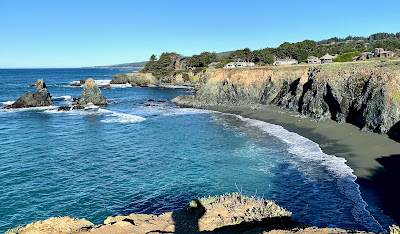
A typical landscape at Sea Ranch (note the houses in the background)

The town of Gualala (as seen from Sea Ranch)

With that in mind, we took a mini-vacation with our daughter, her boyfriend, and our two dogs, up the Sonoma County coast to Sea Ranch—an ostensibly eco-friendly development that I’m personally ambivalent about. The scenery resembles coastal Chile, the night skies sparkle, and there’s almost total silence except for occasional gobbles from wild turkeys outside your windows and waves crashing on the beach. Still, I find the supposedly cutting-edge architecture monotonous and the absence of any urban amenities bothersome—there’s no alternative to the automobile for transportation to the town of Gualala, some miles north, for essential shopping. In effect, Sea Ranch is a de facto “gated community” even though the State of California requires obligatory coastal access for non-residents.

The village of Mendocino, as seen from the nearby headlands
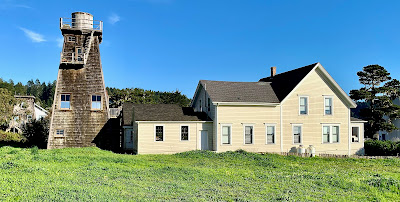
Some Mendocino water towers have been repurposed for residential use.

We spent four nights in a short-term rental house, arriving on a Friday afternoon and leaving the following Tuesday morning. Two full days is about my limit there but, given the late Friday arrival, Saturday and Sunday were dedicated to extended dog walks on the coastal trails (significantly cooler than Buenos Aires). On the Monday, though, we escaped north to the truly picturesque seaside town of Mendocino (population 855), where we walked along the coastal cliffs and explored its quaint architecture, including numerous water towers—some of them since converted to housing.


In popular culture, Mendocino has been a location for numerous films and TV series, but I recall it best for the 1968 hit song “Mendocino” by the Sir Douglas Quintet (Texas transplants to California whose producer chose the name to try to capitalize on the Beatles-inspired “British invasion” craze; the above video is a version by Sahm's later band, the Texas Tornados). Interestingly, my wife knew the song even before we met, as it was also a big hit in Argentina; though neither she nor her friends really understood the lyrics except for the title, they could dance to it.


Even more interestingly, the group leader Doug Sahm (born in San Antonio) was of German extraction and, I recently learned, Michael Holm (above) recorded a German-language version that became a chart-topper in then West Germany the following year. Does this explain the fact that the German real-estate firm Engel & Völkers maintains an office in Mendocino, and that all its window listings there are bilingual in English and German? Perhaps it does, as the comments on Holm's YouTube video include one by a German whose wife insisted he take her to visit there (German used to be my second language, but it’s now a distant third to Spanish and I couldn’t catch much of Helm’s lyrics).


Mendocino seems idyllic, but it’s not immune to the rest of the country’s problems. Almost everyone we saw in town was masked up but, not that long ago, the anti-vax owner of Fiddleheads Café posted notices that he would collect a surcharge for any client wearing a mask, and an additional charge for anyone who bragged about being vaccinated. He’s since gone out of business, but might still be welcome in Texas (in fairness, the state has great food and music despite its COVID-friendly politics).

Friday, February 21, 2020

Buenos Aires Airports (Including the Newest)

The terminal building at Aeropuerto El Palomar
Buenos Aires has airport issues. That’s long been apparent, given the accessibility issues of the main international airport at Ezeiza, the problematical logistics of the urban Aeroparque and, now, a third airport in the suburb of El Palomar, used primarily for the burgeoning low-cost market.
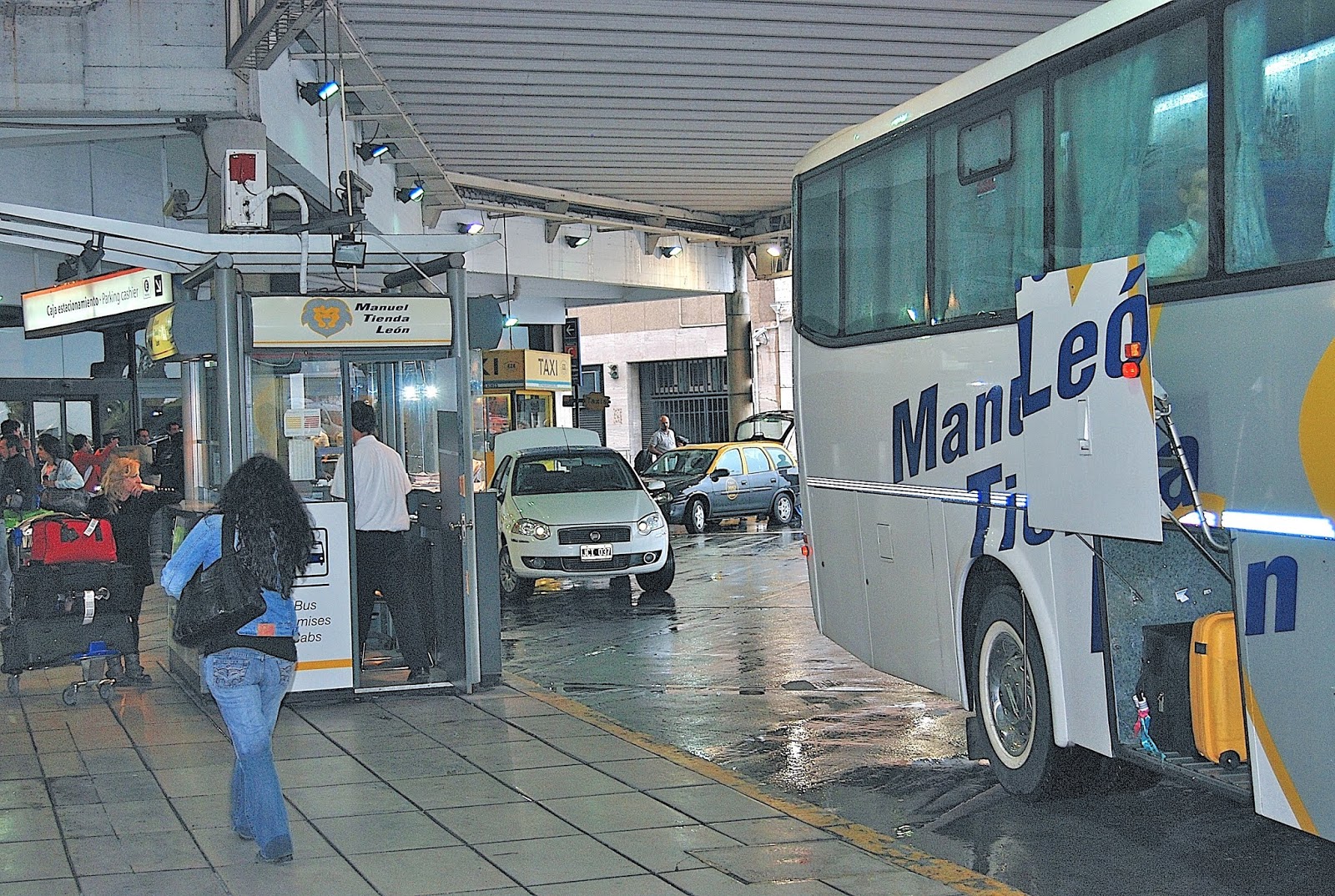
Manuel Tienda León is my default option from Ezeiza into Buenos Aires.
It’s the last of the three that I’ll be most concerned with there, but I’ll briefly mention the first two. Ezeiza, formally known as Aeropuerto Internacional Ministro Pistarini (EZE), is about 22 km south of the city center via the freeway known as the Autopista Teniente General Pablo Riccheri. That’s not far, but transportation can be problematical when suburban traffic clogs the highway at rush hour. Ideally Ezeiza would have rail service but, when I made this observation to a taxi driver, he responded that it would kill one of his main income sources (never underestimate the collective power of taxistas). When arriving at Ezeiza, I normally take the Manuel Tienda León bus/taxi combo into town—short delays don’t mean as much then—but, when leaving the country, I usually choose a cab or remise (livery car) directly there because luggage can be an issue. I still leave plenty early, though.
Aeroparque has few gates, so passengers must often take a shuttle to their plane.
Aeroparque Jorge Newbery (AEP) has different issues. It’s almost walking distance from our apartment in Palermo—or about a ten-minute cab ride—but the narrow road that runs alongside it (currently being widened by a landfill that projects into the Río de la Plata) can also get congested. Aeroparque’s biggest problem, though, is its very convenience, which brings low-flying planes to land on a crowded airfield with so few gates that passengers must often board shuttle buses for the relatively short distance to their plane. Immigration facilities also get really busy on international flights (mostly to and from neighboring countries).
Immigration gets backed up at Aeroparque.
El Palomar (EPA) is something else entirely. Only 20 km from downtown Buenos Aires, just outside the city limits, it’s a converted military airfield with only a single runway to serve FlyBondi and JetSmart, which provide cheap flights to provincial Argentine cities and to Brazil, Uruguay, Paraguay and Chile. Because of objections from neighbors, there are no nighttime flights.
The Ferroccaril San Martín is a commuter line that serves El Palomar.
On board the train to El Palomar
Getting there can be interesting. Manuel Tienda León offers remise service, but the congested approach makes public transportation a better option. The modernized Ferrocarril San Martín, a commuter line that once crossed the entire country to Mendoza, offers direct service from the central Estación Retiro, but I chose to walk from our apartment to the refurbished Estación Palermo (newly constructed overpasses have made the route quicker than it used to be). It’s 37 minutes from Retiro to El Palomar, and only 29 from Palermo, with frequencies every 15 minutes.
The gates to Aeropuerto El Palomar
This disconcerting panel stands outside the gates to Aeropuerto El Palomar.
Better yet, Estación El Palomar is barely a five-minute walk from the airport gates (presuming you’re not weighed down with heavy baggage). Some travelers may find it disconcerting, though, to be greeted by a sign that says that “This base operated as a clandestine detention center under the Air Force. According to witnesses, this was the departure point for ‘death flights’ with the purpose of killing detained and disappeared individuals from various points in the country.” During Argentina’s 1976-83 dictatorship, the military often threw sedated prisoners from planes or helicopters into the river or the open South Atlantic.
El Palomar's check-ins are congested.
After that, the terminal can’t help but be a relief, though its claustrophobic facilities are far inferior to of both Ezeiza and Aeroparque—even if conspicuous signs assure patrons that “We are modernizing El Palomar.” Not intending to fly out of there, I was unable to visit the departure areas, but I was still relieved that my own flight to Neuquén, on low-cost Norwegian Air Argentina, would depart from Aeroparque.

That scenario could change in the near future, as JetSmart has acquired Norwegian Argentina’s routes and will phase out the brand in favor of “JetSmart Argentina.” JetSmart should hold onto those gates at Aeroparque, which many if not most Porteño fliers should still find more convenient than El Palomar. That doesn’t mean, however, that I wouldn’t consider a cheap flight from El Palomar to, say, Bariloche or Ushuaia.

Saturday, December 21, 2019

Returning - to This Blog and Aeroparque

First of all, apologies to my readers for an unavoidable absence - though I’ve been in Argentina for more than two weeks now, computer issues have prevented my posting details of my time in Buenos Aires and parts of coastal Patagonia, from which I just returned late Friday night. At the moment, and for the foreseeable future, I’m working on a tablet, which makes inserting links and photos more awkward, so you may have to bear with me for the time being.

That said, I’ll offer a short account of my return to Aeroparque, Buenos Aires’s main domestic airport (though it does have some international flights). My flight from the southern city of Comodoro Rivadavia was late but, given that I had only carry-on luggage, I was hopeful of getting home quickly, but it wasn’t quite that simple.
My ticket to Palermo 

I walked quickly to the taxi stands and lined up, but then I spotted a sign telling me I should have a ticket to be in line, and realized that I would have to re-enter the terminal and line up again to get a ticket indicating my destination from a touch-screen machine. This was more difficult than it sounds, as I couldn’t find my reading glasses to decipher the small print in dim light.

Finally succeeding, I lined up again outside and finally grabbed a cab to my Palermo apartment. En route, I spoke to the driver about the absurdity of lining up twice to get a ride and, while he agreed with me on one level, he added that this new system - which began last April - has reduced abuses by the taxi mafias that once controlled Aeroparque access. He once avoided the airport, but now it’s a regular part of his routine, and the passenger knows the fare in advance.

While my first impression was negative, I’ll admit to having had unpleasant experiences in previous Aeroparque visits, and this now seems like a step forward - notwithstanding the need to line up twice.

Monday, November 18, 2019

Monday Musings - Mar del Plata, Money and Baseball

Today’s entry will be a potpourri about Argentina and sports. It ranges from the serious (the effect of Argentina’s Dirty War on my wife’s family) to the utilitarian (money and exchange rates) to the whimsical (my own tenuous link between baseball and Patagonia).

Southward Bound
Maru Sanllorenti's hometown of Tandil
As I prepare to head to Buenos Aires, early next month, my wife María Laura Massolo and our daughter Clío are already there (but will return to California before I leave). Their trip is partly vacation but also a family mission, as the remains of my brother-in-law’s first wife—a victim of Argentina’s 1976-83 military dictatorship—have been transferred from her hometown of Tandil to a new Panteón de la Memoria (Pantheon of Memory) in the Cementerio de La Loma in the coastal resort city of Mar del Plata.
My brother-in-law's first wife disappeared shortly after giving birth in 1976.
Maru's mother Eva and son Manuel at Mar del Plata's Panteón de la Memoria (photo by María Laura Massolo)
Abducted on the street in the Buenos Aires Province capital of La Plata in 1976, Maru Sanllorenti is survived by family members that include her mother Eva (now aged 94) and her son (my nephew) Manuel (now 43), who was an infant when she disappeared. My wife accompanied her brother Carlos (Manuel’s father) to Mardel for the ceremony there, then returned almost immediately to Buenos Aires, where Clío arrived on Friday. Yesterday, both of them attended a talk that Manuel regularly gives to visiting tour groups at the city’s Parque de la Memoria, which includes a commemorative plaque with his mother’s name.
Manuel Massolo (right) recounts his mother's story to visiting US tourists at the Parque de la  Memoria.
Money Matters
I haven’t been to Argentina since last year and, consequently, my recent information on exchange rates, prices, and transactions has been mostly second-hand. Since last month’s elections, though, exchange rates have remained relatively stable, and my wife informs me that a fine Peruvian dinner for three at downtown’s Chan Chan cost about US$10 per person, including three entrees plus a beer per person. It’s not an elite restaurant by Buenos Aires standards, but that’s still excellent value.
Our neighborhood cueva, on Palermo's Cabello street, was closed on the weekend.
Changing money, though, always requires reorientation. Bank lines are long, exchange houses are mostly downtown, and there’s still a difference between formal and blue (informal) rates. The difference isn’t huge, though, and the informal exchange houses known as cuevas are fewer than they once were. My wife has used the one near our apartment in Palermo, which remains open, but Dan Perlman of Casa Saltshaker informs me that street changers have taken over the business near his apartment (including the weekend’s Plaza Francia crafts fair outside the Cementerio de la Recoleta). Street-changing, of course, holds potential risk for the inexperienced—not the least of which is counterfeit currency.

It’s possible to change at ATMs, but that has its own issues—on the weekend, when our neighborhood cueva was closed, my wife paid a bank charge of US$10 to withdraw approximately US$50 from the machine. I’m not sure what the maximum withdrawal is at the moment, but it’s almost certainly low by international standards. In Chile, I regularly withdraw the equivalent of US$300 per transaction, but Argentina has been roughly half that—making the service charge a true burden.

Baseball and Patagonia
I love baseball and, for decades now, I’ve enjoyed saying that I leave for South America after the World Series and return in time for Opening Day. This year, I’m still stateside, through two weeks without baseball, but I’m looking forward to being back in Buenos Aires (where I’ve played the game myself) in another fortnight.

Actually, the month of October was a big disappointment, as my own Los Angeles Dodgers fell to the mild card (sic) Washington Nationals in the National League Division Series, and I didn’t pay a lot of attention the subsequent rounds or the World Series itself. The Dodgers were clearly the NL’s best but, as they say, anything can happen in a short series. Of all major sports, baseball is probably the likeliest for a lesser team to prevail—there’s really no such thing as an upset.
The top three finishers in the National League's Most Valuable Player voting
Last week, though, the post-season individual awards drew my attention because of a friendly rivalry with my Wisconsin-born but Chile-based friend Todd Temkin, who’s a diehard Milwaukee Brewers fan (his Cerveceros lost to Washington in a one-game playoff for the right to meet the Dodgers). Todd (who splits his time between Valparaíso/Viña del Mar and a farm in Futaleufú) and I disagree on who’s the NL’s best player; his choice is Milwaukee outfielder Christian Yelich, while mine is LA’s versatile outfielder/first baseman Cody Bellinger.
Dinner will probably take place at Futaleufú's Martín Pescador.
Hand-written menu at Martín Pescador
On one level, that’s a subjective judgement, as they’re both elite players, but Todd suggested that we place a bet on the Most Valuable Player award, “given to a player in each league who has contributed the most to the success of a player’s team,” according to the Baseball Writers Association of America. Depending on which player scored most highly in that poll, the loser would treat the winner to dinner—probably at Futaleufú’s Martín Pescador, with its frequently changing menu.
On my last visit, I enjoyed gnocchi with morels...
and a cheesecake for dessert.
As it happened, Bellinger edged out Yelich for the award, while Anthony Rendón of the champion Nationals came in a respectable third (the vote takes place at the end of the regular season, so the Nationals' playoff success was not a factor here). I’m looking forward to that meal, probably in March, when I’ll be updating Moon Handbooks Patagonia there. If Todd’s not around at that time, though, it could happen in Valparaíso or nearby Viña.

Monday, January 21, 2019

Betrayed by Rita Hayworth? Or Hollywood? (A Film Review, of Sorts)

While I’ve always enjoyed movies, it’s not an obsession so that, on occasion, something comes to my attention that I hadn’t noticed (or only barely knew of) before. That was the case on Saturday night, when our local PBS station showed director Charles Vidor’s Gilda, the film that made Rita Hayworth a star.
Filmed in late 1945 and released in 1946, Gilda is a noirish drama that aroused my interest because its ostensible setting is Buenos Aires, where small-time gambler Johnny Farrell (Glenn Ford) becomes the right-hand man of corrupt casino owner Ballin Mundson (George Macready), newly married to the stunning Gilda (Hayworth) who—unbeknownst to Mundson—has an ambivalent history with his new employee.
Palermo's Hipódromo offers casino slots today, but probably not in the 1940s.
I won’t comment further on the plot, because I want to focus on the movie’s presentation of Argentina and its capital. In the first instance, it’s worth noting that, when Mundson first invites Farrell to his casino, he provides him a “key” because casinos were not legal in the city. This rings true because that’s still the case—there are casinos in the provincial suburbs, but not in the capital except for the floating Casino Buenos Aires (two vessels docked at Puerto Madero) and some slot machines in the Hipódromo Argentino de Palermo, where betting on horse races is legal (I doubt that the Hipódromo had slots in 1945). Other than that, there are only a few bingo parlors.
As the Hotel Centenario, the Palacio Vera was an ostensible location in Gilda (photo by Julieta Sol Narganes, Creative Commons)
Most of the film’s action takes place in building interiors—there’s a brief soundtrack moment of tango and a nod to Carnaval—with almost nothing to suggest the streetscapes of Argentina’s capital (so far as I can tell, the entire film was shot in Hollywood in just three months). One ostensible location is the Hotel Centenario, which then occupied the Palacio Vera, an Art Nouveau structure on the central Avenida de Mayo that dates from 1910. Again, though, the movie does not even offer an image of the building's exterior.

Though the Brooklyn-born Hayworth herself was a Hispanic woman (her father was a Spaniard), she does not play one in this movie. At one point she flees to Montevideo, across the river, but again the only scenes of Uruguay’s capital are interiors.
Argentina Brunetti was one of two Argentines with bit parts in Gilda.
The Hungarian-born Vidor introduces the theme of Argentina’s World War II dark side in the person of two German mining cartel members who frequent the casino. The ostensible Argentines are few, including a police detective played by the Maltese actor Joseph Calleia and another policeman played by Manhattan-born Gerald Mohr, and a washroom attendant played by the Ukrainian Steven Geray. Two Argentines play bit parts: the Buenos Aires-born Argentina Brunetti, who appeared in many Hollywood movies in the 1950s and 1960s, and Jack del Río, best known as the fourth husband of pop singer Peggy Lee.
The late Argentine novelist was a movie geek.
That’s not to dismiss Gilda as a film, but I suspect it could have been even better had it been filmed on location (a remake might be interesting). Who knows, could that be one reason that the late Manuel Puig titled his first novel Betrayed by Rita Hayworth?

Gilda is available on several streaming services.

Support Southern Cone Travel!
If you've found this article interesting or useful, please consider earning me a few pennies by clicking on an ad (ideally, one that might be of interest to you).

Monday, December 3, 2018

G-20? The Buenos Aires Aftermath (With a Nod to FDR)

In early 2016, on the occasion of President Barack Obama’s trip to Buenos Aires, I wrote a short summary of US presidents’ visits to Argentina. It started with Theodore Roosevelt (an ex-president at the time of his visit) and continued with Dwight D. Eisenhower, the recently deceased George H.W. Bush, Bill Clinton, and George W. Bush. Now, for better or worse (evidence suggests the latter), it’s time for an update.
More than a few Argentines thought little of George W. Bush.
Over the weekend, as almost everybody knows, Donald Trump traveled to Argentina’s capital for the annual G-20 summit of the world’s leading economies, at the Centro Costa Salguero (not far from our apartment in Palermo). With concerns about security, the Argentine government declared Friday a holiday and encouraged people to leave town for a long weekend. Trains and subways were shut down for the duration and, from all accounts, the city felt like a ghost town.
Trump's own punctuation, subconsciously at least, undermines his legitimacy.
In an interview today, Argentine president Mauricio Macri revealed that Trump didn’t even want to attend and, from his apparent disinterest in diplomacy, he couldn’t wait to get out. In fact, when Trump was supposed to join the other heads of state for a photo, he marched right past Macri and off the stage (though he eventually rejoined). He did assent to most of the conference’s outcomes with the notable exception of the Paris agreements on climate change, where his denial of the issues makes the US a pariah on the most critical environmental crisis of these times. Ironically enough, in a tweet he issued today, he appears to have doubts about his own legitimacy.
Franklin Delano Roosevelt on the streets of Buenos Aires, 1936
When I wrote the previous article, I was unaware that Franklin D. Roosevelt—arguably the greatest president ever—had visited the Argentine capital in 1936, on an extended cruise through the Americas (at the time, there was no Air Force One to jet the chief executive overseas). Roosevelt spent only three days in Buenos Aires, from November 30 to December 2, addressing the Inter-American Conference for the Maintenance of Peace. One of his goals was to encourage a front of opposition to encroaching European fascism. The text of his speech is online at the FDR Presidential Library.

It’s noteworthy that, in 1961, local authorities changed the name of Calle Guanacache, in the northern barrio of Belgrano, to Franklin D. Roosevelt. The current White House occupant, who’s succeeded in making the rest of the world share the skepticism that many Argentines always do of US presidents, is unlikely ever to achieve any such recognition.

Sunday, February 11, 2018

Buenos Aires, by Bus & Bike

These days, whenever I’m in Buenos Aires, I prefer to get around on foot—while it’s more time-consuming than the Subte, city buses or taxis (all of which I use on occasion), walking offers the opportunity to view the city at a slower pace and also provides some exercise that can be otherwise hard to find on the unrelentingly flat terrain. During my recently stay, I walked as much as 11 miles (about 17 km) per day, though most of the time I did half that or a bit less. At some point soon, I’m planning to write about Buenos Aires specifically as a walker’s city—both the good and the bad.
Outside Buenos Aires Bus offices, on Diagonal Norte
I rarely take tours but, shortly before leaving Argentina earlier this month, I chose to see the city through two services I’d not known personally—Buenos Aires Bus and Biking Buenos Aires. Buenos Aires Bus is a hop-on/hop-off tourist shuttle that runs two separate routes around the city, between 9 a.m. and 9 p.m. (though the northerly recorrido verde operates only between 10 a.m. and 6:50 p.m. Frequencies are 20 minutes on the central and southerly recorrido azul/rojo and 30 minutes on the verde.
The Buenos Aires Bus stop on Avenida Libertador in Palermo, two blocks from my apartment
While the company has its offices downtown, a short walk from the central Plaza de Mayo, it has convenient stops throughout the most visited parts of the city, and it’s possible to purchase tickets online and board near your accommodations. In my case, there’s a stop just a couple blocks from my Palermo Botánico apartment, where I boarded for the ride downtown.
Aboard a roofless Buenos Aires Bus
The buses themselves are double-deckers, sometimes open to the sun and sometimes shaded by a tarp; the lower deck is available when it rains. There are trilingual guides on board—Spanish, English and Portuguese—but there are also audio guides in seven other languages, including German, French, Italian, Chinese, Japanese, Hebrew and Arabic. Every passenger receives a pair of headphones to hear the narration.
The iconic Obelisco, from the upper deck of Buenos Aires Bus
Sitting in the upper deck, I got a view of the city that was rather different from that of a pedestrian and I only regret that, as the end of my stay approached, I was not able to take full advantage of the service. For a first-time visitor to the city, though, it’s an option worth consideration, available either for 24 hours at Ar$670 (about US$34) or 48 hours at Ar$850 (about US$43) per person.

Biking Buenos Aires
On another day, though, I was able to indulge myself on a bicycle tour through parts of the city I’ve long known. Based in San Telmo, Biking Buenos Aires offers a variety of excursions, ranging from a five-hour “Heart of the City Tour” to a seven-hour “Ultimate City Tour” and thematic tours on architecture, urban art (including graffiti) and even a combined bike and kayak trip to the northern suburbs.
The Biking Buenos Aires offices in San Telmo
In the last week of my stay, I chose the “Heart of the City” option, which started around 11 a.m. with an orientation meeting, at Biking’s offices, for the eight of us (all Americans except for an English-speaking French couple). Our guides were Cristina Marey, a Galician woman who headed the group, and Olaf Menger, a Dutchman who brought up the rear and directed traffic at intersections where notoriously aggressive porteño drivers might plow into us.
At Parque Lezama, with the Russian Orthodox Church in the background, at right
Our first stop was Parque Lezama, only a few minutes from Biking’s offices, where Cristina spoke about the city’s supposed founding here by Pedro de Mendoza in 1536, and pointed out local landmarks such as the Iglesia Ortodoxa Rusa. We then rode on to La Boca for a stop at the traditional Caminito, where I was a reluctant recruit for a tango lesson with Olaf—I have two left feet and no sense of rhythm (at tango’s beginning, men danced with each other in brothels while waiting for a prostitute).
The Caminito is an obligatory stop in La Boca.
Until April, Ai Weiwei's "Forever Bicycles" will occupy the sidewalk outside the Fundación Proa.
The lesson was mercifully brief, followed by a short walk around the Caminito, where I saw two interesting novelties: first, at the Fundación Proa, a bicycle-oriented art installation by Ai Weiwei (here until early April), and then a fresh-squeezed orange-juice cart. Increasing in numbers, the orange juice carts are a welcome phenomenon in the city’s summer heat, are increasing in numbers.
Fresh-squeezed orange juice carts are an increasingly common sight on the city's streets.
Local boy Carlos Tévez is a hero in La Boca.
I heard, in the orientation, that we would see murals in La Boca, but I anticipated the historic paintings on the walls of La Bombonera, Boca Juniors’ iconic soccer stadium. Instead, we proceeded to a part of the barrio I didn’t know, where newly painted murals, such as this one of barrio hero Carlos Tévez—who recently re-signed with his original team—cover the sides of high-rise apartments. La Bombonera is visible in the distance, but in the other direction.
Puerto Madero's Reserva Ecológica is a reclaimed landfill.
Also atop the reclaimed landfill are luxury apartment buildings.
From La Boca, we rode toward the shores of the Río de la Plata and the Reserva Ecológica Costanera Sur, where grasses, shrubs, woodlands and birds have colonized a landfill that was once off-limits. It’s part of the city’s newest barrio, Puerto Madero, which is also the wealthiest but, not so far in the future, its luxury high-rises might require canoe or kayak access as rising seas also raise the river’s level in an already flood-prone zone.
Biking's clients lunch at Puerto Madero, with the Reserva Ecológica in the background.
Emerging from the woods, we lunched at a sandwich stand before continuing to the classic diques (basins) of the old port, now surrounded by the city’s priciest real estate, and the landmark Puente de la Mujer pedestrian bridge. Cristina commented that Puerto Madero is unaffordable for all but the wealthiest porteños, and that’s certainly true, but as Andrew Graham-Yooll once remarked to me, its ample public spaces—not limited to the Reserva Ecológica—are open to visitors of all social classes.
Spanish architect Antonio Calatrava's Puente de la Mujer has become an icon of Puerto Madero.

Puerto Madero's public areas are open to all, for activities like pickup soccer games.
Leaving Puerto Madero, we had our only uphill segment—a short one, but still a bit of an effort on a relatively heavy bike—before reaching the central Plaza de Mayo and its landmark buildings. Unfortunately, the Plaza itself is undergoing a major remodel (at the height of tourist season!), so we soon looped back to Biking’s offices and the conclusion of a satisfying 17-km two-wheel trip.
Shortly after I took this photo, from the balcony of the colonial Cabildo, the Plaza de Mayo closed for a major remodel.

Custom Search