Showing posts with label Neuquén. Show all posts

Sunday, December 13, 2020

Corona v. Corona? Virus Meets Eclipse in South America

In mid-2019, Chileans and many foreigners flocked to the coastline, about 500 km north of Santiago, to see a major solar eclipse—a once-in-a-lifetime opportunity for most people. Tomorrow, though, there’s yet another chance, but this year’s event has complications for eclipse-chasers in Argentine Patagonia or southern mainland Chile, the path on which the moon will blot out the sun for a little over two minutes. Those complications have to do with COVID-19, of course, but also the weather.

The path of Monday's eclipse

While people flocked to the 2019 event, that comes with risks this year. A friend in Pucón, who until very recently worked in hotel administration, tells me that the city “is living as if this wave won’t arrive here. There are lots of people who’ve come to see the eclipse, many of whom surely are carrying the virus that will force us to shut down again, perhaps all summer…”

Monday's forecast shows a 90 percent chance of rain at the hour of totality,


Ironically enough, they may be risking their lives—and those of others—for nothing. A few years ago, I and some friends had to cancel an overflight of nearby Volcán Villarrica because heavy cloud cover set in the morning of our departure, and tomorrow’s forecast shows rain throughout the day (the marine west coast climate resembles that of Seattle). In the path of totality, the sky will get darker at 1 p.m., but no one there is likely to see the startling sight of the solar corona (spoiler—it’s nothing to do with the virus!) when the moon blocks the sun.


In theory, visibility should be better on the Argentine side of the border, in the rain shadow of the Andes, but rain is also possible at San Martín de Los Andes, a prime tourist destination that lies barely outside totality. Conditions should be better in the city of Neuquén, a bit farther from the path of totality, but I would expect heavy southbound traffic towards the hamlet of Picún Leufú, which lies within. A 20-something friend of ours in the city (which is not really a tourist destination) at first sounded indifferent when I asked him if he were going to watch it, but now it seems he’ll at least step outside the office to glimpse the partial eclipse.


For those of us unable to reach Chile or Argentina for the event, the National Aeronautics and Space Administration (NASA) will follow it online starting at 9:40 a.m. Eastern Standard Time. There will also be a live show in Spanish starting at 10:30 a.m. EST.

Tuesday, February 4, 2020

The Delta Equation...

I’m old enough to remember when flying was a pleasure, something to look forward to rather than a test of one’s endurance. In my teens, my first flight ever was from Seattle to Los Angeles, and a window seat enthralled me with vistas of Mount Rainier and the Cascade Range, followed by the Sierra Nevada and the Mediterranean landscapes of Southern California. I can’t recall what airline I flew—it might have been the now defunct Northwest—but the experience itself was memorable.

I’ve had comparable experiences since—once I flew a nearly empty Aerolíneas Argentinas jet from Buenos Aires to Miami that let me move around for the best views of the Andes, and provided three seats to stretch across after dark. Many times I’ve also flown the length of the Chilean Andes, and have relished the opportunities to snap aerial photographs of their natural and cultural landscapes, including cities, in the days before window seats cost extra.

Something New (For Me, at Least)
Still, I looked forward to my December flight with Delta to Buenos Aires via Atlanta, if only because I’d never flown that airline—which absorbed Northwest in 2008—nor had I ever been to the Hartsfield-Jackson Atlanta International Airport (ATL), the world’s busiest single airport as recently as 2017. Delta, a legacy airline, began its operations as a cotton crop-dusting operator in 1925—in the Mississippi Delta, of course—and has offered commercial passenger flights since 1929.

Anecdotally speaking, Delta has a pretty good reputation, and my first impressions were positive. For my morning departure at San Francisco International Airport (SFO), the personnel were congenial, lines were short, and I breezed through security without even having to remove belt or shoes. Because of that, I had a longer wait at the gate than I anticipated and, though I found Delta’s boarding procedures a bit confusing, we left SFO on time and arrived at ATL with plenty of time to spare.

Happily, there was no need to go through security again at Hartsfield. I had only eaten a small packet of almonds on the four-hour flight from SFO—another contrast with the past, of course—but found nothing but the lowest-common denominator fast-food options in Atlanta, so I refrained from snacking in anticipation of an on-board meal en route to Argentina. Again, Delta’s boarding procedures were a bit opaque, but we were all seated by the scheduled 9 p.m. departure time.

That’s when things started going wrong, however. As we waited patiently for takeoff, it was half an hour before an announcement informed us that we could not take off until the pilot’s seat received a necessary adjustment, and that mechanics were attending to the problem. In an update an hour later, we heard that the entire seat would require replacement, and cabin crew proceeded to distribute water to passengers (not having eaten since breakfast, I was feeling the first pangs of hunger). An hour later, we learned that the mechanics were successful, but that the repair would require an inspection. Finally, at midnight, we taxied onto the runway and took off for Argentina.
Finally in the air...
Delta's southbound menu from Atlanta
That was only the start of it. About an hour into the flight, as we were anticipating meal service, the crew began to serve a “Peach Bellini” sparkling cocktail that I would have turned down had I had the chance—but, somehow, only passengers on the right side aisle of the plane received them. I have a personal aversion to sparkling wines but, on the left side, I never even had the chance to decline.
The remains of Delta's dinner (no disrespect intended toward Ben & Jerry's)
Finally, dinner arrived in the form of a so-so grilled chicken salad, accompanied by bread that turned to be harder and colder than the ice cream dessert that followed. I managed to sleep about two hours before the egg and Swiss breakfast sandwich arrived and, shortly thereafter, we landed in Buenos Aires—at noon, three hours behind schedule, of course.

It's Better in Argentina?
Over my six weeks in Argentina, I had two orderly no-frills flights from Aeroparque, one with Aerolíneas Argentinas to the southern coastal city of Comodoro Rivadavia and the other on Norwegian Air Argentina to northern Patagonia’s fracking boomtown of Neuquén, capital of its namesake province. I didn’t expect anything special on board, though I was a little surprised that Comodoro’s glisteningly modernized Aeropuerto Internacional General Enrique Mosconi had no food service inside the security area. No matter, as I had abundant lunch options near our Palermo apartment.

Northbound Improvements?
My return to California, late last month, went somewhat more smoothly—Delta left on time, I had the opportunity to decline the Peach Bellini, the grilled chicken salad had mango rather than strawberries (which I don’t much care for), and I got a nightcap of Bailey’s on request. The breakfast sandwich, consisting of an Argentine medialuna with ham and cheese, was an improvement on its southbound counterpart. On balance, though, I found no reason to choose Delta over any of its competitors except that the price was right, but I’ll stop short of saying the company should have stuck with crop-dusting.

An Explanation
I've not posted anything on this blog in more than six weeks, and that's because of a computer issue that occurred as soon as I arrived in Buenos Aires that would have cost a small fortune to repair there, and the iPad and iPhone were too awkward to manage. That's left me with lots of material and, now that I've got my computer repaired, I'll be posting more frequently in the near (and not so near) future-—in the hope that everyone will follow along.

Thursday, July 11, 2019

This Year's Eclipse (and Next Year's?)

Chilean eclipse-chasers filled the beach at Caleta Los Hornos (photo by Marializ Maldonado)
I couldn’t attend last week’s solar eclipse in Chile but, indirectly at least, I had a sort of presence. When my longtime friend Marializ Maldonado, at whose house I often stay when in Santiago, asked to borrow my car to drive north to the Coquimbo region, I immediately said yes, and she was able to view the event at the beachside locale of Caleta Los Hornos, north of the city of La Serena.
In the minutes before totality, at Caleta Los Hornos (photo by Marializ Maldonado)
Partly, this was a favor to a friend, but it was also a favor to me, as it’s best not to leave a car unused for months, as I do by necessity in the outskirts of Santiago. Marializ also often does me the favor of paying my highway tolls as, for some incomprehensible reason, Chile’s online payment system does not want to accept my US credit cards (though I use them regularly when I visit Chile).
The Coquimbo region is home to major international observatories such as Cerro Tololo (CTIO), part of the US National Optical Astronomy Observatory.
Marializ arrived just five minutes before totality, which she described as “two intense and beautiful minutes” on the Pacific shoreline. The most vivid account I’ve read, though, came from the New York Times, whose “52 Places” columnist Sebastian Modak saw the event from the European Southern Observatory at La Silla—also pointing out that this was only the third eclipse to pass over a major international observatory in the last 50 years.

The eclipse turned out to be an economic bonanza for the region. According to the local daily El Observatodo, the event attracted more than 300,000 people over five days, and those visitors spent more than US$82 million. Many if not most arrived by private car, presumably from Santiago as Marializ did, but there were also numerous foreign eclipse-chasers. Plenty of people also witnessed it from the Argentine side of the border, though cloud cover obscured things in Buenos Aires.
Path of next year's eclipse
There's no guarantee of clear weather as next year's eclipse passes over Volcán Villarrica.
For Chileans and others who missed this year’s eclipse, there’ll be another chance soon enough. On December 14th of 2020, the moon will once again block the sun in the southern lakes resort district around Lago Villarrica and the town of Pucón, but that area’s marine West Coast climate—resembling Seattle’s—mean that clear skies are no sure thing. A few years ago, some friends and I planned to do a small plane flyover of Volcán Villarrica’s steaming crater but, after several days of fine clear weather, the clouds moved in the next morning and made the flight impossible. Across the Andes, where Argentina’s Patagonian steppe usually has clear skies, could be a better option.
Next year, the rain-shadow steppes of Argentina's Neuquén province might be a better place to observe totality.

Monday, November 30, 2015

At the Border: An Encounter with Officialdom

In the course of doing what I do, traveling in South America to update my guidebooks and other projects, I often come in contact with government officials – especially when crossing borders (most often between Argentina and Chile). Latin America still has something of a reputation for official intransigence but, for the most part, my experiences have been cordial and routine. In one recent instance, the exchange was memorably positive.
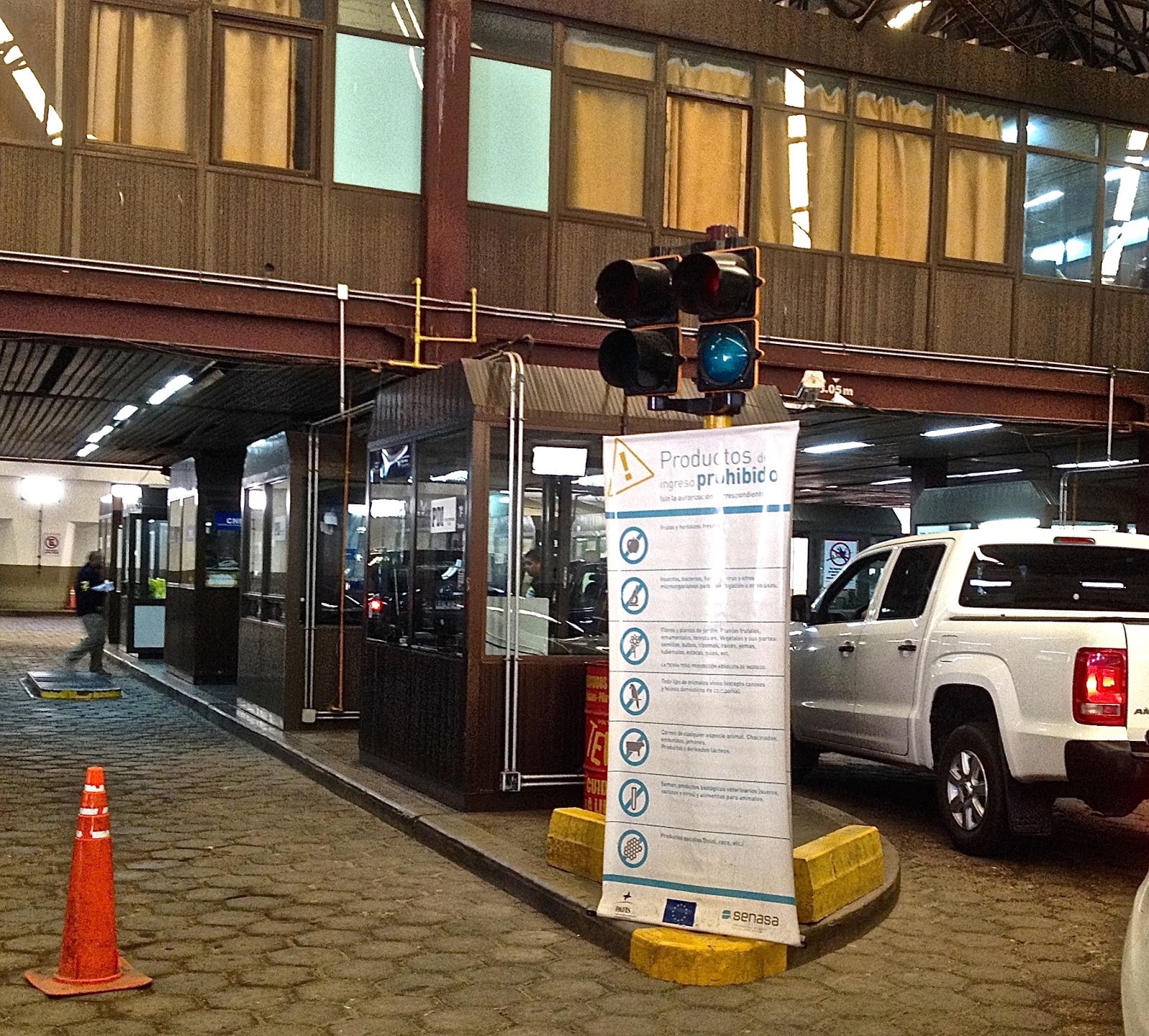
Last week was not one of those, though. En route to visiting the Argentine wine capital of Mendoza – which I had not seen since early 2010 – I had the most disagreeable experience in recent memory while crossing the border at Las Cuevas (eastbound, Argentina and Chile share a border complex on the Argentine side, pictured above; westbound, the shared complex is on the Chilean side, near Portillo).

Crossing the border, with my Chilean car, has almost always been routine but this time it was not. I had everything in order – as in many previous crossings - but the Chilean customs official who handled my paperwork didn’t think so. He was upset that I had no Chilean ID card – I can’t have one because I’m neither a citizen nor a resident – though I do have a RUT (the Chilean tax ID that allows me to pay my annual vehicle registration fees). To the best of memory, no official has ever asked to see any documentation other than the official ownership title and my passport.

This gentleman, though, was adamant that, without a Chilean cédula, I could not leave the country with my own vehicle. Routinely, Chilean customs has given me 90 days to return to Chile but, when he finally relented – I never expressed anger, though I was a bit bewildered - he was only willing to grant me four days to travel to the Patagonian city of Punta Arenas, a distance of roughly 3,000 km that would have required me to spend almost every waking hour on the road.

There followed a sort of dialogue – not exactly a negotiation – in which he extended my stay to 10 days and then 20, but not a second longer. Given what I had planned, to explore much of the Argentine side of the Andean front range and coastal wildlife destinations, even that gives me minimal flexibility to visit anything outside the main cities and off the principal highways.


Eight of my allotted 20 days are already gone, as I prepare to leave the city of Neuquén and continue to the Andean resort town of San Martín de los Andes. From there, I am considering returning to the Chilean side of the border in hopes of re-crossing with a clean slate that would let me resume my Argentine travels at a more leisurely pace. My reliable Santiago customs agent has informed that this shouldn’t raise any red flags the next time I try to cross, and that’s calmed some of my worries.

Saturday, December 27, 2014

No W(h)ining? An Uncommon Tasting in Palermo

Mendoza is the heart of Argentina’s wine country, and one of my favorite destinations in the country. On my recent trip south, though, I barely got out of Buenos Aires and, so, a tasting trip to vineyards and wineries was out of the question. I had to look elsewhere.
In principle, there’s no reason not to grow wine grapes in the vicinity of Buenos Aires – to the best of my knowledge the nearest commercial Argentine vineyard is in Sierra de la Ventana, 550 km to the southwest, but there is a substantial cluster of wineries in nearby Uruguay, just a short hop across the River Plate. In fact, if I recall correctly, vineyards used to form something of a greenbelt on the Argentine capital’s outskirts, until the military dictatorship of 1976-83 uprooted them for highways and suburban sprawl.
That said, there are plenty of places to sample Argentine wines in the city, without even having to hear it through the grapevine. One of those is the Bar du Marché (pictured above), in the Palermo Hollywood area, which purports to have 50 different wines by the glass. It’s a place to which this blog will return in the near future, but in a behind-the-scenes manner that its façade does not even hint at.
In early November, shortly after arriving in Buenos Aires, I described my experience at Vinos de Lujo as a “wine-tasting free-for-all” that left me more overwhelmed than enlightened. Later in the month, though, I was able to attend a more manageable tasting at Anuva Wines that I found far more satisfying.
Founded by US resident Daniel Karlin, Anuva (pictured above; the name comes from combining the indefinite English article “an” with “uva,” the Spanish word for grape) is about a 20-block walk from my own Palermo apartment. The inconspicuous streetside door – two Brazilians arrived late because they walked past the entrance without recognising it - opens onto a lengthy staircase that reaches a spacious tasting room that’s also suitable for more formal events. During a previous stay in the city, I had dined here at El Tejano, a “closed doors” restaurant that now operates its own venue for Texas-style barbecue nearby.
Anuva is not a restaurant, but it does offer tapas paired with a selection of five wines at each tasting. All its wines come not from high-profile Mendoza producers like Catena Zapata and Santa Julia, but from smaller, lesser-known wineries that reflect the industry’s geographical diversity, including vintages from the northwestern Andes around Cafayate and from the Patagonian province of Neuquén.
Our own tasting, beginning around 7 p.m., began with a sparkling wine from Viña Las Perdices, in the Agrelo district a short distance north of Mendoza. I’m personally not a fan of sparkling wines, but our sommelier, a fluent English-speaking Argentine named Florencia Campicelli, pointed out that small bubbles characterize the best and, by that standard, Las Perdices passed the exam.
The next sample, a Mairena Torrontés preceded by a cracker with fresh-sliced pear, basil and a walnut, was more to my liking. Torrontés is Argentina’s signature white grape (we almost always have some in the fridge) and, this one, from the high-altitude vineyards around Cafayate, was typically aromatic. I’d buy this one, but I’m not sure how objective I am, as I’d try almost any Torrontés, especially when complemented by raspberry and lemon sorbets (pictured below).
From there, we proceeded to the reds, starting with a San Gimignano Malbec aged six months in French and American oak. Malbec is my favorite red – we even named our beloved Alaskan malamute after it – and this Mendoza vintage is a worthy one. The tasting finished with two others– the Amauta IV blend of Malbec, Cabernet and Syrah from Bodega El Porvenir of Cafayate (the only winery of this bunch that I know personally) and a Mairena Bonarda from Mendoza. The Bonarda’s acquiring a certain notoriety among connoisseurs here, but it’s got a ways to go before it catches up with Malbec.
Throughout, we snacked on paired cold cuts and cheeses, plus a savoury empanada, and finished with a sample of bittersweet chocolate truffles. By the time we finished the two-hour tasting, I was more than satisfied and, despite the fact that this was never supposed to be dinner, it was all I needed for the night.
I’ve avoided sommelier-speak here, partly because I find it opaque and partly because I know more about wine tourism than I do about wine itself – I know what I like to drink, but I don’t presume to impose my tastes on others. Still, Anuva provides a useful introduction for wine-lovers just getting to know the options in Argentina.
Given the fact that the five wines and tapas cost US$52, it’s fair to mention that you could sample more for less at some wine bars and, at wineries, you might spend even less. Many Argentine wineries charge little or nothing for tours and tasting though, of course, you have to get to Mendoza, Cafayate or Chañar first.

Anuva, of course, wants to sell wine as well, and has a wine club that will ship two, three or four bottles per month to your US address. Even so, their tastings are sociable experiences, soft-sell events at which they will not pressure you to join.
Custom Search