Showing posts with label La Plata. Show all posts

Tuesday, March 24, 2026

An Anniversary of Atrocities

Today is the 50th anniversary of Argentina’s most brutal military dictatorship ever but, in the beginning, it was a bloodless displacement of President Isabel Martínez de Perón, widow of the famous caudillo Juan Domingo Perón. It soon devolved, though, into a bloodbath of some 30,000 Argentines—among them María Eugenía Sanllorenti de Massolo, my brother-in-law’s first wife.

                                               Maru Sanllorenti, mother of Manuel Massolo

A student activist, “Maru” was abducted on the street in the city of La Plata, about 50 km southeast of Buenos Aires, but by good fortune her husband Carlos Massolo, her infant son Manuel, and my wife María Laura (Manuel’s aunt) escaped that fate because they were at home in a house near the city’s hippodrome. Given that many babies and infants were abducted and gifted to military families, we are fortunate that Manuel is still with us.


                                              Poster for Manuel's Exhibition in Buenos Aires


Today Manuel is an occupational therapist and a painter, whose artistic reflections on the coup and its aftermath—Dictadura a Diario (Dictatorship Day by Day)— are on display this month at the Casa de la Provincia de Buenos Aires, a short walk from the Congreso Nacional (National Congress Building). In addition to his day job and painting, Manuel also speaks to visiting overseas tour groups at the Parque de la Memoria, which features a wall with names of all those who disappeared under the dictatorship, in northern Buenos Aires barrio of Núñez.

                               Manuel points out Maru's name to his son at the Parque de la Memoria.


In recent years, the coup’s anniversary has been marked by solemn ceremonies attended by the country’s highest authorities. That’s not the case this year, as “libertarian” President Javier Milei, elected in 2024, is a coup denialist who has gone about dismantling these events and sabotaging institutions and groups that held the coupmongers to account. That said, Argentine courts have recently ruled against appeals from pilots who threw prisoners from helicopters into the ocean, and others who aided illegal adoptions of kidnapped children.


President Milei’s political party goes by the name of La Libertad Avanza (“Freedom Moves Forward”), and it has taken credit for reducing inflation and encouraging foreign investment (at the expense of skyrocketing unemployment). Nevertheless, that seems an odd moniker for an entity that declines to address the issue of Argentina’s human rights violations—the President’s only observations on massive demonstrations taking place today were that it didn’t tell the whole story. It’s perhaps noteworthy that new colloquialisms now describe Milei’s fanatical followers as libertarados (roughly translatable at “liberdimwits”) and libervirgos (‘liberincels”). There are probably many others even less complimentary.

Monday, April 11, 2022

Blue Dollars, or Dollar Blues? Managing Money in Argentina

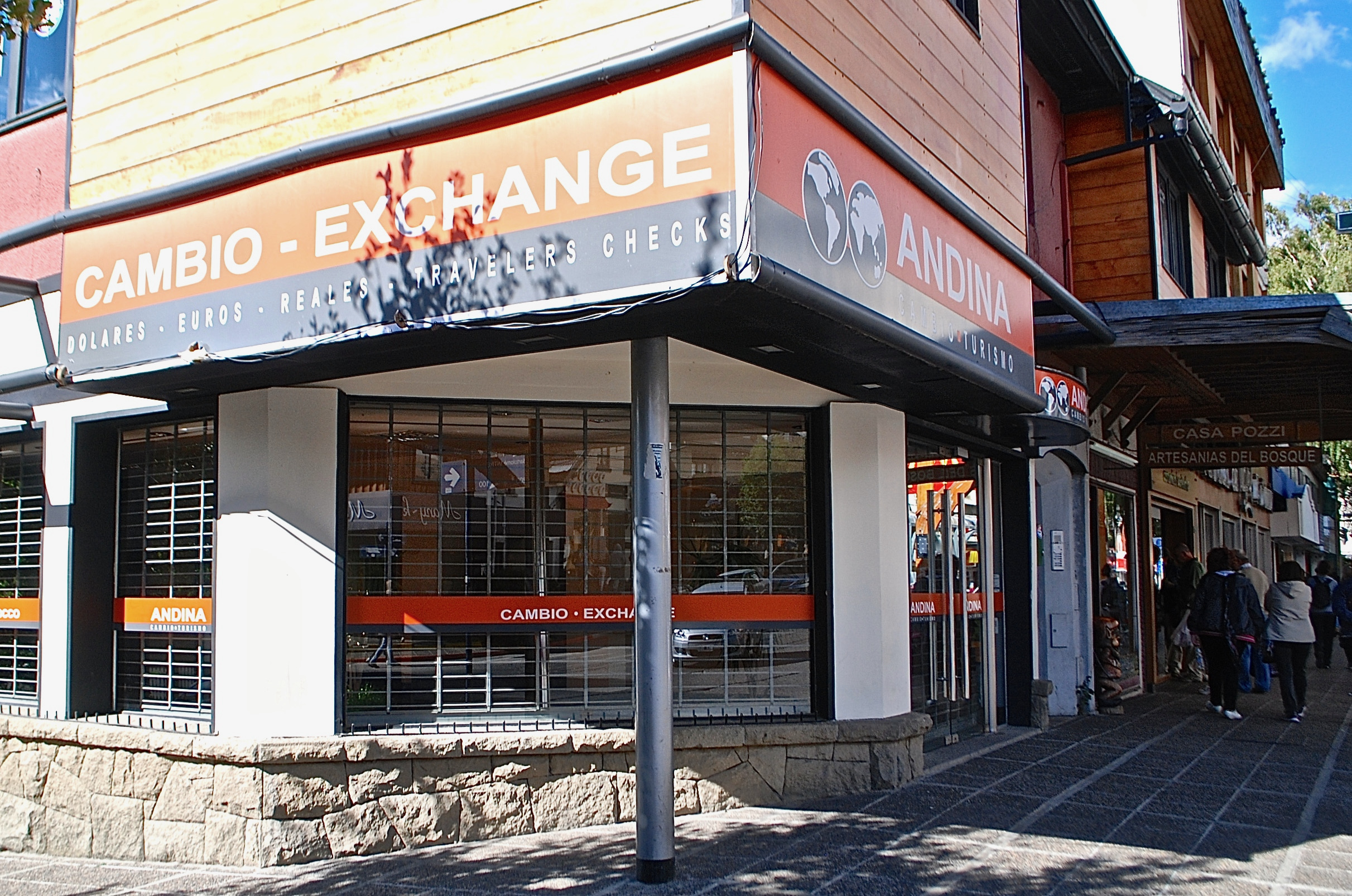
What is a cueva? In Spanish it’s literally a cave and some of them, like the Cueva de las Manos in southern Argentine Patagonia, are major archaeological sites and tourist attractions. But there are caves of a different sort in Buenos Aires and other Argentine cities, and any savvy traveler will get to know them because they are places to change money at an advantageous rate—unlike the traditional casa de cambio (exchange house).

A traditional exchange house in the Patagonian city of San Carlos de Bariloche

When I last visited the coastal Patagonia city of Puerto Madryn, this auto glass dealer gave the best rates for US dollars.

That’s because banks and exchange houses can only change at the official legal rate, which is barely more than half the informal but nevertheless tolerated “blue dollar” rate. In present-day Argentina, using your credit card or withdrawing cash from an ATM means, in effect, doubling the price of everything you may purchase. For the latest rates, there’s a smartphone app called “Dólar Blue Hoy,” which is available on both the App Store and Google Play.

Today's rates on the Dólar Blue app


Walking down Calle Florida, the downtown pedestrian street that’s traditionally the city’s retail hub, you’ll hear a constant chorus of “cambio, cambio” from arbolitos (street changers, known as “little trees” because they’re planted on the sidewalk). In the 1980s, when hyper-inflation was rife here, we used to change travelers’ checks (remember those?) at desks in otherwise vacant office buildings and, though we never got cheated, we never felt really comfortable with it. Today we trust our neighborhood cuevas in Palermo, but might make inquiries before visiting one in another part of the city.

Bring big Bens to the cueva.

At present, Argentina's largest banknote is 1000 pesos (about US$5).


While you may arrive here with a money belt packed with Ben Franklins, you’ll need wallet space for many more bills in a country whose largest denomination is presently 1000 pesos (roughly US$5). Be aware that, at most cuevas, hundreds are the notes of choice (though fifties are usually acceptable), and they’ll have to be in mint condition. Twenties are often unwelcome, but today the Western Union branch down the block from us changed $100 worth at just a slightly lower rate.

The closest cueva to our apartment is this Western Union office (your mileage may vary).


Your blue dollars can't buy one of our sofas.

In a few places, your blue dollar is not welcome, as this sign outside a furniture outlet in the Retiro neighborhood suggests (of course, one could change money elsewhere before making a purchase). Recently, when we visited the exceptional Museo de La Plata in Buenos Aires Province, we found it did not accept cash and we had to pay the admission fee by credit card at the official rate (given that the fee was just AR$300 per person, this was hardly a budget breaker).

Your cash is no good at the Museo de La Plata.

That’s the current scenario, but how long will it last? By November, when the next tourist season rolls around, and given the uncertainties of war in Europe and the lingering pandemic, it’s hard to speculate. One recent report suggests that the breech between the official and informal exchange may diminish over the next year-plus, but there has also speculation about dollarization of the Argentine economy. That’s something that failed in the 1990s under former President Carlos Menem and it’s certainly not gonna happen under current Peronist President Alberto Fernández. Elections are due to take place in October of 2023, though.


Post-Mortem Update

Since I first published this entry, I have learned that Buenos Aire's iconic Cementerio de la Recoleta has just instituted an admission charge of AR$1400 for foreign visitors, though it remains free of charge for Argentines. Like the Museo de La Plata (cited above), they do not accept cash, so it will now cost roughly US$12.50 at the official exchange rate. Visitors can pay online in advance or via QR code or credit card at the main gate.


Monday, November 18, 2019

Monday Musings - Mar del Plata, Money and Baseball

Today’s entry will be a potpourri about Argentina and sports. It ranges from the serious (the effect of Argentina’s Dirty War on my wife’s family) to the utilitarian (money and exchange rates) to the whimsical (my own tenuous link between baseball and Patagonia).

Southward Bound
Maru Sanllorenti's hometown of Tandil
As I prepare to head to Buenos Aires, early next month, my wife María Laura Massolo and our daughter Clío are already there (but will return to California before I leave). Their trip is partly vacation but also a family mission, as the remains of my brother-in-law’s first wife—a victim of Argentina’s 1976-83 military dictatorship—have been transferred from her hometown of Tandil to a new Panteón de la Memoria (Pantheon of Memory) in the Cementerio de La Loma in the coastal resort city of Mar del Plata.
My brother-in-law's first wife disappeared shortly after giving birth in 1976.
Maru's mother Eva and son Manuel at Mar del Plata's Panteón de la Memoria (photo by María Laura Massolo)
Abducted on the street in the Buenos Aires Province capital of La Plata in 1976, Maru Sanllorenti is survived by family members that include her mother Eva (now aged 94) and her son (my nephew) Manuel (now 43), who was an infant when she disappeared. My wife accompanied her brother Carlos (Manuel’s father) to Mardel for the ceremony there, then returned almost immediately to Buenos Aires, where Clío arrived on Friday. Yesterday, both of them attended a talk that Manuel regularly gives to visiting tour groups at the city’s Parque de la Memoria, which includes a commemorative plaque with his mother’s name.
Manuel Massolo (right) recounts his mother's story to visiting US tourists at the Parque de la  Memoria.
Money Matters
I haven’t been to Argentina since last year and, consequently, my recent information on exchange rates, prices, and transactions has been mostly second-hand. Since last month’s elections, though, exchange rates have remained relatively stable, and my wife informs me that a fine Peruvian dinner for three at downtown’s Chan Chan cost about US$10 per person, including three entrees plus a beer per person. It’s not an elite restaurant by Buenos Aires standards, but that’s still excellent value.
Our neighborhood cueva, on Palermo's Cabello street, was closed on the weekend.
Changing money, though, always requires reorientation. Bank lines are long, exchange houses are mostly downtown, and there’s still a difference between formal and blue (informal) rates. The difference isn’t huge, though, and the informal exchange houses known as cuevas are fewer than they once were. My wife has used the one near our apartment in Palermo, which remains open, but Dan Perlman of Casa Saltshaker informs me that street changers have taken over the business near his apartment (including the weekend’s Plaza Francia crafts fair outside the Cementerio de la Recoleta). Street-changing, of course, holds potential risk for the inexperienced—not the least of which is counterfeit currency.

It’s possible to change at ATMs, but that has its own issues—on the weekend, when our neighborhood cueva was closed, my wife paid a bank charge of US$10 to withdraw approximately US$50 from the machine. I’m not sure what the maximum withdrawal is at the moment, but it’s almost certainly low by international standards. In Chile, I regularly withdraw the equivalent of US$300 per transaction, but Argentina has been roughly half that—making the service charge a true burden.

Baseball and Patagonia
I love baseball and, for decades now, I’ve enjoyed saying that I leave for South America after the World Series and return in time for Opening Day. This year, I’m still stateside, through two weeks without baseball, but I’m looking forward to being back in Buenos Aires (where I’ve played the game myself) in another fortnight.

Actually, the month of October was a big disappointment, as my own Los Angeles Dodgers fell to the mild card (sic) Washington Nationals in the National League Division Series, and I didn’t pay a lot of attention the subsequent rounds or the World Series itself. The Dodgers were clearly the NL’s best but, as they say, anything can happen in a short series. Of all major sports, baseball is probably the likeliest for a lesser team to prevail—there’s really no such thing as an upset.
The top three finishers in the National League's Most Valuable Player voting
Last week, though, the post-season individual awards drew my attention because of a friendly rivalry with my Wisconsin-born but Chile-based friend Todd Temkin, who’s a diehard Milwaukee Brewers fan (his Cerveceros lost to Washington in a one-game playoff for the right to meet the Dodgers). Todd (who splits his time between Valparaíso/Viña del Mar and a farm in Futaleufú) and I disagree on who’s the NL’s best player; his choice is Milwaukee outfielder Christian Yelich, while mine is LA’s versatile outfielder/first baseman Cody Bellinger.
Dinner will probably take place at Futaleufú's Martín Pescador.
Hand-written menu at Martín Pescador
On one level, that’s a subjective judgement, as they’re both elite players, but Todd suggested that we place a bet on the Most Valuable Player award, “given to a player in each league who has contributed the most to the success of a player’s team,” according to the Baseball Writers Association of America. Depending on which player scored most highly in that poll, the loser would treat the winner to dinner—probably at Futaleufú’s Martín Pescador, with its frequently changing menu.
On my last visit, I enjoyed gnocchi with morels...
and a cheesecake for dessert.
As it happened, Bellinger edged out Yelich for the award, while Anthony Rendón of the champion Nationals came in a respectable third (the vote takes place at the end of the regular season, so the Nationals' playoff success was not a factor here). I’m looking forward to that meal, probably in March, when I’ll be updating Moon Handbooks Patagonia there. If Todd’s not around at that time, though, it could happen in Valparaíso or nearby Viña.

Friday, June 30, 2017

Devotional Kitsch - An Argentine Update

The Costanera Norte offers river access to the residents of Buenos Aires.
Not far from our Buenos Aires apartment, leading northwest from the Aeroparque Jorge Newbery airport, the Costanera Rafael Obligado provides direct access to the Río de La Plata shoreline for city residents. It’s a popular spot for walking, fishing and asados (barbecues) and, at its northern end, the Parque de la Memoria is an open-air memorial to the tens of thousands who disappeared under the military dictatorship of 1976-83.

One area “attraction” I’ve always ignored is Tierra Santa, a Disneyland for the devout that displays a kitschy version of ancient Jerusalem and its spiritual legacy (as depicted in the video above). About the only thing I can compare it with is Tennessee’s farcically fake Ark Encounter which, deservedly, appears to be approaching financial collapse. On one level that’s easy for me to say—I’m not a believer—but why would any sensible person spend a single peso to watch an hourly mechanical resurrection when genuine devotional sights are so close at hand?
Carlos Menem renounced Islam for Catholicism in order to become Argentina's president in 1989.
The Catedral Metropolitana is Buenos Aires's most conspicuous religious landmark.
It’s worth noting that, for many Argentines, religion is fungible. For instance, former President Carlos Menem—of Syrian descent—converted from Islam to Catholicism to run for office, since that was a constitutional requirement at the time. Buenos Aires, of course, has many important Christian sites, starting with the classic Catedral Metropolitana and even the handsome Iglesia Ortodoxa Rusa of San Telmo. But the Middle East’s other Abrahamic faiths are represented by landmarks such as the Templo de la Congregación Israelita and the Centro Islámico Rey Fahd—both of which are open for free guided tours.
Palermo's Centro Islámico Rey Fahd is the largest mosque in South America.
None of those, of course, is a theme park—for that, visitors to Argentina might be better advised to visit the city of La Plata, whose República de los Niños, where children can explore scale model replicas of diverse structures that even include a mosque. For my part, though, I prefer more offbeat devotional locations that fetishize folk saints.
La Plata's República de los Niños has a scale model mosque for kids to explore.
Rather than a biblical theme park, I would urge visitors to see the syncretic Santuario del Gauchito Gil, where pilgrims pay homage to a Robin Hood figure from the northern province of Corrientes. It also has the advantage of proximity to the Esteros del Iberá, Argentina’s great subtropical wetlands preserve, to view the most diverse concentrations of wildlife within the country’s borders.
Who needs a mechanical Jesus when you can stand before the altar of Gauchito Gil?
Alternatively, in the western province of San Juan—also an underappreciated wine district—the Santuario Difunta Correa memorializes a maternal figure who, according legend, died in the desert while suckling her newborn (who, miraculously, survived to be found by passing muleteers). In truth, she probably never existed, but her story is more plausible—and far more intriguing—than what supposedly happened in the “Holy Land.”
San Juan's Difunta Correa is a legendary folk saint whose infant son supposedly survived at her breast after she died in the desert.

For those unable to visit either the Gaucho Gil or the Difunta, do not despair! Spontaneous roadshrine shrines—some of them quite large—are common on the country’s highways and along some city sidewalks.
Even in sophisticated Palermo, the faithful leave water for the Difunta.

Saturday, January 10, 2015

Does Gold Always Glitter? Plus, More on Buenos Aires Wines

In a lifetime of travel, mostly in Latin America, I’ve usually considered accommodations as a utilitarian service that permitted proximity to the sights I was interested in seeing. A quiet and tidy place with a reasonably firm bed, clean toilets and a hot shower usually satisfies me although, during nearly a quarter-century of writing and updating guidebooks, I’ve felt the need – the obligation, actually – to provide information about more elaborate options.
Even though my own tastes may have evolved as I’ve gotten older – for purely practical reasons, it’s hard to imagine a place without WiFi – I rarely stay at truly upscale places such as those mentioned annually in Condé Nast Traveler’s Gold List (full disclosure: though I subscribe to Condé Nast, I have never written for them, and I would never consider purchasing the magazine at its over-the-counter price). That provides me occasional pleasures – I was agreeably surprised by their article on El Bolsón a couple years ago – and some insight on where the one percent stay when they travel to the Southern Cone countries.

From My Point of View
This year Condé Nast is doing something slightly different. Instead of a routine summary for each hotel – barely varying from one year to the next in what is already a repetitive list – they’ve chosen to focus on distinctive features of those hotels. Of one classic, for instance, they say that “The most glamorous place to get a drink in Buenos Aires is the Lobby Bar at the Alvear Palace” (pictured above and below).
I’m not so sure of that. While there’s no denying the Alvear’s elegance, its Francophile ambience recalls Argentina’s old guard conservatism rather than the glamor of a star-struck contemporary society. I’ve never stayed at the Alvear (though I’ve had tea and attended events there) and I would suggest that Condé Nast has overstated its case to justify a safe choice.
On the other hand, its endorsement of Home Hotel Buenos Aires (pictured above and below) is a more daring inclusion and, arguably, more glamorous – here, you might get invited to U2’s pool party. The article describes Home as “a small boutique outpost in Palermo Hollywood that was doing mismatched wallpaper and slightly ironic shag rugs long before design duo Roman and Williams.”
Since I own an apartment in Palermo, I rarely stay in Buenos Aires hotels, but I have spent a night at Home, and have occasionally eaten or had a drink in the bar/restaurant (full disclosure: co-owner Patricia O’Shea was my unpaid “shopping consultant” on an article I wrote for National Geographic Traveler a few years ago). Though the hotel gets celebrity guests, informality is also a strong selling point – there are several truly affordable rooms for guests of modest means - and it even provides guests its own mini-guidebook of the neighborhood.
Condé Nast’s only other Argentine entry is the House of Jasmines (pictured above and below), on the outskirts of the northwestern city of Salta, gateway to the Andean highlands and the wine country of Cafayate. According to the magazine’s description, “Everything smells deliciously of, yes, flowering jasmine, and there are roses in every room.”
I stayed here several years ago, before the famous actor and noted Argentinophile Robert Duvall sold it, but I’ve not been able to return since it reopened under new ownership. From the photographs on the website, it hasn’t changed dramatically – that’s probably a good thing – but it’s now affiliated with the Relais & Chateaux group of luxury accommodations. Other things being equal, I would probably choose to stay in Salta itself, a walkable city with interesting architecture, excellent museums, and very good restaurants. The House of Jasmines isn’t that far away, though, and is undoubtedly more peaceful.

Argentine Coastal Wines?

And now for something completely different: my longtime Argentine friend Nicolás Kugler and Pablo (a commentator on my previous post) have provided some additional information on vineyards and wines near Buenos Aires. As it happens, the county of Berisso, only 57 km southeast of Buenos Aires on the route to provincial capital of La Plata, holds an annual Vinos de la Costa festival. In the middle decades of the 20th century, this area produced up to a million liters of wine per annum, but now it’s only about 50,000 liters from 25 hectares of vineyards. Nobody suggests the quality comes close to matching that of Mendoza or Cafayate, though.
Custom Search