Showing posts with label California. Show all posts

Wednesday, January 19, 2022

Mendocino is Cooler Than Buenos Aires (Literally)

At the end of last month, I wrote that my wife and I had postponed a planned trip to Buenos Aires because of the spread of the Omicron variant of the COVID-19 virus there. In addition, our route would have taken us through COVID-friendly Texas and, given the frequency of flight cancellations by American Airlines, it was possible we might have had an unwelcome delay of a day or more in Dallas/Fort Worth.

Mapping the heat wave, from Argentina's Servicio Meteorológico (in degrees C)

Very tentatively, we’re hoping to try again in March, but early January provided us yet another reason to justify our decision—a brutal heat wave that struck the Argentine capital and much of the rest of the country. In summer, of course, we would expect warm and even hot temperatures, but last week the mercury soared to 106° F (41° C) in the city and, in the north-central city of Córdoba, it reached 108.5° F (42.5° C). The western desert city of San Juan was a near-furnace at 111° F (44° C).


A few years ago, we reluctantly installed air-conditioning in our Palermo apartment, but we’ve never used it during our time there—our idea was that it would appeal to short-term rentals. Even that mightn’t have mitigated this heat wave, though, as there were power outages in much of the city. Global warming, anybody?
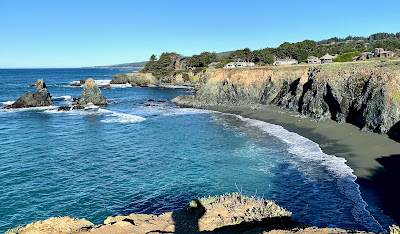
A typical landscape at Sea Ranch (note the houses in the background)

The town of Gualala (as seen from Sea Ranch)

With that in mind, we took a mini-vacation with our daughter, her boyfriend, and our two dogs, up the Sonoma County coast to Sea Ranch—an ostensibly eco-friendly development that I’m personally ambivalent about. The scenery resembles coastal Chile, the night skies sparkle, and there’s almost total silence except for occasional gobbles from wild turkeys outside your windows and waves crashing on the beach. Still, I find the supposedly cutting-edge architecture monotonous and the absence of any urban amenities bothersome—there’s no alternative to the automobile for transportation to the town of Gualala, some miles north, for essential shopping. In effect, Sea Ranch is a de facto “gated community” even though the State of California requires obligatory coastal access for non-residents.

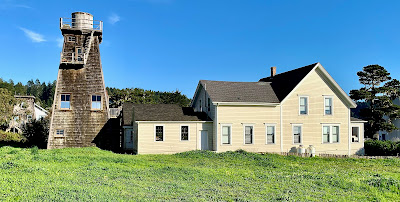
The village of Mendocino, as seen from the nearby headlands
Some Mendocino water towers have been repurposed for residential use.

We spent four nights in a short-term rental house, arriving on a Friday afternoon and leaving the following Tuesday morning. Two full days is about my limit there but, given the late Friday arrival, Saturday and Sunday were dedicated to extended dog walks on the coastal trails (significantly cooler than Buenos Aires). On the Monday, though, we escaped north to the truly picturesque seaside town of Mendocino (population 855), where we walked along the coastal cliffs and explored its quaint architecture, including numerous water towers—some of them since converted to housing.


In popular culture, Mendocino has been a location for numerous films and TV series, but I recall it best for the 1968 hit song “Mendocino” by the Sir Douglas Quintet (Texas transplants to California whose producer chose the name to try to capitalize on the Beatles-inspired “British invasion” craze; the above video is a version by Sahm's later band, the Texas Tornados). Interestingly, my wife knew the song even before we met, as it was also a big hit in Argentina; though neither she nor her friends really understood the lyrics except for the title, they could dance to it.


Even more interestingly, the group leader Doug Sahm (born in San Antonio) was of German extraction and, I recently learned, Michael Holm (above) recorded a German-language version that became a chart-topper in then West Germany the following year. Does this explain the fact that the German real-estate firm Engel & Völkers maintains an office in Mendocino, and that all its window listings there are bilingual in English and German? Perhaps it does, as the comments on Holm's YouTube video include one by a German whose wife insisted he take her to visit there (German used to be my second language, but it’s now a distant third to Spanish and I couldn’t catch much of Helm’s lyrics).


Mendocino seems idyllic, but it’s not immune to the rest of the country’s problems. Almost everyone we saw in town was masked up but, not that long ago, the anti-vax owner of Fiddleheads Café posted notices that he would collect a surcharge for any client wearing a mask, and an additional charge for anyone who bragged about being vaccinated. He’s since gone out of business, but might still be welcome in Texas (in fairness, the state has great food and music despite its COVID-friendly politics).

Tuesday, April 21, 2020

Ice Cream, Empanadas, and the Pandemic

It’s been more than three weeks since I “escaped” from Argentina and Chile, but I never stop thinking about them. I have many relatives in Argentina, and friends in both countries, who’ve been in touch in the coronavirus “aftermath” (obviously, it’s not over yet), but we express concern about each other and the future (short- and medium-term especially). The public health crisis seems to have hit Chile harder than Argentina, although the latter’s statistics seem incomplete according to the regional live data update at NCOV2019 (disclaimer: this site often seems to be overwhelmed with traffic).
A recent screenshot of Coronavirus stats in South America
Last week, I did receive an email from my friend Gabriel Famá, owner of the landmark ice creamery Heladería Cadore in Buenos Aires, and he’s feeling the pinch of Argentina’s near total lockdown. Though food providers such as himself can remain open for delivery, he was in hard-hit Italy when the crisis began, returning at the end of January “with no restrictions or controls, and look what. A lot of people underestimated the situation.” He comes to work “by car, with one of my sons, to avoid contact on public transportation and we operate with as few employees as possible.”
In non-virus times, Cadore can get really crowded.
Another friend, Marcelo Ferrante of Periko’s Hostel in Bariloche (where I spent a night before crossing back into Chile on my odyssey home), found himself on an RV vacation in Spain, another country devastated by the virus—“With luck I was able to get back to Bariloche, it was difficult but I managed it.” On April 8th, he wrote me, “We had to close on March 20th when the last guests left” (I had departed on the 16th). Then, he added, “I don’t think we’ll be able to open before before June 1st,” which would coincide roughly with ski season, but even that sounds optimistic to me.

That said, Argentina appears to be relaxing its strict quarantine restrictions, though the details are not yet clear. It's not been so draconian under California's "shelter-in-place" measures but, on an early Saturday supermarket run, I stocked up on Three Twins ice cream which, sadly, has folded under sustained economic pressure exacerbated by the plague.

Empanada Time!
On the bright side, here in the East Bay we have multiple options for Argentine-style empanadas, which are my favorites. There are four places within 2.1 miles (3.4 km) from our home in Oakland’s Temescal district.
9 de Julio Empanadas at the annual Temescal Street Fair on Telegraph Avenue
Unfortunately the one within easiest walking distance, the 9 de Julio Empanada Kitchen, hasn’t yet opened its new physical location in Rockridge, though it appears to be doing catering. Taking its name from the date Argentina’s independence day, it’s the creation of Erica Sanders, an Afro-American woman who moved to Buenos Aires to learn the art of the empanada. In past years, I’ve tasted her product—which features empanada styles from throughout the Americas—at street fairs in Montclair and Temescal, but the public health crisis appears to have delayed the opening.
Windows at the Wooden Table Café have fileteado flourishes.
The next closest is Uptown Oakland’s Wooden Table Café, which I’ve only sampled erratically because I usually pass it after taxiing my wife to work (she’s now telecommuting). Parking is scarce, though, so stopping is a matter of opportunity on my way back home. It’s very specifically Argentine, to the point of offering yerba mate drinks (the current crisis makes me wonder whether Argentines—and Uruguayans—will give up the custom of passing around the mate gourd, with a shared bombilla, among friends and family). It also offers a variety of sickly sweet alfajores, dulce de leche concoctions which are not to my taste. I do like the decorative fileteado on the windows, though.
Javi's Cooking is the empanadería I've most often patronized.
Nearly as close is Javi’s Cooking, in the Hoover-Foster district, whose products I first saw in the frozen food section at Berkeley Bowl West, and later sampled in Javier Sandes’s food truck during an event at Lake Merritt. It’s a place that I’ll make an occasional escapadita to when food in the fridge is scarce, and it also offers facturas (pastries) including my personal favorite medialunas (croissants, of a sort).
With its sidewalk seating, Café Buenos Aires feel more like a spot in the Argentine capital.
The most distant of the bunch is South Berkeley’s Café Buenos Aires (2.1 miles or 3.4 km), which I stumbled upon while taxiing an Argentine political scientist to a downtown event there. It has a wider menu than the others, especially with regard to pastries, but it’s not quite so convenient as the others. It’s a bit more spacious as well but, under current conditions it—like all the rest—is for takeout or delivery only.
María Laura's homemade empanadas - chard in this case - are our default choice these days.
In any event, we’ve not bought empanadas recently. The local price of roughly $5 each would appall most Argentines but, fortunately, my Argentine wife is capable of making them much more cheaply with no sacrifice in quality. Still, I look forward to revisiting all these others, so nearby, in person when our shelter-in-place restrictions relax.


Monday, March 30, 2020

On the Way Home...

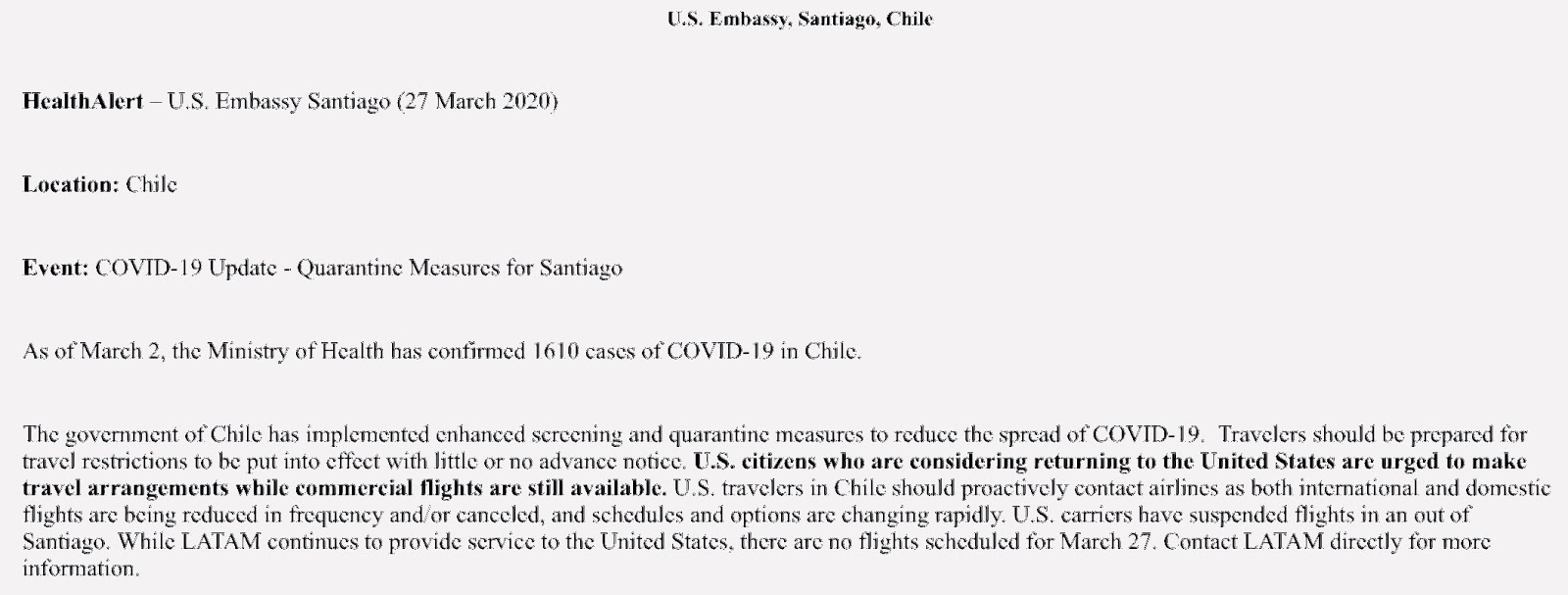
Last Tuesday, after managing to change my flight from Chile to my California home, I was killing time until, on the morning of my presumed Friday departure, I received an email from a friend in Puerto Varas. He referred me to a US embassy warning that LATAM Airlines had no scheduled flights to the United States for that day. This alarmed me, to say the least, as I wasn’t sure I could handle yet another postponement during the coronavirus crisis.
The US Embassy's alert suggested there'd be no Friday night flight.
Unwilling to accept the news from a single source—even one with the embassy’s authority—I immediately emailed a friend who works in the communications department at Nuevo Pudahuel, the concessionaire that operates Santiago’s Aeropuerto Internacional Arturo Merino Benítez. He told me that they’d received a communiqué to that effect from the airline; there would be a flight to Miami, he added, but availability was doubtful.
Nuevo Pudahuel's website showed my flight leaving on time.
This, of course, alarmed me even more, but when I went to LATAM’s flight status page, it assured me that my 11:55 p.m. departure for Los Angeles was still on schedule, even though many other flights had been canceled or delayed. Just in case, I phoned their local customer service number and got the same encouraging response. Still, I asked the agent to look into further, and she left me on hold for some time before repeating that confirmation. She added, however, that if there were any change in status I should receive an email from the airline by 6 p.m.
Neil Young's lyrics suggested the uncertainty of everything. 
On a hunch, I went to Nuevo Pudahuel’s passenger page which—despite what my friend there had written—also showed the flight to be on schedule. With Marializ Maldonado, who would drive me to the airport, I decided on waiting until 7 p.m., rechecking the online resources before departing. Neil Young’s words to "On the Way Home," sung here by Richie Furay, seemed appropriate.

At the Airport, on the Plane
When that hour arrived, we threw my bags into the car and, via a nearly empty highway, arrived at an airport that is usually swarming with people but was now almost equally empty. After confirming with floor personnel that my flight was still in order, I approached the check-in—with virtually no line—to get my boarding pass and drop my bags. It was a pleasant surprise that, even though my reservation inexplicably indicated only one bag on an international flight, LATAM accepted my second one at no additional charge.
Normally packed on a Friday evening, Santiago's airport was eerily empty.
Passing through immigration and security was equally expeditious, and I found myself with nearly four more hours to kill before departure. That left plenty of time for one last pisco sour—even though the only restaurant serving alcohol was a US chain whose name I’ll decline to mention here, I bit the bullet on an overpriced cocktail. I also ordered a chicken sandwich that was at least palatable but, except in desperation, I’ll never choose to eat there again. 
With many flights delayed or canceled, Nuevo Pudahuel has provided cots for napping.
Only about half-full, with passengers spaced fairly well, this was a bare-bones flight that served only water—no alcohol or even soft-drinks (except perhaps in business class). Having sandwiched earlier, I declined the dinner, but the next morning’s breakfast was perhaps the worst airline meal I’ve ever had. Except for one edible asparagus spear and some soggy mushrooms, it wasn’t even recognizable as food, and I really didn't want to know what it was. Nor was there tea or coffee.

Back in the USA
The baggage claim at LAX was virtually vacant.
On arrival at LAX, the airport was even emptier than SCL had been the night before, and I’ve never gone through immigration and customs faster at any US airport. There was one oddity, however—on board the flight, cabin personnel had distributed a CDC traveler health declaration that asked whether a passenger had been to China’s Hubei Province and other destinations that had seen coronavirus outbreaks.
The CDC's explanation of its health declaration.
There was no screener for arriving passengers, nor anywhere to submit the declaration (which I will now recycle).
Badly drawn, the declaration claimed to be mandatory but also seemed to state that only travelers coming from affected countries would be obliged to fill it out. In the end, though, that was irrelevant—nobody collected or even asked for the form, nor was there any box to drop it in. This, of course, could easily be a metaphor for the current administration’s ineptitude and negligence in confronting the greatest public health crisis in a century.

On the Road Again
My ticket home included a connecting flight to San Francisco, but dealing with security theater and being cooped up in another plane didn’t appeal to me, so I chose to rent a car. I’ve done this before, and often use it as an excuse to explore parts of the California coast and coast range that I don’t know as well, and also to visit a winery and have lunch in San Luis Obispo or Paso Robles.
Despite the crisis, Harris Ranch remains the go-to place along I-5 between Los Angeles and the Bay Area.
This time, though, I chose the most direct, quickest route via Interstate 5 through the Central Valley, where digital highway warning signs advised us to stay at home and avoid gatherings. I stopped at Coalinga's Harris Ranch, a classic lunch break at almost the exact midpoint of the trip; in the current crisis, the restaurant proper is closed, but they’ve set up a tent to take orders and deliver them to your car. I chose a grilled chicken sandwich and a lemonade before continuing north, arriving in Oakland around 4 p.m.
Chaltén was ready for a walk.
Here I’m sheltering in place, and couldn’t even embrace my wife or daughter, though I could give a hug to Chaltén, the rescue husky who’s quickly become part of the family. After that, we returned my rental car to Oakland International Airport and, following a light dinner, I was in bed by 8 p.m. (midnight Chilean time, though).
Our neighborhood's many restaurants mostly remain open for takeaway meals.
I awoke at 3 a.m. and, after indulging in some videos, took the dog for a walk at daybreak. On a Sunday morning, there were few people out but, in a neighborhood with many restaurants, I noticed that nearly all of them now offer takeout. For the time being, at least, this is the new normal.

Tuesday, March 24, 2020

Stuck Inside of Renca, with the LATAM Blues Again

Yesterday morning, I was looking forward to my flight home from Santiago (SCL) to SFO via Mexico City, and I decided to do an online check-in—only to learn that LATAM had cancelled that flight. The website offered a link for rebooking but, when I tried to do so, only the Mexico City-San Francisco segment of the itinerary appeared. The leg out of Chile had, apparently, disappeared into the cloud(s).
LATAM's website was not user-friendly yesterday.
This was disturbing, to say the least, because I had made such an effort to return from Argentina to Chile and then to Santiago, having changed my original ticket in the city of Osorno. Still, with some difficulty, I managed to contact LATAM’s Santiago call center and, after trudging through the automated answering system (including a pretty long hold), I managed to speak with a live human—though I worried, at every moment, that we might somehow get disconnected and I’d have to start all over again.

At first, LATAM’s agent suggested a Thursday night flight to New York and thence to SFO but, given the mess that JFK has been with arrivals from Europe (and now spring breakers from Florida, I suspect), that was a non-starter. When I asked about alternatives, he found availability on Friday night’s non-stop to Los Angeles (my original itinerary) and SFO. I jumped at the chance although, rather than take another flight, I may consider renting a car and driving back to the Bay Area.
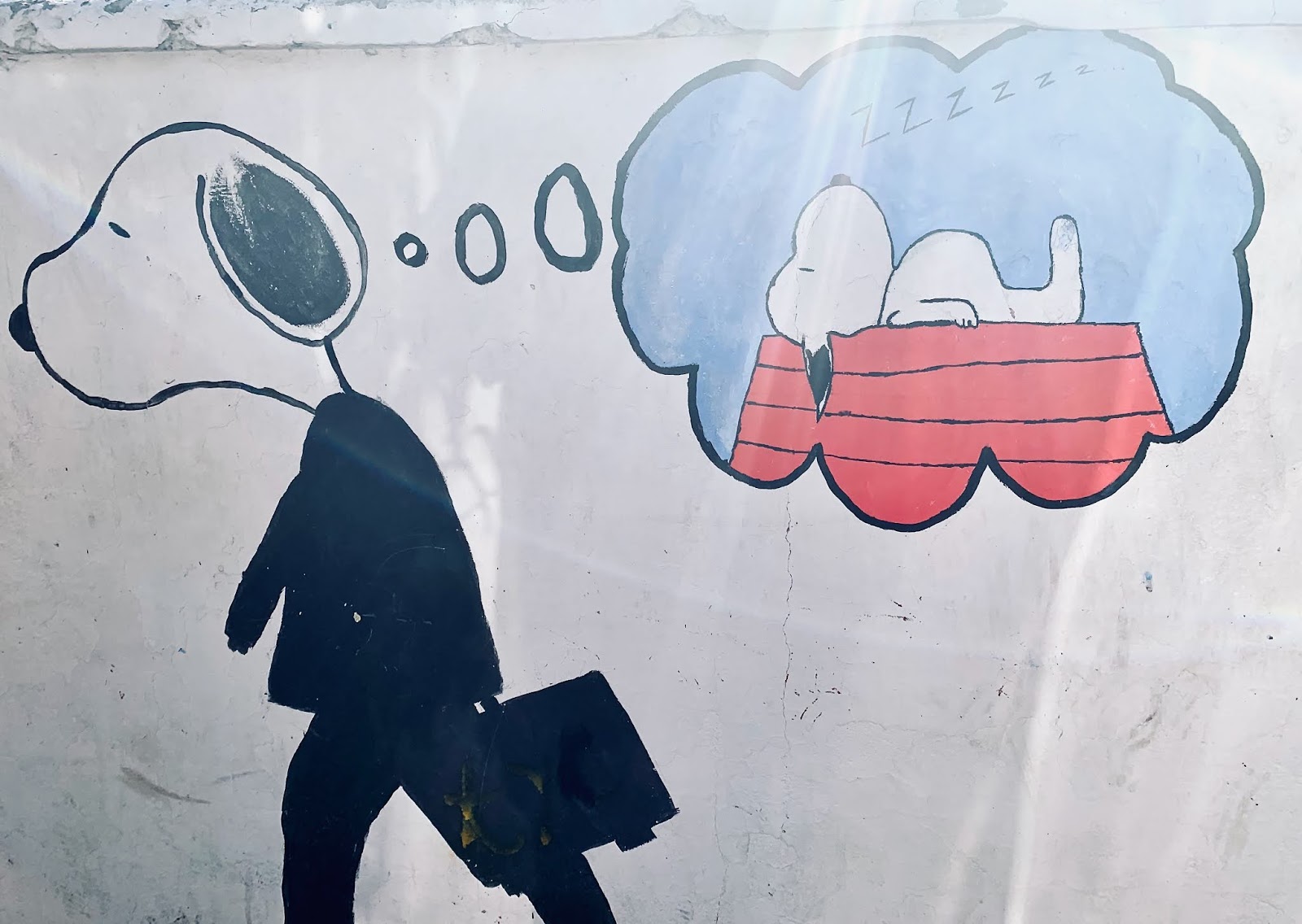
Renca's Snoopy would prefer to shelter in place...
Still, it was a letdown and, for the next few days, I’ll be biding time in Renca, a non-touristed neighborhood about which I’ve written before on this blog. Like most but not all people here, I’m staying indoors, though I do take occasional walks, avoiding the relatively few folks on the street. Some are wearing surgical masks, but others are seemingly oblivious to “keep your distance” recommendations, and middle-aged men still gather outside the local botillería (liquor store). There’s now a 10 p.m. to 5 a.m. curfew throughout the city, though its efficacy in suppressing any virus outbreak seems dubious.
The architectural details may not be the most appealing, but this expanded Renca home suggests the owners are doing well.
Still, Renca is a changing población that, I suggested to my friend Marializ Maldonado, appears to be in transition from working class to (perhaps lower) middle class. The basic housing style consists of side-by-side units known as casas pareadas, which share a central wall and are mirror images of each other. Some people, though, have added improvements such as a second story to their homes, occasionally with balconies, and quite a few now own shiny new SUVs and minivans. Many streets are narrow one-lane alleyways, so people often park on the sidewalks (traffic moves slowly here anyway, so it’s still pedestrian-friendly). At the time the project opened, in 1965, few probably expected to ever own a car.
Many Renca residents park their cars on the sidewalk.
There are other infrastructural improvements. Opposite Marializ’s house, a once neglected park has now become the well-kept Plaza Chile Israel (Israel’s embassy subsidized renovations here), and a formerly graffiti-covered building has become a sede vecinal (neighborhood meeting hall) with a handsome mural. There is daily maintenance, and the plaza remains a garden spot for occasional couples and a very few people who appear unaware of or unconcerned about the public health crisis.
Two years ago, this folkloric event took place on the redeveloped Plaza Chile Israel (Marializ's house is barely visible at the far left).
That said, though I’m getting bored with staring at the computer keyboard and, at times, streaming videos on the iPad, there could be worse places to spend a self-imposed semi-quarantine. I’m still looking forward to boarding that plane for LAX on Friday night, for which I’m saving my last remaining novel, and then getting home to Oakland. There, at least, I’ll be able to work in the garden, walk the dog, and even go for a bike ride (all acceptable under California’s “shelter-in-place” guidelines).
Meanwhile, apologies to Mr. Zimmerman.

Friday, November 1, 2019

Patagonia's Adventure Connect(ion) in San Francisco

Last week, I attended a promotional event for Chilean Patagonia in the Adventure Connect series, organized by the Adventure Travel and Trade Association (ATTA). At a time when Chile’s undergoing political upheaval, the occasion brought the Magallanes regional representative of Sernatur, the national tourism secretariat, and representatives of several different operators to San Francisco as part of a national promotional tour.
The setup at San Francisco's Hotel Zetta
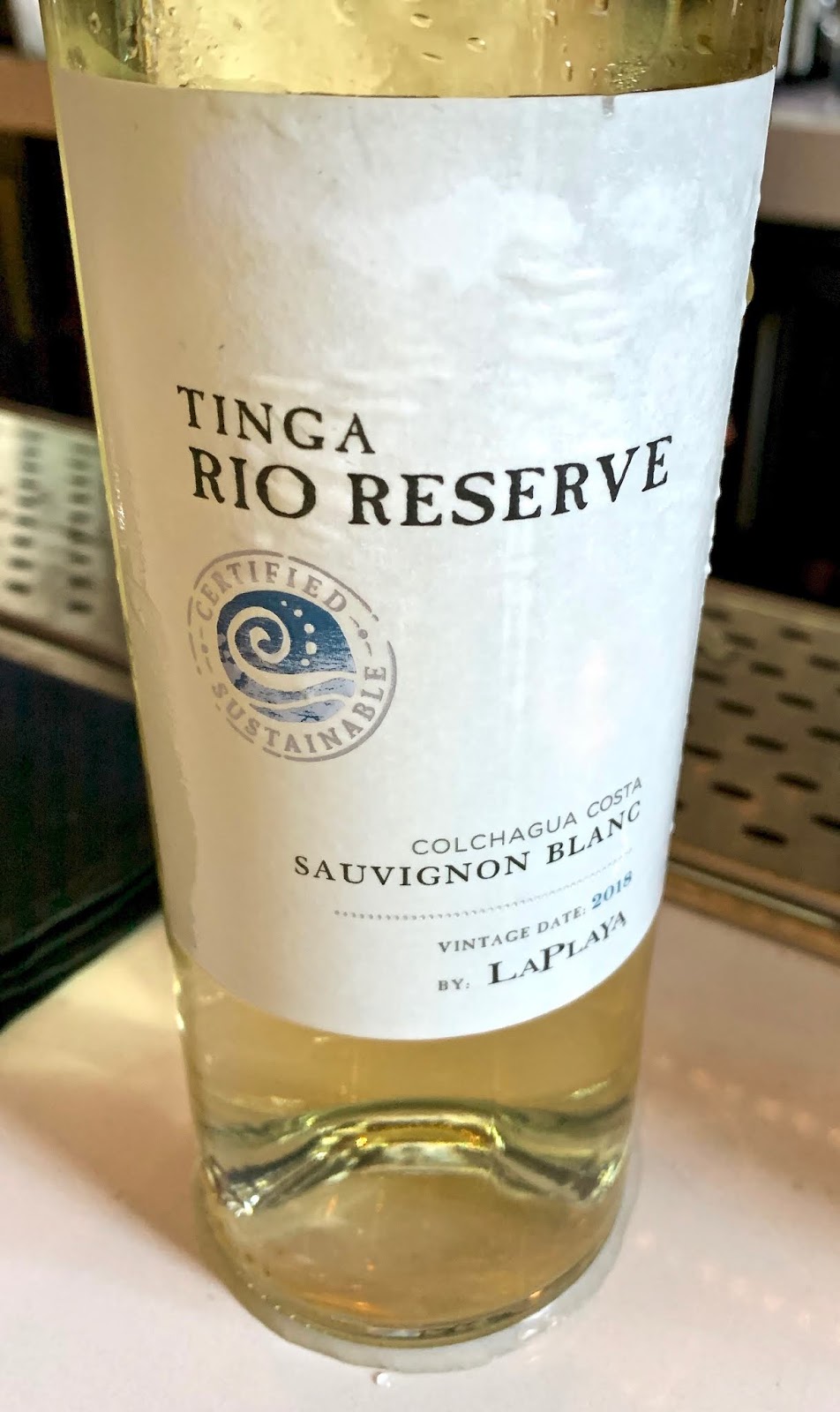
The event took place in the lobby of Hotel Zetta, where eight different operators were to discuss their services with Bay Area travel companies and invited writers (of whom I was one). The format was a sort of musical chairs in which each operator met with one or more attendees for eight minutes before a timer sounded to move elsewhere. This went on for 2-1/2 hours, with a coffee break that included a giveaway raffle, before adjourning to a conference room for a presentation by Sernatur’s regional director Ximena Castro that was probably most useful to those with less experience than mine in the region. Later, there was a Chilean social hour that included snacks and one of the finest Sauvignon Blancs I’ve ever tasted—especially welcome on an unusually hot San Francisco day.

Ximena Castro addresses the attendees.


The Chileans brought this Sauvignon Blanc along with them and, so far, I've been unsuccessful in finding it stateside.
Originally, eight different operators—some of whom I already knew—were to attend the event. In the aftermath of the recent upheavals in Santiago, though, the representatives of Antarctic Airways—with whom I would have liked to discuss their updated services—and Lago Grey - Experience Hotel were unable to get flights out of Santiago. I already knew the owners of Big Foot Patagonia Adventure and the representative of Vértice Patagonia (operator of mountain huts on the famed Paine Circuit, plus a new boutique hotel in Puerto Natales), and was familiar with Antártica 21  and Australis Cape Horn & Patagonia (both of whom sent US-based representatives). New to me were the Chile Nativo adventure operator and HD Hotel Natales (the rebranded Hotel Cisne de Cuello Negro) in Puerto Bories.

The not quite unspoken topic that permeated the meeting was what effect Chile’s recent political disruptions and disorder might have on the upcoming season. There was certainly concern, but also consensus that the Región Metropolitana de Santiago and the coastal region of Valparaíso would be more directly hit than remote Magallanes. That said, cruise ship and hotel cancellations would certainly affect a city like the regional capital of Punta Arenas, which has seen some demonstrations. I recently saw an online story—can’t find the link now—whose headline spoke of “80 percent cancellations” in Chile, but what the story actually said was that 80 percent of hotels and other services had experienced cancellations (which could have been just a single cancellation each for some).

That’s not to dismiss the issue of vandalism and disorder by a destructive fringe, even as the great majority of demonstrations have been peaceful, but President Sebastián Piñera’s embattled government has cancelled the upcoming COP climate conference (at which Swedish activist icon Greta Thunberg was due to appear and also the Asia-Pacific Economic Cooperation summit.

Personally, I would not hesitate to travel to Santiago, Valparaíso or elsewhere in Chile at present, even though I’d advise those with little or no experience of the country to be on alert. In a recent newsletter, the private Federación de Turismo de Chile cited the Subsecretaría de Turismo to the effect that  “our tourism continues to function throughout the country and the most popular destinations visited by international tourists, such as San Pedro de Atacama, Elqui Valley, the islands of Rapa Nui [Easter Island] and Juan Fernández [Robinson Crusoe], the Chilean Patagonia and Torres del Paine National Park, are operating with normality.” Aeropuerto Internacional Arturo Merino Benítez is back to normal, but visitors would still do well to have travel insurance in case of disruption.

And the Money?
For foreign visitors, there may be a bright side to all this. About two months ago, the last time I wrote about exchange rates, both the Argentine and Chilean pesos were slipping against the US dollar, and that has continued with the upheaval in Chile and the recent election in Argentina, when the Peronist Alberto Fernández defeated the incumbent president Mauricio Macri.
The Dólar Blue Hoy app is a useful addition to one's smartphone.
The so-called “markets” (and many individual Argentines) have little confidence in Peronism and, consequently, Argentina’s Banco Central (Central Bank) has reinstituted a cepo cambiario (“currency clamp”) that restricts Argentines’ overseas ATM advances to US$50 per transaction (oddly, it puts no restrictions on the number of transactions per day, but those ATM charges could really add up. Meanwhile, individual Argentines can now officially purchase no more than US$200 per month, a measure that seems to be encouraging the informal dólar blue (visitors to Argentina might consider downloading the Dólar Blue Hoy app, pictured here, on their smartphones). Exactly this will develop as the Macri administration gives way to Fernández remains to be seen, but it seems likely that the informal exchange rate will benefit tourists in the short to medium term.
Chile's peso has also slipped against the US dollar and some other currencies.
In Chile, meanwhile, the peso has dipped to 740 per dollar, a fall of roughly three percent since August. This may affect prices slightly, but if foreign visitors avoid the country because of the perception of instability, services such as hotels and tour operators may drop their prices. In any event, matters are less predictable than they seemed even a few months ago.


Friday, February 15, 2019

Summer in the City? Not Quite Yet

Spring training has only just begun, but this morning I expected to be in the summer heat of Santiago, where it’s presently 88° F (31° C), but it was not to be. At 7:30 a.m. yesterday, I took a ride share (which shall remain anonymous) on my wife’s account, and arrived at San Francisco International Airport shortly after 8 a.m. for an Alaska Airlines flight that would connect to Los Angeles for a non-stop to Chile.
Santiago can (must) wait for my arrival.
Or so I thought. The night before, Alaska had denied me an online check-in because of the international code-share flight, and I spent an hour waiting in line only to learn that all flights to LAX had been canceled because of heavy rain (in both cities). In fairness, the clerk at the Alaska counter made every effort to find me an alternative flight, including a COPA route that would have left at 12:30 a.m. this morning and, after changing planes in Panamá, would have arrived in the Chilean capital at 8 p.m. this evening.

I have no complaint about Alaska’s service and suggestion, but it didn’t appeal to me—partly because it would have messed with my already fragile biological clock. Still, if like many travelers these days I had purchased my tickets online, I might have faced a daunting process of trying to contact LATAM (my carrier on the flight from LAX to SCL) and revise my plans for another day.

For this flight, though, I had trusted my itinerary to Analía Rupar-Przebieda of Eureka Travel in Southern California. She had already saved me the time-consuming process of searching for and purchasing the international flight, and had gotten me on the non-stop from Los Angeles instead of the route that stops in Lima, with a possible layover to change planes, and had also gotten me the best possible price.

Instead of re-doing it all myself, I managed to phone Analía, an Argentine whom I had met at one of my book talks at the late lamented Distant Lands in Pasadena. Then, within about five minutes, she phoned me back with the same itinerary rescheduled for Sunday, saving me time and, probably, aggravation. Then I was able to return home and rest rather than navigate an automated phone system to change my dates.

Unfortunately, that does mean I’ll have lost three days off a scheduled two-month trip. And it’ll delay my departure for the south because I also have some vehicle paperwork to do in Santiago, but I can live with it.

Help Support Southern Cone Travel
If you've found this article informative or otherwise useful, please consider clicking on an appropriate advert to earn me a few pennies.

Monday, January 21, 2019

Betrayed by Rita Hayworth? Or Hollywood? (A Film Review, of Sorts)

While I’ve always enjoyed movies, it’s not an obsession so that, on occasion, something comes to my attention that I hadn’t noticed (or only barely knew of) before. That was the case on Saturday night, when our local PBS station showed director Charles Vidor’s Gilda, the film that made Rita Hayworth a star.
Filmed in late 1945 and released in 1946, Gilda is a noirish drama that aroused my interest because its ostensible setting is Buenos Aires, where small-time gambler Johnny Farrell (Glenn Ford) becomes the right-hand man of corrupt casino owner Ballin Mundson (George Macready), newly married to the stunning Gilda (Hayworth) who—unbeknownst to Mundson—has an ambivalent history with his new employee.
Palermo's Hipódromo offers casino slots today, but probably not in the 1940s.
I won’t comment further on the plot, because I want to focus on the movie’s presentation of Argentina and its capital. In the first instance, it’s worth noting that, when Mundson first invites Farrell to his casino, he provides him a “key” because casinos were not legal in the city. This rings true because that’s still the case—there are casinos in the provincial suburbs, but not in the capital except for the floating Casino Buenos Aires (two vessels docked at Puerto Madero) and some slot machines in the Hipódromo Argentino de Palermo, where betting on horse races is legal (I doubt that the Hipódromo had slots in 1945). Other than that, there are only a few bingo parlors.
As the Hotel Centenario, the Palacio Vera was an ostensible location in Gilda (photo by Julieta Sol Narganes, Creative Commons)
Most of the film’s action takes place in building interiors—there’s a brief soundtrack moment of tango and a nod to Carnaval—with almost nothing to suggest the streetscapes of Argentina’s capital (so far as I can tell, the entire film was shot in Hollywood in just three months). One ostensible location is the Hotel Centenario, which then occupied the Palacio Vera, an Art Nouveau structure on the central Avenida de Mayo that dates from 1910. Again, though, the movie does not even offer an image of the building's exterior.

Though the Brooklyn-born Hayworth herself was a Hispanic woman (her father was a Spaniard), she does not play one in this movie. At one point she flees to Montevideo, across the river, but again the only scenes of Uruguay’s capital are interiors.
Argentina Brunetti was one of two Argentines with bit parts in Gilda.
The Hungarian-born Vidor introduces the theme of Argentina’s World War II dark side in the person of two German mining cartel members who frequent the casino. The ostensible Argentines are few, including a police detective played by the Maltese actor Joseph Calleia and another policeman played by Manhattan-born Gerald Mohr, and a washroom attendant played by the Ukrainian Steven Geray. Two Argentines play bit parts: the Buenos Aires-born Argentina Brunetti, who appeared in many Hollywood movies in the 1950s and 1960s, and Jack del Río, best known as the fourth husband of pop singer Peggy Lee.
The late Argentine novelist was a movie geek.
That’s not to dismiss Gilda as a film, but I suspect it could have been even better had it been filmed on location (a remake might be interesting). Who knows, could that be one reason that the late Manuel Puig titled his first novel Betrayed by Rita Hayworth?

Gilda is available on several streaming services.

Support Southern Cone Travel!
If you've found this article interesting or useful, please consider earning me a few pennies by clicking on an ad (ideally, one that might be of interest to you).

Friday, November 2, 2018

A California Tango?

California has a long and illustrious history of contacts with Chile, about which I’ve regularly written, but its relations with Argentina have been less conspicuous. Perhaps the most infamous episode was an invasion by the Franco-Argentine privateer Hipólito Bouchard, who occupied the Presidio of Monterey for six days in 1818, when the area was still under Spanish rule.
The sheet music for La Reina, Francisca Carrillo Vallejo's tango
Last week, though, I found a new and somewhat enigmatic connection when I accompanied a Buenos Aires visitor to the Oakland Museum of California. There I found, behind a vitrine in the Gallery of California History, the sheet music to “La Reina,” described as a California tango by Francisca Carrillo Vallejo. Published in 1925, when Carlos Gardel was at his peak, the song probably reflects the early 20th-century globalization of this distinctively Argentine music and dance.
General Mariano Vallejo, grandfather of the tango composer
There is scant online information about this piece of music, but the museum's Program Administrator Eileen Hansen informed me that the author was the granddaughter of General Mariano Guadalupe Vallejo, a Californio who spent his life under Spanish, Mexican, and US governments. Ironically enough, Vallejo (born 1807, d. 1890) would have been a boy in Monterey when Bouchard occupied the Presidio. Unfortunately, Ms. Harris could not access the sheet music from the vitrine on short notice, so I’ve been unable to see the lyrics.
This house on San Francisco's Filbert Street was the home address for the song's publisher.
From the limited genealogical information available, I’ve not been able to determine Francisca’s exact lineage, but there were three Vallejo sons who might have been her father (there were also several Vallejo daughters, but their children would have had different surnames). The señorita depicted on the sheet music would appear more appropriate to a Mexican ranchera than an Argentine tango but, coming from an apparently Anglo publisher—Dudley and Barrett—that stereotype is perhaps unsurprising.

I look forward to reading the lyrics, eventually, and learning more about this topic.
Custom Search