Showing posts with label Cafayate. Show all posts

Saturday, January 10, 2015

Does Gold Always Glitter? Plus, More on Buenos Aires Wines

In a lifetime of travel, mostly in Latin America, I’ve usually considered accommodations as a utilitarian service that permitted proximity to the sights I was interested in seeing. A quiet and tidy place with a reasonably firm bed, clean toilets and a hot shower usually satisfies me although, during nearly a quarter-century of writing and updating guidebooks, I’ve felt the need – the obligation, actually – to provide information about more elaborate options.
Even though my own tastes may have evolved as I’ve gotten older – for purely practical reasons, it’s hard to imagine a place without WiFi – I rarely stay at truly upscale places such as those mentioned annually in Condé Nast Traveler’s Gold List (full disclosure: though I subscribe to Condé Nast, I have never written for them, and I would never consider purchasing the magazine at its over-the-counter price). That provides me occasional pleasures – I was agreeably surprised by their article on El Bolsón a couple years ago – and some insight on where the one percent stay when they travel to the Southern Cone countries.

From My Point of View
This year Condé Nast is doing something slightly different. Instead of a routine summary for each hotel – barely varying from one year to the next in what is already a repetitive list – they’ve chosen to focus on distinctive features of those hotels. Of one classic, for instance, they say that “The most glamorous place to get a drink in Buenos Aires is the Lobby Bar at the Alvear Palace” (pictured above and below).
I’m not so sure of that. While there’s no denying the Alvear’s elegance, its Francophile ambience recalls Argentina’s old guard conservatism rather than the glamor of a star-struck contemporary society. I’ve never stayed at the Alvear (though I’ve had tea and attended events there) and I would suggest that Condé Nast has overstated its case to justify a safe choice.
On the other hand, its endorsement of Home Hotel Buenos Aires (pictured above and below) is a more daring inclusion and, arguably, more glamorous – here, you might get invited to U2’s pool party. The article describes Home as “a small boutique outpost in Palermo Hollywood that was doing mismatched wallpaper and slightly ironic shag rugs long before design duo Roman and Williams.”
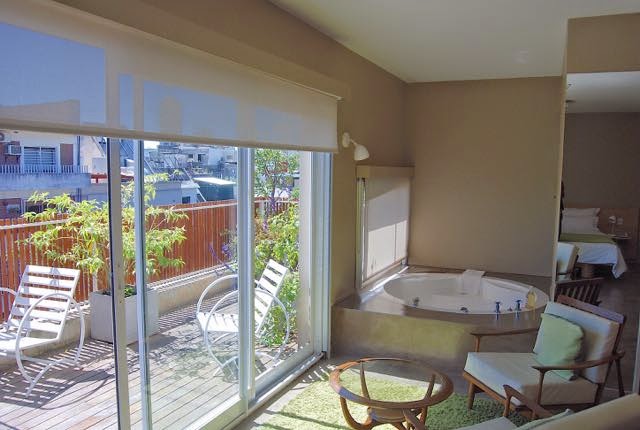
Since I own an apartment in Palermo, I rarely stay in Buenos Aires hotels, but I have spent a night at Home, and have occasionally eaten or had a drink in the bar/restaurant (full disclosure: co-owner Patricia O’Shea was my unpaid “shopping consultant” on an article I wrote for National Geographic Traveler a few years ago). Though the hotel gets celebrity guests, informality is also a strong selling point – there are several truly affordable rooms for guests of modest means - and it even provides guests its own mini-guidebook of the neighborhood.
Condé Nast’s only other Argentine entry is the House of Jasmines (pictured above and below), on the outskirts of the northwestern city of Salta, gateway to the Andean highlands and the wine country of Cafayate. According to the magazine’s description, “Everything smells deliciously of, yes, flowering jasmine, and there are roses in every room.”
I stayed here several years ago, before the famous actor and noted Argentinophile Robert Duvall sold it, but I’ve not been able to return since it reopened under new ownership. From the photographs on the website, it hasn’t changed dramatically – that’s probably a good thing – but it’s now affiliated with the Relais & Chateaux group of luxury accommodations. Other things being equal, I would probably choose to stay in Salta itself, a walkable city with interesting architecture, excellent museums, and very good restaurants. The House of Jasmines isn’t that far away, though, and is undoubtedly more peaceful.

Argentine Coastal Wines?

And now for something completely different: my longtime Argentine friend Nicolás Kugler and Pablo (a commentator on my previous post) have provided some additional information on vineyards and wines near Buenos Aires. As it happens, the county of Berisso, only 57 km southeast of Buenos Aires on the route to provincial capital of La Plata, holds an annual Vinos de la Costa festival. In the middle decades of the 20th century, this area produced up to a million liters of wine per annum, but now it’s only about 50,000 liters from 25 hectares of vineyards. Nobody suggests the quality comes close to matching that of Mendoza or Cafayate, though.

Saturday, December 27, 2014

No W(h)ining? An Uncommon Tasting in Palermo

Mendoza is the heart of Argentina’s wine country, and one of my favorite destinations in the country. On my recent trip south, though, I barely got out of Buenos Aires and, so, a tasting trip to vineyards and wineries was out of the question. I had to look elsewhere.
In principle, there’s no reason not to grow wine grapes in the vicinity of Buenos Aires – to the best of my knowledge the nearest commercial Argentine vineyard is in Sierra de la Ventana, 550 km to the southwest, but there is a substantial cluster of wineries in nearby Uruguay, just a short hop across the River Plate. In fact, if I recall correctly, vineyards used to form something of a greenbelt on the Argentine capital’s outskirts, until the military dictatorship of 1976-83 uprooted them for highways and suburban sprawl.
That said, there are plenty of places to sample Argentine wines in the city, without even having to hear it through the grapevine. One of those is the Bar du Marché (pictured above), in the Palermo Hollywood area, which purports to have 50 different wines by the glass. It’s a place to which this blog will return in the near future, but in a behind-the-scenes manner that its façade does not even hint at.
In early November, shortly after arriving in Buenos Aires, I described my experience at Vinos de Lujo as a “wine-tasting free-for-all” that left me more overwhelmed than enlightened. Later in the month, though, I was able to attend a more manageable tasting at Anuva Wines that I found far more satisfying.
Founded by US resident Daniel Karlin, Anuva (pictured above; the name comes from combining the indefinite English article “an” with “uva,” the Spanish word for grape) is about a 20-block walk from my own Palermo apartment. The inconspicuous streetside door – two Brazilians arrived late because they walked past the entrance without recognising it - opens onto a lengthy staircase that reaches a spacious tasting room that’s also suitable for more formal events. During a previous stay in the city, I had dined here at El Tejano, a “closed doors” restaurant that now operates its own venue for Texas-style barbecue nearby.
Anuva is not a restaurant, but it does offer tapas paired with a selection of five wines at each tasting. All its wines come not from high-profile Mendoza producers like Catena Zapata and Santa Julia, but from smaller, lesser-known wineries that reflect the industry’s geographical diversity, including vintages from the northwestern Andes around Cafayate and from the Patagonian province of Neuquén.
Our own tasting, beginning around 7 p.m., began with a sparkling wine from Viña Las Perdices, in the Agrelo district a short distance north of Mendoza. I’m personally not a fan of sparkling wines, but our sommelier, a fluent English-speaking Argentine named Florencia Campicelli, pointed out that small bubbles characterize the best and, by that standard, Las Perdices passed the exam.
The next sample, a Mairena Torrontés preceded by a cracker with fresh-sliced pear, basil and a walnut, was more to my liking. Torrontés is Argentina’s signature white grape (we almost always have some in the fridge) and, this one, from the high-altitude vineyards around Cafayate, was typically aromatic. I’d buy this one, but I’m not sure how objective I am, as I’d try almost any Torrontés, especially when complemented by raspberry and lemon sorbets (pictured below).
From there, we proceeded to the reds, starting with a San Gimignano Malbec aged six months in French and American oak. Malbec is my favorite red – we even named our beloved Alaskan malamute after it – and this Mendoza vintage is a worthy one. The tasting finished with two others– the Amauta IV blend of Malbec, Cabernet and Syrah from Bodega El Porvenir of Cafayate (the only winery of this bunch that I know personally) and a Mairena Bonarda from Mendoza. The Bonarda’s acquiring a certain notoriety among connoisseurs here, but it’s got a ways to go before it catches up with Malbec.
Throughout, we snacked on paired cold cuts and cheeses, plus a savoury empanada, and finished with a sample of bittersweet chocolate truffles. By the time we finished the two-hour tasting, I was more than satisfied and, despite the fact that this was never supposed to be dinner, it was all I needed for the night.
I’ve avoided sommelier-speak here, partly because I find it opaque and partly because I know more about wine tourism than I do about wine itself – I know what I like to drink, but I don’t presume to impose my tastes on others. Still, Anuva provides a useful introduction for wine-lovers just getting to know the options in Argentina.
Given the fact that the five wines and tapas cost US$52, it’s fair to mention that you could sample more for less at some wine bars and, at wineries, you might spend even less. Many Argentine wineries charge little or nothing for tours and tasting though, of course, you have to get to Mendoza, Cafayate or Chañar first.

Anuva, of course, wants to sell wine as well, and has a wine club that will ship two, three or four bottles per month to your US address. Even so, their tastings are sociable experiences, soft-sell events at which they will not pressure you to join.

Monday, November 10, 2014

Self-Medicating with Malbec

A few days before flying to Buenos Aires, I suffered what, according to the Gospel of Spinal Tap, might be considered a “bizarre gardening accident.” In the morning, while squatting to fill the compost bin, I felt a brief twinge in my right quadriceps and, though I brushed it off at the time, by mid-afternoon it had become sore and, when I finally looked, it had swollen to the point where it appeared inflated.

Alarmed, I phoned the Kaiser advice nurse and arranged an appointment with my GP for the following morning. He speculated a torn muscle or tendon, but said he had never seen anything quite like it and referred to the orthopedics department, where x-rays and even an MRI didn’t tell us much more – the orthopedist told me she hadn’t seen anything exactly like it either, but suggested that it should heal with time and cleared me to travel.

In the weeks since I arrived in Argentina, I’ve gotten out and about far less than I would like – while the swelling and pain decrease at night, both continue to return the following day, though I think the swelling has diminished gradually every day. I have bruises from the ankle to the groin.
Nevertheless, I did manage to get out of the neighborhood on Wednesday evening for the annual Vinos de Lujo tasting at the Alvear Palace Hotel. After a quick stop at a Recoleta cueva, where I changed dollars for pesos at a 13:1 rate, I made a slightly longer stop at Casa Salt Shaker and then hit the hotel for what I can only describe as a wine-tasting free-for-all.

In reality, Vinos de Lujo is not a sip-and-spit operation with sophisticated sommeliers, but rather an overwhelming assemblage of at least 50 wineries, mostly Argentine but a few Chilean, offering unlimited samples for the price of 500 pesos (US$59 at the official rate, but only US$38 on the informal exchange market). I, however, scored a discount ticket for 350 pesos (U$27 at the informal rate) through the non-profit autism research organization Panaacea.
Vinos de Lujo drew a few fashionable people but most of us were, despite the elite venue, informally dressed. It was so crowded, though, that moving from one stand to another presented problems, and it was hard to get close to some wineries. Arriving early, I took the approach of trying the whites first, then gradually moving to the reds, but at times it was elbow-to-elbow. Given my sore leg, simply standing up for the three hours I was there was an effort, but I can’t deny that it’s good value. I took a taxi home.

Surprising, Vinos de Lujo has no dedicated website, though there’s a fairly good general description (in Spanish) at Espacio Vino. That description, though, focuses primarily on the major wineries, not the smaller boutique operations that were abundant at the event. Still, there were representatives from all of Argentina’s major wine regions, including the Andean Northwest (Cafayate and vicinity), Cuyo (primarily Mendoza) and northern Patagonia (primarily Neuquén’s Chañar district). The handful of snacks consisted of rather small samples of cold cuts, cheeses and chocolates.

Sunday, May 5, 2013

Wining and Driving: Mendoza's New Winery Bus


Over the past couple decades, I’ve driven literally hundreds of thousands of kilometers through Argentina, Chile and Uruguay in the course of creating and updating my guidebooks to those countries. In the course of doing so, one of my favorite activities has been visiting vineyards, as the wineries of all three countries have achieved a growing presence on the global stage.

There’s a risk in this, though, as driving and consuming alcohol is, obviously, against the law. In Chile, with one of the continent’s most restrictive drunk-driving laws and a professional police force to apply it, visitors should be particularly attentive. If at all possible, use a designated driver or take a tour though, in regions like the Colchagua valley where the wineries are spread out, tours can be an expensive alternative.
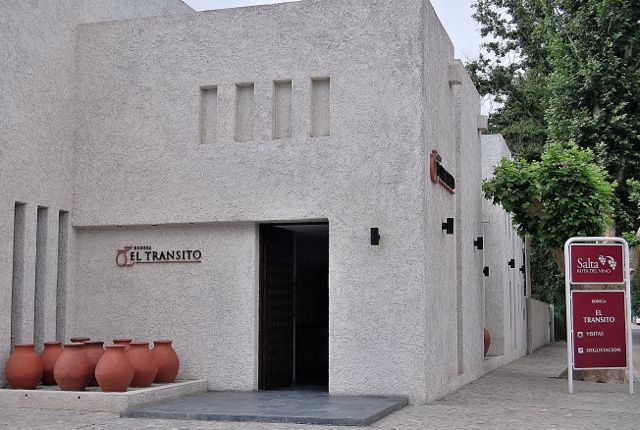
In a few places, this isn’t an issue – in the northern Argentine town of Cafayate, for instance, many wineries (such as Bodega El Tránsito, pictured above) are almost literally within staggering distance of each other, so the big issue can be crossing the street. Fortunately, Cafayate’s traffic is far less ferocious than many other Argentine towns.

On the highways, Argentina is another issue entirely. In all the years I’ve been driving there, I have seen plenty of dangerously and even willfully reckless driving, but I have never seen an Argentine policeman pull over anyone for a moving violation. It’s common, though, for Argentine police to camp out on the roadside and, between sips of yerba mate, pull over motorists to see whether their brake lights or turn signals are malfunctioning. Safety, though, is rarely their concern – rather, it’s the opportunity to supplement their meager salaries with a coima (bribe). This is common in Argentina, where particularly corrupt provincial governments control the police.

Given the slack police work, and the legal obstacles to getting any DUI conviction in Argentina, one might think alternatives for getting around the wineries in a city like Mendoza might be few, but they’re increasing in a city where more than 120 of them are open to the public. When I first did this, after the economic collapse of 2002, it was preposterously cheap to hire a car and driver for the day and, for a group of three or more persons, that’s probably still desirable. Nevertheless, there’s a new option in the Bus Vitivinícola, which connects downtown Mendoza with wineries just south of the city.
The new service offers two itineraries, known as El Sol and Luján Sur, with a hop-on, hop-off service that’s valid for up to ten hours, allowing extended tours and tasting of up to three wineries. The more northerly El Sol itinerary also stops at the suburb of Chacras de Coria, which has critical mass of accommodations and fine restaurants, and five different wineries, including Bodega Vistalba (pictured above) and Bodega Lagarde. The more southerly Luján Sur route offers a choice of seven, including Bodega Séptima (pictured below), Terrazas de los Andes, Dominio del Plata, and Bodega Tapiz. Most of these wineries have restaurants, and several also offer accommodations.
Given Argentina’s relatively lax treatment of potential DUI’s, it’s a little surprising to see this forward-looking service establish itself here first. Chilean and Uruguayan wineries would do well to look at its example (the Uruguayan cities of Montevideo and Colonia have similar sightseeing buses, but nothing that serves their wineries).

Wednesday, February 29, 2012

Argentina's Amazing Race

I have a natural antipathy to “reality” TV shows which, as most everybody acknowledges, are no such thing – any group of people followed around by a camera crew is acting, whether or not they admit it. That said, I’ll plead guilty to never having watched one, and I don’t mind being castigated for ignorance. I nearly broke my pledge never to watch one this week, though, when The Amazing Race visited northwestern Argentina, one of my favorite parts of the country.
My friend and colleague Edward Hasbrouck – one of the best-traveled people I know, and we share a publisher – is an addict of The Amazing Race. He regularly reviews the show on his own blog, managing to provide serious travel information in the context of a program that might otherwise be considered frivolous. He sent me a link to the episode, which started in the northwestern wine region surrounding the town of Cafayate, and I even opened it, but was stymied by constant buffering on the YouTube page.

Nevertheless, today I received a copy of Edward’s regular newsletter with his critique of the episode, and I have a few comments on his comments, intended in the spirit of constructive criticism. Given his broad knowledge of the travel world, he knows far more than I do about most places, but there were a few items I could not let pass.
Argentina’s Andean Northwest is indeed the most indigenous region of the country and, as Edward notes, “All the people the racers met this week appeared to be of indigenous heritage” (such as the woman above, from the town of Humahuaca). He repeats, however, the oversimplification that “most Argentines are mainly or entirely of European ancestry, with the largest proportion descended from 19th and early 20th century immigrants.” It’s true, of course, that Argentina saw massive European immigration during that period, and it’s particularly noticeable in the cities, but a DNA study a few years ago – to which I don’t have the reference at hand - concluded that nearly half of all Argentines can trace their heritage back to the country’s pre-Columbian peoples. It doesn’t mean, of course, that the indigenous heritage is dominant everywhere, but it is significant.

I enjoyed Edward’s commentary on the outlying stockyards barrio of Mataderos, where the city meets the countryside in the Feria de Mataderos, a weekly street fair. I have to take exception, though, with Edwards statement that the barrio’s Nueva Chicago soccer gang can’t match the violence levels of Britain’s soccer hooligans. Argentina’s barras bravas are a plague on the sport, and often intimidate players on their own team and even management – which timidly gives them free tickets in hopes of maintaining “peace” with them. In fact, it’s not unusual for rival barras of the same team to attack each other, and deaths are not unusual – in a recent case, one barra shot at a bus carrying their rivals, and killed somebody on board. I wholeheartedly agree with Edward, though, that anybody attending a soccer match in Buenos Aires or elsewhere in the country should wear neutral colors – drab is good, drabber is better.
Finally, the grammatical pedant in me has to note that the word “Quilmes” – which describes the pre-Colombian fortress ruins near Cafayate (pictured above), the Buenos Aires suburb that takes its name from the indigenous people marched there by the Spaniards, and the beer that’s manufactured there today – does not have an accent. Likewise, the transport company Buquebus, which operates the ferries between Buenos Aires and Uruguay, has no accent.

Wednesday, August 4, 2010

Backroads of Salta (Part 1)

It’s been a frigid winter in Argentina, from the tip of Tierra del Fuego to the northern border with Bolivia - even at subtropical Iguazú, tonight’s temperature will bottom out around 41° F (5° C). Toward the end of the week, though, there’ll be a warming trend and, for the rest of the winter, the climate should be ideal for one of my favorite road trips: the roughly 500-km (300-mile) triangle from the northwestern colonial city of Salta and back via the polychrome Quebrada de Cafayate and its high desert wine country, the scenic Calchaquíes valley hamlets of Molinos and Cachi, and the vertiginous zigzag descent through the Quebrada de Escoipe.

Because it’s a circuit, this route is ideal for a rental car or, for those with more time and energy, a bicycle. Southbound from Salta, the smoothly paved road climbs slowly but steadily through the lush Lerma valley but becomes far more scenic when it crosses into the valley of the Río de las Conchas, otherwise known as the Quebrada de Cafayate. Here, the Sierra de Carahuasi reveals a series of free-standing landforms, box canyons (pictured above) and dunes reminiscent of southern Utah or northern New Mexico - not to mention “gauchos de Güemes” (pictured below) with the oversized, stiff leather chaps that protect them from the thorny backcountry brush. It’s roughly a three-hour drive to the town of Cafayate but, with stops to explore the scenery and take photographs, figure a late afternoon or early evening arrival.

With a population of about 10,000, Cafayate is the hub of one of the world’s highest wine-growing districts - at 1,660 meters (5,446 feet) above sea level, it enjoys warm days and cool nights that bring its grapes, most notably the fruity white Torrontés, to a perfect maturity. At this time of the year, of course, the vines stand leafless as pruning and other vineyard activities proceed, but by next month they’ll start leafing out - even in some nearby vineyards that are nearly a thousand meters higher.

While the vineyards may be dormant, the wineries are not, and Cafayate has more than half a dozen of them within staggering distance of each other - there is no need or excuse for a DUI here. On top of that, the traffic moves more slowly and cautiously, in town at least, than it does elsewhere in Argentina, so even slightly tipply pedestrians are safer than they might normally expect among some of South America’s worst drivers.

Calafate has seven wineries in town proper, and another three are within cycling distance; in some cases, as with Bodega Nanni and Bodega El Tránsito (pictured above), they’re literally right across the street from each other. My current favorite is the Pequeña Bodega Salvador Figueroa, a Lilliputian locale producing only 2,500 bottles of classic Malbec, 2,500 of oaked Malbec, and 600 bottles of Torrontés per annum. Most of them offer free tours and tasting though, in a few cases, there’s a token charge.

When you tire of tasting, one of Argentina’s most impressive archaeological sites is only half an hour’s drive south: the ruins of Quilmes, in Tucumán province (pictured above), are the closest thing to Machu Picchu to be found in Argentine territory. It’s best to stay in Cafayate, though; a two-night stay should suffice to visit the ruins and most if not all of the wineries. A personal favorite for accommodations is Hotel Killa Cafayate, just a couple blocks off the main plaza, but Villa Vicuña is also very fine and, for luxury, there’s the Sheraton-owned Hotel Patios de Cafayate (pictured below), on the grounds of Bodega El Esteco at the north end of town.

For those who have never dined on llama steak before, downtown’s Macacha (Avenida Güemes Norte 28) is the place to do so. Nearby Heladería Miranda offers wine-flavored ice cream - the fruity white Torrontés tops the red Cabernet (sadly, says the owner, Malbec grapes do not make good ice cream).

Within a few days, look for the rest of this backroads tour, covering the more rugged sector up the Calchaquíes valley to Molinos and Cachi, and then back to Salta.
Custom Search