Showing posts with label Camarones. Show all posts

Wednesday, March 16, 2011

Argentina, Chile and the NYT

Two Sundays ago, The New York Times travel section published a long feature on Bahía Bustamante, a remote company town on Argentina’s Patagonian coast north of Comodoro Rivadavia. Founded as a kelp gathering settlement, it’s part of the “Parque Interjurisdiccional Marino Costero Patagonia Austral,” which comprises a coastal strip roughly 100 km long in Chubut province, south and west from Cabo Dos Bahías.

Only about 30 km southeast of Ruta Nacional 3, the main coastal Patagonian highway, Bahía Bustamante dates from 1953; it once had 400 residents - most of them employees - but now has only about 40 or so. Many of them gather seaweed along the shoreline; it is then dried in the sun and trucked to Gaiman (best known for its Welsh teahouses), where a factory processes it into food additives.

At Bustamante, where I spent a couple nights two years ago, the streets take their names from species of seaweed, and its restaurant La Proveeduría serves meals that often use seaweed as a condiment. Only a handful of the houses are occupied, but some of those - the former administrators’ houses - have been transformed into stylishly retrofitted guesthouses now called Casas del Mar, facing the beach, at premium prices on an all-inclusive basis.
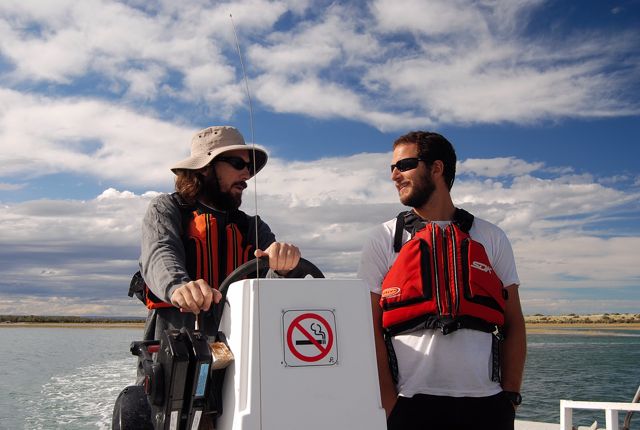
The Times article goes to great lengths to stress Bustamante’s exclusivity, almost portraying its owner Matías Soriano (pictured above, left) as a near-hermit who limits access to his own personal Galápagos - home to thousands of Magellanic penguins, cormorants, dolphin gulls, and steamer ducks, plus large colonies of southern sea lions and fur seals. It implies that Bustamante’s wealth of wildlife is available only to those able and willing to pay upwards of US$400 per night (double) for the privilege.

In fact, while Bustamante is a company town and the surrounding lands are a sheep estancia, all private property, the site is readily accessible by public roads, another of which leads south from the town of Camarones. Having met Soriano in Buenos Aires and dined with him at Bustamante, I can affirm that he’s gregarious and far more open toward budget travelers than the Times suggests - in fact, he’s even permitted people to camp nearby, and the simpler “Casas de la Estepa” offer cheaper accommodations with kitchen access (US$120 for up to three persons), though meals and excursions are extra (full-board guests have priority on the excursions).

Those excursions include a visit to an offshore island full of Magellanic penguins and other birds, but this is possible only at high tide - the five-meter tidal range makes it impossible for the flat bottom launch to navigate at low tide. At low tide, though, there are other options: on the nearby steppe, guanacos and flightless choikes (rheas) scamper through the bunch grasses and scrublands. Farther inland, Bustamante possesses a remarkable badlands with a sprawling petrified forest comparable to Santa Cruz Province’s Monumento Natural Bosques Petrificados and Chubut’s own Monumento Natural Bosque Petrificado de Sarmiento.

It would be a shame for anyone to pass up Bustamante simply because of the Times’s implied exclusivity.

Santiago’s No. 1?

Meanwhile, across the Andes, the Times recently named the Chilean capital No. 1 among places to go in 2011. In correspondent Paola Singer’s words, “Santiago has in recent years added modern museums, smartly designed hotels and sophisticated restaurants. The city has become decidedly more vibrant.” She suggests that new hotels, such as The Aubrey (pictured above) and the W Santiago (pictured below), along with arts landmarks such as the Centro Cultural Gabriela Mistral (ironically enough, once the administrative center of the Pinochet dictatorship) have turned the city around. Next month, it will host the Lollapalooza music festival.

Personally, I’ve always thought Santiago was an underrated city, but it’s always kept a lower profile than its trans-Andean counterpart of Buenos Aires. Santiago has outstanding restaurants, museums, and theaters, plus easy access to an Andean backcountry that Buenos Aires can’t come remotely close to. All that said, I can’t honestly say I’d consider it the world’s No. 1 destination - but I would say that anybody visiting Chile should spend at least a few days here before or after visiting Torres del Paine, San Pedro de Atacama, or the nearby wine country. In this case, the Times’s hyperbole is not completely misplaced.

Monday, August 3, 2009

Safer than Home, in the Southern Cone

A few years ago, as I was delivering a slide lecture on Buenos Aires in Southern California, someone brought up the issue of personal safety in the question-and-answer period. My impulsive response, which brought a nervous laugh from the audience, was that “there are no drive-by shootings in Buenos Aires” - which there are in Los Angeles.

It’s true that, before Americans go overseas, one of the first things they think about is crime and insecurity, even if their own country can be as dangerous, or more so, than many foreign destinations. Colombia, to cite one example, has a terrible reputation that lingers from sensational - and sensationalist - stories of its drug wars and guerrilla insurgencies. Mexico, especially the cities along the US border, has seen some horrendous crimes and smuggling of drugs and people to the north is notorious.

Yet both those countries are generally safe, sometimes extremely safe, as I pointed out in writing about Colombia last year. In that context, it’s always surprised me that so many residents of Chile, Argentina, and Uruguay think that their countries are dangerous - as José Miguel Insulza, Secretary General of the Organization of American States (OAS) pointed out in a recent interview, “In spite of the social perception and public opinion alarm, countries to the south of the continent have lower rates of insecurity compared to other countries of the region.”

That’s not to say crime does not exist but, as Insulza notes, “All over the continent news begins with crimes.” A sensationalist emphasis on crime stories, which increase TV ratings and sell newspapers, does a disservice to countries and cities that don't really deserve it. To my mind, for instance, it’s a testament to urban security when park playgrounds near my Buenos Aires apartment in Palermo are full of families with kids well after dark and often until midnight or later in summer. Likewise, I’ve spent extended periods in Santiago and other Chilean cities, without excessive concern for my personal safety.

Chile, for its part, has Latin America’s most highly respected police force in its Carabineros. Argentina can’t match that, unfortunately - provincial police in Buenos Aires are notoriously corrupt and highway checkpoints are often opportunities for them to shake down motorists for minor equipment violations - but that rarely affects foreign visitors. Uruguay falls somewhere in between, but closer to Chile - its police are generally trustworthy. With all of them, though, investigative professionalism lags behind.

Buenos Aires, meanwhile, is creating a new municipal police force to take over many of the functions of the Policía Federal (pictured here), which until now has handled police matters in the city. The feds are arguably more competent than provincial forces but it remains to be seen whether the new force, whose officers are mostly ex-feds, will be any improvement.

Sunday, March 15, 2009

Perón Plays Patagonia!

Argentine literary great Jorge Luis Borges, who detested Juan Domingo Perón, famously said that “Peronists are neither good nor bad, but incorrigible.” I tend to agree with Borges’ assessment of a political party whose leaders’ motto always seems to be “If you’re not with us, you’re against us.” At the same time I’ll admit to being impressed with the new Museo de la Familia Perón, which I visited last Thursday, in the Patagonian town of Camarones.

There are, to my knowledge, two other Perón museums in Argentina: at Juan Perón’s birthplace in the Buenos Aires province town of Lobos, and the Museo Evita in the Buenos Aires city neighborhood of Palermo (barely two blocks from our apartment). The former is surprisingly bland, while the latter is an uncritical homage to Perón’s first lady that’s more interesting for where it is (a mansion that Evita turned into a home for unwed mothers from the provinces, scandalizing the neighbors in what was then an elite neighborhood).

Camarones’ Perón museum occupies a shiny new replica of the caudillo’s boyhood home - his father, Tomás Perón, ran a sheep estancia on the town’s western outskirts in the early years of the 20th century (Juan Domingo Perón was born in 1895). It differs from the other Perón museums not in that it’s professionally organized - so is the Evita museum - but in that it admits that Perón was a controversial and contradictory figure whose loyalists even engaged each other in firefights in the 1970s (right- and left-wing factions were each convinced the general was on their side).

While the museum leans toward the interpretations of Argentina’s current left-of-center Peronists, it avoids the polemics so common in Argentine politics. Not only that, the English translations that accompany the exhibits are well above average. For anyone visiting the wildlife routes of coastal Chubut province - Camarones is only a short distance from the Cabo Dos Bahías reserve - the Perón museum deserves a stopover.
Custom Search