In 1970, Chilean filmmaker Alejandro Jodorowsky released El Topo, a surrealist movie that seemingly created the Acid Western genre and was a Mexican entry for the Oscars (it was filmed in Mexico, but ultimately not nominated). This year, Chilean director Maite Alberdi’s El Agente Topo (The Mole Agent) is most emphatically not a sequel, but this rather differently offbeat picture earned a nomination for best documentary, even though it didn’t take home the prize last Sunday.
On one level, The Mole Agent is a real-life spy movie in which a private detective recruits Sergio Chamy, a charming 80-something widower, to infiltrate a nursing home where the detective’s client suspects her mother has been subject to elder abuse. This involves a crash course in surveillance techniques and technology for Chamy, whose sociability swiftly inserts him into a milieu where women outnumber men by ten to one.
Alberdi’s production crew filmed the entire work, with permission (but perhaps some deception), at the Hogar de Ancianos San Francisco in the Santiago suburb of El Monte, in an area I’ve visited as a lesser-known wine region. The finished film is an outgrowth of what was originally a more general focus on Chile’s aging population—by the end of this decade, it could be Latin America’s fastest-aging country, but that’s not what foreign tourists see.
With some minor shortcomings, the Hogar de Ancianos appears to be a well-kept facility, with comfortable accommodations and pleasant gardens, that provides attentive services to its residents. Chamy eventually frustrates his handler by insisting that there is no abuse but, in the end, he concludes that loneliness and familial neglect are major issues that don’t get the attention they deserve. When the popular Chamy finally departs the home, the result is more like a feel-good comedy than an exposé. In fact, it hardly feels like a documentary at all, and Alberti has stated that there’s interest in doing a fictional version—which she herself won’t do because she’s too invested in the one she’s just finished.
El Agente Topo is available for streaming on Hulu (with English-language subtitles, free trial available).
In the current months of semi-quarantined torpor I have, like millions of others, spent an inordinate amount of time in front of the tube. Often my tastes run to Scandi-Noir mysteries but, over the past week, we discovered a worthwhile alternative that takes me back to Buenos Aires and elsewhere in Latin America with Rompan Todo (Break It All), a six-part documentary on rock music south of the border (despite some notable omissions, to be detailed below).
Rompan Todo focuses primarily on Mexico (Mexico City, mostly) and Argentina (primarily Buenos Aires), and evokes nostalgia not just for the distant origins of that scene, but also for the city that I can’t visit for the foreseeable future. I’m of the generation for which rock music is a touchstone, and I touched on the Argentine scene myself in a National Geographic Traveler assignment a decade ago.
In the Beginning…
The series, though, starts with the California-born Richard Steven Valenzuela—better known as Richie Valens—who energized aspiring south-of-the-border musicians with his now standard “La Bamba,” adapted from a Mexican folk song. Not so many years later, though, the influence came from across the Atlantic with the Beatles. As the series’ Argentine producer Gustavo Santaolalla notes, the earliest Argentine bands often performed cover versions in English and were often derivative—Sandro, the “Argentine Elvis,” performed Spanish-language versions of songs like Tim Hardin’s “If I Were a Carpenter.”
This tribute album to the late Sandro is a fine introduction to Mexican and South American bands.
From the first, governments and other institutions like the Catholic Church were skeptical and often hostile toward rock. In 1971, for instance, Mexico had its own Woodstock in the unexpectedly politicized Festival de Avándaro, and Mexican officials forced rock to go underground—almost literally—for years. Argentine musicians underwent a similar experience in the approach to and aftermath of the 1976 military coup that resulted in exile for many.
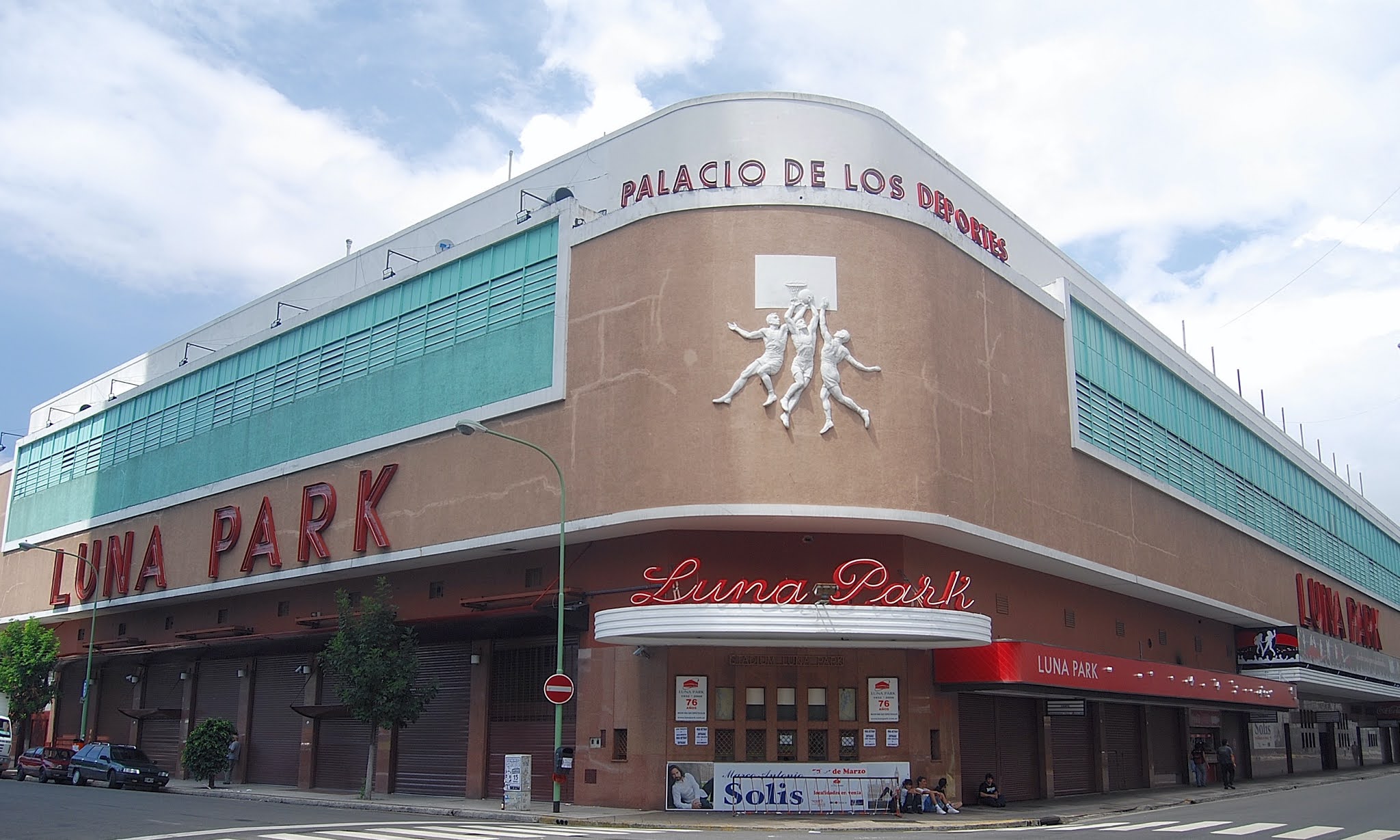
Billy Bond's fans trashed the interior of Luna Park.
One of those was Billy Bond, whose appearance in the film was a revelation–I’d never even heard of the Italian-born rocker (given name Giuliano Canterini) but, from the footage here, he seems a precursor of punk. In 1972, when he and his band La Pesada del Rock and Roll played the iconic Luna Park Stadium—an auditorium where Eva Duarte first charmed Juan Perón en route to becoming Argentina’s most powerful woman ever—Bond urged his cheap-seats fans to descend to the unsold vacancies closer to the stage, resulting in vandalism and a police round-up. Within two years, apprehensive of Argentina’s authoritarian trends, Bond left for Brazil, but continued to produce Argentine bands and, in the course of this series, he proves himself to be admirably articulate (The series, by the way, takes its name from an album by Uruguay’s Los Shakers, but “Break It All” might as well have been Bond’s motto in his youth).
Meanwhile, in Chile
Chile's coupmongers executed Víctor Jara in 1973.
Chile underwent a similar trauma with the 1973 coup that overthrew constitutional President Salvador Allende and essentially shut down the music scene—beginning with folksinger Víctor Jara, whom Augusto Pinochet’s forces tortured and killed in an especially gruesome manner. My experience there has been more limited, though I did have the good fortune to meet, in Santiago, Claudio Parra of Los Jaivas, a group that formed in 1963 (the band name, by the way, is an adaptation of their original English “High-bass,” though it can also mean a species of crab found in Chilean waters).
Los Jaivas backstage at the Teatro Universidad de Chile (Claudio Parra is second from left)
I had assumed the band left because of the coup, but Parra corrected me on that—as the film makes clear, they had already decided to head to Argentina for commercial reasons, and the coup merely delayed their departure. They then spent several years there and in Paris before returning to Chile, where they still tour every year. When I saw them in Santiago around the turn of the century, they struck me as a Pink Floyd comparable and, onscreen here, La Ley’s Beto Cuevas compares their Alturas de Machu Picchu (Heights of Machu Picchu, based on a poem by Pablo Neruda) to Floyd’s Live at Pompeii.
Rock Nacional, In the Post-War
My own experience with Argentina's rock nacional dates from the post-Falklands/Malvinas War period, when the dictatorship faltered (in a brief interview, the Dylanesque León Gieco ruefully admits that he and other musicians were complicit in supporting the war and, by extension, a regime they presumably loathed). After the conflict, though, they focused on songs with Spanish rather than English lyrics—Charly García, for instance, has recorded a Spanish-language version of the Byrds’ “I’ll Feel a Whole Lot Better” and once, in an under-the-railroad-tracks dive in Palermo, I heard him do “Soldado de Lata,” a similar adaptation of the Small Faces’ “Tin Soldier.”
A performance at Palermo's Roxy Live Bar (the bassist, second from right, is Charly García's bandmate Zorrito von Quintiero).
Fito Páez performs in El Calafate.
Other than García, the biggest names I’ve ever come close to are Soda Stereo, the first Argentine band to become a major international touring sensation, and Fito Páez, now a solo artist who also worked with García and others. I know little about Soda’s music, but I happened to be in the provincial capital of Tucumán when their publicists were passing out promotional packs of cigarettes in the central Plaza de la Independencia prior to a concert (I was not impressed). Páez I saw as part of El Calafate’s annual Festival del Lago in 2014, but the outdoor sound system was less than ideal.
Oversights and Omissions
One unspoken theme through most of the series is the scene’s overwhelmingly masculinity, but there are several prominent women, most notably Andrea Echeverri of Colombia’s Aterciopelados and Mexico’s California-born Julieta Venegas, who has worked with Santaolalla (who lives in Los Angeles). I’ll note that when I saw Charly García in Palermo, his lead guitarist was María Gabriela Epumer, who died at 39 due in part, apparently, to a medical misdiagnosis. Truly unique is Los Jaivas’ Juanita Parra (in the Chile section photo above), who replaced her father Gabriel as the group’s drummer after a fatal automobile accident. Santaolalla, though, says rock’s future is female—and, as a producer with pedigree, he’s in a position to contribute to that.
In summary, Break It All remains a worthy account of rock music south of the border (and the Equator), but with one other major omission—although it subtitles itself “The History of Rock in Latin America,” Brazil is conspicuous by its absence. I’ll confess to knowing little about its music beyond bossa nova, but a cursory glance at Wikipedia suggests that the region’s largest country has had a flourishing rock music scene ever since the mid-1950s. Perhaps Netflix should retitle the current series to represent its Spanish-language bias, and then underwrite a separate work on the history of rock em português.
It's been a while since I've posted but, given the pandemic disruption of global travel, especially in my favored region of southernmost South America, I've been distracted with other matters. We're not dead yet, though, and I notice that, in recently commemorating the 75th anniversary of World War II's conclusion, the New York Times Book Review included just one minor item in the Western Hemisphere beyond the Río Grande—a children's book set in Cuba.
In that context I'll note that for every other Western Hemisphere country, the United States is not “America” but, rather, part of the Americas (In the end, we are all Americans). So, here's a book that addresses the Times's lacuna.
The Tango War covers the conflict from a southerly perspective.
In The Tango War, US journalist Mary Jo McConahay demonstrates that the Allied Forcesand Axis powers tangled (pun intended) away from the European and Asian spotlights both before and during the actual conflict. She focuses primarily on the United States and Germany, and their involvement in Mexico, Peru, Brazil and Argentina, though her title misleadingly suggests the centrality of Buenos Aires. There is less coverage of other countries, though Chile and Uruguay also figure into the story.
Hoover was a publicity hound who tried to intimidate his opponents, but Donovan preferred to work behind the scenes. While Hoover often sent ill-prepared agents into the field, primarily in Mexico, Donovan employed professionals—one of whom was the late Woodrow Borah, a colonial Mexican history specialist who was also my own outside dissertation adviser at Berkeley. Borah, a fairly conservative man whose job involved working directly under a Soviet informant supervisor, told me that his main Research and Analysis (R&A) task was tracing the movement of German money south of the border.
Beyond the Equator
Farther south, the scenario was more complex. On the Pacific Coast, the issue was Japan and, in a regrettable development, legitimate concern took an illegitimate form—with little or no evidence, Peruvian authorities collaborated to expel nearly 2,000 Japanese-Peruvians to so-called “relocation centers” in North America, where US citizens of Japanese descent were already confined. Some of these Nikkei were, in effect, held hostage for prisoner exchanges during the war, though others remained in the United States after the conflict ended.
Brazil gave off ambiguous signals, as dictator Getúlio Vargas had strong economic ties with Germany and Italy, and large German and Italian immigrant communities abounded with Nazi and Fascist sympathizers. Brazil also had its own homegrown Fascist movement, the Integralists, but Vargas’s response to Franklin Delano Roosevelt’s “Good Neighbor Policy” tipped the balance. In fact, in support of the famous 10th Mountain Division, Brazilian troops played a key role in the Allied campaign that brought down Italy’s Benito Mussolini.
British agents watched the Graf Spee from atop Montevideo's Palacio Salvo.
The Graf Spee's captain killed himself at Buenos Aires's Centro Naval.
That said, the United States laid the grounds for Argentina’s belated entry into the war, at least partially, through the exercise of “soft power” in the form of–wait for it—Walt Disney! As part of the Good Neighbor Policy, Disney and a crew of assistants known as “El Grupo” produced an animated film that depicted positive stereotypes of Brazil and Argentina, including the legendary “Gaucho Goofy.” Later, Argentine gaucho caricaturist Florencio Molina Campos worked on several Disney projects.
El Gaucho Goofy was part of a longer animated film called Saludos, ¡Amigos!
While Argentina came around opportunistically at war’s end, the country became a prime destination for ex-Nazis who, with Vatican collusion, used so-called “ratlines” to escape Europe and reach South America. Some of the most notorious war criminals, such as Adolf Eichmann and Erich Priebke, became long-term Argentine residents, but others, such as Klaus Barbie, Joseph Mengele and Walter Rauff, ended up in Bolivia, Paraguay, and Brazil. A low-level Nazi, Paul Schäfer, headed the cultish Colonia Dignidad in southern mainland Chile and cooperated with the Pinochet dictatorship before escaping to Argentina to avoid prosecution as a pedophile. Eventually extradited, he died in prison in Santiago.
The Cold War and Its Aftermath
All this constitutes a readable account that fills a notable gap in the World War II saga, but in my opinion McConahay (whom I have met) stretches it a bit to attribute Argentina’s “Dirty War” too directly to World War II. She cites Uki Goñi and Patricia Bernardi, both of whom I know, on the parallels between Nazi tactics and those practiced by their own country’s 1976-83 dictatorship (Patricia’s sister Claudia, who also works with the Equipo Argentino de Antropología Forense (Argentine Forensic Anthropology Team) is a frequent houseguest of ours in California).
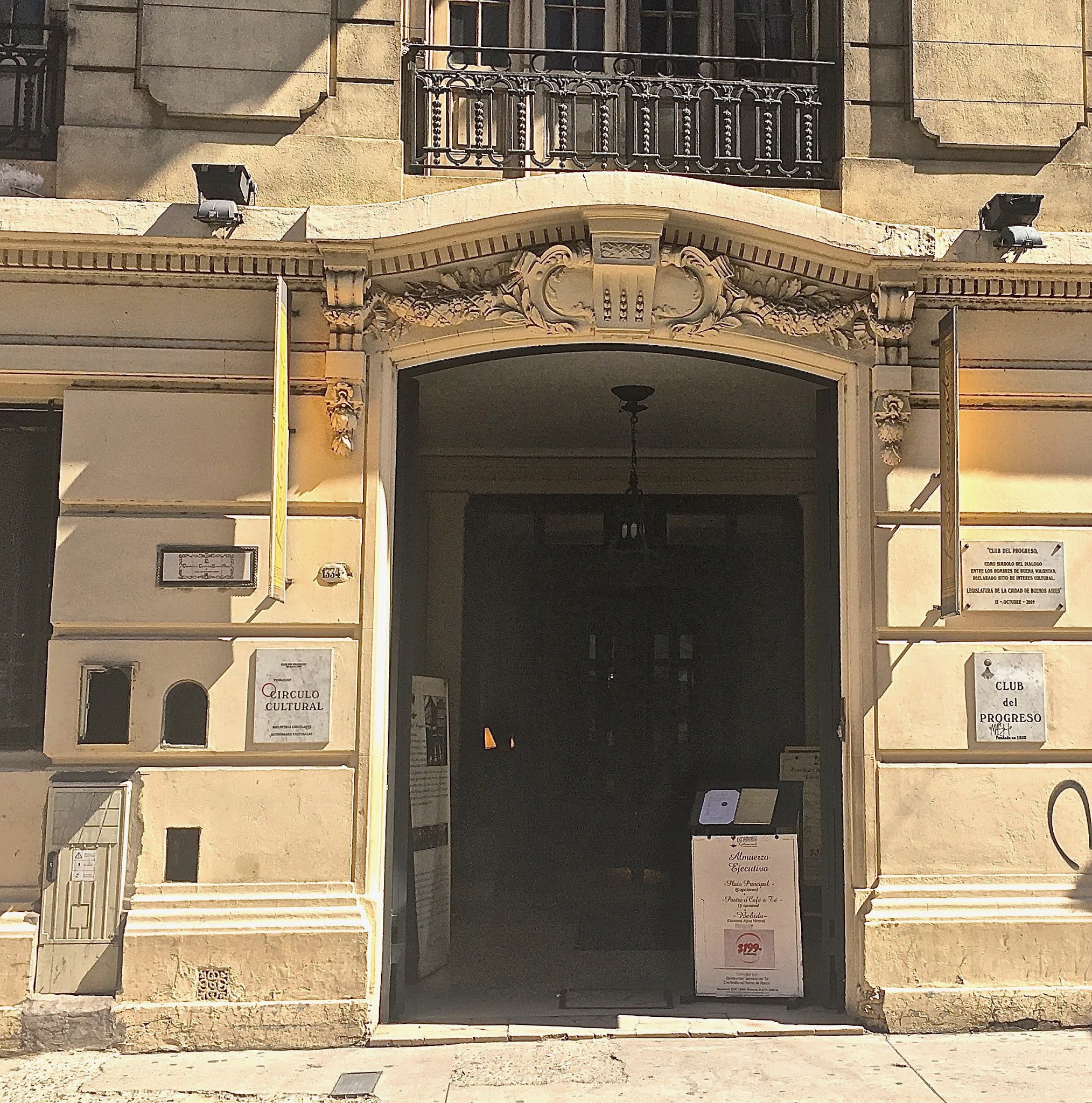
Intending to dine at the Club del Progreso, in 2002, we were startled to see a dining salon outfitted for an apparent Nazi event.
Certainly the Argentine military had extreme right-wing, often anti-Semitic elements. Anecdotally, I can’t forget the time in Buenos Aires that my wife, her brother, and I were startled to see an entire dining salon at the classic Club del Progreso restaurant outfitted for an apparent private event with swastika flags and other questionable artifacts. Preparing to leave in disgust, we nevertheless asked about the décor, and learned that it was a set for a scene in the 2003 film of Imagining Argentina, with Antonio Banderas and Emma Thompson. That relieved our misgivings for the moment, but the fact that even a period film would depict Nazi nostalgia in Argentina has left a lingering impact—especially since the United States government was not guiltless in the so-called Proceso.
Support Southern Cone Travel
If you've found this article useful and informative, please consider earning me a few pennies by clicking on an ad.
Guidebook writing has been my occupation for three decades, though the digital revolution has put pressure on the print sector for at least two-thirds of that time. In the context of the coronavirus crisis, it drew renewed attention last week when Lonely Planet, my first publisher, announced the closure of its Australian flagship in Melbourne and its London editorial office. It is also shutting down its namesake magazine. This will leave it with a reduced presence in the Nashville suburb of Franklin, Tennessee (!) and Dublin, where it’s presumably cheaper to operate. The Tennessee office replaced its former US headquarters in my hometown of Oakland, California.
The skeletal 1989 edition of LP's Argentina prominently featured the author's name.
I’ve always had misgivings about digital travel content, especially crowd-sourced sites like TripAdvisor. They are vulnerable to anonymous and pseudonymous comments—especially by competitors—but not everything about them is necessarily untrustworthy. I would never even consider a restaurant on the basis of a TripAdvisor recommendation, for example, but if somebody reports claims to have eaten there three days ago, I’ll have reasonable confidence that the business in question still exists (except, perhaps, in times of coronavirus).
While the proliferation of digital content is certainly a factor in the decline of print guidebooks, LP’s corporate culture has also devolved from what it once was. In the beginning, the company gave its authors an autonomy to explore and make decisions on the content of their titles. Developing regional expertise over the years, those authors held copyright to their work, and received generous royalties—enough, in some cases to result in six-figure annual incomes.
Arguably, LP’s decline coincided with the devaluation of the on-the-ground regional expertise that first made them credible. In this context, Paula Hardy’s quasi-obituary in the Guardian (linked above)is a blend of naiveté and misinformation, not to mention gaping lacunae. About the time she came on board, in 1999, LP was morphing from an author-friendly company to one that dispensed with experiencedauthors, eliminating their copyrights and royalty contracts.Some were told that (I’m paraphrasing here) “You’re getting a reputation as difficult to work with.”
After the company warned that it mightstart titles from scratch with new writers, longtime authors learned that continuing with LP would involve fixed-fee contracts for a third or less of their previous income, with no certainty of future employment.Several whom I know opted out—choosing to sell their copyrights to the company, which seemed to conclude that destinations and authors were fungible (in fairness, the copyright buyouts could be generous).
Nothing in Santiago de Chile remotely resembles the Cathedral of Santiago de Compostela, but an LP editor wanted it as a cover shot.
New editions and titles became the product of multiple writers, some with doubtful qualifications—if an author had collaborated on a guide to, say, Sweden, he or she could just as easily draw an assignment for Myanmar, academic preparation and language skills notwithstanding. Many incoming authors and editorial personnel were neophytes whose geographical ignorance was palpable—in one case that I know of, an editor chose a photograph of Spain’s Santiago de Compostela (population about 96,000) to represent the capital of Chile (population five million-plus).
My first LP guide (left) omitted our names from the cover, but the licensed Spanish-language version acknowledged us.
In that context, it’s noteworthy that LP stopped putting authors’ names on the covers of their books in the late 1980s, as best I can figure. After signing my first LP contract in 1990, I never had my name on the cover with a single exception—when Barcelona’s Editorial Kairós licensed my Argentina, Uruguay & Paraguay title, it featured both my wife’s and mine (María Laura was also the translator).
I spent ten years with LP, producing titles on Argentina, Chile, Buenos Aires, Santiago, Baja California and The Rocky Mountain States, but was never so fortunate as to have a royalty contract. That said, the flat fees seemed reasonable at the time and, in one instance, LP provided me a supplement when Argentina dollarized its economy, which made it a very expensive destination for several years.
Meanwhile, Hardy’s assertion that LP is the only guidebook publisher to send authors into the field is laughable. I can contradict that on the basis of my own experience, in part after returning, earlier than I had hoped, from fieldwork in Argentina and Chile to update my Patagonia title. Because of the public health crisis, I have no idea when(or even if) Imay be able to resume the work, but I still hope to do so. A friend, also an ex-LP author, recently informed me that a different publisher has commissioned him to update two of his titles, and I am confident that other publishers will do the same.
The Independent’s Simon Calder seems to share Hardy’s romanticism about the publisher’s struggles: “When this wretched crisis is over, we may begin a new era where travellers will be hungry for resources they can trust, in particular guides researched and written by professionals, which don’t require batteries or an internet connection, and which feed our sense of adventure.”
I too would like to think so, but LP seems unlikely to carry that torch forward. After two ownership changes since my time, it is wearing down; the current contraction is part of a process that began decades ago when it jettisoned its most credible and dedicated authors. In both the physical and the publishing world, erosion is a slow but inexorable process.
Chile's Juan Fernández archipelago was, for years, the home of castaway Alexander Selkirk - the real-life Robinson Crusoe.
In the course of a career spent traveling throughout the
Americas, I’ve had the opportunity to visit numerous offshore Pacific islands—mostly,
though, in South America, where the Juan Fernández
archipelago is one of my favorite destinations in this category (I omit Rapa Nui/Easter Island
here, due to its 2000 mile/3500 km distance from the mainland). I’ve set foot
on many of archipelagic Chile’s
islands, starting with the Chiloé group
in the south.
The Farallones are about 25 nautical miles west of San Francisco.
North of the Equator, I’ve not had so much experience. One
highlight was a trip to Mexico’s Isla Cedros—off the Baja
California coast—where I caught a fishing-boat lift to the more distant Islas San Benito (There
I saw northern elephant seals and, on the voyage back, the crew treated me to a
scallop ceviche). Having spent decades in the San Francisco Bay Area, I’ve often
seen the outlines of the forbidding Farallon Islands,
and have always yearned to see them up close and personal.
The Farallones' rugged topography helps make them a wildlife reserve (photo, public domain)
That’s not easy, because, though the Farallones belong politically
to the City and County of
San Francisco, they’re desert islands off limits to the public at large. In
the 19th century, collectors gathered hundreds of thousands of seabird eggs for
sale on the mainland, and US Navy and Coast Guard long kept a presence, but
today the archipelago is under protection of US Fish and Wildlife Service as
the Farallon Islands
National Wildlife Refuge. Only research biologists have access to the
islands themselves, where several buildings remain from their previous
incarnations.
Once a naval and coast guard base, the Farallones now host research biologists.
Earlier this month, though, we booked a day tour to the
islands with Álvaro’s Adventures,
from Pillar
Point Harbor at Half Moon Bay, south of San Francisco. Álvaro Jaramillo,
whom I’ve known for some years, lives there but also leads birding trips to Argentina
and Chile, where I usually work. This, though, was an opportunity to see
something new.
Nesting murres and guano cover much of the rugged Farallones terrain.
Many, if not most, of the other passengers were enthusiastic
birders who braved the rough seas in hopes of expanding their lifelists—though
some were repeat customers. I’m only a casual birder, but the sight of islands
covered with birds and guano reminds me of my experiences in the penguin-rich
South Atlantic, and the presence of buildings on remote islands reminded me—on a
midsummer’s day that was no less chilly than the Strait of Magellan—of
structures in Tierra
del Fuego. It’s also whale-watching season, though we didn’t nearly as
close to the grays and humpbacks here as I have in antipodean destinations like
Península
Valdés (where it’s now breeding season for right whales) and Isla
Carlos III (summer feeding grounds for southern humpbacks). The Farallones
are also a place to spot great white sharks, though July’s a little too early
for that.
Unfortunately, at the Farallones we never so close to the whales as I was to this southern humpback in the Strait of Magellan.
Later this year and early next year, I should get the chance
to revisit some of my South American islands, but there’s one notable omission
on my offshore lifelist. I’d really like the chance to visit Chile’s Isla Mocha,
off the coast of the Araucanía region.
Nearly half of it’s a national reserve and, though it might not complete my
insular aspirations, it would be a major step forward.
Chile's Isla Mocha is on my wishlist, even if it won't look the way it did to 16th-century Dutch pirates.