Showing posts with label León Gieco. Show all posts

Monday, December 14, 2015

The Stars of Fireland

Recently, a young Chilean woman told me she moved to Tierra del Fuego because its clear nighttime skies offered spectacular views of the stars. It struck me, later, that there’s more than one way to interpret what she said.
Divided between Argentina and Chile, Tierra del Fuego is a large but thinly populated archipelago with an international reputation but only a handful of cities and towns. For most foreign visitors on a Patagonia vacation, the prime destination is Argentina’s Beagle Channel port of Ushuaia, the gateway to Antarctica, usually reached by air or cruise ship. For overland travelers, though, the tiny town of Tolhuin, where the land begins to rise midway between the industrial flatlands city of Río Grande and Ushuaia’s scenic sierras, the bakery known as Panadería La Unión has become an obligatory stopover.
In fact, all the buses that travel between Ushuaia and the Chilean city of Punta Arenas, on the South American mainland, stop here so that passengers can load up on medialunas (Argentina’s version of the French croissant) and other pastries, plus empanadas and chocolates for a 12-hour trip that involves a ferry crossing over the Strait of Magellan (there are no longer any flights between Ushuaia and Punta Arenas). So does almost every Argentine motorist en route to “the uttermost part of the earth” (to appropriate the title of pioneer Lucas Bridges’s memoir of his life on the island).
Many of them stop in hopes of glimpsing the Argentine and even foreign celebrities whose photographs cover the walls. Among them are the (now disgraced) President Carlos Menem (pictured above), the Dylanesque folk-rock singer León Greco (pictured below at left; his signature album “De Ushuaia a La Quiaca” spanned the length of the country) and even the US rock drummer Marky Ramone (pictured at bottom; the Ramones were enormously popular in Argentina). In a town that takes its name from an indigenous word meaning the “heart” of the island, there’s also a tribute to the late Buenos Aires surgeon René Favaloro, who pioneered coronary bypass surgery while working in the United States.
However quintessentially Argentine La Unión may be, it has one surprising shortcoming. In a country where almost every remote town offers fresh espresso on the spot, the “bakery to the stars” offers only a coin-operated vending machine to purchase coffee.

Monday, October 25, 2010

Bandidos Rurales: Beyond Butch and Sundance

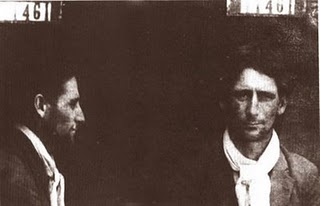
Like the Wild West of the United States, Patagonia was a frontier region and, as such, it was often a lawless place where might made right - and, as often as not, that might came out of the barrel of a pistol or a rifle. Like the West, it spawned legends such as the Robin Hood figure Juan Bautista Bairoletto (pictured below in a mugshot) and the rebel ranchhand José Font (also known as Facón Grande, or “Big Knife,” he was a key character in director Héctor Olivera’s film La Patagonia Rebelde). In fact, the Argentine folk-rock singer León Gieco recorded an album, Bandidos Rurales, whose title song gave the same treatment to Bairoletto and others that Bob Dylan did to John Wesley Harding.

In fact, several Old West figures, such as the self-styled sheriff and tall-tale teller Martin Sheffield of Texas, even made their presence known in southernmost South America (Bruce Chatwin recounted Sheffield’s tale in his classic travelogue In Patagonia). Sheffield’s was not the only yanqui presence in Patagonia, though - in the early 1900s, Robert Leroy Parker and Harry Longabaugh fled the United States to homestead near Cholila, a hamlet in southern Chubut province, where US author Anne Meadows tracked down their homestead more than a decade ago.

Better known as Butch Cassidy and the Sundance Kid, Parker and Longabaugh didn’t last long at Cholila, but they did build a distinctive cabin that survives today. The province of Chubut acquired the then crumbling cabin (pictured above), long occupied by the aging gaucho Aladín Sepúlveda (who died in 1999), and has since restored it without turning it into a theme park attraction - at least, there are no cardboard cutouts of Paul Newman and Robert Redford standing outside or peeking through the windows.

Meadows detailed her findings and much more in a book, Digging Up Butch and Sundance, that has gone through several editions since its initial publication in 1994. More than anything else, their book has been probably responsible for bringing gringos to Cholila, even if many only catch a glimpse of the cabin from the left side of the bus that goes from the city of Esquel through Parque Nacional Los Alerces to the town of Lago Puelo.

Butch and Sundance, though, may not have been the most interesting outlaw in Patagonia - that title might well fall to an unsung Englishwoman, their contemporary Elena Greenhill, whose story may hit the big screen some time in the future. According to the Buenos Aires daily La Nación, Olivera would like to bring journalist Francisco Juárez’s account of Greenhill’s life to the cinema.

And there’s a colorful story to tell. Born in Bath, Ellen Greenhill arrived in Chile in 1888, at the age of 13. Six years later, she married a rustler twenty years her senior who died, mysteriously, in the backcountry - amid tales of marital discord and spousal abuse. Continuing her husband’s activities, she became known as la bandolera inglesa (the English bandit) and, though she apparently never killed anybody herself, she once kidnapped two Chubut policemen and humiliated them by forcing them to do household chores.

That challenge to their machismo, apparently, inspired the police to seek revenge. At the locality of El Chacay, on the Patagonian steppe midway between Esquel and the coastal city of Puerto Madryn, they set an ambush at which Greenhill died in 1914.

Events Reminder: Last Chance for Exploring Argentina
This week, I wind up my tour promoting Moon Handbooks Argentina with two events in Chicago: Tuesday evening with a 6 p.m. dinner meeting at the Adventurers Club, under the auspices of the Geographic Society of Chicago, and Wednesday afternoon at the Chicago Cultural Center, also with the sponsorship of the Geographic Society, at 3:15 p.m.
Custom Search