Showing posts with label Archaeology. Show all posts

Monday, May 23, 2022

Mayhem Among the Moai? It's Fiction, Fortunately.

A few weeks ago, while walking the dog, I rifled through a nearby Little Free Library and stumbled upon an intriguing title by the late Lyn Hamilton, a Toronto-based author of archaeological mysteries. The Moai Murders, as you might guess, is not about the destruction of iconic statues on Rapa Nui (Easter Island), but rather about events at a fictional “Rapa Nui Moai Congress,” where academic disagreements appear to escalate into mayhem. I enjoy whodunits, so I took it home and have finally finished it.

The Moai Murders is one of a series of archaeological mysteries.

Hamilton’s protagonist, Lara McClintoch, is a Canadian antiques dealer who chances upon violent death everywhere she goes (there are 11 books in the series, in destinations including Mexico, Perú, Italy and China as well). According to her website, Hamilton made a point of doing fieldwork in the destinations she wrote about, and traveled to Rapa Nui in 2004.


Lara is an archaeological amateur, and that’s apparent from her (and Hamilton’s) infatuation with Thor Heyerdahl, whose legacy there is more notoriety than scholarship (Heyerdahl proved it was possible to raft from South America to Rapa Nui, but not that it happened that way; the overwhelming consensus is that the island was settled from the Western Pacific rather than the continent to the east). Could bitter differences of opinion result in multiple deaths at the Congress, however?  

Do not embrace the moai at Abu Tongariki (or elsewhere).

I’m not going to offer any plot spoilers, but I will quote the late Georgia Lee, founder of the Rapa Nui Journal (for which I have written in a somewhat more academic vein) to the effect that “The Moai Murders would be a good book to take along on the flight home from a visit to Rapa Nui; the reading time is just about the same as the flight time” (back to Santiago, at least). I will note, however, that Lara’s friend and companion Moira’s impulse to embrace a moai would probably, at present, be enough to get you expelled from the island, and that the Rapanui people—as Georgia Lee emphasizes—are barely noticeable in the book.

Flights have resumed to Rapa Nui's Aeropuerto Mataveri, but restrictions remain and schedules could change.

For my part, though I’ve been to Rapa Nui half a dozen times or so, I haven’t visited since 2012. Because I’m not presently writing a guidebook to Chile, I’m not likely to return any time soon but I will note that, in the hopefully waning days of the pandemic, flights from the mainland have resumed. The island has been highly dependent on the tourist economy and, while there’s only one weekly flight at this time, there will be two or three per week after August 1st. These will be subject to restrictions, including vaccination records, PCR tests and other requirements. These requirements could also change, depending on public health developments.

Sunday, October 29, 2017

Polynesias of the Americas, North and South

When I was a toddler, my traveling life began when my parents left Minnesota for the
Pacific Northwest, and my earliest memories include crossing the Rockies en route to a suburb of Tacoma, Washington. In later years I became a stamp collector, imagining remote destinations I might someday visit, and I listened to the radio—when, after dark, the signals from remote 50,000-watt stations would boom onto my tiny transistor radio, under the blankets.
In 1961, Hawai'i's Frankie Reveira was starting catcher for the Pacific Coast League champion Tacoma Giants.
Growing up on the West Coast, I heard major league baseball when the Brooklyn Dodgers and New York Giants relocated to Los Angeles and San Francisco, respectively, and the legendary Vin Scully helped make me a lifetime Dodgers fan. Locally, though, I was a fan of the Tacoma Giants (Pacific Coast League), and I would lie awake until the bars closed—even though I was nowhere near drinking age—to hear Don Hill’s re-creations when Tacoma played the Hawai’i Islanders in Honolulu (those games started at 11 p.m. Pacific Standard Time). In fact, the Tacoma Giants themselves employed a Hawaiian catcher by the name of Frankie Reveira (whom Hill, unfortunately, nicknamed “Johnny Pineapple”), and a number of Hawaiians now play in the majors.
Hanga Roa is the only town on Rapa Nui (Easter Island)
Oddly, despite its relative accessibility, Hawai’i was not the first Polynesian island I ever visited—that “honor” goes to Rapa Nui (Easter Island), which I’ve visited at least half a dozen times in the course of writing and updating guidebooks to southernmost South America (Rapa Nui, of course, is a Chilean possession, though it’s gained some autonomy is recent years).
Hawai'i, especially the Big Island, has dense forests and rivers that Rapa Nui lacks.
Hawai’i, of course, has a far greater land mass (10,931 square miles, about 28,300 sq km) than Rapa Nui (just 63 square miles or 164 sq km), with a much larger population (1.43 million v. 5,800 or so), but the two still have much in common. While Hawai’i is a literally tropical archipelago (Honolulu’s latitude is 21° N), Rapa Nui (27° S) is a bit farther from the Equator and, with the islets of Motu Iti and Motu Nui, it barely classifies as an archipelago.
Motu Iti and Motu Nui lie a short distance off the Rapa Nui shoreline.
Rapa Nui's Playa Ovahe is far less crowded than just about anywhere in Hawai'i.
Both areas are volcanic, though Rapa Nui has no active volcanism and its handful of beaches is far less crowded than Hawai’i’s. Both have lava tubes, however, that are open for short hikes. Hawai’i retains much of its native forest, while nearly barren Rapa Nui now has only non-native trees. There have been efforts, however, to re-introduce the native toromiro tree, which is extinct in the wild but present at botanical gardens at Kew and Gothenburg.
Hiking through the Thurston Lava Tube, Volcanoes National Park, Big Island of Hawai'i

Rapa Nui's Ana Te Pahu is far smaller than the Thurston Lava Tube.
There are also some links between the Polynesian peoples of the two archipelagos. Educated in the United States, former Rapa Nui governor Sergio Rapu earned an M.A. in Pacific culture and archaeology from the University of Hawai’i, and has helped supervise the restoration of megalithic monuments such as those at Ahu Tongariki and other sites (the term ahu, denoting a memorial altar or shrine, is also common in Hawai’i and other parts of Polynesia). What Rapa Nui really lacks, though, may be its own Frankie Reveira—soccer, sadly, is the prime participant sport here.
Former governor Sergio Rapu, who has studied and lived in Hawai'i, helped restore Rapa Nui's Ahu Tongariki.

Monday, September 19, 2016

Malbec, Malamutes and Moai

Frequently, in person and sometimes on social media, I joke about the 2004 vintage Malbec we keep in our house. The joke, of course, is that while Malbec is our favorite red wine, it’s also the name of our beloved but aging Alaskan malamute (pictured below), who was born in May of 2004. Given that a malamute’s average lifespan is 10 to 12 years, and that he’s slowed noticeably – he used to drag us around the block and now we have to drag him - we've started to wonder about what’s left for him.
While we wouldn’t go to extremes to prolong his life – I wouldn’t even expect that for myself – I couldn’t help noticing, recently, a research project at the University of Washington (my undergraduate alma mater) to test an anti-aging drug with pet dogs. The drug in question, Rapamycin, has been successful in extending the lives of laboratory mice by 13 percent in females and nine percent in males.
Canine longevity aside, what interested me here was the origin of the drug – Rapamycin, also known as Sirolimus, was developed from a bacterium discovered on remote Easter Island (pictured above), where I have traveled at least half a dozen times in the course of researching and writing my guidebooks to Chile. It takes its name from Rapa Nui, the island’s place name in the local indigenous language. All this time, though I never knew it, a potential cure was at my feet – or at least at the base of the island’s iconic moai (two of which appear below, at the Rano Raraku quarry site).

The UW researchers are recruiting dog owners to participate in their study and, for that reason, I nominated Malbec as a potential participant. Given his relatively advanced age, I expect he’d be a low-priority candidate for any treatment, and those treatments do have potentially serious side effects. Maybe, though, we’ll name our next malamute “Moai.”

Friday, January 16, 2015

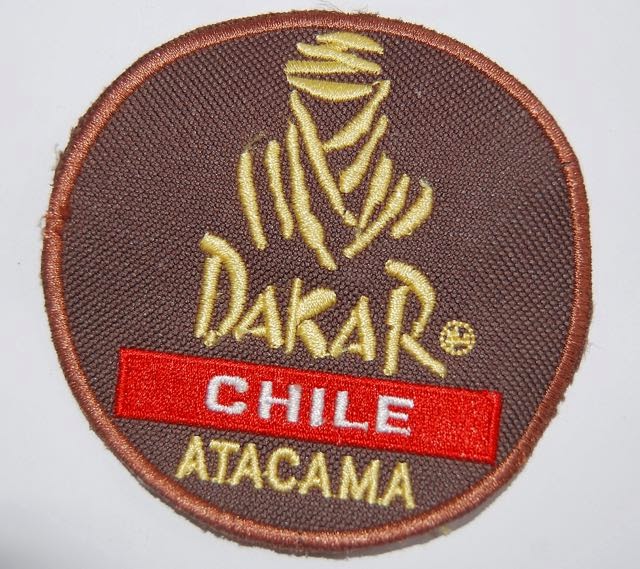
Dakar 2016? With Luck, DOA

In the early 1980s, when I was researching my M.A. thesis on llama and alpaca herding in the Chilean Andes, Horacio Larraín was my local mentor. Then a professor of geography at Santiago’s Universidad Católica, he helped get approval for the project (funded by the Inter-American Foundation). We still see each other occasionally, though he has since retired to the northern city of Iquique and the interior desert village of Matilla.
A longtime aficionado of the Atacama Desert, Horacio is (like me) concerned with the human and environmental destruction wrought by the annual Dakar Rally, which relocated from Africa to South America in 2009. Since then, Dakar has killed both participants and spectators, and damaged or threatened countless archaeological sites and ecosystems in Argentina, Bolivia, Chile and Peru. Last year, a Spanish competitor smuggled 1.4 tons of cocaine back toEurope; this year, there’s been only one death, but two participants – a Dutchman and an Italian – were arrested into Antofagasta for off-route wanderings that damaged an archaeological site.
I’ve only ever seen Dakar at its starting point in BuenosAires (as pictured above in 2010), but I know the Atacama and deplore what this senseless event has done to it. I rarely if ever do guest posts but, in this case, I have translated Horacio’s open letter as published on the website Piensa Chile (Think Chile), where you can see the Spanish-language original.

I have edited Horacio’s essay for brevity and taken some liberties for clarity in English (I am not a professional translator, though I’m confident I have conveyed the meaning), and all the hyperlinks are mine. The photographs below display some of the landscapes and features that Dakar puts at risk.

Open Letter: A Critical Opinion on Dakar and the Preservation of Cultural Resources
In recent years, we have fought a difficult battle against this Rally which is presumably a sporting competition, but which really destroys landscapes and cultural heritage. To summarize, this Rally is a competition and pleasure for the rich (the entry fee is US$240,000) to try out the latest model vehicles before they hit the international market.
This pseudo-sport competition contains the following essential faults that make it totally incompatible with serious and responsible protection of the natural and cultural patrimony of our Tarapacá region:

1) There’s a maliciously false idea that “there’s nothing in the desert” and that, for that reason, you can go anywhere and drive through any part of it. Archaeologists, paleontologists, geologists, paleoecologists and paleobotanists know perfectly well that the subsoil is genuine mine of findings of the past, but all of them hidden from view today. For that reason, a superficial glimpse (which they seem to request) can detect little or nothing.
2) Many times, specimens of extinct fauna from the Tertiary and Quaternary, with extraordinary scientific value (species new to science) have been found on the desert flats.
3) The Pampa del Tamarugal is marked by numerous ancient trails, full of history, as manifested by the cultural artifacts tossed or left along them. Thus we can learn about the nitrate industry and the borax industry, of their abandoned settlements and their ancient ways and circuits of exchange. The ancient routes constitute living history for anyone who knows how to read them. For us archaeologists, they are bearers of culture, genuine archaeological sites.

4) One of the oldest and most venerable routes, the Quahpaqñanor “Inka Trail,” crosses the Pampa, from Quillagua to the north along the Salarde Llamara. Some months ago, we verified that the Dakar heavy support vehicles of 2012 and 2013 followed this same Inka route for more than 30 km, a criminal act that we reported, as the Camino del Inka Study Group (Universidad Nacional Arturo Prat) to the National Monuments Council in 2014. We received no reply.
This inaction and apathy by regional and national authorities worries us. It especially alarms and disturbs us that, to hear their declarations, our repeated scientific proof seems to carry no weight with them, and they are demonstrating an unfortunate absence of cultural consciousness.
Even a schoolchild is capable of understanding our fears and shock, on seeing how they expose the vulnerable desert landscape and destroy its surface, on which there was life thousands or millions of years ago that’s hidden to our eyes today. We could cite numerous cases of noteworthy findings in the open flats, where there’s nothing visible today except for some stones.
The Pampa is not a desert lacking life and bygone human activity: it is an open book for anyone who wants and has learned to read it. And that, necessarily, is the job of the scientist who talks about the danger that these off-road competitions involve, that they respect nothing, they trample and destroy, competitors and spectators alike, leaving thousands of new marks, marks that unfortunately will last for centuries.
For us, Dakar is a true hurricane, highly destructive, whose only objective is to satisfy the insatiable appetite of the powerful automotive industry and appease that hunger for bread and circuses to a bored and deprived humanity that lacks any greater cultural stimulus.

My Own Perspective
The Atacama desert, and corresponding parts of neighboring countries, should not be ecological sacrifice areas to fossil-fuel “sports.” With luck, Dakar 2015 will the last of its kind, or one of the last, but that will require the governments in question to remove subsidies and forego the international publicity they think benefits them - not to mention the damage Dakar does to their countries.

For earlier commentaries of mine on Dakar, please go to this link. 
Custom Search