Showing posts with label Money. Show all posts

Thursday, December 22, 2022

Where's the Money? The Latest in Chile and Argentina

Since arriving in Chile, I’ve had four occasions to change money—thrice at ATMs and once over the counter at a casa de cambio (exchange house). Normally in Chile I use an ATM but, in the latter case, I had to pay my mechanic for auto repair that exceeded the Ch$200,000 (about US$225) withdrawal limit for a single transaction.

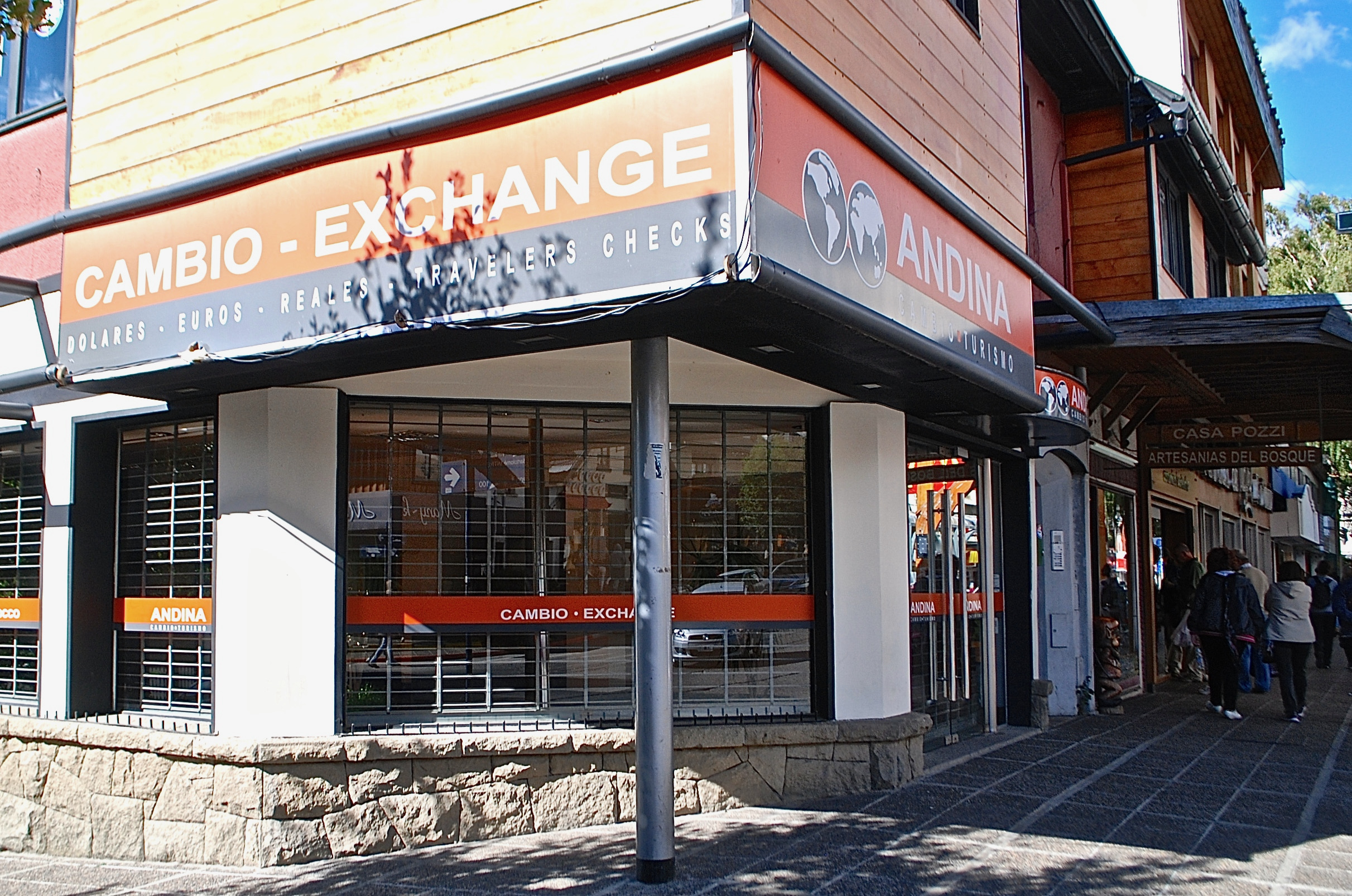
A casa de cambio in Pucón, Chile

A BancoEstado ATM (also in Pucón)

Using the ATM here still makes sense, but there are drawbacks as well. In the past, the public BancoEstado made no charge for any withdrawal, but now it collects Ch$5500 (about US$6) per transaction, amounting to a 2.75 percent fee. Later, out of curiosity (and necessity), I made a similar withdrawal from the private Banco Itaú and incurred a charge of CH$6000 (almost US$7, or 3 percent). I rather assumed that would be the private bank standard but I was mistaken—at a Banco de Chile machine, I paid Ch$8500 (nearly US$10, 4.25 percent).


Thus, BancoEstado remains my default option but, in most places, private bank machines are far more abundant. The exception is very small towns, where BancoEstado is often the only option, and that’s fine with me.


Meanwhile, there’s been another development in Chilean travel, and that has to do with credit card surcharges. Since I arrived in the country, I have experienced multiple purchases with a small additional charge for paying with a foreign credit card. Yesterday morning, for instance, my Ch$9000 breakfast (about US$10) came with a surcharge of Ch$328 (3.6 percent). There seems to be no consistency on this, however, and at least half my purchases have had no additional charge whatsoever. Still, visitors should be prepared for this.


Meanwhile, in Argentina…

The Dólar Blue is nearly double the official rate.

For several years now, one of the hassles of traveling in Argentina has been the multiplicity of exchange rates, and the necessity to carry large amounts of US cash to exchange at the “blue dollar” rate (that’s a euphemism for black market, which is widely accepted). Even with the more favorable blue rate, visitors have to carry large numbers of Argentine banknotes, because the highest value is just 1000 pesos (about US$3 at the blue rate).


Now, however, there’s been a step in the right direction, as the government recently instituted the “Dólar MEP,” which stands for Mercado Electrónico de Pagos (Electronic Payment Market). What this means is that visitors, when paying for good or services with a foreign credit card, will benefit from the blue rate rather than the official exchange rate but, according to a Bariloche friend who operates an adventure tourism agency, the situation isn’t perfect.

A cueva near our apartment in Palermo, Buenos Aires

That’s because many Argentine businesses still prefer to deal in cash, and that means visiting so-called cuevas, informal exchange houses that operate with official tolerance (though not approval). It’s also because, as yet, it’s not clear whether or not the the Dólar MEP applies to ATM transactions—will visitors still get the official and disadvangeous exchange rate when withdrawing cash from local banks? Stay tuned.

This Western Union office also serves as a cueva, and you go to the front of the line.


Saturday, December 10, 2022

Returning to Santiago (and all that entails)

At very long last, this past Monday, I arrived back in Chile for the first time since March of 2020, when I abruptly flew home to California as the seriousness of the COVID-19 pandemic became obvious. I was originally to arrive on the previous Saturday but, late that week, LATAM suddenly canceled my nonstop Friday flight from Los Angeles International Airport (LAX) to Aeropuerto Arturo Merino Benítez (SCL).

Thanks to my heroic travel agent—there are still such things!—I was able get rescheduled for Sunday even though not without trepidation that the new flight might also be canceled. Analía Rupar-Przebieda (an Argentine resident of Southern California) first tried to reschedule me on Delta (a LATAM partner) via Atlanta, but Delta refused (even though the SFO-LAX leg of my flight was with them). That would have gotten me to SCL on Saturday as planned, but the rescheduled LATAM left on Sunday and didn’t get me here until early Monday morning.

The lines at immigration were long, but moved surprisingly quickly.


The flight was reasonably comfortable if crowded, and I was one of few coach passengers wearing a mask (those in first and business seemed to take it more seriously). On deplaning and arriving at immigration, though, we were faced with the longest lines I’ve ever seen at any airport. We also saw a warning for monkeypox—Chile continues to take contagion seriously—but the lines moved surprisingly quickly. So did the customs and agricultural checkpoint, so I was finally officially in the country.

Is monkeypox the next big thing?


Now to get to the city, and I purchased a seat on a shared TransVIP shuttle and was surprised to find a 5.5 percent surcharge on my foreign credit card. This has also been the case on some restaurant meals, but not on a purchase I made at a downtown department store. I had arrived with a small amount of Chilean cash but, at the new international terminal, the exchange houses were offering very poor rates and there was no functional ATM anywhere to be seen.


I rested most of Monday, other than a fine Peruvian dinner at with my host Marializ Maldonado at Del Carajo, across from the Hipódromo (racetrack) in the untouristed neighborhood of Independencia. The next day, I found a BancoEstado ATM and learned that their once-free ATMs now charge Ch$5500 (roughly US$6.50) for any withdrawal from a foreign account. Yesterday I made the maximum withdrawal of Ch$200,000 (about US$230) with the private Banco Itaú at a cost of Ch$6,000 (US$7). I haven’t yet tried to change US cash in the city, because I’m saving most of that for unpredictable Argentina.

With luck, my so far trusty Suzuki will be back on the road soon.


In preparation for upcoming Patagonian road trip, I’m now awaiting replacement of the catalytic converter on my 2005 Suzuki Grand Nomade, which failed its most recent revision. The most worrisome part of this, at present, is the availability of a replacement part, though my trusted mechanic Mauricio Donoso sounds reasonably optimistic.


Another issue I’ve had to deal with is cell phone service. My US carrier provides phone and data coverage here, but with limits—not exactly clear—on how much, and I’ll be in Chile and Argentina for three months. Because my new iPhone 12 uses an E-SIM rather than a physical chip, I cannot use a pay-as-you-go option here and, without legal residence in the country, nor can I open an account with a monthly plan. Yesterday, though, my host Marializ added me to her plan (and I’ll reimburse her), but that’s not an option for the overwhelming majority of visitors. Some will be limited to WiFi.

Monday, April 11, 2022

Blue Dollars, or Dollar Blues? Managing Money in Argentina

What is a cueva? In Spanish it’s literally a cave and some of them, like the Cueva de las Manos in southern Argentine Patagonia, are major archaeological sites and tourist attractions. But there are caves of a different sort in Buenos Aires and other Argentine cities, and any savvy traveler will get to know them because they are places to change money at an advantageous rate—unlike the traditional casa de cambio (exchange house).

A traditional exchange house in the Patagonian city of San Carlos de Bariloche

When I last visited the coastal Patagonia city of Puerto Madryn, this auto glass dealer gave the best rates for US dollars.

That’s because banks and exchange houses can only change at the official legal rate, which is barely more than half the informal but nevertheless tolerated “blue dollar” rate. In present-day Argentina, using your credit card or withdrawing cash from an ATM means, in effect, doubling the price of everything you may purchase. For the latest rates, there’s a smartphone app called “Dólar Blue Hoy,” which is available on both the App Store and Google Play.

Today's rates on the Dólar Blue app


Walking down Calle Florida, the downtown pedestrian street that’s traditionally the city’s retail hub, you’ll hear a constant chorus of “cambio, cambio” from arbolitos (street changers, known as “little trees” because they’re planted on the sidewalk). In the 1980s, when hyper-inflation was rife here, we used to change travelers’ checks (remember those?) at desks in otherwise vacant office buildings and, though we never got cheated, we never felt really comfortable with it. Today we trust our neighborhood cuevas in Palermo, but might make inquiries before visiting one in another part of the city.

Bring big Bens to the cueva.

At present, Argentina's largest banknote is 1000 pesos (about US$5).


While you may arrive here with a money belt packed with Ben Franklins, you’ll need wallet space for many more bills in a country whose largest denomination is presently 1000 pesos (roughly US$5). Be aware that, at most cuevas, hundreds are the notes of choice (though fifties are usually acceptable), and they’ll have to be in mint condition. Twenties are often unwelcome, but today the Western Union branch down the block from us changed $100 worth at just a slightly lower rate.

The closest cueva to our apartment is this Western Union office (your mileage may vary).


Your blue dollars can't buy one of our sofas.

In a few places, your blue dollar is not welcome, as this sign outside a furniture outlet in the Retiro neighborhood suggests (of course, one could change money elsewhere before making a purchase). Recently, when we visited the exceptional Museo de La Plata in Buenos Aires Province, we found it did not accept cash and we had to pay the admission fee by credit card at the official rate (given that the fee was just AR$300 per person, this was hardly a budget breaker).

Your cash is no good at the Museo de La Plata.

That’s the current scenario, but how long will it last? By November, when the next tourist season rolls around, and given the uncertainties of war in Europe and the lingering pandemic, it’s hard to speculate. One recent report suggests that the breech between the official and informal exchange may diminish over the next year-plus, but there has also speculation about dollarization of the Argentine economy. That’s something that failed in the 1990s under former President Carlos Menem and it’s certainly not gonna happen under current Peronist President Alberto Fernández. Elections are due to take place in October of 2023, though.


Post-Mortem Update

Since I first published this entry, I have learned that Buenos Aire's iconic Cementerio de la Recoleta has just instituted an admission charge of AR$1400 for foreign visitors, though it remains free of charge for Argentines. Like the Museo de La Plata (cited above), they do not accept cash, so it will now cost roughly US$12.50 at the official exchange rate. Visitors can pay online in advance or via QR code or credit card at the main gate.


Wednesday, March 9, 2022

Is Purgatory Real? SFO to DFW to EZE on American Airlines

I’m not Catholic—in fact, I’m an atheist—but after completing my first flight in two years, I think I finally understand the concept of Purgatory. Early Sunday morning I started the initial leg of an odyssey that took me from San Francisco to Dallas Fort Worth to Buenos Aires and, except at the very beginning and the very end, it was a disagreeable experience that I felt might never end.

First the good—after my wife dropped me off at SFO, the counter attendant who did my check-in was a simpático Uruguayan who did his best to promote his homeland, though it’s unlikely I’ll cross the Río de la Plata to Montevideo or any other port in the Banda Oriental on this trip. After checking my vaccination card and PCR test (no more than 72 hours prior to departure for Argentina), he also snagged me aisle seats for both legs of the journey (In theory I still prefer window seats to enjoy the landscape from 35,000 feet, but my prolonged recovery from last year’s ankle surgery has made ease of access more important than it used to be).


Things quickly deteriorated from there and that, of course, meant security theater from the so-called “Department of Homeland Security.” On my body scan, they saw things they didn’t like—one of which was a money belt that included the US cash I was carrying to Argentina because the official exchange rate is so disadvantageous. That was fairly easy to explain, but they also detected a “suspicious” elastic knee support I was wearing because of recent soreness and, even worse, a support sock apparently set off their metal detectors (I’ve been wearing one ever since my surgery, and it contains trace amounts of copper). In both cases I rolled up my trousers to invite a direct inspection, but the individual who detained me felt obliged to call in a superior who eventually authorized me to continue.

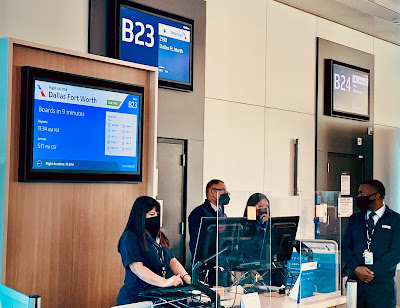
SFO to DFW left on time from Gate B23.

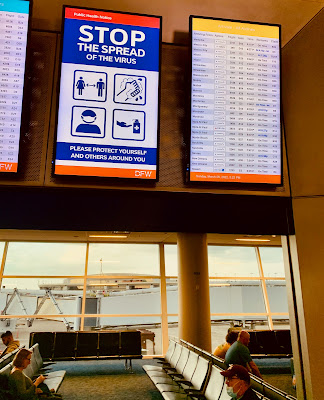
At DFW, prominent signs didn't necessarily mean compliance.

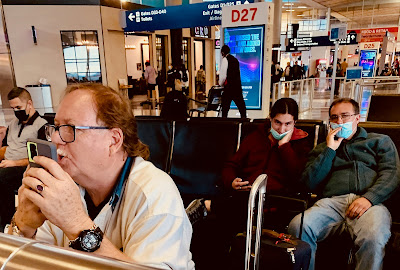
Gathering my belongings and putting my shoes back on, I proceeded to the gate and, surprise of surprises, the flight to DFW (Dallas Fort Worth) left on time and even arrived a few minutes early, with no anti-masker incidents on board. Immediately I noticed, though, that in COVID-friendly Texas many people were disregarding CDC masking regulations despite numerous posted signs. At SFO, mask compliance appeared to be 100 percent, while at DFW I would estimate that some 30 percent were ignoring the regulations in one way or another. The worst case that I observed was a 60-something porteño loudmouth on his phone at a charging station; when I gently suggested he should use his mask, he went ballistic.

The loudest scofflaw was an Argentine shouting into his cell phone.

DFW recently made No. 8 on a list of the country’s ten-worst airports. That’s partly because of frequent delays and, indeed, our departure for Buenos Aires was more than two hours after the scheduled time. It got worse, though, as the gritón mentioned above was just one seat away and, for most of the flight, couldn’t be bothered to wear his mask. He was not the only one, though, and even some of the flight attendants couldn’t be bothered on a plane that was nearly full. There was also one of the worst shrieking toddlers ever to keep me from even attempting to sleep.

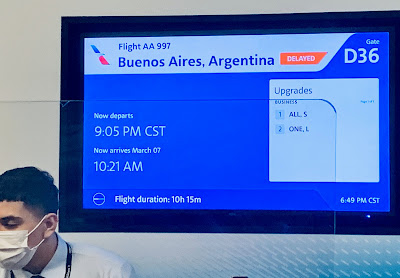
AA 997 left more than two hours late from Gate D36.

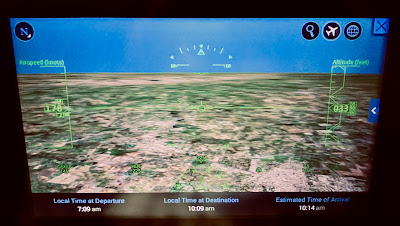
I passed on both dinner and breakfast—life’s too short to dine on airplane food, and I eaten had a decent prosciutto sandwich while waiting for takeoff. I did sample a glass of a Pinot Grigio on board (American has been one of the last airlines to resume alcoholic beverage service), but it was almost undrinkable. My only regret is that I hadn’t realized that my video screen included a window-seat view camera which, though not so good as an actual window seat, at least provides a rough view of the landscapes below.

Unfortunately, I only discovered the window-seat camera view shortly before we landed in Buenos Aires.

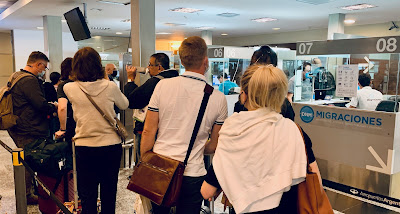
Immigration was fairly quick and efficient at Ezeiza.

Once we deplaned on Monday morning, things got better. Immigration lines weren’t long, and the official who processed me asked only to see my declaración jurada (affidavit) for evidence of vaccination and other info (it’s obligatory to fill out the declaration 48 hours prior to departure for Argentina). I quickly showed him the PDF on my phone, and then he put the first stamp in my brand-new passport. I then went to the office of Transfer Express for a cab, for which I had to pay the official exchange rate via credit card because I fell just short of enough Argentine pesos acquired at the so-called “blue rate” on my last visit.

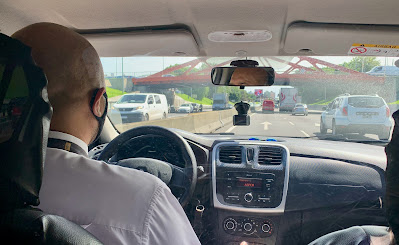
A glass partition separated me from my Venezuelan driver, but didn't inhibit conversation.

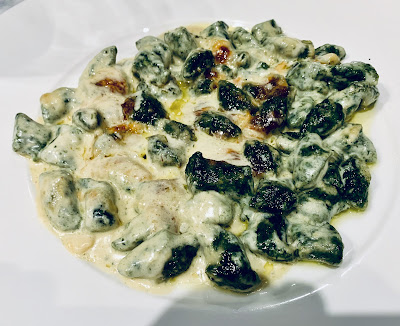
Traffic into town wasn’t bad, and my cabbie was an agreeable Venezuelan with whom I could talk baseball—a pleasant coda to perhaps the worst flight I’ve ever endured—despite the glass partition that now minimizes driver-passenger contact in the pandemic world. At home in our Palermo apartment, after a refreshing nap to make up for lost sleep, I enjoyed a plate of spinach gnocchi at Bella Italia Café, just down the block, before retiring for the night.

I ended the day with a plate of spinach gnocchi at Bella Italia.

Support Southern Cone Travel

If you've found this essay amusing, interesting or otherwise useful, feel free to click on an ad to earn me a few pennies. Thanks for your attention.


Monday, November 18, 2019

Monday Musings - Mar del Plata, Money and Baseball

Today’s entry will be a potpourri about Argentina and sports. It ranges from the serious (the effect of Argentina’s Dirty War on my wife’s family) to the utilitarian (money and exchange rates) to the whimsical (my own tenuous link between baseball and Patagonia).

Southward Bound
Maru Sanllorenti's hometown of Tandil
As I prepare to head to Buenos Aires, early next month, my wife María Laura Massolo and our daughter Clío are already there (but will return to California before I leave). Their trip is partly vacation but also a family mission, as the remains of my brother-in-law’s first wife—a victim of Argentina’s 1976-83 military dictatorship—have been transferred from her hometown of Tandil to a new Panteón de la Memoria (Pantheon of Memory) in the Cementerio de La Loma in the coastal resort city of Mar del Plata.
My brother-in-law's first wife disappeared shortly after giving birth in 1976.
Maru's mother Eva and son Manuel at Mar del Plata's Panteón de la Memoria (photo by María Laura Massolo)
Abducted on the street in the Buenos Aires Province capital of La Plata in 1976, Maru Sanllorenti is survived by family members that include her mother Eva (now aged 94) and her son (my nephew) Manuel (now 43), who was an infant when she disappeared. My wife accompanied her brother Carlos (Manuel’s father) to Mardel for the ceremony there, then returned almost immediately to Buenos Aires, where Clío arrived on Friday. Yesterday, both of them attended a talk that Manuel regularly gives to visiting tour groups at the city’s Parque de la Memoria, which includes a commemorative plaque with his mother’s name.
Manuel Massolo (right) recounts his mother's story to visiting US tourists at the Parque de la  Memoria.
Money Matters
I haven’t been to Argentina since last year and, consequently, my recent information on exchange rates, prices, and transactions has been mostly second-hand. Since last month’s elections, though, exchange rates have remained relatively stable, and my wife informs me that a fine Peruvian dinner for three at downtown’s Chan Chan cost about US$10 per person, including three entrees plus a beer per person. It’s not an elite restaurant by Buenos Aires standards, but that’s still excellent value.
Our neighborhood cueva, on Palermo's Cabello street, was closed on the weekend.
Changing money, though, always requires reorientation. Bank lines are long, exchange houses are mostly downtown, and there’s still a difference between formal and blue (informal) rates. The difference isn’t huge, though, and the informal exchange houses known as cuevas are fewer than they once were. My wife has used the one near our apartment in Palermo, which remains open, but Dan Perlman of Casa Saltshaker informs me that street changers have taken over the business near his apartment (including the weekend’s Plaza Francia crafts fair outside the Cementerio de la Recoleta). Street-changing, of course, holds potential risk for the inexperienced—not the least of which is counterfeit currency.

It’s possible to change at ATMs, but that has its own issues—on the weekend, when our neighborhood cueva was closed, my wife paid a bank charge of US$10 to withdraw approximately US$50 from the machine. I’m not sure what the maximum withdrawal is at the moment, but it’s almost certainly low by international standards. In Chile, I regularly withdraw the equivalent of US$300 per transaction, but Argentina has been roughly half that—making the service charge a true burden.

Baseball and Patagonia
I love baseball and, for decades now, I’ve enjoyed saying that I leave for South America after the World Series and return in time for Opening Day. This year, I’m still stateside, through two weeks without baseball, but I’m looking forward to being back in Buenos Aires (where I’ve played the game myself) in another fortnight.

Actually, the month of October was a big disappointment, as my own Los Angeles Dodgers fell to the mild card (sic) Washington Nationals in the National League Division Series, and I didn’t pay a lot of attention the subsequent rounds or the World Series itself. The Dodgers were clearly the NL’s best but, as they say, anything can happen in a short series. Of all major sports, baseball is probably the likeliest for a lesser team to prevail—there’s really no such thing as an upset.
The top three finishers in the National League's Most Valuable Player voting
Last week, though, the post-season individual awards drew my attention because of a friendly rivalry with my Wisconsin-born but Chile-based friend Todd Temkin, who’s a diehard Milwaukee Brewers fan (his Cerveceros lost to Washington in a one-game playoff for the right to meet the Dodgers). Todd (who splits his time between Valparaíso/Viña del Mar and a farm in Futaleufú) and I disagree on who’s the NL’s best player; his choice is Milwaukee outfielder Christian Yelich, while mine is LA’s versatile outfielder/first baseman Cody Bellinger.
Dinner will probably take place at Futaleufú's Martín Pescador.
Hand-written menu at Martín Pescador
On one level, that’s a subjective judgement, as they’re both elite players, but Todd suggested that we place a bet on the Most Valuable Player award, “given to a player in each league who has contributed the most to the success of a player’s team,” according to the Baseball Writers Association of America. Depending on which player scored most highly in that poll, the loser would treat the winner to dinner—probably at Futaleufú’s Martín Pescador, with its frequently changing menu.
On my last visit, I enjoyed gnocchi with morels...
and a cheesecake for dessert.
As it happened, Bellinger edged out Yelich for the award, while Anthony Rendón of the champion Nationals came in a respectable third (the vote takes place at the end of the regular season, so the Nationals' playoff success was not a factor here). I’m looking forward to that meal, probably in March, when I’ll be updating Moon Handbooks Patagonia there. If Todd’s not around at that time, though, it could happen in Valparaíso or nearby Viña.

Friday, November 1, 2019

Patagonia's Adventure Connect(ion) in San Francisco

Last week, I attended a promotional event for Chilean Patagonia in the Adventure Connect series, organized by the Adventure Travel and Trade Association (ATTA). At a time when Chile’s undergoing political upheaval, the occasion brought the Magallanes regional representative of Sernatur, the national tourism secretariat, and representatives of several different operators to San Francisco as part of a national promotional tour.
The setup at San Francisco's Hotel Zetta
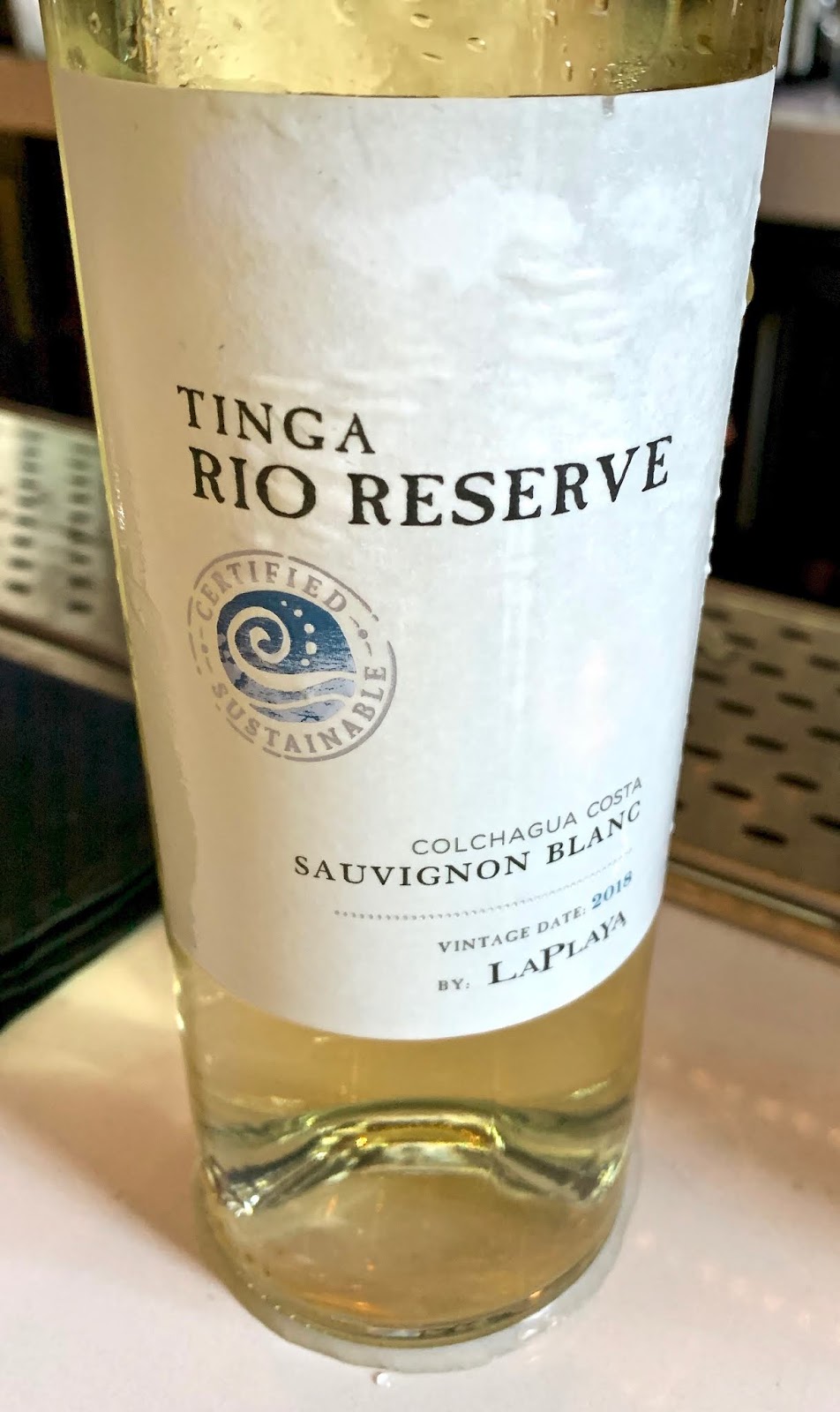
The event took place in the lobby of Hotel Zetta, where eight different operators were to discuss their services with Bay Area travel companies and invited writers (of whom I was one). The format was a sort of musical chairs in which each operator met with one or more attendees for eight minutes before a timer sounded to move elsewhere. This went on for 2-1/2 hours, with a coffee break that included a giveaway raffle, before adjourning to a conference room for a presentation by Sernatur’s regional director Ximena Castro that was probably most useful to those with less experience than mine in the region. Later, there was a Chilean social hour that included snacks and one of the finest Sauvignon Blancs I’ve ever tasted—especially welcome on an unusually hot San Francisco day.

Ximena Castro addresses the attendees.


The Chileans brought this Sauvignon Blanc along with them and, so far, I've been unsuccessful in finding it stateside.
Originally, eight different operators—some of whom I already knew—were to attend the event. In the aftermath of the recent upheavals in Santiago, though, the representatives of Antarctic Airways—with whom I would have liked to discuss their updated services—and Lago Grey - Experience Hotel were unable to get flights out of Santiago. I already knew the owners of Big Foot Patagonia Adventure and the representative of Vértice Patagonia (operator of mountain huts on the famed Paine Circuit, plus a new boutique hotel in Puerto Natales), and was familiar with Antártica 21  and Australis Cape Horn & Patagonia (both of whom sent US-based representatives). New to me were the Chile Nativo adventure operator and HD Hotel Natales (the rebranded Hotel Cisne de Cuello Negro) in Puerto Bories.

The not quite unspoken topic that permeated the meeting was what effect Chile’s recent political disruptions and disorder might have on the upcoming season. There was certainly concern, but also consensus that the Región Metropolitana de Santiago and the coastal region of Valparaíso would be more directly hit than remote Magallanes. That said, cruise ship and hotel cancellations would certainly affect a city like the regional capital of Punta Arenas, which has seen some demonstrations. I recently saw an online story—can’t find the link now—whose headline spoke of “80 percent cancellations” in Chile, but what the story actually said was that 80 percent of hotels and other services had experienced cancellations (which could have been just a single cancellation each for some).

That’s not to dismiss the issue of vandalism and disorder by a destructive fringe, even as the great majority of demonstrations have been peaceful, but President Sebastián Piñera’s embattled government has cancelled the upcoming COP climate conference (at which Swedish activist icon Greta Thunberg was due to appear and also the Asia-Pacific Economic Cooperation summit.

Personally, I would not hesitate to travel to Santiago, Valparaíso or elsewhere in Chile at present, even though I’d advise those with little or no experience of the country to be on alert. In a recent newsletter, the private Federación de Turismo de Chile cited the Subsecretaría de Turismo to the effect that  “our tourism continues to function throughout the country and the most popular destinations visited by international tourists, such as San Pedro de Atacama, Elqui Valley, the islands of Rapa Nui [Easter Island] and Juan Fernández [Robinson Crusoe], the Chilean Patagonia and Torres del Paine National Park, are operating with normality.” Aeropuerto Internacional Arturo Merino Benítez is back to normal, but visitors would still do well to have travel insurance in case of disruption.

And the Money?
For foreign visitors, there may be a bright side to all this. About two months ago, the last time I wrote about exchange rates, both the Argentine and Chilean pesos were slipping against the US dollar, and that has continued with the upheaval in Chile and the recent election in Argentina, when the Peronist Alberto Fernández defeated the incumbent president Mauricio Macri.
The Dólar Blue Hoy app is a useful addition to one's smartphone.
The so-called “markets” (and many individual Argentines) have little confidence in Peronism and, consequently, Argentina’s Banco Central (Central Bank) has reinstituted a cepo cambiario (“currency clamp”) that restricts Argentines’ overseas ATM advances to US$50 per transaction (oddly, it puts no restrictions on the number of transactions per day, but those ATM charges could really add up. Meanwhile, individual Argentines can now officially purchase no more than US$200 per month, a measure that seems to be encouraging the informal dólar blue (visitors to Argentina might consider downloading the Dólar Blue Hoy app, pictured here, on their smartphones). Exactly this will develop as the Macri administration gives way to Fernández remains to be seen, but it seems likely that the informal exchange rate will benefit tourists in the short to medium term.
Chile's peso has also slipped against the US dollar and some other currencies.
In Chile, meanwhile, the peso has dipped to 740 per dollar, a fall of roughly three percent since August. This may affect prices slightly, but if foreign visitors avoid the country because of the perception of instability, services such as hotels and tour operators may drop their prices. In any event, matters are less predictable than they seemed even a few months ago.


Monday, August 26, 2019

Politics and Pesos...

Three Sundays ago, the government of Argentine President Mauricio Macri suffered a serious setback to his re-election campaign, when Peronist opposition candidateAlberto Fernández drew nearly 50 percent of the vote in the country’s presidential primary elections. Discontent with the economic situation, including high inflation and unemployment, propelled a protest vote against the party in power. Fernández is the odds-on favorite in the general election, which will take place October 27th.
Today's official exchange rates against the US dollar.
In the aftermath of the primary, Argentina’s peso plunged from 45 to the dollar to nearly 60 before rebounding slightly into the high 50s. That fueled inflationary fears—though one might argue that’s something Argentines are accustomed to—but the bigger problem appeared to be the Macri administration’s shambolically inconsistent approach toward the issues.
An extensive wine tasting at Aldo's tomorrow will cost about US$10.
In the short term, foreign visitors may benefit—at least until prices catch up with devaluation. For the moment I’ll just note, anecdotally, that a wine tasting tomorrow at Aldo’s—a premium restaurant just a block off Buenos Aires’s central Plaza de Mayo—will cost only about US$10. That includes accompanying snacks, plus discounts on optional wine purchases and dinner itself, if desired (Full disclosure: I have lunched anonymously at Aldo’s and would certainly recommend it).
In 2014, in Puerto Madryn, I changed my dollars at this auto glass repair shop.
Even if there’s a short-term advantage, politics may mean it doesn’t last, especially if the opposition wins in October. Under the previous government of Cristina Fernández de Kirchner, foreign exchange controls and currency manipulation made travel in Argentina awkward, and encouraged a flourishing black market where tourists and Argentines themselves would change their dollars under the table in cuevas, so-called “caves”—in one case, in the Patagonian city of Puerto Madryn, I changed my cash dollars surreptitiously in an auto glass repair shop.

Meanwhile, in Argentina’s Byzantine politics, the presidential candidacy of Alberto Fernández seems an odd one because the vice-presidential running mate is Cristina Fernández de Kirchner (no relation)—a political powerhouse in her own right who’s under multiple corruption indictments from which her current senatorial seat provides her immunity.
In 1973, when Argentines chose Héctor Cámpora as their president, they knew they'd be getting Juan Domingo Perón.
Given that Alberto Fernández served both the late former President Néstor Kirchner and his successor/wife, Cristina could be the power behind the throne, so to speak. This is not unprecedented in Argentine politics—in 1973, when Héctor Cámpora won the presidency with Juan Domingo Perón still in exile, the party’s slogan was “Cámpora al Gobierno, ¡Perón al poder!” (Cámpora to the government, Perón in power!).

Trans-Continental Coda
It’s worth noting that Argentina’s isn’t the only currency Southern Cone currency showing weakness. When I left Chile, in mid-April, their peso was at 660 to the dollar. Today it’s almost 720, nearly a ten percent decline. That may make Argentina’s neighbor somewhat more affordable, but its economy (and politics) are not nearly so volatile.

Custom Search