Showing posts with label Gauchos. Show all posts

Friday, February 5, 2016

The Huaso and the Rodeo

Visitors to Argentina expect to see gauchos, but few are even aware of their Chilean counterpart – less publicly celebrated, the huaso resembles his trans-Andean counterpart in many ways but differs in others. Both, of course, are horsemen, but the gaucho arose from a background of fierce independence on the Pampas, while the subservient huaso originated on the landed estates that dominated economic and social life in colonial and republican Chile.
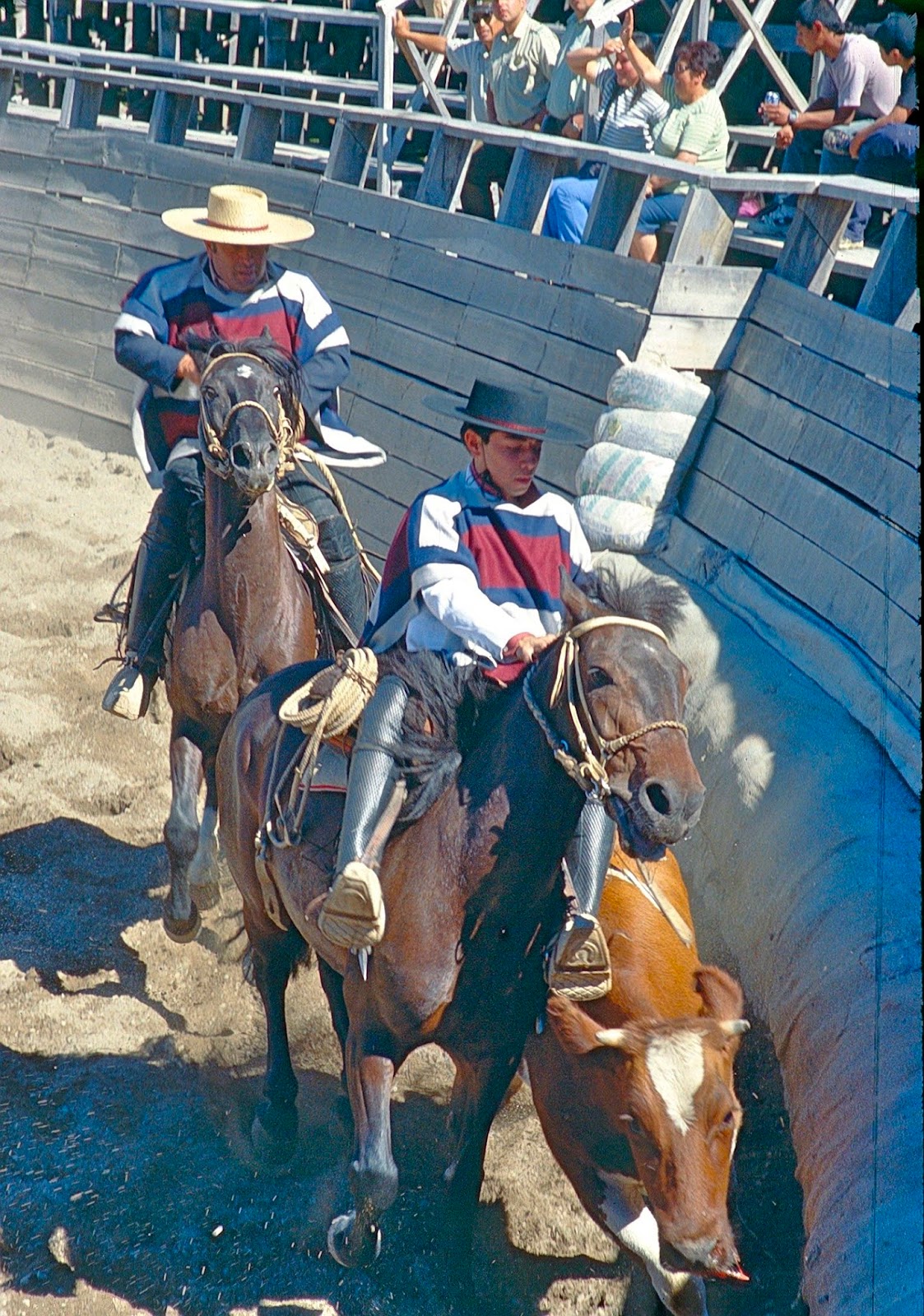
Though the huaso was a hired hand or even a peon attached to the property, on Sundays he and his colleagues could blow off steam by racing their horses, betting, and drinking. As the spontaneous rodeo grew too raucous, though, it drew disapproval from landowners, who responded by organizing competitions that, over time, became more genteel versions of their huaso origins.
Though Chilean rodeo remains popular, it is now, according to historian Richard Slatta, a nostalgic exercise that's "a middle- and upper-class pastime, not a profession," as it has become in North America. Riders wear colorful ponchos, flat-brimmed hats known as chupallas (depicted above), oversized spurs, and elaborately carved wooden stirrups (photograph below).
The signature event is the atajada, in which a pair of jinetes (riders) guide and pin a calf or steer to the padded wall of the medialuna, the semicircular rodeo ring (as depicted at top). Since it's harder to control the steer by the body than the head - the chest is best - the horsemen get more points for this. They lose points if the steer strikes any unpadded part of the wall or escapes between the horses.

There are no cash prizes, though the event ends by acknowledging the champions and other riders with wine and empanadas. Compared to Canada, the United States, and even Mexico, Chilean rodeo is truly machista - women prepare and serve food, dress in costume, and dance the traditional cueca with the men, but they do not ride.


An hour south of Santiago, the city of Rancagua is the capital of Chilean rodeo, drawing thousands of spectators to March's national festival. In the Andean foothills of central Chile and in small settlements along the Carretera Austral, though, rodeo probably comes closest to its historic roots.

Monday, July 28, 2014

Attack of the Anteaters?

I’ve always found it odd that athletic teams at the Irvine campus of the University of California go by the nickname “Anteaters.” It’s even stranger than the fact the teams at the University’s Santa Barbara campus go by the nickname “Gauchos,” even though colonial California’s horsemen went by the Mexican term vaquero (“buckaroo” is a likely corruption of the Spanish original).
Still, maybe the usage of anteaters isn’t so inappropriate for a potentially dangerous competitor - as two Brazilian hunters recently learned but cannot regret at this point. That’s because the hunters became the hunted or, at least, their presumptive prey turned the tables on them. One was a farmer who approached the animal with a knife but didn’t reckon on the beast’s long sharp foreclaws, which caused “deep puncture wounds in his thighs and upper arms.” The man bled to death.

There is no evidence that giant anteaters, which range from Honduras into northernmost Argentina, are aggressive toward humans, but will defend themselves, even against jaguars. They have poor eyesight, though, and may strike out accidentally (or not) against humans. If you’re fortunate enough to see one in the wild, keep your distance.

In captivity, they can also be dangerous - in 2007, a zookeeper in Buenos Aires Province also died from an anteater attack. At Rincón del Socorro, in Argentina’s Esteros del Iberá wetlands where Douglas Tompkins’s conservation initiative is reintroducing this endangered species to the region, there’s a large wired enclosure for an adult male anteater that killed its owner – yes, someone was keeping it as a pet – in the city of Santiago del Estero.

I actually have some first-hand knowledge of this latter case, which concerned a gentle beast (pictured above) that licked my hand through the fence with the long slender tongue it uses to consume the contents of large antmounds. All the same, lacking fear of humans, it’s literally capable of killing someone with affection. For that reason, they can’t risk letting it loose in the wild, but it’s also a good cautionary tale against keeping wild animals as pets.

South America Talk Radio
And now for something completely different: My recent appearance on Montreal's "Armchair Traveler" radio show is now available for streaming at http://tinyurl.com/l6mjxzk (in English, fortunately, not my desperation language of French).

Wednesday, April 9, 2014

Silly Symbolism? Argentina's New Banknote et al.

Not so long ago, I remarked that Argentina needs to create new banknotes because the country’s galloping inflation had made dealing with cash so unwieldy – with the largest denomination at 100 pesos (less than US$10), the volume  of bills is stressing the capacity of our wallets and, as far as I know, even ATM machines (though I have not used an Argentine ATM for quite some time). Bills of 200 or even 500 pesos would be a relief to overstuffed wallets.
Last week, President Cristina Fernández de Kirchner finally announced a new banknote, but it was not what the country needed. Instead of printing larger bills – which would have been a tacit acknowledgment of the inflation problem – her government chose to introduce a new 50-peso banknote with a map of the Falkland Islands. Even worse, she made the announcement on the 32nd anniversary of the Dirty War dictatorship’s foolish invasion of the Islands, despite the fact that her administration (and her late husband Néstor’s) have made a point of condemning the murderous military’s human rights abuses.

The hypocrisy did not pass unnoticed. While Argentines may be virtually unanimous in their opinion that the Islands should be Argentine, some were vocally upset that the government commemorated their claim on a date linked to the dictatorship. Hernán Lombardi, cultural secretary of the city of Buenos Aires, unleashed a series of bitter tweets, including the statement that “Celebrating April 2nd as a holiday follows a logic that could end in a monument to [General Leopoldo]Galtieri. Not in my name!” Independent journalist Uki Goñi, who has written eloquently on human rights issues, tweeted that “It would be beautiful to celebrate the Malvinas on another day not the anniversary of April 2, 1982,” linking to a YouTube video of the masses applauding Galtieri on the Plaza de Mayo (see below).
In fairness, the national government was not the only one to engage in silly symbolism last week. The Buenos Aires city council, in a similar measure, voted to rename the block-long street of Inglaterra (“England,” in the barrio of Agronomía) as “2 de Abril,” after the date of the invasion. Apparently, few in the neighborhood agreed with the change, but those opposed were reluctant to speak out publicly.
Perhaps it’s too much to expect Argentine politicians to abandon grand (or petty) symbolic gestures, Even if they can’t do so entirely, a good model to follow might be the postage stamp (pictured above) issued to commemorate the 1829 establishment of the “Political and Military Command of the Malvinas Islands” by the United Provinces of the River Plate (a precarious precursor of modern Argentina). Commander Louis Vernet, a German Huguenot businessman who had settled in the Islands some years earlier, was primarily interested in commercial sealing.


At the same time, it’s perhaps worth noting that the obverse of the new banknote contains an image of the gaucho Antonio Rivero, who murdered five holdover employees from Vernet’s settlement after the British assumed control in 1832. Some Argentine sources have tried to portray Rivero as a political folk hero against the British, but it’s likelier his grudges stemmed from management maltreatment.

Meanwhile, Argentines will continue to wait for larger banknotes to conduct their daily business, as the new 50-peso bill is barely worth US$5.

Friday, October 18, 2013

Law(lessness?) of the Gaucho


Many years ago, while researching my doctoral dissertation on the Falkland Islands, I did extensive archival work in the Public Records Office at Kew and the Islands themselves, where I had unprecedented access of a sort that would not possible today. Some time after I left, the late Jane Cameron preserved and organized a wealth of documents to make them more usable but, at the same time, less easily available than they were to me.
One intriguing item I came across, in both places, was the tale of a renegade gaucho who remained in the Islands after 1833, when a British warship expelled most of a small Buenos Aires contingent that remained from a precarious colonization effort. As the sketch above (from the Illustrated London News of 1856) indicates, the gauchos helped capture feral cattle that provide subsistence and livelihood to the Islands’ inhabitants.

After the British vessel departed, leaving the settlement under the authority of another holdover, a Scotsman named Matthew Brisbane, who was soon murdered by the gaucho Antonio Rivero and several accomplices. It’s been nearly two centuries since the events in question, but Argentine ultra-nationalists have long invoked Rivero’s name to justify their irredentist claim to the Islands even though the murder probably had no political significance whatsoever. In all likelihood, it was a foreman-peon dispute.
Last year, though, the province of Tierra del Fuego began to enforce the so-called “Gaucho Rivero” law, preventing two British-flagged vessels from docking at Ushuaia. In a separate but not necessarily unrelated incident in Buenos Aires, political bullies even accosted cruise-ship passengers and vandalized company offices that provided support services. The bumper-sticker slogan above protests the "docking of pirate vessels" in Rivero's name.

Ushuaia businesses that depend on cruise ship visits were furious that the two vessels could not dock. In the words of local businessman Marcelo Lietti, even as he affirmed his belief in the Argentine claim to what they call the Malvinas, it was counter-productive to punish the cruise ship sector: “If the measure was intended to harm the English and the Falklands, the damage has been inflicted on all the people that were scheduled to work with the two cruises in Ushuaia.” It cost the city and its residents income, and damaged the city's reputation with the industry.

Nevertheless, the provincial government appears ready to up the ante this season, apparently unconcerned that it could have any negative effect on the tourism sector even as the tiny Chilean settlement of Puerto Williams looks toward drawing some of that traffic away. One friend of mine who operates a B&B in Ushuaia makes the following anonymous observation: “I don´t think any merchant in Ushuaia is happy with that stupid law. The only persons interested in that are politicians making politics and playing with our income.”

Wednesday, August 4, 2010

Backroads of Salta (Part 1)

It’s been a frigid winter in Argentina, from the tip of Tierra del Fuego to the northern border with Bolivia - even at subtropical Iguazú, tonight’s temperature will bottom out around 41° F (5° C). Toward the end of the week, though, there’ll be a warming trend and, for the rest of the winter, the climate should be ideal for one of my favorite road trips: the roughly 500-km (300-mile) triangle from the northwestern colonial city of Salta and back via the polychrome Quebrada de Cafayate and its high desert wine country, the scenic Calchaquíes valley hamlets of Molinos and Cachi, and the vertiginous zigzag descent through the Quebrada de Escoipe.

Because it’s a circuit, this route is ideal for a rental car or, for those with more time and energy, a bicycle. Southbound from Salta, the smoothly paved road climbs slowly but steadily through the lush Lerma valley but becomes far more scenic when it crosses into the valley of the Río de las Conchas, otherwise known as the Quebrada de Cafayate. Here, the Sierra de Carahuasi reveals a series of free-standing landforms, box canyons (pictured above) and dunes reminiscent of southern Utah or northern New Mexico - not to mention “gauchos de Güemes” (pictured below) with the oversized, stiff leather chaps that protect them from the thorny backcountry brush. It’s roughly a three-hour drive to the town of Cafayate but, with stops to explore the scenery and take photographs, figure a late afternoon or early evening arrival.

With a population of about 10,000, Cafayate is the hub of one of the world’s highest wine-growing districts - at 1,660 meters (5,446 feet) above sea level, it enjoys warm days and cool nights that bring its grapes, most notably the fruity white Torrontés, to a perfect maturity. At this time of the year, of course, the vines stand leafless as pruning and other vineyard activities proceed, but by next month they’ll start leafing out - even in some nearby vineyards that are nearly a thousand meters higher.

While the vineyards may be dormant, the wineries are not, and Cafayate has more than half a dozen of them within staggering distance of each other - there is no need or excuse for a DUI here. On top of that, the traffic moves more slowly and cautiously, in town at least, than it does elsewhere in Argentina, so even slightly tipply pedestrians are safer than they might normally expect among some of South America’s worst drivers.

Calafate has seven wineries in town proper, and another three are within cycling distance; in some cases, as with Bodega Nanni and Bodega El Tránsito (pictured above), they’re literally right across the street from each other. My current favorite is the Pequeña Bodega Salvador Figueroa, a Lilliputian locale producing only 2,500 bottles of classic Malbec, 2,500 of oaked Malbec, and 600 bottles of Torrontés per annum. Most of them offer free tours and tasting though, in a few cases, there’s a token charge.

When you tire of tasting, one of Argentina’s most impressive archaeological sites is only half an hour’s drive south: the ruins of Quilmes, in Tucumán province (pictured above), are the closest thing to Machu Picchu to be found in Argentine territory. It’s best to stay in Cafayate, though; a two-night stay should suffice to visit the ruins and most if not all of the wineries. A personal favorite for accommodations is Hotel Killa Cafayate, just a couple blocks off the main plaza, but Villa Vicuña is also very fine and, for luxury, there’s the Sheraton-owned Hotel Patios de Cafayate (pictured below), on the grounds of Bodega El Esteco at the north end of town.

For those who have never dined on llama steak before, downtown’s Macacha (Avenida Güemes Norte 28) is the place to do so. Nearby Heladería Miranda offers wine-flavored ice cream - the fruity white Torrontés tops the red Cabernet (sadly, says the owner, Malbec grapes do not make good ice cream).

Within a few days, look for the rest of this backroads tour, covering the more rugged sector up the Calchaquíes valley to Molinos and Cachi, and then back to Salta.
Custom Search