Showing posts with label Montevideo. Show all posts

Friday, September 11, 2020

The Tango War (a Book Review)

It's been a while since I've posted but, given the pandemic disruption of global travel, especially in my favored region of southernmost South America, I've been distracted with other matters. We're not dead yet, though, and I notice that, in recently commemorating the 75th anniversary of World War II's conclusion, the New York Times Book Review included just one minor item in the Western Hemisphere beyond the Río Grande—a children's book set in Cuba.

In that context I'll note that for every other Western Hemisphere country, the United States is not “America” but, rather, part of the Americas (In the end, we are all Americans). So, here's a book that  addresses the Times's lacuna.

The Tango War covers the conflict from a southerly perspective.

In The Tango War, US journalist Mary Jo McConahay demonstrates that the Allied Forces and Axis powers tangled (pun intended) away from the European and Asian spotlights both before and during the actual conflict. She focuses primarily on the United States and Germany, and their involvement in Mexico, Peru, Brazil and Argentina, though her title misleadingly suggests the centrality of Buenos Aires. There is less coverage of other countries, though Chile and Uruguay also figure into the story.


South of the Border… 

Being closest to the United States, Mexico was a priority because of Germany’s need for petroleum and President Lázaro Cárdenas‘s nationalization of the oil industry. In the runup to the actual war, there was a domestic turf war between FBI Director J. Edgar Hoover and Colonel William “Wild Bill” Donovan, head of what became the Office of Strategic Services (OSS) and, after the war, the Central Intelligence Agency (CIA).


Hoover was a publicity hound who tried to intimidate his opponents, but Donovan preferred to work behind the scenes. While Hoover often sent ill-prepared agents into the field, primarily in Mexico, Donovan employed professionals—one of whom was the late Woodrow Borah, a colonial Mexican history specialist who was also my own outside dissertation adviser at Berkeley. Borah, a fairly conservative man whose job involved working directly under a Soviet informant supervisor, told me that his main Research and Analysis (R&A) task was tracing the movement of German money south of the border.


Beyond the Equator

Farther south, the scenario was more complex. On the Pacific Coast, the issue was Japan and, in a regrettable development, legitimate concern took an illegitimate form—with little or no evidence, Peruvian authorities collaborated to expel nearly 2,000 Japanese-Peruvians to so-called “relocation centers” in North America, where US citizens of Japanese descent were already confined. Some of these Nikkei were, in effect, held hostage for prisoner exchanges during the war, though others remained in the United States after the conflict ended.


Brazil gave off ambiguous signals, as dictator Getúlio Vargas had strong economic ties with Germany and Italy, and large German and Italian immigrant communities abounded with Nazi and Fascist sympathizers. Brazil also had its own homegrown Fascist movement, the Integralists, but Vargas’s response to Franklin Delano Roosevelt’s “Good Neighbor Policy” tipped the balance. In fact, in support of the famous 10th Mountain Division, Brazilian troops played a key role in the Allied campaign that brought down Italy’s Benito Mussolini.

British agents watched the Graf Spee from atop Montevideo's Palacio Salvo.


Outright combat was rare in the Americas, but the Battle of the River Plate was an exception. In 1939, damaged in battle with three British vessels, the German battleship Graf Spee took refuge in neutral Uruguay—as permitted by international law—where British agents observed it from the upper stories of Montevideo’s Palacio Salvo and the Royal Navy bluffed Captain Hans Langdorff into scuttling it. Langsdorff later committed suicide in the Centro Naval in Buenos Aires; in Argentina, Juan Domingo Perón had sympathized with the Germans, who had suggested they would support his country’s longstanding claim to the British-governed Falkland Islands (Islas Malvinas).

The Graf Spee's captain killed himself at Buenos Aires's Centro Naval.

That said, the United States laid the grounds for Argentina’s belated entry into the war, at least partially, through the exercise of “soft power” in the form of–wait for it—Walt Disney! As part of the Good Neighbor Policy, Disney and a crew of assistants known as “El Grupo” produced an animated film that depicted positive stereotypes of Brazil and Argentina, including the legendary “Gaucho Goofy.” Later, Argentine gaucho caricaturist Florencio Molina Campos worked on several Disney projects.

El Gaucho Goofy was part of a longer animated film called Saludos, ¡Amigos!

While Argentina came around opportunistically at war’s end, the country became a prime destination for ex-Nazis who, with Vatican collusion, used so-called “ratlines” to escape Europe and reach South America. Some of the most notorious war criminals, such as Adolf Eichmann and Erich Priebke, became long-term Argentine residents, but others, such as Klaus Barbie,  Joseph Mengele and Walter Rauff, ended up in Bolivia, Paraguay, and Brazil. A low-level Nazi, Paul Schäfer, headed the cultish Colonia Dignidad  in southern mainland Chile and cooperated with the Pinochet dictatorship before escaping to Argentina to avoid prosecution as a pedophile. Eventually extradited, he died in prison in Santiago.


The Cold War and Its Aftermath

All this constitutes a readable account that fills a notable gap in the World War II saga, but in my opinion McConahay (whom I have met) stretches it a bit to attribute Argentina’s “Dirty War” too directly to World War II. She cites Uki Goñi and Patricia Bernardi, both of whom I know, on the parallels between Nazi tactics and those practiced by their own country’s 1976-83 dictatorship (Patricia’s sister Claudia, who also works with the Equipo Argentino de Antropología Forense (Argentine Forensic Anthropology Team) is a frequent houseguest of ours in California).
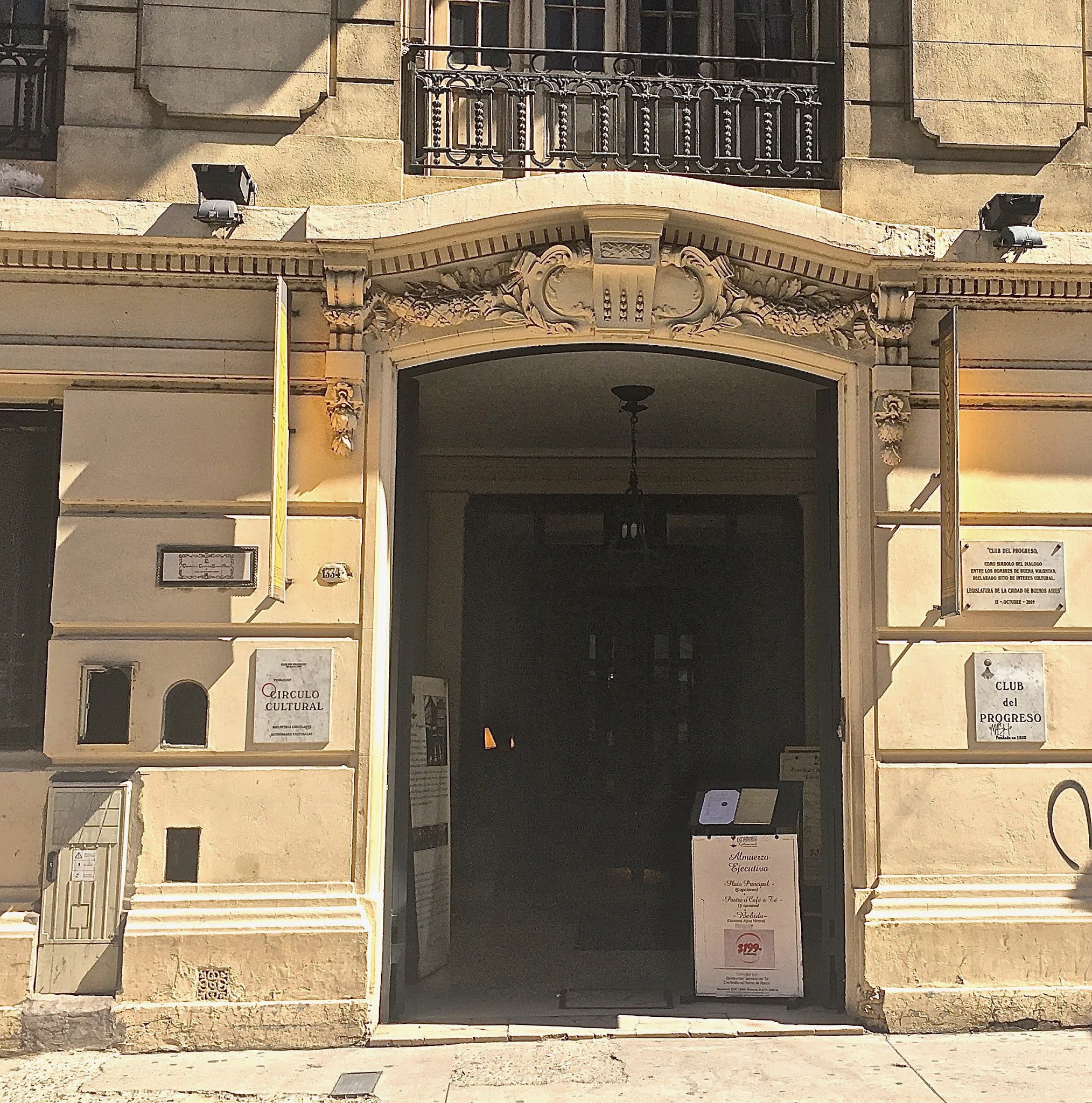
Intending to dine at the Club del Progreso, in 2002, we were startled to see a dining salon outfitted for an apparent Nazi event.

Certainly the Argentine military had extreme right-wing, often anti-Semitic elements. Anecdotally, I can’t forget the time in Buenos Aires that my wife, her brother, and I were startled to see an entire dining salon at the classic Club del Progreso restaurant outfitted for an apparent private event with swastika flags and other questionable artifacts. Preparing to leave in disgust, we nevertheless asked about the décor, and learned that it was a set for a scene in the 2003 film of Imagining Argentina, with Antonio Banderas and Emma Thompson. That relieved our misgivings for the moment, but the fact that even a period film would depict Nazi nostalgia in Argentina has left a lingering impact—especially since the United States government was not guiltless in the so-called Proceso.


Support Southern Cone Travel

If you've found this article useful and informative, please consider earning me a few pennies by clicking on an ad.

Monday, January 21, 2019

Betrayed by Rita Hayworth? Or Hollywood? (A Film Review, of Sorts)

While I’ve always enjoyed movies, it’s not an obsession so that, on occasion, something comes to my attention that I hadn’t noticed (or only barely knew of) before. That was the case on Saturday night, when our local PBS station showed director Charles Vidor’s Gilda, the film that made Rita Hayworth a star.
Filmed in late 1945 and released in 1946, Gilda is a noirish drama that aroused my interest because its ostensible setting is Buenos Aires, where small-time gambler Johnny Farrell (Glenn Ford) becomes the right-hand man of corrupt casino owner Ballin Mundson (George Macready), newly married to the stunning Gilda (Hayworth) who—unbeknownst to Mundson—has an ambivalent history with his new employee.
Palermo's Hipódromo offers casino slots today, but probably not in the 1940s.
I won’t comment further on the plot, because I want to focus on the movie’s presentation of Argentina and its capital. In the first instance, it’s worth noting that, when Mundson first invites Farrell to his casino, he provides him a “key” because casinos were not legal in the city. This rings true because that’s still the case—there are casinos in the provincial suburbs, but not in the capital except for the floating Casino Buenos Aires (two vessels docked at Puerto Madero) and some slot machines in the Hipódromo Argentino de Palermo, where betting on horse races is legal (I doubt that the Hipódromo had slots in 1945). Other than that, there are only a few bingo parlors.
As the Hotel Centenario, the Palacio Vera was an ostensible location in Gilda (photo by Julieta Sol Narganes, Creative Commons)
Most of the film’s action takes place in building interiors—there’s a brief soundtrack moment of tango and a nod to Carnaval—with almost nothing to suggest the streetscapes of Argentina’s capital (so far as I can tell, the entire film was shot in Hollywood in just three months). One ostensible location is the Hotel Centenario, which then occupied the Palacio Vera, an Art Nouveau structure on the central Avenida de Mayo that dates from 1910. Again, though, the movie does not even offer an image of the building's exterior.

Though the Brooklyn-born Hayworth herself was a Hispanic woman (her father was a Spaniard), she does not play one in this movie. At one point she flees to Montevideo, across the river, but again the only scenes of Uruguay’s capital are interiors.
Argentina Brunetti was one of two Argentines with bit parts in Gilda.
The Hungarian-born Vidor introduces the theme of Argentina’s World War II dark side in the person of two German mining cartel members who frequent the casino. The ostensible Argentines are few, including a police detective played by the Maltese actor Joseph Calleia and another policeman played by Manhattan-born Gerald Mohr, and a washroom attendant played by the Ukrainian Steven Geray. Two Argentines play bit parts: the Buenos Aires-born Argentina Brunetti, who appeared in many Hollywood movies in the 1950s and 1960s, and Jack del Río, best known as the fourth husband of pop singer Peggy Lee.
The late Argentine novelist was a movie geek.
That’s not to dismiss Gilda as a film, but I suspect it could have been even better had it been filmed on location (a remake might be interesting). Who knows, could that be one reason that the late Manuel Puig titled his first novel Betrayed by Rita Hayworth?

Gilda is available on several streaming services.

Support Southern Cone Travel!
If you've found this article interesting or useful, please consider earning me a few pennies by clicking on an ad (ideally, one that might be of interest to you).

Sunday, March 5, 2017

Emptying the VAT? Argentina, Chile & Uruguay Offer Tourists Tax Breaks

Recent developments in tourist taxation, in the Southern Cone countries of Chile, Argentina and Uruguay, should interest readers of this blog. In the near future, though, I’ll also be addressing potential visa complications in the face of the United States’ new xenophobic government.

CHILE
For many years, I’ve advised visitors to Chile that, when paying for accommodations in US dollars or by foreign credit card, they are entitled to a 19 percent discount. That’s because foreigners on a tourist visa are exempt from the country’s Impuesto de Valor Agregado (IVA, or Value Added Tax).
Termas de Puyehue, an historic spa hotel eligible for IVA discounts
For those unfamiliar with VAT, it’s a sort of sales tax that levied on products and services within Chile, but not on those intended for export. For some reason, Chile has chosen to define accommodations and some related services as export items, though it’s always mystified me that sleeping in, say, a Puerto Natales hotel might qualify as an export. It’s a legal fiction that also applies, in some cases, to meals and even tours that are part of an all-inclusive package at destinations like Termas de Puyehue Wellness & Spa and the Puyuhuapi Lodge & Spa.
The remote Puyuhuapi Lodge & Spa can also grant IVA discounts.
It’s not quite automatic, though. In the first instance, not all hotels can take advantage of it—they must apply to Chile’s Servicio de Impuesto Internos (SII, Internal Revenue Service) for a franquicia tributaria (export permit) and, in the process, prove that a minimum percentage of their clientele comes from outside the country. In reality, this requirement excludes many modest but perfectly acceptable hostales (B&Bs) and hostels from consideration, even though such facilities could probably use the tax break more than their far wealthier counterparts.
Modest accommodations, like Puerto Natales's Hostal La Cumbre, are often ineligible for IVA discounts.
There’s a recent change in the law that merits noting. Generally, on arrival, foreign visitors receive a 90-day visa, and hotels must make a photocopy of your passport and tourist in order to provide the IVA discount. Though the immigration policy itself has not changed, however, visitors who have been in the country more than 60 days are no longer eligible for the discount.

While the great majority of visitors are unlikely to stay longer than 60 days—even a brief detour in Argentina or another country restarts the clock—it’s worth noting. If it’s more, though, you might as well be a Chilean resident. Note also that the discount depends on an exchange rate that the hotel may have set early in the season, and could be less (or perhaps more) advantageous than the current daily rate.

URUGUAY
To receive an IVA discount at Jacinto, pay with your foreign credit card.
I spend far less time in Uruguay than I do in Argentina and Chile, and only recently became aware of developments in their tourist taxation regime according to Ley 17934. Set at 18 percent, Uruguay’s IVA discount benefits tourists not only in accommodations refunds, but also services such as car rentals and meals. Last year, while dining at Jacinto in Montevideo’s Ciudad Vieja neighborhood, I was surprised to find the discount applied directly to my bill when I paid by credit card. In some cases, though, the discount appeared only when I received my credit card statement at home in California.
My receipt from Jacinto indicates the IVA discount under Ley 17934
For none of the transactions in question did I have to show proof of tourist status—merely paying with a foreign credit card was sufficient. This makes the Uruguayan policy far more convenient than its Chilean counterpart but also potentially vulnerable to abuse—in theory, I suppose, a foreigner could pay for a large dinner by credit card and be reimbursed by Uruguayan friends who would thereby receive the benefit indirectly.

It’s worth adding, though, that the IVA discount for accommodations is only 10.5 percent, and it has seasonal limits—this year, for instance, it is available only until April 21st. Still, the policy benefits everyone, or at least these able to pay with the proper card.

ARGENTINA
Stays at Camping El Bolsón - which has its own brewery - are now eligible for IVA discounts in Argentina.
Both Chile and Uruguay have been doing IVA discounts for some time, but Argentina’s a latecomer to the party. The law’s been on the books since 2001, but only this summer did the government of President Mauricio Macri declare that foreign hotel guests would not have to pay the 21 percent IVA that applies to all other products and services in the country. It’s also applicable to all accommodations, ranging from campgrounds to five-star luxury hotels, though clients will have to show their passports or other identification (visitors from neighboring countries may not need passports). The only acceptable means of payment, though, is a foreign credit or debit card, or a bank transfer. Cash is not acceptable (though Argentine hotels often provide cash discounts).
A stay at Bariloche's classic Hotel Llao Llao also means an IVA discount for foreign visitors.
As always, there’s a strange twist in Argentina’s new measure—it applies only to provinces with international borders. Thus, the interior provinces of Tucumán, Santiago del Estero, Santa Fe, Córdoba, San Luis and La Pampa will not benefit from it. All these provinces probably draw more in-country visitors than foreigners, but Córdoba, San Luis and Tucumán especially could be at a disadvantage to neighbors which do have foreign borders.
Because Córdoba province has no international border, guests at Hotel Sierras in Alta Gracia - Che Guevara's boyhood home - cannot receive IVA discounts.
One final note. The current issue of Condé Nast Traveler misleadingly says that “Argentina did away with its 21 percent hotel tax for foreigners.” This is simply wrong—there never was a hotel tax for foreigners, and Argentine tourists and residents will still be on the hook for that 21 percent IVA (presuming they’re not paying cash under the table).
This kiosk poster in Santiago de Chile promotes Argentina's new tourist tax refund.

Monday, October 21, 2013

Zinfandel v. Tannat? California Winery Arrives in Uruguay


Some weeks ago, I wrote about the Wine of Uruguay Tannat tasting event in San Francisco, at which I met Leslie Fellows, a California resident who owns the Artesana Winery on the outskirts of Montevideo. After the event, and finding some of Artesana’s wines at my favorite supermarket, I approached her about an email interview, in which she graciously provided some insights on Uruguayan wine and her own project there. The answers follow.
WB: What is your background in wine? Did you grow up in California?

LF: I grew up in California and after working in the arts for many years, finally decided to follow my true passion, wine. I took two years of courses at Cabrillo and UC Davis and became a Certified Specialist of Wine and Sommelier Level 1. As a winery owner and member of the Wines of Uruguay Association, I advocate for and promote Uruguayan wines. I currently live in Santa Cruz, California and spend about two months a year in Uruguay.

WB: How did you end up in Uruguay? How do you compare it with Argentina and Chile, which have a much higher profile?

LF: My uncle started traveling in Uruguay for business in 2003 and fell in love with the country. He bought a home in the countryside with the idea of having a small vineyard to support the property. At that time the US dollar was strong so it was a good time to invest. The vineyard started as a few acres in the backyard and became a larger project after meeting two local winemakers who introduced him to Tannat and the distinctive terroir of Uruguay. In 2006, in collaboration with these winemakers, Analia Lazaneo and Valentina Gatti, we began developing Artesana, the first American-owned winery in Uruguay.

Uruguay is an extraordinary country, known for its economic stability and democratic, socially liberal policies, gorgeous countryside and beaches, and now recognized for its many outstanding and diverse wines. Differing from Argentina and Chile, Uruguay is a country of small-scale, family-owned wineries with a European winemaking tradition dating back to the 18th century when the Spanish brought vines to the region. There are 270 wineries in Uruguay producing approximately 10 million cases from 22,000 acres of vines. As a comparison, Chile’s Concha y Toro winery produces more wine than all of Uruguay. Uruguay does not have the production capacity to compete on price point with Argentina and Chile, so we have to do it by focusing on quality. Small producers will become more recognized as bigger producers with international wine consultants like Michel Rolland, Alberto Antonini and Paul Hobbs help put Uruguay on the map.

Additionally, Uruguay has the cleanest water on the continent and one of the purest environments in the world, ranking third after Norway and Finland in the Environmental Sustainability Index (ESI) in 2005.

WB: Tannat is Uruguay’s signature wine, but you have cultivated Zinfandel, which I have never seen in South America. Were there any special challenges in a climate and terroir that’s so different from California? What other varietals do you produce?
LF: Tannat is indeed the signature varietal of Uruguay, originating from the Madiran region of southwestern France. Tannat is a well-structured grape with an exotic spicy character. Named for high tannin content, Tannat [photograph courtesy of Leslie Fellows] has been found to be the healthiest of red wines in several studies due to its high antioxidant and resveratrol levels. My colleague, Dr. Francisco Carrau of Bodegas Carrau, recently sequenced the Tannat genome (only the second grape after Pinot Noir to be sequenced), once again proving this.

Our winery, Artesana, is located 30 miles north of Uruguay’s seaside capital Montevideo, in the acclaimed Canelones region, which is home to the majority of the country’s vineyards. The coastal Atlantic climate produces growing conditions similar to France’s Bordeaux region. Twenty acres of our 80-acre estate are planted to Tannat, Merlot and Zinfandel, the only Zin to be planted and produced in Uruguay. As Californians, we wanted to bring Tannat to California, and Zinfandel to Uruguay. Tannat grows beautifully in Uruguay, but the humidity is difficult on the Zin, so each vintage is unique. In great years like 2011 we made 60 cases of a Zinfandel Reserve (18 months in French oak), that’s received excellent reviews. It has a classic Zin profile, yet is much more earth-driven than most California Zinfandels. In 2012, a more difficult vintage, we made an unoaked Zin that is an easy-drinking fresh and fruity style. Because we produce so little Zinfandel, we sell it only in the domestic market.

WB: Do you plan to add any other varietals, specifically whites? Will you acquire any more acreage?

LF: We specialize in terroir-driven, single vineyard Tannat and Tannat blends. This year we are grafting one 2.5-acre parcel of Merlot to Cabernet Franc, which will give us more blending options. We are focused exclusively on reds, however there are some excellent white wines produced in Uruguay including Sauvignon Blanc, Albariño, Viognier and Petit Manseng.

WB: What size is the operation? Its very name suggests a modest size, but what acreage do you have in Uruguay? Are those vineyards dispersed, or concentrated? Do you depend on your own vineyards exclusively, or do you purchase grapes as well?

LF: We are a small, ultra-premium estate winery, meaning we only use fruit from our 20-acre vineyard for our wines and everything is done is small lots with minimal intervention using only the very best equipment and barrels. The vineyard is entirely hand-farmed to produced low yield highly concentrated fruit. We practice sustainable, IPM (Integrated Pest Management), low-input, dry farming to maintain the long-term health of the land. Lots from the thirteen various Tannat, Merlot and Zinfandel blocks are fermented separately using gentle handling techniques in small stainless steel temperature-controlled tanks, allowing the character of the fruit to be expressed. Twenty-day cool maceration regimes provide excellent aroma and favor extraction. Barrel aging is done in French and American oak for 12 to 24 months to carefully accentuate the flavors of the wines, which are then custom blended and bottled without fining or filtration.

WB: What is your annual production? What percentage of that production is exported? How easy are Artesana wines to find in California and elsewhere in the US?

LF: We have a future capacity of 4,000 cases and are currently producing about 2,000 cases, so we are halfway there. About 30 percent is exported to the US, but we hope to increase this percentage in the next few years. Our Tannat wines are sold in shops and restaurants throughout California by our importer/distributor Epic Wines. The wines can also be found in stores throughout Pennsylvania and we are starting to sell in Washington and Oregon. We hope to have our wines available in small quantity throughout the US and Canada in the future. Please inquire with your local wine merchant about bringing the wine in for you.

WB: In Chile’s Colchagua valley, eight French women have opened Viña Las Niñas in the Apalta district, and I notice your winemakers are women. Is this a feminist project?

LF: The name of the winery, Artesana, inspired by our female winemakers, is a feminized derivation of the Spanish word for artisan or handcrafted, synonymous with fine wine. The two winemakers and I run the company and we are proud to be all women. We work very hard and are passionate about the wines we are producing.

WB: Is Artesana open for tours and tasting? If so, what do they include? How easy is access from Montevideo?

LF: Artesana is open to the public and is a member of Los Caminos del Vino, a wine trail of 15 member wineries. We offer guided tours with our winemakers, tastings and catered lunches. We are 30 minutes’ drive from Montevideo in the beautiful Las Brujas area of Canelones and easily accessible.

WB: Is there anything else that I’ve overlooked that deserves mention?

LF: Try a Tannat or any wine from Uruguay if you see one. These wines are getting on the radar in the US and beyond, and deservedly so. Tannat wines can be big and bold, yet elegant and complex and pair beautifully with strong cheeses, charcuterie, pasta dishes, and roasted and grilled meats including sausage, beef and lamb.

Custom Search