Showing posts with label Falkland Islands. Show all posts

Tuesday, June 28, 2022

Tuesday Topics: Patagonia, Reopening Chile, Vaccines, Masks & Linguistics, and Falklands Flights

When I arrived in Santiago de Chile in late February of 2020, to begin updating Moon Handbooks Patagonia for the upcoming sixth edition, what we now recognize as the COVID pandemic had barely begun and few of us appreciate what was a transformative event it would be. A couple weeks later, after I had crossed into northern Argentine Patagonia, its significance had become apparent and I managed to return to Chile before the border shut down and then, after various delays, to home in California.

When I landed in Santiago during the pandemic's earliest days, there were only the most basic temperature checks for airport arrivals.

After that lengthy delay, I’m once again planning—tentatively—to return to Chile in November. While I did travel to Buenos Aires and surroundings in March and April, I didn’t even consider a detour into Chile because its government had been slow to acknowledge foreign-administered vaccinations—an approval that’s necessary to obtain a pase de movilidad (mobility pass) permitting access to museums, restaurants, and other sites of interest to non-resident visitors.

Chile's acceptable vaccines list, according to Minsal (Health Ministry)

At that time, it was taking weeks to obtain the obligatory homologación, requiring an extended quarantine that made tourist travel inconvenient at best. Under pressure from the tourism sector, though, it has now instituted a process that should take no more than 48 hours through the Health Ministry’s vaccination website. Unfortunately, this does not (yet?) appear in English or any other foreign language but, since the policy in question is barely a week old, perhaps that’s just a short-term glitch? For those of us competent in Spanish that’s not an issue, but for the upcoming season it would seem essential.


What Is a Mask? A Linguistic Digression

A Chilean mascarilla

Ever since the pandemic started, we’ve been wearing masks and, when out in public, I still wear one (Alameda County, where I live, has only just rescinded its indoor mask mandate). I was in Chile when the pandemic started but before the mandate but, after I returned home quickly, the mascarilla soon became universal there and is still obligatory indoors and in outdoor spaces where it’s not possible to maintain one meter of distance between individuals. Mascarilla, by the way, is a diminutive of máscara, but I think the latter implies something that covers the entire face. In English, of course, we have just one term that covers both, though there qualifiers—“surgical mask,” for instance.

Instructions for your barbijo.

In Argentina, where I recently spent a month-plus, there are no mascarillas—rather, there are barbijos and tapabocas, two words that seem etymologically or otherwise curious. Barbijo derives from barba (beard), which feels odd since both men and women wear them, so perhaps it should be “barbijx” in interest of inclusive language?

This tapabocas covers more than just the mouth.

Alternatively, Argentines use tapabocas, which literally means “mouth covering”—oddly inappropriate, one would think, when masks are supposed to cover both the mouth and nose. Nevertheless, during my time there, Argentines were pretty conscientious about wearing their masks properly—both indoors and outdoors.


SCL to PUQ to MPN

Mount Pleasant International Airport (MPN) in the Falklands

Meanwhile, flights from the South American continent to the Falkland Islands will resume this coming Saturday, July 2nd. Since the Islands—insular Patagonia, if you will—form an important entry in the book, I’m very keen to return. Also, having lived there for more than a year in 1986-7 and revisited half a dozen times, I have many friends and acquaintances whom I am keen to revisit.

The Offices of International Tours and Travel (LAN has since been rebranded as LATAM)

According to an email I received from Sally Ellis, of Stanley’s International Tours and Travel, “The LATAM airlink with Chile will resume on 02 July with its normal route of Santiago - Punta Arenas - Falklands roundtrip, and a roundtrip possible from [the Argentine provincial capital of] Rio Gallegos if you travel to the Falklands on the second Saturday of each month and return on the third Saturday of each month.” It’s worth noting here that anyone flying from Punta Arenas to the Falklands and disembarking in Río Gallegos on return could run afoul of Argentine immigration—since Argentina consider the Falklands to be theirs, they may not give you an entry stamp at the airport and, when you try to leave at another border post, officials there might say you entered the country illegally.


Before the pandemic hit, there was an alternative route via Brazil and the central Argentine city of Córdoba but, according to Sally, “The Brazil route has no resumption date yet but will not be before the summer - maybe November?” I’ve never taken this route, but I wouldn’t rule it out at some point—especially since it would give me a chance to revisit one of Argentina’s most historic provincial capitals and its nearby Sierras.

Thursday, December 30, 2021

Why We're Not Going to Buenos Aires Now, and Other Miscellanea

Recently I dreamt that, having arrived at Buenos Aires’s Aeropuerto Internacional Ministro Pistarini (commonly called “Ezeiza”), I was in a taxi to our apartment in the barrio of Palermo—where my wife and I had been longing to go ever since the pandemic began. En route, though, I realized I’d left the keys at our California home—and then I awoke wondering whether that was a metaphor for the times we’re in. In fact, we’d planned to fly to Argentina this New Year’s Eve, and were eager to see friends and family in and around the Argentine capital, but I’d begun to have my doubts as news of the Omicron variant hit the country especially hard.

We might have hired a taxi here...

Uki Goñi's Twitter account is a good up-to-date source on many Argentine topics.

In fact, I’d contemplated postponing the trip a few days earlier, but María Laura was still committed to going until Monday, when she first expressed doubts and then consulted with siblings, nephews, nieces, and friends (some of whom are directly involved in the healthcare system there). Everyone concurred that the situation was worsening, and expressed doubts about the trip despite their eagerness to see us.

Argentina's vax rollout has actually been pretty good, but I couldn't resist posting this photo from my nephew's Parque Patricios neighborhood.

For our part, we are fully vaccinated and boostered, and live in an area where people take vaccinations and masking seriously, so we were never panic-stricken. That said, we could still theoretically be carriers, and we didn’t want to risk a breakthrough case that could put others at risk. We also worried, however, that flight cancellations and layovers might disrupt the trip—partly because San Francisco International Airport (SFO) is notorious for weather delays and also with respect to our connecting flight in COVID-friendly Texas. That state has great food and music, but deplorable government.


That said, we look forward to trying again in March or so. I might stay a bit longer than the month we originally planned on, as I’m starting to work on the upcoming sixth edition of Moon Patagonia—perhaps an excursion to Ushuaia is in order.


Meanwhile, in Chile…

Chile, of course, will be a key part of the Patagonia update, and its high vaccination rates have made it an example to emulate in handling the pandemic. It’s been circumspect about the entry of non-resident foreigners, though, and that seems likely to complicate the upcoming tourist season, even though more border crossings are opening with Argentina and its other neighbors. Still, there are fairly stringent requirements, including quarantine, and the Chilean bureaucracy has also been slow to acknowledge intending visitors’ vaccination status—according to a friend of mine who’s a permanent resident, a friend of his spent two weeks stranded in Lima because LATAM Airlines would not let him board a connecting flight.

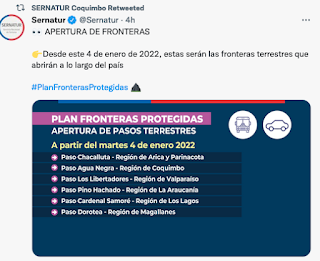
Chile's border are reopening, at least in theory.

For me, as an independent traveler having to cross the border multiple times while updating my book, frequent retesting and quarantines would mean significant delays and expense. As the attached screenshot shows, that situation may be improving), but requirements are likely to change even more so that southern spring—October or November—seems more agreeable.


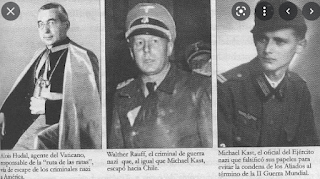
Of course, Chile’s made international headlines for its recent presidential election in which the left-leaning (but hardly extreme) Gabriel Boric defeated right-wing extremist José Antonio Kast (a Pinochet worshipper whose German-born father was literally a Nazi). Though Kast finished first in the multi-candidate primary (there were seven options), the 35-year-old Boric won the runoff handily and, to Kast’s credit, he quickly conceded and congratulated the winner. It’s worth noting that Boric’s final margin was almost identical to that of the 1988 plebiscite that ended Pinochet’s “presidency,” and that Communist candidate Eduardo Artés received only 1.46 percent of the primary vote.

The losing candidate's late father, at right, was literally a Nazi.

Even so, Kast partisans’ accusations of extremism have continued, the “markets” were not pleased with the result, and the peso has slipped against the US dollar (any visitor so inclined could now eat a Weißwurst more cheaply at the Bavaria restaurant chain that is the basis of the Kast family fortune). Still, as Chile proceeds with a Convención Constitucional to draft a new constitution to replace the Pinochet-friendly document authored by the late rightist lawyer Jaime Guzmán, the challenges to a long overdue reform won’t disappear. The new charter must be approved by plebiscite but until then and even after, governing could be a challenge.


In Other News…

My Patagonia title also includes the Falkland Islands, where I once spent an entire year and have revisited at least half a dozen times. Except for my initial trip, when I flew from and back to the United Kingdom (with a memorable stopover on Ascension Island), I’ve always arrived via the southern Chilean city of Punta Arenas but, since the start of the pandemic, there’ve been no flights on that route, which requires overflying Argentine airspace.

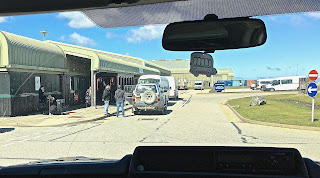
The passenger terminal at the Falklands' Mount Pleasant Airport

Next year, hopefully, these flights will resume, but the Argentine government (which claims the Islands as the “Malvinas”) has recently stonewalled humanitarian charter flights that would have allowed the Islands’ Chilean residents (there are roughly 200 of them) to return home for the holidays. That’s not an auspicious development.

Alex Olmedo's Waterfront Café is a Chilean-owned business in Stanley.

For an incisive account of the Islands and their current prosperity, read Larissa MacFarquhar’s outstanding piece in The New Yorker, researched immediately before the pandemic.


Friday, September 11, 2020

The Tango War (a Book Review)

It's been a while since I've posted but, given the pandemic disruption of global travel, especially in my favored region of southernmost South America, I've been distracted with other matters. We're not dead yet, though, and I notice that, in recently commemorating the 75th anniversary of World War II's conclusion, the New York Times Book Review included just one minor item in the Western Hemisphere beyond the Río Grande—a children's book set in Cuba.

In that context I'll note that for every other Western Hemisphere country, the United States is not “America” but, rather, part of the Americas (In the end, we are all Americans). So, here's a book that  addresses the Times's lacuna.

The Tango War covers the conflict from a southerly perspective.

In The Tango War, US journalist Mary Jo McConahay demonstrates that the Allied Forces and Axis powers tangled (pun intended) away from the European and Asian spotlights both before and during the actual conflict. She focuses primarily on the United States and Germany, and their involvement in Mexico, Peru, Brazil and Argentina, though her title misleadingly suggests the centrality of Buenos Aires. There is less coverage of other countries, though Chile and Uruguay also figure into the story.


South of the Border… 

Being closest to the United States, Mexico was a priority because of Germany’s need for petroleum and President Lázaro Cárdenas‘s nationalization of the oil industry. In the runup to the actual war, there was a domestic turf war between FBI Director J. Edgar Hoover and Colonel William “Wild Bill” Donovan, head of what became the Office of Strategic Services (OSS) and, after the war, the Central Intelligence Agency (CIA).


Hoover was a publicity hound who tried to intimidate his opponents, but Donovan preferred to work behind the scenes. While Hoover often sent ill-prepared agents into the field, primarily in Mexico, Donovan employed professionals—one of whom was the late Woodrow Borah, a colonial Mexican history specialist who was also my own outside dissertation adviser at Berkeley. Borah, a fairly conservative man whose job involved working directly under a Soviet informant supervisor, told me that his main Research and Analysis (R&A) task was tracing the movement of German money south of the border.


Beyond the Equator

Farther south, the scenario was more complex. On the Pacific Coast, the issue was Japan and, in a regrettable development, legitimate concern took an illegitimate form—with little or no evidence, Peruvian authorities collaborated to expel nearly 2,000 Japanese-Peruvians to so-called “relocation centers” in North America, where US citizens of Japanese descent were already confined. Some of these Nikkei were, in effect, held hostage for prisoner exchanges during the war, though others remained in the United States after the conflict ended.


Brazil gave off ambiguous signals, as dictator Getúlio Vargas had strong economic ties with Germany and Italy, and large German and Italian immigrant communities abounded with Nazi and Fascist sympathizers. Brazil also had its own homegrown Fascist movement, the Integralists, but Vargas’s response to Franklin Delano Roosevelt’s “Good Neighbor Policy” tipped the balance. In fact, in support of the famous 10th Mountain Division, Brazilian troops played a key role in the Allied campaign that brought down Italy’s Benito Mussolini.

British agents watched the Graf Spee from atop Montevideo's Palacio Salvo.


Outright combat was rare in the Americas, but the Battle of the River Plate was an exception. In 1939, damaged in battle with three British vessels, the German battleship Graf Spee took refuge in neutral Uruguay—as permitted by international law—where British agents observed it from the upper stories of Montevideo’s Palacio Salvo and the Royal Navy bluffed Captain Hans Langdorff into scuttling it. Langsdorff later committed suicide in the Centro Naval in Buenos Aires; in Argentina, Juan Domingo Perón had sympathized with the Germans, who had suggested they would support his country’s longstanding claim to the British-governed Falkland Islands (Islas Malvinas).

The Graf Spee's captain killed himself at Buenos Aires's Centro Naval.

That said, the United States laid the grounds for Argentina’s belated entry into the war, at least partially, through the exercise of “soft power” in the form of–wait for it—Walt Disney! As part of the Good Neighbor Policy, Disney and a crew of assistants known as “El Grupo” produced an animated film that depicted positive stereotypes of Brazil and Argentina, including the legendary “Gaucho Goofy.” Later, Argentine gaucho caricaturist Florencio Molina Campos worked on several Disney projects.

El Gaucho Goofy was part of a longer animated film called Saludos, ¡Amigos!

While Argentina came around opportunistically at war’s end, the country became a prime destination for ex-Nazis who, with Vatican collusion, used so-called “ratlines” to escape Europe and reach South America. Some of the most notorious war criminals, such as Adolf Eichmann and Erich Priebke, became long-term Argentine residents, but others, such as Klaus Barbie,  Joseph Mengele and Walter Rauff, ended up in Bolivia, Paraguay, and Brazil. A low-level Nazi, Paul Schäfer, headed the cultish Colonia Dignidad  in southern mainland Chile and cooperated with the Pinochet dictatorship before escaping to Argentina to avoid prosecution as a pedophile. Eventually extradited, he died in prison in Santiago.


The Cold War and Its Aftermath

All this constitutes a readable account that fills a notable gap in the World War II saga, but in my opinion McConahay (whom I have met) stretches it a bit to attribute Argentina’s “Dirty War” too directly to World War II. She cites Uki Goñi and Patricia Bernardi, both of whom I know, on the parallels between Nazi tactics and those practiced by their own country’s 1976-83 dictatorship (Patricia’s sister Claudia, who also works with the Equipo Argentino de Antropología Forense (Argentine Forensic Anthropology Team) is a frequent houseguest of ours in California).

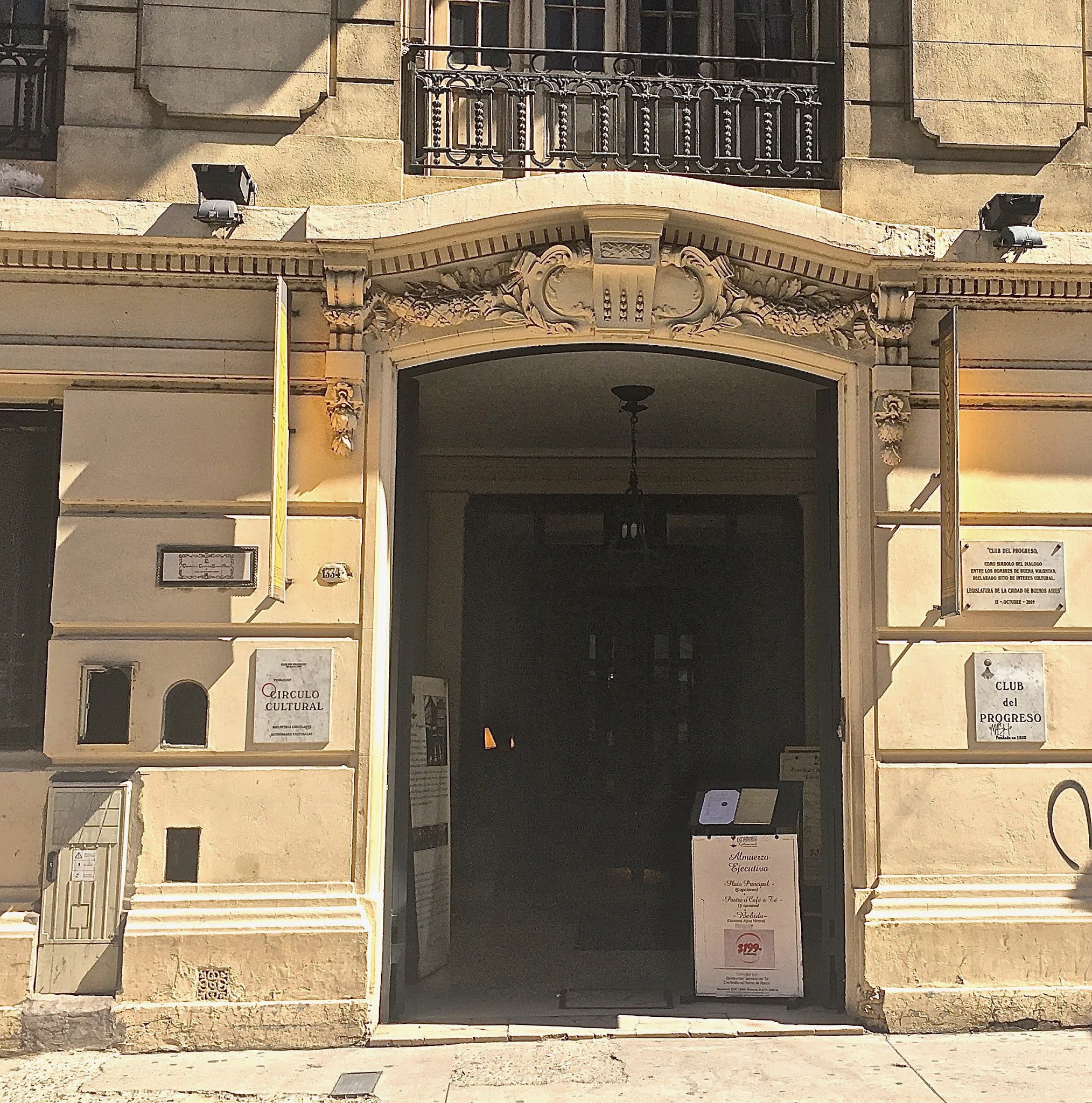
Intending to dine at the Club del Progreso, in 2002, we were startled to see a dining salon outfitted for an apparent Nazi event.

Certainly the Argentine military had extreme right-wing, often anti-Semitic elements. Anecdotally, I can’t forget the time in Buenos Aires that my wife, her brother, and I were startled to see an entire dining salon at the classic Club del Progreso restaurant outfitted for an apparent private event with swastika flags and other questionable artifacts. Preparing to leave in disgust, we nevertheless asked about the décor, and learned that it was a set for a scene in the 2003 film of Imagining Argentina, with Antonio Banderas and Emma Thompson. That relieved our misgivings for the moment, but the fact that even a period film would depict Nazi nostalgia in Argentina has left a lingering impact—especially since the United States government was not guiltless in the so-called Proceso.


Support Southern Cone Travel

If you've found this article useful and informative, please consider earning me a few pennies by clicking on an ad.

Monday, July 29, 2019

In the Falkland Islands, a Week Is Not Enough

As a travel writer myself, I’ve long enjoyed The New York Times 52 Places Traveler, in which a single writer (now one much younger than myself) spends a year exploring the world and producing weekly dispatches from some relatively well-known destinations and other more remote ones. In my own experience, the logistics of organizing several months of travel is taxing enough in my three chosen countries—Argentina, Chile and to a lesser degree Uruguay—that I truly admire the drive and skills of the chosen individual. This year, that individual is Sebastian Modak, whose dispatches appears every Sunday (in print and online).
An aerial view of Stanley Harbour, looking east,
with the city airport at the upper left
For part of 1986-7, we resided in a house belonging to the Sheepowners' Association, at 63 Fitzroy Road.
Yesterday,  Modak’s column dealt with the Falkland Islands, a personal favorite where I spent more than a year as a Fulbright-Hays scholar in 1986-7 and have returned at least half a dozen times. He went, apparently, in early July—“a couple of weeks after the winter solstice”—and says that there were only three other tourists on the Islands (I’m skeptical of that claim). The highlight was penguins, though the only species he mentions are kings and gentoos, which are present year-round (macaronis, rockhoppers and Magellanics are migratory summer residents).

Penguins in Winter 
King penguins are the biggest attraction - except for the nearby elephant seals - at Volunteer Point.
On FIGAS's "Round Robin" flights, visitors can view impressive periglacial "stone runs" from above.
To see the kings, at East Falkland’s Volunteer Point, Modak took advantage of Falklands Helicopter Services, a new enterprise that obviates the need for an all-day Land Rover tour from the capital of Stanley, but that comes at a cost of £349 (about US$430) per person, with a two-person minimum (cheaper overland options are possible, but probably not in July). I can certainly concur, however, with his recommendation of the “Round Robin Flights” by the Falkland Islands Government Air Service (FIGAS) that can give visitors a spectacular aerial overview of the entire archipelago at a fraction of that cost. He also went overland to the settlement of Darwin to see the Bodie Bridge, the world’s southernmost suspension bridge that’s apparently on its last legs (er, towers…) in the peninsula of Lafonia (while I have visited Darwin, I never made it farther south to the bridge).
Darwin from the air
Bodie Suspension Bridge, under construction in 1925 (Creative Commons)
Stranded in Stanley?
Ross Road, Stanley, as it appeared in early 1987.
The Historic Dockyard Museum is part of Stanley's renovated waterfront.
Modak, meanwhile, is almost shockingly silent on the capital of Stanley even though, of necessity, he spends several days there because weather delays his departure from the Islands. That’s not an uncommon occurrence but, for a journalist scheduled to report on 52 destinations in 52 weeks, it’s a major inconvenience. He uses the time to explore Stanley’s pub culture but, somehow, he overlooks a surprisingly creative food scene and the Historic Dockyard Museum—which might the best in the world for a town of its size (about 2,500 residents).
The Tasty Treat snackbar serves items such as St. Helenian plo - chicken and bacon with vegetables and rice in a South African curry,  topped with a fried egg.
Roast reindeer - once culled from South Georgia and now raised on West Falkland - is on the menu at Malvina House Hotel.
While the Falklands is much more than 1982 war between Britain and Argentina, the museum offers a professionally measured description of that conflict, which he says comes up with virtually everybody he meets. That’s not quite my experience, even though my wife is an Argentine who also spent a year there with me (on her US passport). He also, apparently, overlooked the multi-ethnic melting pot that the Islands have become since the war, with Chileans, Saint Helenians or "Saints," and even Argentines (there have always been some and, at one point, there was an Argentine policewoman).
During the 1982 war, Eileen Vidal kept countryside residents current on happenings in Stanley and elsewhere via radio telephone. When we lived there, she always knew where everybody was.
While Modak had some trouble getting out of the Islands he does, in my experience, overstate their inaccessibility and remoteness: “Consumed by a sense of total isolation, I leaned into the rare feeling of being off the map, stuck somewhere and part of a small community of travelers.” In fact, the Islanders themselves have always been in constant contact with the outside world—whether by mailboat, amateur radio, telephone and now Internet—and often express a sophisticated understanding of overseas events. The Internet may be slow and expensive—I can attest to that—but, as he acknowledges, there will now be a second weekly flight from the South American continent (in addition to the well-established connection with Santiago and Punta Arenas, Chile).
In the summer high season, cruise ship visits can nearly double Stanley's population - briefly.
Had he visited in January, when cruise ships can double Stanley’s population for a day, he might have adjusted his conclusion that “There’s no chance of ever being a major destination…” The Islands may be a niche experience, but one that’s likely to grow, especially as the logistics improve for those who prefer to be land-based. That’s my preference, I’ve been back at least half a dozen times, and I’ll do so again soon.

Post-Script
While the Argentine occupation left large numbers of land mines,  demining efforts have been successful and no civilian has ever been injured.
This being The New York Times, it’s worth mentioning the readers’ comments, of which there were just 17—almost all of them superficial and a couple astonishingly ignorant. One Patty Mutkoski of Ithaca lamented that there was no place for “long walks” because of “all the land mines left over from the war.” As someone who undertook multi-day treks on both East and West Falkland only four years after the conflict, and has seen the results of removal efforts since then, I can assert that there are many fine hiking opportunities around Stanley and also on the outer islands, such as Pebble, Saunders and Carcass. The biggest obstacle is not land mines, but rather the almost incessant winds.
A hike along the headlands of Saunders Island passes through The Rookery, with large colonies of black-browed albatrosses, cormorants, and penguins.
Another reader, Barbara from California, bemoaned that she “didn’t understand why the USA was sending troops to the Falklands [in 1982], and I still don’t, now.” Perhaps that’s because the United States never sent a single soldier there; in fact, the Reagan Administration made every effort to appease Argentina’s military dictatorship before finally providing rhetorical support for British Prime Minister Margaret Thatcher’s counter-invasion. Another commenter, MBV from New York, dismissively proclaimed that “There’s nothing to see here, and it shows.” Just because Modak missed an opportunity doesn’t make that true.

Post-Post Script

Thursday, January 10, 2019

Airport Scrabble? SFO to LAX to SCL to PHD(?)

Over the weekend, the New York Times Magazine published an amusing column on airport codes as literature, and it coincides with a southbound trip I’ll be making to from San Francisco to Los Angeles to Santiago de Chile and beyond next month. The rest of the trip from Chile’s capital will be mostly overland, with an exact itinerary to be determined.
Outside the international terminal at SCL
Flying used to be a pleasure but today, for the most part, it’s an experience to be endured. On my upcoming trip, though, I at least have the benefit of an overnight non-stop from LAX to SCL, though a potential LIM (Lima) stopover would at least have offered the option of a pisco sour (which, however, will be abundant if rather different in Chile). Still, I can’t help but put in a word for favorite airline and, by extension, my all-time favorite airport code.
On the tarmac at Stanley
The FIGAS pilot checks with the passengers.
That would be the Falkland Islands Government Air Service (FIGAS), which connects the Islands’ capital of Stanley with outlying airports and settlements. In fact, there’s only one other true airport, Mount Pleasant Airport (MPN), where intercontinental flights arrive from the United Kingdom (via Ascension Island) and South America (via Chile and, occasionally, Argentina). The other destinations have grass airstrips which serve relatively small settlements and some single-family farms.
The Royal Air Force manages Mount Pleasant Airport, which explains - at least in part - its utilitarian aspect.
In the mid-1980s, when I spent a year-plus in the Islands under a Fulbright-Hays Doctoral Dissertation Research Abroad fellowship, I had the opportunity to visit many of those outer destinations, occasionally by sea—hitching a lift on the vessel that gathered the wool clip—but also by air. In fact, the introductory chapter of my dissertation was a round-the-Islands itinerary in the form of a FIGAS flight, with observations on their natural and cultural landscape.
A FIGAS flight arrives at Carcass Island, in the archipelago's northwestern corner.
While my own itinerary was an amalgam of flights that I had actually done, I recently learned that visitors to the Falklands can do this in the form of a “round-robin flight” that depends on seat availability—if a given day’s flights are not full, it’s possible to arrange the trip for £55 (East and West islands only) to £88 (including outer islands). In fact I have done this de facto, without paying any premium, because the day’s itinerary just worked out that way (FIGAS itineraries depend on individual demand for any given day).
Island settlements have grass airstrips, such as this one at Port Howard. The flowering bushes surrounding it are gorse.
Most visitors to the Islands are cruise ship passengers, for whom this not really an alternative, but for land-based passengers it’s something I’d highly recommend. Given that there are only weekly flights to the Islands from Chile, there’s no guarantee it’ll be possible to arrange it on short notice, but it’s worth consideration.
Port Howard settlement from the air
Referring to the beginning of this post, I'll return to the theme of my all-time favorite airport code, which is Port Howard’s “PHD,” as depicted among others in the photograph here.
FIGAS airport codes, including Port Howard at the lower left.
Missing Malbec?
Leaving California at this time, even for a relatively short two-month trip, is bittersweet—an epiphany that came to me as I read an article in the Buenos Aires daily La Nación about a Mar del Plata family that located its missing Alaskan malamute after six years, thanks to a Facebook page that they had persistently maintained. Chornyk had been stolen but then found—now 16 years old—in the western Buenos Aires suburb of Caseros, nearly 400 km to the north.
Chornyk disappeared six years ago from the beach resort of Mar del Plata.
This strikes home because my own beloved malamute Malbec is approaching his 15th birthday and, for a dog his size, that’s elderly. He still has a healthy appetite and surprising strength and stamina, but he’s increasingly arthritic—walking around our block, which is about half a mile in distance, is pretty much his limit. At his advanced age, there’s always a chance he won’t be here when I get back, but Chornyk’s longevity at least gives me cause for optimism.
In his retirement, Malbec no longer participates in backyard squirrel patrol.
An Addendum
If you've found this information entertaining and/or useful, please click on an ad to earn me a few pennies. Thank you for your time and effort.
Custom Search