Showing posts with label San Juan. Show all posts

Saturday, May 18, 2019

Chasing Chile's Eclipses...Across the Andes, Perhaps?

Many times I’ve visited north-central Chile’s desert regions—Coquimbo, Atacama and Antofagasta—which are home to some of the world’s most important astronomical observatories. There is also a constellation of smaller community observatories that offer visitors a chance to see the austral night skies through what, not that long ago, would have been professional telescopes.
The clear skies around Cerro Tololo Observatory (upper left here) an ideal for astronomy.
Combarbalá is one of many town and cities eagerly anticipating July's eclipse.
That said, I’ve never seen a solar eclipse there or elsewhere in South America, even though Chile (and Argentina) experienced major events in 1994 and again in 2010. There’ll be another opportunity soon, though, in the best of all possible areas—on July 2nd, the path of totality will pass directly over the city of La Serena and the Coquimbo region, home to Cerro Tololo and several other observatories. Even area beyond totality expect to take advantage of the event, as I learned last month when I visited the town of Combarbalá, which lies just south of the path.
The July eclipse's path takes it over the Coquimbo region and into Argentina's San Juan Province.
On the Argentine side, totality will pass over the Humid Pampas and just south of Buenos Aires, but winter weather could obscure the event.
From Coquimbo the path then trends southeast, crossing the Andes to the Argentine province of San Juan—another ideal viewing location for its clear desert skies—and continuing toward Buenos Aires. The eclipse will not be total in the Argentine capital, though it will be—theoretically at least—in parts of Buenos Aires province. Theoretically, I say, because that part of the Humid Pampas has a good chance of heavy cloud cover and rain in mid-winter. The skies will darken, certainly, but there’s no guarantee of seeing the moon cover the sun.

Either way, I won’t see this year’s eclipse because I’ll be in California and, in the days leading up to it, we’ll be hosting our Argentine nephew Manuel, his wife Ivana, and their son Simón. They’re flying back to Buenos Aires on July 1st, and I’m not sure whether they’ll arrive in time for the big event. I suspect that a lot of Porteños will leave the city, if just for the day, to spend some time in totality, especially if the weather seems likely to cooperate.
The map here indicates the 2019 eclipse coverage at various locations throughout Chile.
The map here indicates coverage during the 2020 eclipse. 
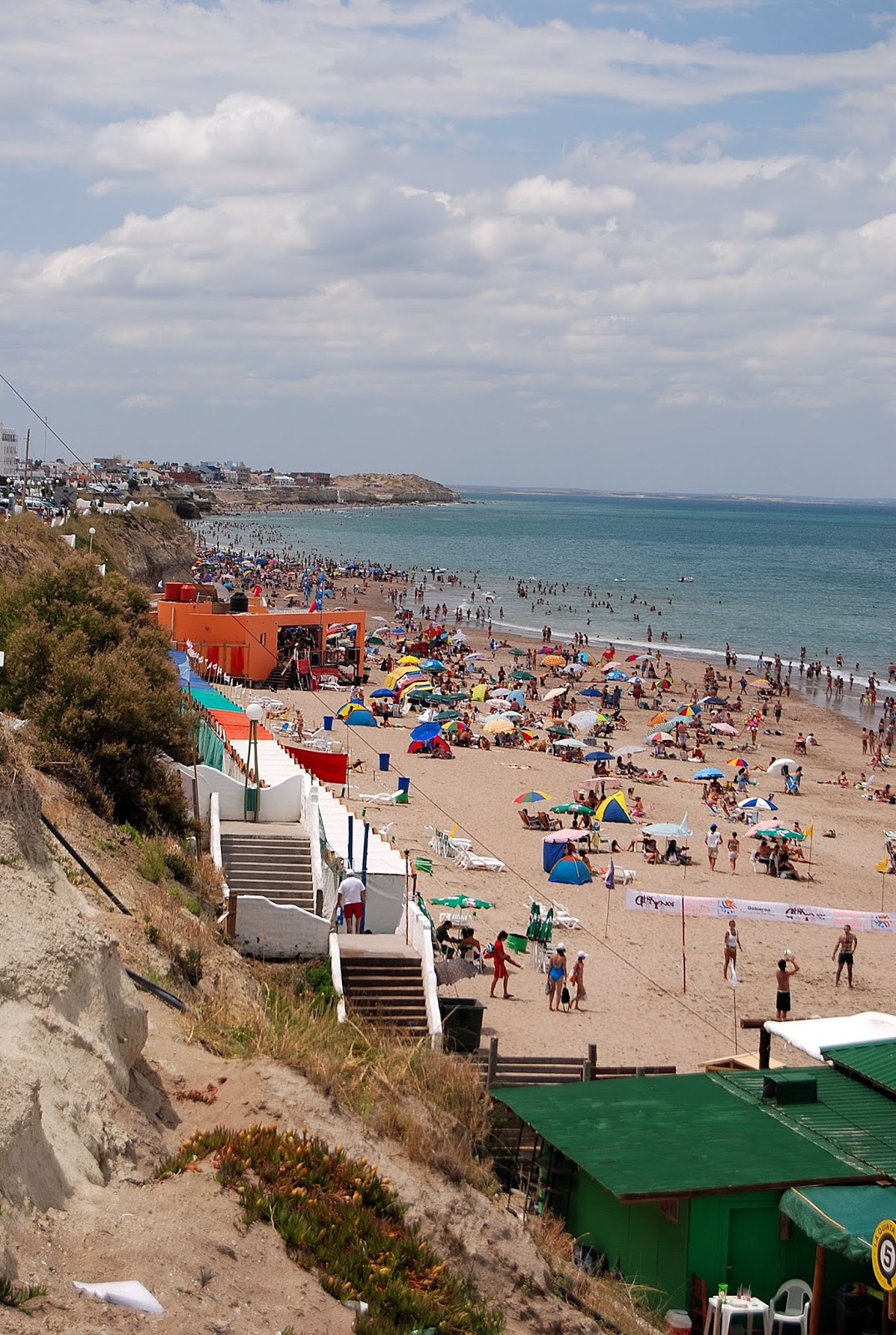
Even if you (or I) won’t see this one, there’s another upcoming opportunity. On December 14, 2020, Chile will experience another total eclipse in the southern mainland region of La Araucanía, passing over the prime tourist towns of Pucón and Villarrica. The downside is that, like the Pacific Northwest, this area enjoys a marine west coast climate that can bring cloud cover and drizzle at any time of year. It might be better seen in Argentine Patagonia, as the rain shadow of the Andes usually means clear skies on the sprawling steppes. It can get windy there, though, so the beach resort of Las Grutas might be the comfiest option.
For the 2020 eclipse, it won't quite be high season at Las Grutas.

Friday, June 30, 2017

Devotional Kitsch - An Argentine Update

The Costanera Norte offers river access to the residents of Buenos Aires.
Not far from our Buenos Aires apartment, leading northwest from the Aeroparque Jorge Newbery airport, the Costanera Rafael Obligado provides direct access to the Río de La Plata shoreline for city residents. It’s a popular spot for walking, fishing and asados (barbecues) and, at its northern end, the Parque de la Memoria is an open-air memorial to the tens of thousands who disappeared under the military dictatorship of 1976-83.

One area “attraction” I’ve always ignored is Tierra Santa, a Disneyland for the devout that displays a kitschy version of ancient Jerusalem and its spiritual legacy (as depicted in the video above). About the only thing I can compare it with is Tennessee’s farcically fake Ark Encounter which, deservedly, appears to be approaching financial collapse. On one level that’s easy for me to say—I’m not a believer—but why would any sensible person spend a single peso to watch an hourly mechanical resurrection when genuine devotional sights are so close at hand?
Carlos Menem renounced Islam for Catholicism in order to become Argentina's president in 1989.
The Catedral Metropolitana is Buenos Aires's most conspicuous religious landmark.
It’s worth noting that, for many Argentines, religion is fungible. For instance, former President Carlos Menem—of Syrian descent—converted from Islam to Catholicism to run for office, since that was a constitutional requirement at the time. Buenos Aires, of course, has many important Christian sites, starting with the classic Catedral Metropolitana and even the handsome Iglesia Ortodoxa Rusa of San Telmo. But the Middle East’s other Abrahamic faiths are represented by landmarks such as the Templo de la Congregación Israelita and the Centro Islámico Rey Fahd—both of which are open for free guided tours.
Palermo's Centro Islámico Rey Fahd is the largest mosque in South America.
None of those, of course, is a theme park—for that, visitors to Argentina might be better advised to visit the city of La Plata, whose República de los Niños, where children can explore scale model replicas of diverse structures that even include a mosque. For my part, though, I prefer more offbeat devotional locations that fetishize folk saints.
La Plata's República de los Niños has a scale model mosque for kids to explore.
Rather than a biblical theme park, I would urge visitors to see the syncretic Santuario del Gauchito Gil, where pilgrims pay homage to a Robin Hood figure from the northern province of Corrientes. It also has the advantage of proximity to the Esteros del Iberá, Argentina’s great subtropical wetlands preserve, to view the most diverse concentrations of wildlife within the country’s borders.
Who needs a mechanical Jesus when you can stand before the altar of Gauchito Gil?
Alternatively, in the western province of San Juan—also an underappreciated wine district—the Santuario Difunta Correa memorializes a maternal figure who, according legend, died in the desert while suckling her newborn (who, miraculously, survived to be found by passing muleteers). In truth, she probably never existed, but her story is more plausible—and far more intriguing—than what supposedly happened in the “Holy Land.”
San Juan's Difunta Correa is a legendary folk saint whose infant son supposedly survived at her breast after she died in the desert.

For those unable to visit either the Gaucho Gil or the Difunta, do not despair! Spontaneous roadshrine shrines—some of them quite large—are common on the country’s highways and along some city sidewalks.
Even in sophisticated Palermo, the faithful leave water for the Difunta.

Friday, January 2, 2015

Buenos Aires Wines? History and Novelty in the Vicinity

In my previous post, I briefly mentioned the greenbelt that once surrounded Buenos Aires; in the interim, I set about making some inquiries about it. I asked my wife whether she could recall any vineyards from her youth and she couldn’t, but Andrew Graham-Yooll wrote me that, in his rather longer experience, “there have been many chacras [smallholdings] on the outskirts of BA over the decades.”
Andrew cites the example of Tigre and the Paraná Delta, which was a major fruit-growing area – in fact, the riverside market there is still known as the “Puerto de Frutos” (pictured above). He also notes that there were vineyards, for both wine and table grapes, in southern Buenos Aires suburbs like Florencio Varela and Monte Grande, and western fruit and vegetable-growing areas like Castelar, Moreno, General Rodríguez and Luján (all within 25 to 70 km from Buenos Aires), “but all of that has been wiped out by the urban sprawl. My photograph below would suggest that, though I’m not sure of the its precise location – it was taken from a flight landing at Ezeiza, on the capital's southern outskirts.
I wrote, in my previous piece, that the nearest wine-growing area to Buenos Aires was in Sierra de la Ventana (550 km away), but I was wrong. To the north, parts of the provinces between the Paraná and Uruguay rivers – sometimes known as Argentine Mesopotamia (a section of which appears below, from the air) - were a flourishing wine-growing area, but political pressure from the Cuyo provinces (Mendoza and San Juan) eliminated the practice until recently.
Now, in the province of Entre Ríos, near the attractive riverside town of Colón (about 330 km north of Buenos Aires), Bodega Vulliez Sermet has begun to produce a variety of reds, including Tannat, under conditions similar to those in Uruguay. On the west bank of the Río Uruguay, Colón is considerably closer to Buenos Aires than Sierra de la Ventana, though still farther away than those in Uruguay itself. The photograph below is Colón's municipal tourism office, now housed in the historic riverside customs house.
It’s been a while since I’ve been to that part of Argentina, but it’s potentially a worthwhile stop for overland travelers en route to the wildlife-rich Iberá marshes or the thunderous cascades of Parque Nacional Iguazú. It’s also a possible detour from Gualeguaychú, the hearth of Argentine Carnaval (due to begin Saturday, January 10th).

There’s another winery, Corrales Vier, in the more westerly city of Victoria (about 340 km northwest of Buenos Aires). When a sommelier friend of mine tried to contact Vuillez and Corrales by email, though, neither one responded – although Vuillez makes a point of advertising its cabaña-style accommodations. He hasn’t seen wines from either one for sale in Buenos Aires, but did have a sample of Vuillez's at a tasting event several years ago.


Maybe these are mystery wines but, the next time I visit Colón or Victoria, I’ll make an effort to stop.

Saturday, November 28, 2009

San Juan is Juiced!

When most of us travel overseas, we’re in search of world-class sights and experiences such as Argentina’s Iguazú falls and Chile’s Torres del Paine - the icons that make us endure long flights and rough roads. Unfortunately, those icons often make us overlook the “lesser” destinations, sights and experiences that make travel so rewarding.

Take, for instance, the Argentine city of San Juan. Roughly two hours north of Mendoza, about which I wrote recently, the capital of its namesake province is smaller, drier and hotter than its southern neighbor - in summer, temperatures frequently rise above 40° C (more than 100° F). In fact, when I arrived around midday last Monday, the heat was almost suffocating as I emerged from my air-conditioned car.

Fortunately, like Mendoza, the streets of San Juan’s city center enjoy a dense canopy of sycamore trees that leave it, as Mexican novelist Carlos Fuentes noted in writing about Mendoza, “protected by a roof of leaves woven together like the fingers of a huge circle of inseparable lovers.” The shade can’t completely offset the heat but, on the corners around the city’s central Plaza 25 de Mayo (pictured above), the traditional carretas that offer gulps of chilled fresh orange juice for one peso (about 25 US cents) make their contributions as well. In fact, they are so noteworthy that the province has declared them to be “of cultural and tourist interest.”

Orange juice may not be enough to justify an overseas trip, but its sheer refreshment is a small experience I always look forward to when I visit San Juan - even though it has its own notable wine district only a short distance outside the city.
Custom Search