Showing posts with label Rancagua. Show all posts

Friday, February 5, 2016

The Huaso and the Rodeo

Visitors to Argentina expect to see gauchos, but few are even aware of their Chilean counterpart – less publicly celebrated, the huaso resembles his trans-Andean counterpart in many ways but differs in others. Both, of course, are horsemen, but the gaucho arose from a background of fierce independence on the Pampas, while the subservient huaso originated on the landed estates that dominated economic and social life in colonial and republican Chile.
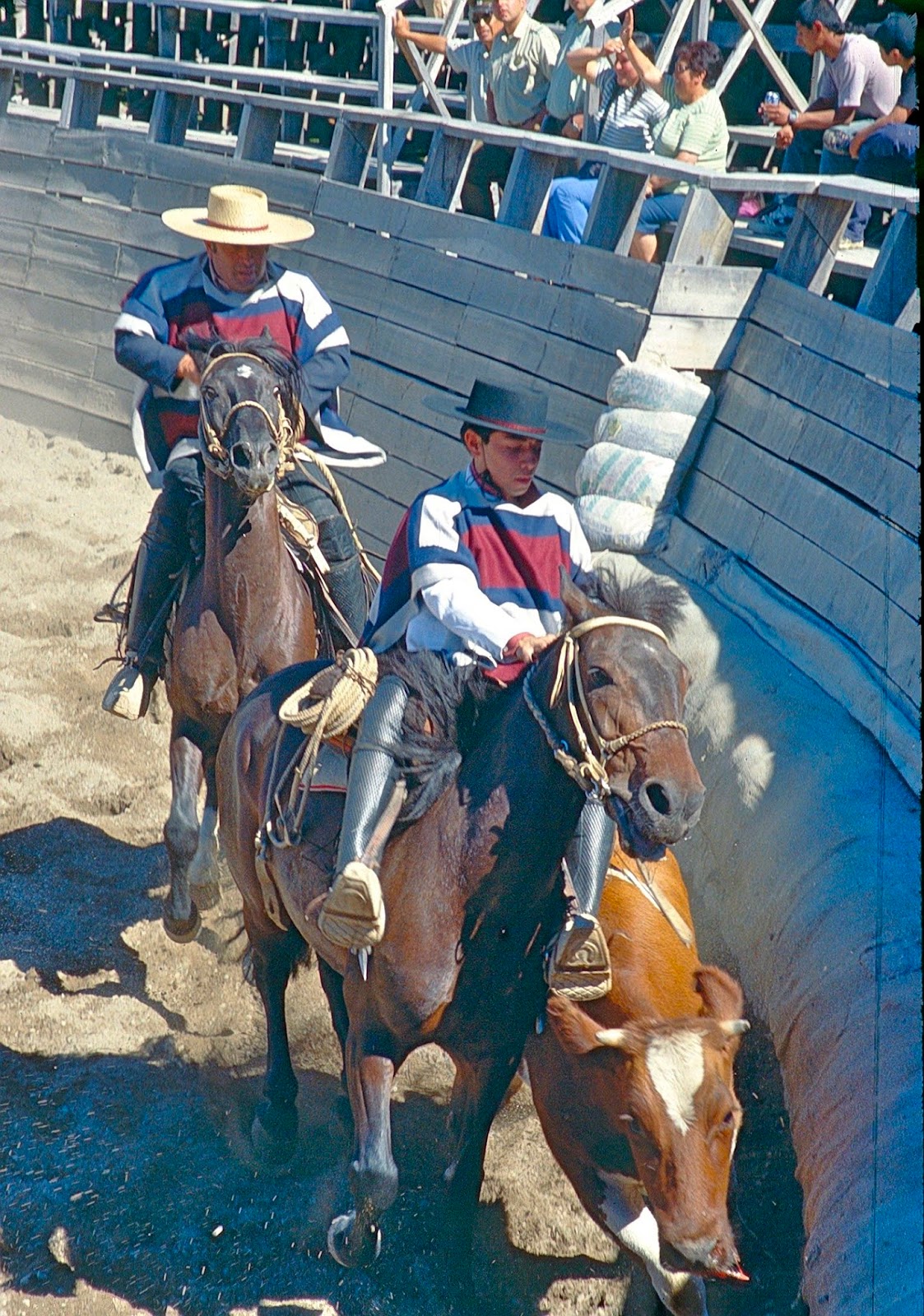
Though the huaso was a hired hand or even a peon attached to the property, on Sundays he and his colleagues could blow off steam by racing their horses, betting, and drinking. As the spontaneous rodeo grew too raucous, though, it drew disapproval from landowners, who responded by organizing competitions that, over time, became more genteel versions of their huaso origins.
Though Chilean rodeo remains popular, it is now, according to historian Richard Slatta, a nostalgic exercise that's "a middle- and upper-class pastime, not a profession," as it has become in North America. Riders wear colorful ponchos, flat-brimmed hats known as chupallas (depicted above), oversized spurs, and elaborately carved wooden stirrups (photograph below).
The signature event is the atajada, in which a pair of jinetes (riders) guide and pin a calf or steer to the padded wall of the medialuna, the semicircular rodeo ring (as depicted at top). Since it's harder to control the steer by the body than the head - the chest is best - the horsemen get more points for this. They lose points if the steer strikes any unpadded part of the wall or escapes between the horses.

There are no cash prizes, though the event ends by acknowledging the champions and other riders with wine and empanadas. Compared to Canada, the United States, and even Mexico, Chilean rodeo is truly machista - women prepare and serve food, dress in costume, and dance the traditional cueca with the men, but they do not ride.


An hour south of Santiago, the city of Rancagua is the capital of Chilean rodeo, drawing thousands of spectators to March's national festival. In the Andean foothills of central Chile and in small settlements along the Carretera Austral, though, rodeo probably comes closest to its historic roots.

Saturday, May 12, 2012

Beyond the Medialuna: Rodeo for the Rich?

In his Cowboys of the Americas, historian Richard W. Slatta provides a thorough and lavishly illustrated account of horsemen from Canada to Cape Horn, even including the vast Pacific in the person of the Hawaiian paniolo (his overlooking the riders of Easter Island and their mounts is perhaps forgivable). One characteristic event, everywhere, was the rodeo, but it could differ dramatically from country to country.
In South America’s Southern Cone, of course, Slatta focuses on the Argentine gaucho, but he does not overlook the lesser-known Chilean huaso. Unlike the original gaucho, who was notoriously independent, the huaso was a hired hand or even a peon attached to an hacienda, but he and his colleagues could blow off steam by racing their horses, betting and drinking on Sundays. As this spontaneous rodeo grew too raucous, though, it drew the disapproval of landowners, who responded by organizing competitions that, over time, became more genteel versions of their predecessors.

Though Chilean rodeo remains popular it is now, according to Slatta, a nostalgic exercise that’s “a middle- and upper-class pastime,” not a profession as it has become in North America. The signature event is the atajada, in which a pair of jinetes (riders) guide and pin a calf or steer against the padded wall of the medialuna, the semi-circular rodeo ring. Since it’s harder to control the beast by the body than the head – the chest is best – horsemen get more points for this. They lose points if the animal strikes any unpadded part of the wall, or escapes between the horses.
Riders wear colorful ponchos, flat-brimmed sombreros known as chupallas, leather leggings, over-sized spurs, and elaborately carved wooden stirrups. According to an article in last week’s Economist, that’s part of what keeps the proles out of the spotlight. It costs up to US$2,500 to participate in an event such the annual national championships, which attracted 50,000 spectators to the heartland city of Rancagua in March.

But it’s not just the entry fees. One of Chile’s richest men, El Mercurio owner Agustín Edwards Eastman, sponsored this year’s champions. Edwards reportedly spends up to US$60,000 per month in rodeo-related expenses, including salaries for the riders and grooms, and veterinary and breeding consultants. That’s well beyond the reach of any amateur participants, even though these are ostensibly non-professional events.
That said, it’s still possible see to genuine, participatory Chilean rodeo outside the lavishly funded indulgences of the Chilean elite. Virtually every town and village in the Chilean heartland and beyond has its own medialuna, and I took the photograph above in the tiny community of Palena – with a permanent population of fewer than 2,000 – in northern Chilean Patagonia. In settlements like this, the rodeo comes closest to its historic roots.

Wednesday, September 28, 2011

Clearing the Air: Pollution in the Southern Cone

Earlier this week, the World Health Organization released a report on air pollution in 1,100 cities around the world, which it says contribute to respiratory problems and 1.34 million premature deaths per annum. Unsurprisingly, it’s cities in densely populated Asian countries, specifically Iran, India and Pakistan, that have the world’s worst air quality, due largely to dirty fuels that include firewood and coal, and poorly monitored motor vehicles.

The WHO calculates its rankings on the basis of airborne particles smaller than ten micrometers, with a recommended upper limit of 20. By that standard, the Iranian city of Ahvaz has the world’s worst air quality, at 372 grams micrograms per cubic meter. At the other extreme, Santa Fe, New Mexico, registered only six micrograms per cubic meter and Washington DC measured 18.

By these standards, Southern Cone cities, particularly those in Chile, come off not so good but less than catastrophic – at least compared with their Asian counterparts. Chile, of course, is a mining country and, on top of that, its geography is unfavorable: like Southern California, Santiago and other heartland cities lie in a basin between a coast range and the high Andes, which traps particulate matter. This gives Santiago (pictured above, after a winter storm has cleared the air) the country’s second-highest figure, with a reading of 69. Only Rancagua, about an hour south, has a higher reading, at 74; Rancagua not only has a similar geography to Santiago, but suffers from its proximity to the huge El Teniente copper mine in the Andean foothills to the east.
Most heartland cities are in a similar plight: Talca (pictured above) registered 49 and Chillán 52. Of the northern mining cities, the port of Antofagasta (pictured below) was the most polluted, with a reading of 55, while Calama measured only 50 – despite the presence of the gigantic open-pit copper mine at nearby Chuquicamata. The southern city of Temuco had a surprisingly low figure of 49, given that its residents use so much firewood for heating and cooking.
While all these figures are higher than desirable, they’re not alarmingly high like the Asian and all are below the global average of 79. The figures also can be misleading because they are not geographically specific – the air quality in Santiago’s poorer western neighborhoods, for instance, is worse than the richer eastern barrios. While that’s deplorable in terms of environmental justice, at best, it also means it will not affect most visitors. It’s those who have to live there that suffer most.
Across the Andes, things are a bit better. I’ve long argued against the clichéd depiction of Buenos Aires (pictured above) as the “Paris of the South,” but in one sense that’s true – according to the WHO, its reading of 38 is identical to the French capital. Across the Río de la Plata, Uruguay’s capital of Montevideo (pictured below) checked in only a little worse, with a reading of 39.


Moon Handbooks Buenos Aires in Millbrae (San Mateo County)


Thursday September 29 will mark the last of four digital slide presentations on the fourth edition of Moon Handbooks Buenos Aires, at various branches of the San Mateo Public Library. This event starts at 1 p.m. at the Millbrae Library (1 Library Avenue, Millbrae, CA 94030, tel. 650/697-7607). There will be ample time for questions and answers, and books (also including Moon Argentina and Moon Chile) will be on sale (at a discount).

Next month, I will be on the road promoting the new third edition of Moon Handbooks Patagonia. Most of the events will be in the San Francisco Bay Area, but I will also be appearing in Seattle and Bellingham, Washington; Vancouver BC; Santa Fe, New Mexico; and Pasadena, California. Watch this space for details.
Custom Search