Showing posts with label Music. Show all posts

Wednesday, January 19, 2022

Mendocino is Cooler Than Buenos Aires (Literally)

At the end of last month, I wrote that my wife and I had postponed a planned trip to Buenos Aires because of the spread of the Omicron variant of the COVID-19 virus there. In addition, our route would have taken us through COVID-friendly Texas and, given the frequency of flight cancellations by American Airlines, it was possible we might have had an unwelcome delay of a day or more in Dallas/Fort Worth.

Mapping the heat wave, from Argentina's Servicio Meteorológico (in degrees C)

Very tentatively, we’re hoping to try again in March, but early January provided us yet another reason to justify our decision—a brutal heat wave that struck the Argentine capital and much of the rest of the country. In summer, of course, we would expect warm and even hot temperatures, but last week the mercury soared to 106° F (41° C) in the city and, in the north-central city of Córdoba, it reached 108.5° F (42.5° C). The western desert city of San Juan was a near-furnace at 111° F (44° C).


A few years ago, we reluctantly installed air-conditioning in our Palermo apartment, but we’ve never used it during our time there—our idea was that it would appeal to short-term rentals. Even that mightn’t have mitigated this heat wave, though, as there were power outages in much of the city. Global warming, anybody?
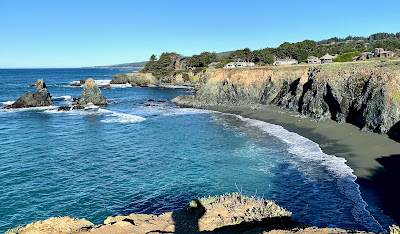
A typical landscape at Sea Ranch (note the houses in the background)

The town of Gualala (as seen from Sea Ranch)

With that in mind, we took a mini-vacation with our daughter, her boyfriend, and our two dogs, up the Sonoma County coast to Sea Ranch—an ostensibly eco-friendly development that I’m personally ambivalent about. The scenery resembles coastal Chile, the night skies sparkle, and there’s almost total silence except for occasional gobbles from wild turkeys outside your windows and waves crashing on the beach. Still, I find the supposedly cutting-edge architecture monotonous and the absence of any urban amenities bothersome—there’s no alternative to the automobile for transportation to the town of Gualala, some miles north, for essential shopping. In effect, Sea Ranch is a de facto “gated community” even though the State of California requires obligatory coastal access for non-residents.

The village of Mendocino, as seen from the nearby headlands
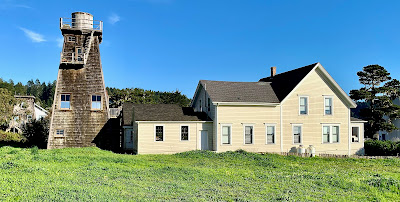
Some Mendocino water towers have been repurposed for residential use.

We spent four nights in a short-term rental house, arriving on a Friday afternoon and leaving the following Tuesday morning. Two full days is about my limit there but, given the late Friday arrival, Saturday and Sunday were dedicated to extended dog walks on the coastal trails (significantly cooler than Buenos Aires). On the Monday, though, we escaped north to the truly picturesque seaside town of Mendocino (population 855), where we walked along the coastal cliffs and explored its quaint architecture, including numerous water towers—some of them since converted to housing.


In popular culture, Mendocino has been a location for numerous films and TV series, but I recall it best for the 1968 hit song “Mendocino” by the Sir Douglas Quintet (Texas transplants to California whose producer chose the name to try to capitalize on the Beatles-inspired “British invasion” craze; the above video is a version by Sahm's later band, the Texas Tornados). Interestingly, my wife knew the song even before we met, as it was also a big hit in Argentina; though neither she nor her friends really understood the lyrics except for the title, they could dance to it.


Even more interestingly, the group leader Doug Sahm (born in San Antonio) was of German extraction and, I recently learned, Michael Holm (above) recorded a German-language version that became a chart-topper in then West Germany the following year. Does this explain the fact that the German real-estate firm Engel & Völkers maintains an office in Mendocino, and that all its window listings there are bilingual in English and German? Perhaps it does, as the comments on Holm's YouTube video include one by a German whose wife insisted he take her to visit there (German used to be my second language, but it’s now a distant third to Spanish and I couldn’t catch much of Helm’s lyrics).


Mendocino seems idyllic, but it’s not immune to the rest of the country’s problems. Almost everyone we saw in town was masked up but, not that long ago, the anti-vax owner of Fiddleheads Café posted notices that he would collect a surcharge for any client wearing a mask, and an additional charge for anyone who bragged about being vaccinated. He’s since gone out of business, but might still be welcome in Texas (in fairness, the state has great food and music despite its COVID-friendly politics).

Wednesday, December 30, 2020

Break It All! Rocking Around the Americas

In the current months of semi-quarantined torpor I have, like millions of others, spent an inordinate amount of time in front of the tube. Often my tastes run to Scandi-Noir mysteries but, over the past week, we discovered a worthwhile alternative that takes me back to Buenos Aires and elsewhere in Latin America with Rompan Todo (Break It All), a six-part documentary on rock music south of the border (despite some notable omissions, to be detailed below).

Rompan Todo focuses primarily on Mexico (Mexico City, mostly) and Argentina (primarily Buenos Aires), and evokes nostalgia not just for the distant origins of that scene, but also for the city that I can’t visit for the foreseeable future. I’m of the generation for which rock music is a touchstone, and I touched on the Argentine scene myself in a National Geographic Traveler assignment a decade ago.


In the Beginning…

The series, though, starts with the California-born Richard Steven Valenzuela—better known as Richie Valens—who energized aspiring south-of-the-border musicians with his now standard “La Bamba,” adapted from a Mexican folk song. Not so many years later, though, the influence came from across the Atlantic with the Beatles. As the series’ Argentine producer Gustavo Santaolalla notes, the earliest Argentine bands often performed cover versions in English and were often derivative—Sandro, the “Argentine Elvis,” performed Spanish-language versions of songs like Tim Hardin’s “If I Were a Carpenter.”

This tribute album to the late Sandro is a fine introduction to Mexican and South American bands.

From the first, governments and other institutions like the Catholic Church were skeptical and often hostile toward rock. In 1971, for instance, Mexico had its own Woodstock in the unexpectedly politicized Festival de Avándaro, and Mexican officials forced rock to go underground—almost literally—for years. Argentine musicians underwent a similar experience in the approach to and aftermath of the 1976 military coup that resulted in exile for many.

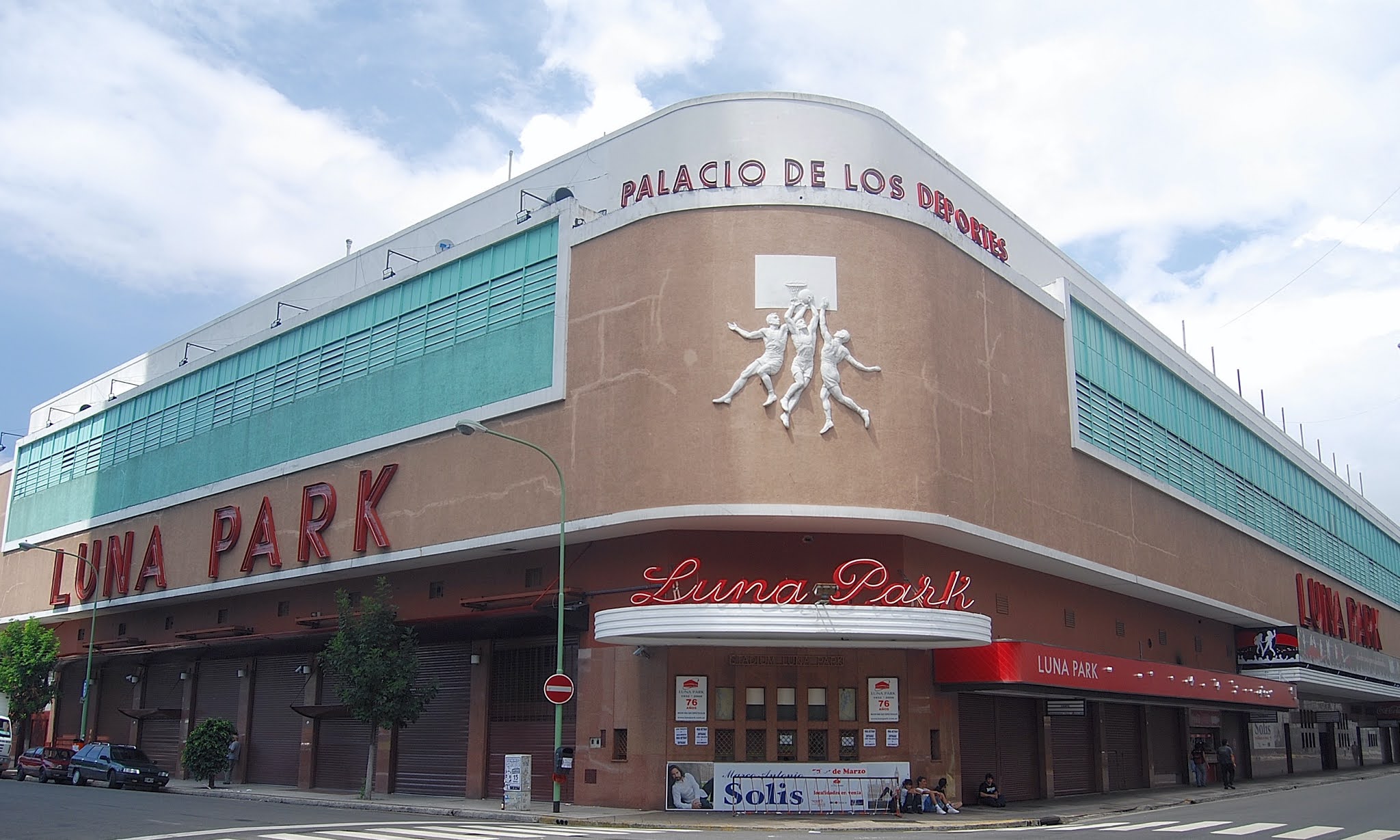
Billy Bond's fans trashed the interior of Luna Park.

One of those was Billy Bond, whose appearance in the film was a revelation–I’d never even heard of the Italian-born rocker (given name Giuliano Canterini) but, from the footage here, he seems a precursor of punk. In 1972, when he and his band La Pesada del Rock and Roll played the iconic Luna Park Stadium—an auditorium where Eva Duarte first charmed Juan Perón en route to becoming Argentina’s most powerful woman ever—Bond urged his cheap-seats fans to descend to the unsold vacancies closer to the stage, resulting in vandalism and a police round-up. Within two years, apprehensive of Argentina’s authoritarian trends, Bond left for Brazil, but continued to produce Argentine bands and, in the course of this series, he proves himself to be admirably articulate (The series, by the way, takes its name from an album by Uruguay’s Los Shakers, but “Break It All” might as well have been Bond’s motto in his youth).


Meanwhile, in Chile

Chile's coupmongers executed Víctor Jara in 1973.

Chile underwent a similar trauma with the 1973 coup that overthrew constitutional President Salvador Allende and essentially shut down the music scene—beginning with folksinger Víctor Jara, whom Augusto Pinochet’s forces tortured and killed in an especially gruesome manner. My experience there has been more limited, though I did have the good fortune to meet, in Santiago, Claudio Parra of Los Jaivas, a group that formed in 1963 (the band name, by the way, is an adaptation of their original English “High-bass,” though it can also mean a species of crab found in Chilean waters).

Los Jaivas backstage at the Teatro Universidad de Chile (Claudio Parra is second from left)

I had assumed the band left because of the coup, but Parra corrected me on that—as the film makes clear, they had already decided to head to Argentina for commercial reasons, and the coup merely delayed their departure. They then spent several years there and in Paris before returning to Chile, where they still tour every year. When I saw them in Santiago around the turn of the century, they struck me as a Pink Floyd comparable and, onscreen here, La Ley’s Beto Cuevas compares their Alturas de Machu Picchu (Heights of Machu Picchu, based on a poem by Pablo Neruda) to Floyd’s Live at Pompeii.


Rock Nacional, In the Post-War

My own experience with Argentina's rock nacional dates from the post-Falklands/Malvinas War period, when the dictatorship faltered (in a brief interview, the Dylanesque León Gieco ruefully admits that he and other musicians were complicit in supporting the war and, by extension, a regime they presumably loathed). After the conflict, though, they focused on songs with Spanish rather than English lyrics—Charly García, for instance, has recorded a Spanish-language version of the Byrds’ “I’ll Feel a Whole Lot Better” and once, in an under-the-railroad-tracks dive in Palermo, I heard him do “Soldado de Lata,” a similar adaptation of the Small Faces’ “Tin Soldier.”

A performance at Palermo's Roxy Live Bar (the bassist, second from right, is Charly García's bandmate Zorrito von Quintiero).


Fito Páez performs in El Calafate.

Other than García, the biggest names I’ve ever come close to are Soda Stereo, the first Argentine band to become a major international touring sensation, and Fito Páez, now a solo artist who also worked with García and others. I know little about Soda’s music, but I happened to be in the provincial capital of Tucumán when their publicists were passing out promotional packs of cigarettes in the central Plaza de la Independencia prior to a concert (I was not impressed). Páez I saw as part of El Calafate’s annual Festival del Lago in 2014, but the outdoor sound system was less than ideal.


Oversights and Omissions

One unspoken theme through most of the series is the scene’s overwhelmingly masculinity, but there are several prominent women, most notably Andrea Echeverri of Colombia’s Aterciopelados and Mexico’s California-born Julieta Venegas, who has worked with Santaolalla (who lives in Los Angeles). I’ll note that when I saw Charly García in Palermo, his lead guitarist was María Gabriela Epumer, who died at 39 due in part, apparently, to a medical misdiagnosis. Truly unique is Los Jaivas’ Juanita Parra (in the Chile section photo above), who replaced her father Gabriel as the group’s drummer after a fatal automobile accident. Santaolalla, though, says rock’s future is female—and, as a producer with pedigree, he’s in a position to contribute to that.

In summary, Break It All remains a worthy account of rock music south of the border (and the Equator), but with one other major omission—although it subtitles itself “The History of Rock in Latin America,” Brazil is conspicuous by its absence. I’ll confess to knowing little about its music beyond bossa nova, but a cursory glance at Wikipedia suggests that the region’s largest country has had a flourishing rock music scene ever since the mid-1950s. Perhaps Netflix should retitle the current series to represent its Spanish-language bias, and then underwrite a separate work on the history of rock em português.

Tuesday, April 30, 2019

I've Never Been to Spain?

I’ve never been to Spain. Well I have been, I guess, if you count Catalonia as part of Spain, because I once spent a week in Barcelona. But I’ve been to Salamanca…oh, wait, not that Salamanca! Earlier this month, I spent two nights in the Chilean city of Salamanca, which I’d visited before, but this was an escape from Santiago after spending most of the previous two months in Patagonia.
Gregorio de la Fuente's "Abrazo de los Pueblos" still decorates the now disused passenger  terminal of Los Andes' Ferrocarril Transandino.
How did I get to Salamanca? Well, I started slow, thanks to late-rush hour traffic out of Santiago, but then headed north to the town of Los Andes, where the Ferrocarril Transandino once carried passengers and freight across the Andean divide to Mendoza. I had no intention of visiting Argentina this time, but I did want to see the mural by Gregorio de la Fuente—his "El Abrazo de los Pueblos” (Embrace of the Peoples) at the old train station is a celebration of Argentine-Chilean friendship. It was just a brief stop, though I did learn that there’s now an occasional tourist train on this route.
Vehicles pass along the old railroad route through Túnel La Grupa, near the town of Cabildo.
Symbolically, at least, trains played a role in my route to Salamanca, as I took the paved highway west to the town of San Felipe and then north through scenic Andean foothills that resemble the higher, drier parts of Southern California. There are only scattered settlements along this route E-71, which leads to the town of Cabildo; there, a traffic light controls access through the Túnel La Grupa, one of a series of tunnels that belonged to the Longino, the Ferrocarril Longitudinal that connected La Calera (west of Santiago) to the nitrate mines and ports of the northernmost Atacama Desert.
The landscape here resembles the higher, drier areas of Southern California.
I’d driven this route before, but not for several years. In the interim, authorities have either paved—or begun to pave—much of it north of the border between Region V (Valparaíso) and Region IV (Coquimbo). This is significant because most of Coquimbo’s population resides along the coast, where cities like Los Vilos and La Serena attract beachgoers from Santiago, and this is a more adventurous (if slower) alternative to lesser-known points.
Túnel Las Palmas marks the border between the Valparaíso and Coquimbo regions.
Café Quarzo is one of few roadside services here.
There are few services on this stretch of “highway” but, surprisingly, one enterprising local has opened a small café on the northbound descent from Túnel Las Palmas, which marks the regional border. She sells ground coffee drinks—in a country where Nescafé is often still the default option—as well as juices and mineral souvenirs (hence the name Café Quarzo). The road continues, passing several railroad bridges, to the enigmatically named village of Caimanes (there are no carnivorous aquatic reptiles here, though; the name apparently comes from an indigenous Mapundungun [Mapuche] word meaning “six condors”).
Carnivorous aquatic reptiles do not populate the area around Caimanes.
Túnel Las Astas is the last of three short tunnels north of Caimanes.
The foundations of the old railroad station still stand here, but there’s no more obvious evidence until a short distance north, where the road passes through three short tunnels with no traffic lights. Several years ago, in Argentina, I met two US cyclists who’d taken this road on my guidebook recommendation and loved it, but they confessed their trepidation in riding through the narrow tunnels, with little room to dodge any oncoming vehicle. That said, this route remains a potentially great ride for adventure-seeking cyclists.
The old train station at Limáhuida is now a country store.
Emerging from the Túnel Los Astas, the road continues to Limáhuida, where the old train station is now a small market and fading wooden workshops still stand below it. That’s also where a new bridge crosses the Río Choapa and leads east to Salamanca, where I spent two nights at the modern and comfortable Hotel Recanto, on the eastern outskirts of town.
Hotel Recanto is full during the week, but nearly empty on weekends.
Oddly—or not—I was virtually the only guest in contemporary accommodations with spacious rooms, solar-powered hot water, and an outstanding restaurant. That’s because it clears out on the Thursday and Friday, as mining managers—there are large copper deposits in the area—leave for the weekend.
Farm-fresh garlic spreads at Salamanca's central plaza
Salamanca's old train station is now a museum and part of a pleasant public park.
Nevertheless, the hotel was still walking distance from a handsome central plaza with a lively crafts and farmers market, a former train station turned museum and municipal park, and easy access to nearby petroglyphs. There are also wineries in the area, though I didn’t get to visit those, but Salamanca—where I’d stayed once several years earlier, still struck me as a good weekend getaway.
The pre-Columbian petroglyphs at Cerro Chalinga are walking distance from downtown Salamanca.
It’s not the area’s only attraction, though. The next day I took the paved highway north to Combarbalá, a village which, on the face of it, resembles some Mexican villages, with narrow streets lined by adobe houses and even ranchera music. To get there, I did veer northwest off the more direct but still unpaved railroad route (though, had there been tunnels, I would have taken it again).
The fountain at Combarbalá's central plaza represents indigenous Diaguita motifs.
Mexican ranchera music is popular in rural Chile, including Combarbalá.
Small-scale mines extract combarbalita for local crafts workers.
What Combarbalá does have is small-scale mining for the semi-precious gemstone combarbalita (I visited a local mine, thanks to Paola Yáñez of Inti Wasi Tour), and the community astronomical Observatorio Cruz del Sur, which offers nighttime tours in one of the best possible areas for professional and amateur astronomy. I stayed at the cozy Eco-Hostal Alto Algarrobal, one of many accommodations that will fill up in for July 2nd, when a total eclipse of the sun will pass nearby (Combarbalá will be slightly south of totality).
The approach to Observatorio Cruz del Sur, in the daylight hours.
The beginning of a nighttime tour at Observatorio Cruz del Sur
Combarbalá and other nearby towns will fill up for the July 2nd eclipse.
After a night at Combarbalá, I headed the next morning for the coast, where Los Vilos would make an ideal beach break for Santiaguinos returning to Chile’s capital. For my part, I continued along the coast to Viña del Mar and Valparaíso, which will be another story here in the near future.

Monday, February 11, 2019

Justice Delayed for Víctor Jara (A Film Review)

This Thursday I fly from California to Chile, changing winter—last week we even had snow on our backyard deck in Oakland—for summer. It’s been hot in Santiago and, when I arrive on Friday, the predicted high is 91° F (33° C).
The year after I took this photograph, in 2015 in Santiago's Barrio Brasil, the cultural center known as the Galpón Víctor Jara closed because of a dispute with the landlord.
Not precisely in preparation, I just viewed director Bent-Jorgen Perlmutt’s “Massacre in the Stadium,” a documentary about the murder of Chile’s legendary folksinger Víctor Jara in the aftermath of the 1973 military coup that overthrew constitutional president Salvador Allende. It is presently streaming on Netflix.

A bit longer than an hour, Perlmutt’s film begins with Jara’s personal background and stock footage of the coup led by General Augusto Pinochet Ugarte, whose troops herded thousands of political prisoners in Ñuñoa’s Estadio Chile (an enclosed facility that that now bears Jara’s name; it is not the adjacent gigantic soccer stadium).

The film continues with interviews, including one with former Army Lieutenant Pedro Barrientos—Jara’s presumptive killer—but a supposed eyewitness later recants his testimony. Nevertheless, supported by subsequent testimony from several conscripts who were present in the stadium, Jara’s widow Joan (a British national) and the Center for Justice and Accountability persist with a civil suit in Florida against Barrientos (who is now a US citizen through marriage).

Barrientos submits to a lie detector test–his own condition for being interviewed–but there’s an unspoken implication that he has been coached to make the test unreliable. Nevertheless, Joan Jara and her daughters won a US$28 million judgment in compensatory and punitive damages.

Meanwhile, eight Chilean officers have since been imprisoned for Jara’s murder, but the film does not mention that Chilean prosecutors have indicted Barrientos (or not), nor does it suggest he could be extradited. However, a mid-2018 article in The Guardian, cited at the previous link, says that US is considering extradition.

In my opinion, one of the film’s strengths is that it avoids name-calling and political polemic to present the evidence, even though Perlmutt may subtly suggest that Barrientos has sidestepped the polygraph judgment. For anyone interested in Chile and this controversial period, it’s well worth seeing.

Support Southern Cone Travel
If you've found this article interesting and/or useful, please consider earning me a few pennies by clicking on an advertisement here.

Friday, November 2, 2018

A California Tango?

California has a long and illustrious history of contacts with Chile, about which I’ve regularly written, but its relations with Argentina have been less conspicuous. Perhaps the most infamous episode was an invasion by the Franco-Argentine privateer Hipólito Bouchard, who occupied the Presidio of Monterey for six days in 1818, when the area was still under Spanish rule.
The sheet music for La Reina, Francisca Carrillo Vallejo's tango
Last week, though, I found a new and somewhat enigmatic connection when I accompanied a Buenos Aires visitor to the Oakland Museum of California. There I found, behind a vitrine in the Gallery of California History, the sheet music to “La Reina,” described as a California tango by Francisca Carrillo Vallejo. Published in 1925, when Carlos Gardel was at his peak, the song probably reflects the early 20th-century globalization of this distinctively Argentine music and dance.
General Mariano Vallejo, grandfather of the tango composer
There is scant online information about this piece of music, but the museum's Program Administrator Eileen Hansen informed me that the author was the granddaughter of General Mariano Guadalupe Vallejo, a Californio who spent his life under Spanish, Mexican, and US governments. Ironically enough, Vallejo (born 1807, d. 1890) would have been a boy in Monterey when Bouchard occupied the Presidio. Unfortunately, Ms. Harris could not access the sheet music from the vitrine on short notice, so I’ve been unable to see the lyrics.
This house on San Francisco's Filbert Street was the home address for the song's publisher.
From the limited genealogical information available, I’ve not been able to determine Francisca’s exact lineage, but there were three Vallejo sons who might have been her father (there were also several Vallejo daughters, but their children would have had different surnames). The señorita depicted on the sheet music would appear more appropriate to a Mexican ranchera than an Argentine tango but, coming from an apparently Anglo publisher—Dudley and Barrett—that stereotype is perhaps unsurprising.

I look forward to reading the lyrics, eventually, and learning more about this topic.

Wednesday, August 16, 2017

Asleep at the Roadhouse(s)

August is a slow time of the year, when I start to think about returning to South America but am not really doing much about it. My wife María Laura, though, has been visiting family in Argentina and, this past weekend, I left the house for the roadhouse—that is, to Marin County’s Rancho Nicasio for the annual outdoor “barbecue on the lawn” performance by Asleep at the Wheel.
Asleep at the Wheel played Rancho Nicasio on Sunday, August 14th
In rural west Marin, but only 35 miles from my home in Oakland, the village of Nicasio feels remote from the rest of the metropolitan Bay Area. At one time, businessmen bargained for cattle and timber here, and Rancho Nicasio is a reminder of the roadhouse hotel—destroyed by fire in 1940—where they once stayed. Though I wouldn’t want to exaggerate the comparison, it also reminds me of the Patagonian roadhouses along Argentina’s legendary RN 40—the counterpart to Route 66 that Asleep always sings about (many other artists, of course, also perform this standard).
Bandleader Ray Benson's memoir
Over the years, my wife has embraced bandleader Ray Benson’s traditional western swing, though the band’s other personnel has changed over time (only Ray remains from the band I first saw at Berkeley’s legendary Longbranch Saloon in 1972). The band’s story is available in Benson’s memoir/autobiography Comin’ Right at Ya, which includes a period of residence in my longtime hometown.
Javier Jury of Ushuaia didn't arrive on his motorbike, but he did get to see Asleep at the Wheel at Rancho Nicasio.
We’ve even taken Argentine friends to enjoy the afternoon, such as my friend Javier Jury of Ushuaia’s Martín Fierro B&B, at the southern end of “La Cuarenta.” Most of the highway’s roadhouses, though, are on the thinly populated stretch between El Calafate (in the south) and the northern Santa Cruz province town of Perito Moreno (to the north)—a section of highway where, when I drove it in the early 1990s, I saw only four vehicles in three days. At that time it was almost entirely gravel, but now it’s nearly completely paved.
Hotel La Leona is probably the most visited of Patagonia's roadhouses.
Again, I don’t want to take the Rancho Nicasio comparison too far. After all, the roadhouses along “La Cuarenta” can’t offer western swing, but they are undergoing something of a renaissance—the riverside Hotel La Leona, for instance, has become a popular stop along the highway from El Calafate to Argentina’s “Trekking Capital” of El Chaltén. Farther north, west of Gobernador Gregores and near the turnoff to Parque Nacional Perito Moreno, the rejuvenated Hotel Las Horquetas is worth a stop or even an overnight.
Closed for many years, Hotel Las Horquetas has reopened to offer accommodations and food on one of the most remote segments of Patagonia's RN40.

Hotel El Olnie, sadly, is now closed.
Farther north, the Hotel El Olnie, now closed, offered the ambience of a place where gauchos once congregated for drinks. The granddaddy of them, all, though, is the Hotel Bajo Caracoles, close to the UNESCO World Heritage Site of Cueva de las Manos. At Bajo Caracoles, lines of southbound buses, cars and motorcycles often queue in hope that the weekly fuel supply will arrive—by the most direct route, it’s several hundred km to the next gas station, at Tres Lagos. Northbound vehicles can usually make it to the town of Perito Moreno.
Hotel Bajo Caracoles is a landmark roadhouse in northern Santa Cruz province.

Custom Search