Showing posts with label Malargüe. Show all posts

Tuesday, May 19, 2015

Firing Up the Grill: Argentina's Mallmann Does Netflix

In the course of two-decades-plus writing guidebooks and other travel pieces on southernmost South America, I’ve only rarely stayed at elite hotels – they’re expensive and freebies are far less common than many people think they are – but I have managed to eat at some of the region’s best restaurants. It’s one thing to shell out US$500 for a room and something else entirely to splurge on a meal (especially at times when devaluation makes eating cheap even when top accommodations maintain their prices at international levels). For me, personally, a hotel is rarely more than a place to sleep, but a fine dinner feels like a reward for a hard day’s work.
That’s why, the other night, I streamed the new Netflix series Chef’s Table with interest, because one episode covers Argentina’s Francis Mallmann, who’s become something of a franchise with restaurants in Mendoza, Buenos Aires, and Uruguay, but with strong connections to Patagonia. As one might expect from an Argentine, Mallman specializes in cooking over an open fire.
My only meal at a Mallman restaurant came at 1884, at Mendoza’s Escorihuela winery (pictured above), where I summarized the offerings as “gourmet versions of regional dishes such as kid goat from Malargüe , and a diversity of tapas-style appetizers.” A few years ago, after being commissioned to write a National Geographic Traveler piece on Buenos Aires, I missed an opportunity to dine at his Patagonia Sur (pictured below) because it was closed on the only night my invited guest and I had mutually available.
The Netflix program focuses on Mallmann’s time at Bahía Arenal, a remote lakeside lodge in a part of Argentina’s Chubut province that I’ve never visited (I’ve been fairly close to it on the Chilean side of the border, but there’s no access from there). Throughout the show, Mallmann displays his devotion to fire – sometimes Big Fire – as a cooking technique. He also displays a mammoth ego but, I suppose, that’s not unusual among celebrity chefs with his pedigree.


Mallmann implies, strongly, that his preference for cooking over open fires was something of a reaction against the European training he eagerly sought when he was younger. There’s still something of a disconnect, though, between the self-conscious rusticism of a wealthy restaurateur who prefers grilled food, and the practices of poorer people for whom there is no alternative to firewood – even when the smoke within their homes, essential for heating and cooking, is a health issue.

Tuesday, February 12, 2013

Dancing in the Mud? Andean Aftermath


There’s dancing in the streets of Buenos Aires today, just as there is in New Orleans and Rio de Janeiro – it’s Fat Tuesday, and Carnaval celebrations are in full swing. It’s not the spectacle in the Argentine capital that it is in Brazil or Louisiana, but neighborhood murgas (troupes) still kick up their heels. So do those in Gualeguaychú, the acknowledged capital of Argentine Carnaval, and in Uruguay (whose Museo del Carnaval in Montevideo - pictured below - is well worth a visit).
Meanwhile, in the Andes on both sides of the border, Argentines and Chilean are digging their way out of the mud left by summer storms in Argentina’s Mendoza province, which have closed the main border crossing, and the Chilean village of San Pedro de Atacama, which received almost unprecedented rainfall. In the short term, there’s been no solution for the disruptions caused by these unusual weather events.
Last Friday, I speculated that Chile’s southerly Paso Vergara might be an alternative crossing to Argentina but, according to the Mendoza daily Los Andes, the Vergara is also closed. That leaves only the Paso Pehuenche (pictured above, looking toward the Chilean side) from Talca to Malargüe, but the paper adds that the increased traffic has overwhelmed the customs and immigrations facilities along the route, “with lines of vehicles one kilometer long, and an almost five hour wait at the border post of Las Loicas,” on the Argentine side. Lines at the Chilean border post of La Mina were even longer.

With insufficient facilities at a rarely used crossing, Argentine authorities have kept the border open beyond the normal 6 p.m. closure, but that’s only helped slightly. According to one eastbound traveler, the usual five-hour journey from Talca to Malargüe took 11 hours this time. It’s still looking like a challenging season, especially with Mendoza’s wine harvest festival on the horizon.
Meanwhile, I received a couple first-hand reports from and about San Pedro de Atacama. My friend Martin Beeris, owner of the Cosmo Andino travel agency in San Pedro, reports that “The road to Calama got washed away, big, big holes really. All sites closed for three full days, only now slowly getting back to normal. The Río San Pedro returned to its course, where it used to run years ago” before authorities decided to build housing projects there. “It's a mudpool right now, many people have debris, rocks and shit up to their necks, some have actually lost their homes. No lives lost and that's a miracle. I had not seen this kind of rain since 2001, possibly even 1988. 33 millimetres in less than one hour, the first time we got wet.”
On top of that, a Dutch cyclist who was camping nearby got swept away by a mudflow but, fortunately, Carabineros police rescued him, “buried in mud and water, in precarious conditions and dressed only in shorts,” after receiving reports of an unattended tent and bicycle. With temperatures below freezing at night, the cyclist was fortunate to suffer only a broken leg and is now hospitalized in Antofagasta.

On Friday, I also speculated that the Hotel Alto Atacama might have been affected by the floods, and hotel publicist Kristina Schreck tells me that “the Alto is closed until Feb. 17 until we can get everything in order. We've been moving reservations and/or returning money to clients booked during this time.” It was not, as I had guessed, an issue of access up the narrow river canyon, but that “The pools flooded and the generator area was flooded so they're trying to fix that - less of an access issue and more of a cleaning up issue.” It’s probably a tossup whether Mendoza or San Pedro returns to normality first.


Win This App!
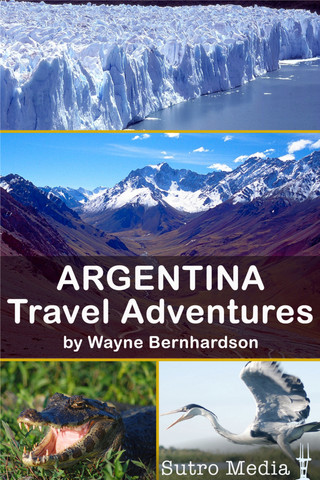
Soon, as the new edition of Moon Handbooks Chile comes out later this month, I will have a contest to give away some free copies on this blog. In the meantime, for those of you have an iPhone, iPad or iPod Touch, I am giving away ten copies of my Argentina Travel Adventures and Chile Travel Adventures apps, with no strings attached.
Simply write me at southerncone (at) mac.com, and I will send a code for a free download of either Argentina or Chile, up to a total of ten (no more than one per person, please). For those of you who use Android devices, I regret that Google does not permit such promotions, so you’ll have to shell out US$2.99 (which presumably should not break your budget).
Custom Search