Wednesday, August 24, 2011

Surfin' Tango


At first glance this might seem off-topic to a post on Buenos Aires but, last Saturday night, my wife and I went to see Los Straitjackets at the Great American Music Hall in San Francisco. After all, the Straitjackets are a Nashville-based instrumental surf music band whose members all wear Mexican lucha libre wrestling masks on stage. While they sometimes play with guest vocalists, they almost never sing, and only speak to introduce their songs in broken Spanish.

All that said, there is a Buenos Aires connection here – a few years ago, in the basement of the downtown Club Unione e Benevolenza (the Italian Benevolent Union, pictured above), I saw the Straitjackets’ lead guitarist Danny Amis – also known as Daddy O Grande – on the same stage with the local surf bands Los Kahunas and The Tormentos. Yes, you read right – however improbable it might seem, there is a surf music scene in the birthplace of the tango. For the finale performance of “Pipeline,” not another musician could have fit on stage.

What’s more, surf music and tango are not incompatible, at least to judge from the work of Daddy O Grande and The Tormentos. In 2009, they performed “La Cumparsita” – possibly the most famous of all tangos, composed by the Uruguayan Gerardo Matos Rodríguez – on stage in Buenos Aires. The venue appears to be Palermo’s Niceto Club.

Unfortunately, Daddy O Grande did not appear with the Straitjackets last Saturday, as he is under treatment for multiple myeloma. The group’s tour continues in the Pacific Northwest and tonight, August 24, there will be a benefit concert for him in Boston. At none of these events, unfortunately, are you likely to hear “La Cumparsita.” Those of you in Buenos Aires may well hear it at Festival y Mundial de Tango, the tango festival and dance championship that continues through August 30 - but without that distinctive surf guitar.

Moon Handbooks Buenos Aires in Belmont (San Mateo County)
Next Tuesday, August 30, will mark the third of several digital slide presentations on the fourth edition of Moon Handbooks Buenos Aires, at various branches of the San Mateo County Library. The Tuesday event starts at 7 p.m. at the Belmont Library (1110 Alameda de las Pulgas, Belmont CA 94002, tel. 650/591-8286). There will be ample time for questions and answers, and books (also including Moon Argentina and Moon Chile) will be on sale (at a discount).

Help Support Southern Cone Travel
If you have found this article informative, please consider clicking on one or more of the AdSense links that accompany it - always presuming, of course, that it’s a product or service that interests you.

Friday, August 19, 2011

Capybaras in California?


I first saw a capybara, a rodent roughly the size of a Rottweiler, on a 1976 boat trip down the Río Napo, an Amazon tributary in the Oriente region of Ecuador. Along with several other gringos, I was a passenger on a motorized dugout from Misahuallí to the then remote oil camp of Coca, through a lush, humid tropical rainforest environment. One of the most exciting things we saw was an enormous capybara dog-paddling from the river’s southern shore toward the north.

We grew even more excited, or rather alarmed, when the dugout's crew turned sharply and began to club the animal with their oars (on board in case the motor failed). For the passengers, most of us Europeans, the capybara was an exotic animal whose sighting was something unique in our lives; for them, living in the rainforest, it was dinner.

Since then, I’ve seen hundreds if not more capybaras, most notably in Argentina’s Esteros del Iberá wetlands, where they tamely graze the lawns at Estancia Rincón del Socorro and the visitors center at the provincial reserve. I’ve never even seen them in a zoo elsewhere, so I was surprised to read that, according to the San Luis Obispo Tribune, a carpincho (to use the Spanish word) has been sighted in the California town of Paso Robles. It’s believed to be an escaped pet, though it’s not legal to keep capybaras in California.

Apparently that’s alarmed some people, but it shouldn’t. Despite its size, the capybara is an innocuous herbivore that keeps a respectful distance from human beings – as you might if a riverboat crew ever thought of clubbing you on the head. It’s worth mentioning that, in Argentina, they are bred in captivity, with their spotted leather highly prized for clothing and coverings for souvenir items such as mate gourds.

El Rincón: A Sad Farewell

While traveling to southern Chile, I have always spent an overnight at the gracious German guesthouse El Rincón, just north of the city of Los Ángeles (about 500 km south of Santiago, close to Parque Nacional Laguna del Laja, pictured above). Last month, though, its host Winfried Lohmar died suddenly and his widow Elke has decided to sell the property. It’s a lovely house, on wooded grounds with extensive vegetable gardens, and suitable to continue as accommodations or for another purpose.

The price is 150,000,000 Chilean pesos, about US$320,000 at the current exchange rate. For more details, contact Elke Lohmar’s daughter Silke (slohmar_2000@yahoo.com).

Moon Handbooks Buenos Aires in Atherton (San Mateo County)

Tomorrow, August 20, will mark the second of several digital slide presentations on the fourth edition of Moon Handbooks Buenos Aires, at various branches of the San Mateo County Library. The Saturday event starts at 2 p.m. at the Atherton Library (2 Dinkelspiel Station Lane, Atherton, CA 94027, tel. 650/328-2422). There will be ample time for questions and answers, and books will be on sale.

As I mentioned earlier this week the town of Atherton, one of the Bay Area’s wealthiest communities, has strong South American connections – Massachusetts-born Faxon Atherton, for whom the city is named, spent 27 years as a merchant in the Chilean port of Valparaíso, married a Chilean woman who gave him seven children, and lived in California from 1860 until his death in 1877. He also owned large tracts of present-day Hayward and Watsonville.

Help Support Southern Cone Travel
If you have found this article informative, please consider clicking on one or more of the AdSense links that accompany it - always presuming, of course, that it’s a product or service that interests you.

Tuesday, August 16, 2011

The Huella Andina: Northern Patagonia's New Trekking Trail


Begun over a decade ago, the Sendero de Chile is an ambitious project to create a foot, bicycle and horseback trail that runs the length of one of the world’s longest countries. Argentina hasn’t yet attempted anything quite so ambitious but, soon enough, a 560-km Huella Andina (Andean Trail) through five northern Patagonian national parks should unite Lago Aluminé, in Neuquén province, with the Baguilt area near Trevelin, in Chubut province.

Like the Sendero de Chile, the Huella Andina will integrate a series of existing forest footpaths to provide a long-distance hiking alternative that could become a major trekking attraction – perhaps comparable to California’s 211-mile (340 km) John Muir Trail through the Sierra Nevada. From north to south, it will pass through Parque Nacional Lanín, Parque Nacional Nahuel Huapi, Parque Nacional Los Arrayanes, Parque Nacional Lago Puelo and Parque Nacional Los Alerces. It will also pass through equally scenic areas such as El Bolsón, which are not (yet, at least) part of any national park.

Another way of considering the trail may be “From the Araucarias to the Alerces.” On the Argentine side of the Andes, as in Chile, the monkey puzzle tree and the false larch (also known as Patagonian cypress) are both endemic species with a small geographical range. Araucaria araucana (pictured above, it bears the name pewen in the indigenous Mapudungun language) starts just north of Lago Aluminé and ends around the latitude of San Martín de los Andes, though some may have been introduced into Nahuel Huapi. The alerce (Fitzroya cupressoides) has an even smaller range, nearly limited to its namesake national park (the photograph below displays one of the finest specimens).

About midway, the Huella Andina will visit another arboreal attraction – just south of Villa La Angostura, hikers will pass through the myrtle forests of Los Arrayanes (pictured below). While it has a far greater range than either the Araucaria or the alerce, the finest specimens of this red-barked, glossy-leave species are found on this narrow peninsula that juts into Lago Nahuel Huapi).


Moon Handbooks Buenos Aires in Atherton (San Mateo County)
Next Saturday, August 20, will mark the second of several digital slide presentations on the fourth edition of Moon Handbooks Buenos Aires, at various branches of the San Mateo County Library. The event starts at 2 p.m. at the Atherton Library (2 Dinkelspiel Station Lane, Atherton, CA 94027, tel. 650/328-2422). There will be ample time for questions and answers, and books will be on sale.

Atherton, one of the Bay Area’s wealthiest communities, has strong South American connections – Massachusetts-born Faxon Atherton, for whom the city is named, spent 27 years as a merchant in the Chile's World Heritage port of Valparaíso, married a Chilean woman who gave him seven children, and lived in California from 1860 until his death in 1877. He also owned large tracts of present-day Hayward and Watsonville.

Help Support Southern Cone Travel
If you have found this article informative, please consider clicking on one or more of the AdSense links that accompany it - always presuming, of course, that it’s a product or service that interests you.

Friday, August 12, 2011

Friday Feast: Peruvian Food, Antarctica & Buenos Aires Live

Today's entry covers Peruvian cuisine, a new shortcut to Antarctica, and a reminder about an upcoming Buenos Aires event.

South America's Finest Food

In last month’s Condé Nast Traveler, my friend Patrick Symmes – author of the classic travelogue Chasing Che – turned his talents to writing about Peruvian food. In describing the dining scene in Lima, Patrick may have indulged in hyperbole with his comment that “Buenos Aires is so over” - the Argentine capital’s food scene remains one of the world’s most vibrant. Still, I can’t fault him for pointing out that Peru’s cuisine, from its Pacific shores to the heights of Machu Picchu and above, is the finest on the continent. Even longtime Buenos Aires Herald food writer Dereck Foster agrees that its variety of diverse fresh seafood, native Andean grains like quinoa, and appetizingly creative versions of the humble potato (a Peruvian domesticate) is unmatchable.

In fact, Peruvian food has made major inroads in both Buenos Aires and Santiago, what with restaurants such as Astrid y Gastón (in both cities), Bardot (Palermo), Lucumma (Belgrano), Puerto Perú (Providencia) and Barandiarán (Providencia and Barrio Bellavista). It’s even taken off in the provinces, where I recently had excellent Peruvian dinners in the Chilean cities of Puerto Montt (at Cantolao) and Concepción (at Las Américas), and the Colchagua valley wine country town of Santa Cruz (at La Casita de Barreales).

What’s surprising in Argentina and Chile is that, except in the provinces, it’s hard to find llama on the menu. In the early 1980s, when I lived in the far northern Chilean village of Parinacota while doing research on llama and alpaca herders in the altiplano, this lean meat was a frequent part of my diet. As the above photograph from the Quebrada de Humahuaca might suggest, the llama is a common sight in northwestern Argentina, and I’ve eaten its meat in the city of Salta (at José Balcarce, with a sunflower seed sauce) and the wine country town of Cafayate (at Macacha). Somehow, sadly, this cocina de altura (high-altitude cuisine) doesn’t seem to make it to the lowlands metropoli.

For those of you interested in Peruvian food, but unable to visit South America at present, an accompanying Condé Nast article offers dining suggestions for anyone living in Los Angeles, New York City and San Francisco.

A Chilean Shortcut to Antarctica?
According to Montevideo-based Mercopress, the Chilean navy has built a new lighthouse on the Grupo Sandwich islets at the south end of Bahía Cook in the Tierra del Fuego archipelago. In principle, this would permit Antarctica-bound vessels, including cruise ships, to bypass the Beagle Channel, saving up to eight hours en route to the frozen continent.

Whether that will be sufficient to make vessels such as Chile’s own Antarctic Dream to prefer the city of Punta Arenas, rather than the Argentine port of Ushuaia back to is open to question. At present, Ushuaia is a full day’s sailing closer to Antarctica than Punta Arenas and, given the ease of flying into Ushuaia, Antarctic Dream switches its departures and returns to Ushuaia.

Moon Handbooks Buenos Aires in San Carlos (San Mateo County)
Just a reminder that tomorrow, August 13, will mark the first of several digital slide presentations on Moon Handbooks Buenos Aires, at various branches of the San Mateo County Library. The event starts at 2 p.m. at the San Carlos Library (610 Elm Street, San Carlos, CA 94070, tel. 650/591-0341). There will be ample time for questions and answers, and books will be on sale.

Help Support Southern Cone Travel
If you have found this article informative, please consider clicking on one or more of the AdSense links that accompany it - always presuming, of course, that it’s a product or service that interests you.

Tuesday, August 9, 2011

Eternity with Evita? the Crypt Brokers of Recoleta

An aerial view of Recoleta Cemetery
It’s a common aphorism that it’s cheaper to live extravagantly all your life than it is to be buried in the Cementerio de la Recoleta, the elite boneyard of Buenos Aires. My own description of the cemetery, in the current editions of Moon Handbooks to Argentina and Buenos Aires, argues that it’s even more exclusive than the surrounding neighborhood, which has some of the city’s most valuable real estate: “enough cash can buy an impressive residence, but not a surname like Alvear, Anchorena, Mitre, Pueyrredón or Sarmiento.”
A fixer-upper on the resale market
Well, I may have been wrong. According to the Buenos Aires daily Clarín, the Buenos Aires real estate market has its own post-mortem sector with so-called “crypt brokers.” At present, about 20 percent of Recoleta’s tombs are on the market, at prices ranging from US$20,000 fixer-uppers (like the one above) to US$500,000 luxury lodgings; prices also vary within Recoleta because, as the real estate cliché goes, everything depends on “location, location, location.”

By this standard, the median price of roughly US$250,000 could conceivably purchase an apartment overlooking the cemetery, but you would enjoy that only as long as you lived. On the other hand, if you invest the same amount of money in the cemetery itself, you could find yourself spending eternity alongside…Eva Perón! On the crypt next to Evita’s, the owner has placed a small “for sale” sign with his email address (dsabelli@hotmail.com) and, according to Clarín, he’s received about 20 to 30 messages since putting it on the market in January.
Tourists gather outside Evita's crypt.
Given that Evita’s tomb is the most visited in all of the Recoleta, anyone interred next door will at least get a few curiosity seekers awaiting their turn to see the former first lady’s final resting place, as in the photo above (these are not potential buyers lined up for the open house). On the other hand, those who need more immediate gratification might consider looking to buy her apartment at Posadas 1567 (pictured below), less than five blocks from the cemetery gates.
In life, Evita lived not so far from her final resting place.
Moon Handbooks Buenos Aires in San Carlos (San Mateo County)
This coming Saturday, August 13, will mark the first of several digital slide presentations on Moon Handbooks Buenos Aires, at various branches of the San Mateo County Library. This week’s event starts at 2 p.m. at the San Carlos Library (610 Elm Street, San Carlos, CA 94070, tel. 650/591-0341). There will be ample time for questions and answers.

Help Support Southern Cone Travel
If you have found this article informative, please consider clicking on one or more of the AdSense links that accompany it - always presuming, of course, that it’s a product or service that interests you.

Friday, August 5, 2011

Big Water, Monumental Buildings & Mine Rescues

Today's entry touches on Argentina's Iguazú falls, Chile's remote Aisén region, and an important exhibition on the Chilean mine rescue of 2010.

Big Water Gets Bigger

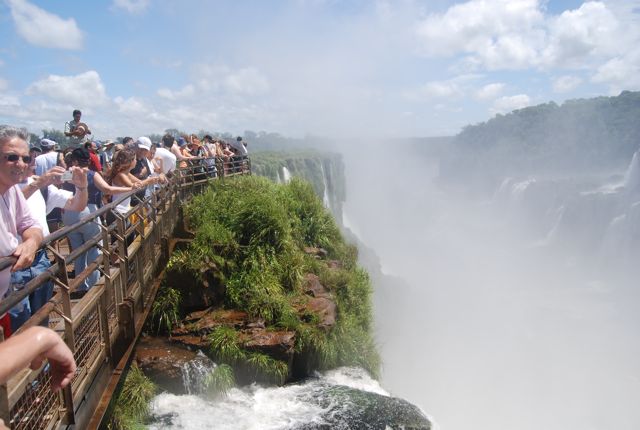
In the indigenous Guaraní language, Iguazú means “big water” and, for anyone bound for Parque Nacional Iguazú and its magnificent Cataratas in this southern winter, that means good news and bad news. First the good news: temperatures are mild (upwards of 70° F for the next several days) and the falls are even more spectacular than usual. That’s because, thanks to heavy rainfall in the Río Iguazú’s upper drainage in Brazil, the falls are carrying 13,000 cubic meters of water per second, about eight times their normal flow of 1,500.

The bad news is that the flow is so heavy that national park authorities have had to close the observation deck opposite the Garganta del Diablo, the single most impressive of the nearly 300 separate falls. Even with normal runoff, the deck (pictured above) gets plenty of spray from the falls, so that visitors sometimes wear rain gear on bright sunny days.

At present, though, the increased flow makes it dangerous and slippery (nobody wants to go over the Garganta del Diablo, in a barrel or otherwise). At the same time, the excursion boats that approach the falls from below have also been suspended. With the storms ending in Brazil, Iguazú should return to normal in a few days at most.

Puerto Puyuhuapi: a Monumental Event

Much farther south, the town of Puerto Puyuhuapi, where Luisa Ludwig lives, is part of dankest Patagonia – winter gets wet and cool on the Chilean side of the Andes. August rainfall averages 401 mm (about 16 inches), but there’s a ray of sun this month - her Casa Ludwig B&B (pictured above) is the first private building to be designated a national historical monument in Chile’s southern Aisén region.

Luisa’s parents were among the 1930s Sudeten German pioneers at Puerto Puyuhuapi, which has become well-known for its custom carpet factory Alfombras de Puyuhuapi, which sends its products around the world (the photo above is one of weavers, from the island of Chiloé; the photo below is a finished product). The monument designation limits what can be done with Casa Ludwig – the exterior cannot be altered – but Luisa’s happy with the results: “Actually we asked for the declaration. We find the house beautiful as it is. And maybe it can be good publicity.”

Rescue at the Smithsonian
For those of you fortunate enough to live in Washington DC – despite the manufactured political crisis of the past several weeks, there are good things about DC, where I once spent a semester teaching at George Washington University – there’s something worth seeing starting today. With sponsorship by the Chilean embassy, the Smithsonian Institution’s Natural History Museum will host the exhibition “Against All Odds: Rescue at the Chilean Mine” as the first anniversary of the successful evacuation of the collapsed San José mine near Copiapó approaches. The Chileans, at least, can get things done; among the objects on display will be the actual rescue capsule that brought the miners to the surface (claustrophobics may want to stay away).

Help Support Southern Cone Travel
If you have found this article informative, please consider clicking on one or more of the AdSense links that accompany it - always presuming, of course, that it’s a product or service that interests you.

Tuesday, August 2, 2011

Winter Whale Watch: the Word from Madryn


Recently I wrote about the Southern Cone winter, stressing skiing in Argentina and Chile, but the Patagonian coast is also a worthwhile winter destination – in Argentina, at least. Except in the desert north, where upwelling from the Humboldt Current keeps the waters cool all year, the Chilean coastline tends to be wet and inhospitable in winter.

On the Argentine side the climate can be cool but, by contrast, the air is dry and the famous Patagonian winds tend to abate at this time of year. That’s partly why coastal Chubut province, in particular, has become a popular destination for Argentine winter holidays.

Primarily, though, it’s the abundance of wildlife on nearby Península Valdés that gives the city of Puerto Madryn (pictured at top, courtesy of María Alicia Sacks) a longer tourist season than most of the region. The village of Puerto Pirámides (pictured above and below), which is actually on the peninsula, is more convenient for watching the southern right whales that frolic along the eastern shore of the Golfo Nuevo, but its accommodations and other services are fewer than the larger city’s.

Consequently, most visitors to the region stay at Madryn and visit Valdés as a day trip – although, in fact, whales also breach beneath the headlands at Playa El Doradillo (pictured below, courtesy of María Alicia Sacks), only 15 minutes from downtown. This year, though, the June eruption of Chile’s Volcán Puyehue has reduced air travel to the city, which is 1,300 km south of Buenos Aires, making long-distance buses the preferred option. That’s a 20-hour marathon from the capital, but services range from merely comfortable to fully reclining seats that provide nearly as much space as business class on international flights.


The View from Buenos Aires and Puerto Madryn
For the latest from the region, I recently exchanged emails with two friends, Silvina Garay of Say Hueque Travel in Buenos Aires and María Alicia Sacks of Puerto Madryn’s municipal Secretaría de Turismo. I translate their comments in the following paragraphs.

WBB: Has the ashfall affected flights to Puerto Madryn and Trelew?

Silvina Garay: Yes, Puerto Madryn’s airport is very small and normally has only a few flights. All the same Madryn, and the principal airport at Trelew, have had no flights for a month. Most of our clients have decided to take buses.

María Alicia Sacks: The real problem is that suspended ash is keeping the flights from arriving. This is because of the ash plume that’s blowing over Patagonia and, depending on the wind, is reaching our coast, just as it’s affected Aeroparque [Buenos Aires’s domestic airport) and Ezeiza [the capital’s international airport].

WBB: Have you noticed any reduction in the numbers of foreign travelers because of the volcano, as they would usually travel by plane?

SG: It’s really hard to measure because it’s low season here, when passenger numbers always decline. And we don’t work much with the Brazilian market, which is the biggest national market in winter. It’s true that most of our clients travel by plane, but we haven’t received any abnormal number of cancellations because of the ash.

WBB: What about the whale-watching season at Península Valdés? Has demand for hotels and tours fallen because of the volcano?

SG: I can’t say in detail. From our point of view [in Buenos Aires], it’s about the same as last year.

MAS: All the services are operating fully. Just the other day we had a great whale-watching trip in Puerto Pirámides.

WBB: Is there anything else worth mentioning?

SG: I would re-emphasize that Península Valdés and Bariloche are both destinations with good long-distance bus service. Many of our clients who had to take the bus because the ash closed the airports were glad they did so.

MAS: I can’t say exactly when the flights will start up again. It all depends on the ash. Clearly this has had an economic impact on us.

Help Support Southern Cone Travel
If you have found this article informative, please consider clicking on one or more of the AdSense links that accompany it - always presuming, of course, that it’s a product or service that interests you.

Friday, July 29, 2011

Skinny Houses & Luxury Landmarks


Earlier this month, New York’s narrowest house – a mid-19th century construction in Manhattan that’s only 2.4 meters (less than eight feet) wide - went on the market for US$4.3 million. By that measure, Buenos Aires’s Casa Mínima, in the colonial barrio of San Telmo, is a mansion that sprawls across its 2.5-meter facade on the cobbled colonial alleyway of Pasaje San Lorenzo (dating from 2008, the photograph above includes the adjacent building, which has a normal frontage).

Dating from the early 19th century, the Casa Mínima is no longer a residence and is not for sale (the photograph above dates from the 1930s). An improbable legend says it was a manumission gift from a slaveholder to his former chattel, but it now belongs to businessman Jorge Eckstein. Eckstein has made it part of El Zanjón de Granados, an events center that sits atop a warren of colonial tunnels (pictured below) that are now open for tours.

For anyone who wants an idea of what it might be like to live in such small quarters, and can’t afford Manhattan prices, a tour of the Casa Mínima offers an alternative budget option. The house’s narrow entrance leads onto a slightly wider patio (pictured below) where the former kitchen sits and a wall-hugging staircase leads to an even narrower bedroom, which features a street-side balcony directly above the exterior doorway.

And Now for Something Completely Different

About 2-1/2 years ago, I wrote about Lord Alain Levenfiche’s attempt to sell his 14th floor apartment in Retiro’s Edificio Kavanagh, the landmark building that will celebrate its 75th anniversary this year. According to the Buenos Aires daily Clarín, Levenfiche has upset his consortium neighbors, who value their privacy highly, by gutting the historic interior for a remodel and renting it out for meetings and events – “turning it into a tacky nightclub,” according to one resident. Strangers come and go at all hours.

Overlooking Plaza San Martín, the apartment, once occupied by the building’s original owner, Corina Kavanagh, remains on the market. Levenfiche has lowered the price to just US$4.5 million – making it just a tad more expensive than the narrowest house in Manhattan. Unfortunately, unlike the Casa Mínima, the Kavanagh is not open for tours; unless we decide to make an offer, neither you nor I are likely ever to see its interior.

Help Support Southern Cone Travel
If you have found this article informative, please consider clicking on one or more of the AdSense links that accompany it - always presuming, of course, that it’s a product or service that interests you.
Custom Search