Saturday, January 12, 2013

Modernizing the Subte?


For decades now, riding Línea A of the Buenos Aires Subte – Latin America’s oldest underground railway – has given its regular patrons and tourists alike the sensation of riding though history. Yesterday that became literally true, as municipal authorities shut down the line for two months and, when it reopens, the classic wooden Brugeoise carriages that have, served the former Compañía de Tranvias Anglo Argentina (CTAA) will no longer operate. With minor makeovers, those carriages had operated since 1913, so they fall just days short of a century.
According to the Buenos Aires Herald, they comprise “70 carriages out of the original fleet … of an original total of 120 carriages, built by La Brugeoise, Nicaise et Delcuve between 1912 and 1919 in Belgium.” On one level, that’s a pity, because their outward solidity and the craftsmanship of their burnished wooden interiors evoked a period when Argentina’s future seemed bright, and the decades of political turmoil that began with the 1930 military overthrow of President Hipólito Yrigoyen were yet unimaginable. In recent years, political conflict has paralyzed the system, as the federal and city governments have argued over who should operate the system, and pay for it.

Despite their picturesque patina, the historic cars had outgrown their usefulness. They shook on the rails and, frequently, their sliding doors would not close properly – or not at all. I’ve never heard of anyone falling from a moving car, but it wouldn’t have surprised me. During the suspension of service, the city government will retrain its personnel and install electrical upgrades to accommodate 45 new Chinese carriages; 30 others from Italy’s Fiat are already in operation.

According to the city daily Clarín, nostalgic Porteños overran the line yesterday with cameras and cell phones yesterday to snap the final hours of the historic cars, but the question remains what to do with them. Apparently, the operators will retain some 15 cars and, presumably, some might be in good enough condition to operate them as a tourist attraction on weekends, when ridership is lower. That leaves another 55 or so to dispose of, and municipal culture secretary Hernán Lombardi made an ambiguous suggestion that they could serve as libraries in city parks – it was unclear whether he was proposing placing intact cars in the parks or dismantling them for the wood, in order to build new structures. In the former case, they would probably suffer vandalism by the same tasteless taggers who have already defaced so many of them.
In other rail-related news, Argentina’s federal government has announced similar overhauls on the Mitre and Sarmiento suburban rail lines, which will receive 409 new Chinese-built coaches to replace the dilapidated, vandalized cars that now operate on both systems. The notoriously ruinous Sarmiento line was the site of a major crash that killed 52 passengers last February at Estación Once de Septiembre (pictured above in 1900, and below immediately after the crash with the damaged area screened behind the policeman).
Both the Subte and suburban lines, particularly the Sarmiento, have been the victims of disinvestment that have made them uncomfortable and even dangerous. This has been the fault of successive federal governments that have suppressed fares at rock-bottom levels in the interest of “social peace,” but it apparently took major fatalities to spur the current administration into action.

At the same time, the federal government has deplored the city’s apparent intention to raise Subte fares to 3.50 pesos, about 70 US cents at the official exchange rate. It’s worth noting that in Chile, where general price levels are roughly comparable to Argentina, fares on Santiago’s immaculately maintained Metro system range from 590 to 670 pesos (roughly US$1.25 to US$1.45), depending on the time of day. If the new Subte fares take effect, they will have tripled in a year, but they’re still a bargain by almost any standard.

Wednesday, January 9, 2013

Painting the Walls: Murals of Buenos Aires


Buenos Aires has 48 barrios, and their inhabitants often identify with their neighborhoods as strongly as New Yorkers do with the boroughs of Brooklyn, Manhattan or Queens. Most tourists visit only a handful of those barrios and, though I myself live in BA part of the year, I know only a few of them in any depth. Some are simply below the radar – I’ve never been close to Villa Devoto, which is infamous for its namesake prison – but over the years I’ve expanded my geographical horizons and, sometimes, I’ve simply stumbled onto surprising sights.
That happened a few weeks ago when, after finishing an outstanding Asian dinner at the “closed doors” restaurant Cocina Sunae in the northwestern barrio of Villa Ortúzar (which to the best of my knowledge I had never visited before), I left to catch a bus back to Palermo. As I walked toward the bus stop and, under dim lights at the intersection of Roseti and 14 de Julio streets, I used my phone to photograph a startling mural that, I have since learned, depicts a Sudanese woman with what the city daily Clarín aptly calls “an enigmatic smile.”
Murals, the Clarín article points out, are not unusual in Buenos Aires, though from my experience they’re more common in more self-consciously artistic barrios such as San Telmo. Infamously, a few years ago, a demolition on Avenida Independencia destroyed a vivid mural of the barrio's bygone Afro-Argentine Carnaval celebrations.
Personally, I deplore brainless tagging that defaces public and private property, though I’ll acknowledge that, on occasion, unauthorized art of the sort that BA Graff (pictured immediately above) leaves on some Barrio Norte walls shows some genuine talent. In the case of the Villa Ortúzar mural, I was pleased to read that the two young painters, Sacha Reisien y Nicolás Germani, are twenty-something cousins who make a point of seeking permission for their work, which now numbers some 20 sites around the city.  They painted the mural at top, whose title is Expresiones 2 (Expression 2), in just two days. Some of their work is done with spray paint, but most of it with latex.

The two cousins’ website, Primo Murales, chronicles the development of all their murals through before and after photographs. It also includes Google Map locations, so that visitors to the city can undertake a self-guided tour – rather than simply stumbling upon their work, as I did.

Saturday, January 5, 2013

Breathing Easier in Chile


It’s been a long time coming but, as of March, visitors to Chile – and Chileans themselves - will be able to enjoy cleaner indoor air. At long, long last, the Chilean Congress has approved a law expanding current tobacco-control legislation to the entirety of restaurants, bars, discos and most other enclosed locations. Tentatively taking effect when the school year begin, it will also restrict tobacco advertising in a country that, unfortunately, suffers one of the highest levels of nicotine addiction in the Americas.
At present, the law only requires restaurants to set aside smoke-free areas if they serve customers under age 18, which has meant in practice that many restaurants have caved into the smokers’ lobby – tobacco companies’ influence over legislation has been notorious – and simply refused to accommodate families and, by extension, non-smokers. Under the new legislation, they will have not have that option; apparently, the only area open to smokers will be sidewalk seating and perhaps patios and terraces. That’s still not ideal – the air indoors will be cleaner than outdoors – but it’s a big improvement. Sitting indoors, I will now take a chance on some restaurants that I would not even have considered before.

One strength of the Chilean law is that it will prevail nation-wide, unlike in Argentina, where tobacco-producing provinces such as Salta need not conform to the norms of Buenos Aires, where tobacco control has been surprisingly effective. Given that Argentines are, often, greater scofflaws than Chileans, it’s been a revelation to see how effective the legislation there has been. Now if they could only get smokers to stop flicking their butts onto the sidewalk and into the gutter.

The new Chilean law appears to have one other major shortcoming: health minister Jaime Mañalich himself has criticized a clause that lets stadium administrators set aside areas for smokers; this could make soccer matches problematical, as their crowds can get rowdy (though not so rowdy as those in Argentina). It also leaves open the question of open-air concerts: in her Santiago appearance last month, Madonna berated smokers in the crowd and walked offstage in protest. In future appearances, the US$150 non-smoking fine could conceivably double the price of their tickets.

Andean Pass Closed
On New Year’s Eve, a fire destroyed the customs post on the Chilean side of the border at Paso Cardenal Samoré, the second-busiest overland crossing between Chile and Argentina. Incinerating US$700,000 worth of computer equipment in addition to the structure itself, the blaze will close the border until at least January 15.
This will require tourists and commercial traffic bound for the Argentine lakes district destinations of Villa la Angostura and San Carlos de Bariloche to make a 550-km detour north to Pucón and over the Mamuil Malal pass. The effect will be roughly comparable to what happened in mid-2011, when the eruption of the Puyehue-Cordón Caulle volcano closed the border for several months, but hopefully this disruption will be shorter.

Wednesday, January 2, 2013

Passing (on) the Salt?


Most people, especially overseas travelers, appreciate that excessive consumption of red meat is a health hazard, especially for those at risk of heart disease. Still, in the Southern Cone countries of Argentina, Uruguay and Chile, where beef products dominate the traditional diet and the quality is often high, it’s hard to resist the temptation of a succulent bife de chorizo (roughly comparable to a porterhouse).
That said, Argentines and their neighbors are increasingly diet-conscious, and many are reducing their beef consumption in the interest of health. If you’re on a two-week Argentine holiday, and intend to enjoy the best the Pampas have to offer, this may not be a major issue, presuming you return home to a more balanced diet.

Beef, though, isn’t the only issue. For decades, at family asados (barbecues) in Argentina, I’ve seen the cook cover the meat in so much salt that it looked like snow (OK, that’s hyperbole, but you get the idea). My friend Dan Perlman, who runs the ironically named Casa SaltShaker restaurant out of his Recoleta apartment, does not provide salt at the table unless his guests specifically request it: “I see here, time and again, people who don't even taste their food, who will actually take the top off the saltshaker and pour the salt over the food so it looks like snow-capped peaks.” Most of his patrons are foreigners, but Argentines are not uncommon.

That’s why it surprised me to read recently, in the Buenos Aires daily Clarín, that Buenos Aires province (whose beaches are the No. 1 vacation destination for city residents) will prohibit the presence of salt shakers on restaurant tables this summer – unless, of course, diners ask for them. This is specifically for public health reasons, given salt’s contribution to high blood pressure; according to provincial statistics, 3.7 million of the province’s roughly 15.6 million inhabitants suffer from hypertension, and half of them ignore the issue.

Dan, for his part, is skeptical about the measure’s effectiveness: “I doubt those people will make any changes in the way they eat. And this whole no saltshakers on the table thing has been in play for three years now. Each summer they've made a big announcement that it's going into effect, and each summer it never does. I'm not holding my breath.”

Having suffered from cardiac problems myself, I have fortunately avoided hypertension issues, and I don’t particularly care for salt. I spend much more time in the capital than in the province, but I do find it encouraging that city restaurants no longer flinch when I ask them to prepare a meat dish without salt while, just a few years ago, they might have looked at me as if I had just arrived from Mars. Eschewing salt is still a little unusual in the Argentine provinces, Uruguay, and Chile, however.

Interestingly, in the Falkland Islands, beef per se is a relatively minor issue, because the overwhelming percentage of grazing animals are sheep – when I lived in the Islands for a year plus, in 1986-7, we were only able to obtain beef in the winter months, when they were slaughtered on the outer islands and shipped to Stanley by coastal freighter – tied to the deck by ropes in winter temperatures, the meat kept well until it arrived to town.
At that time, on the Islands, there was insufficient freezing capacity to maintain beef through the summer, while sheep – primarily raised for wool – were so abundant that they would normally be slaughtered and consumed on the same day or soon thereafter. For most of the year, mutton is still the main source of animal protein – lambs and other young sheep are simply too valuable for their wool.

Another note of dietary caution: In the Southern Cone countries, carne (commonly translated as “meat”) means beef – pork, chicken, lamb and the like are something else, commonly described as carne blanca (“white meat”). Unless they are careful, monolingual vegetarians who warn the waiter that they do not eat carne could well wind up with another sort of animal product on their plate.

Saturday, December 29, 2012

Comparative Amenities: Buenos Aires v. Santiago


Every year, the international consulting company Mercer publishes a survey that ranks cities of the world according to their quality of life and infrastructure. The 2012 survey covers some 221 cities around and, while the entire document is only available for a hefty price, some of the publicly released information deserves a look.

Invariably, the highest rated cities are in Europe, with a handful in North America (such as Vancouver) and Asia (such as Hong Kong and Singapore). I won’t go over the standards in detail, but eight US cities rank in the top 50 for quality of living (Honolulu is highest at No. 28), and nine for infrastructure (Atlanta is highest at No. 13). For quality of life, the world’s worst is Baghdad, while the worst for infrastructure is Port-au-Prince.
In South America, my chosen region, Mercer is less impressed than it is in Europe, Asia and North America. For quality of life, Montevideo (No. 77) ranks highest, with Buenos Aires (No. 81) and Santiago de Chile (No. 91) the next best. For infrastructure, Buenos Aires (No. 83) is tops, while Santiago (No. 89) and Montevideo (No. 96) lag behind.

That said, I have to question some of Mercer’s conclusions, or at least consider them to be oversimplifications. I spend a great deal of time in both Buenos Aires and Santiago, rather less in Montevideo, and one of the categories in the infrastructure survey is public transportation. Certainly, compared with most North American cities, both Buenos Aires and Santiago are far ahead in frequency – city buses operate 24/7 – and lower in cost.

In fairness, though, Santiago long ago outstripped Buenos Aires in quality of its public transportation, especially with the Chilean capital’s expanding and immaculate Metro system (pictured above). As Buenos Aires struggles to add stations to the continent’s oldest underground rail system, Santiago’s service is growing at the speed of light, relatively speaking at least, and now more than doubles the mileage of its trans-Andean counterpart.
Buenos Aires’s Subte also suffers from extensive vandalism, especially as the system has become a political football between the federal and city governments. With graffiti that saturates some cars and stations (as pictured above and below), sometimes even covering the windows so that passengers find it impossible to see out as their stop approaches, the Subte is simply a mess. On the Santiago Metro, by contrast, I have never seen even a hint of graffiti.
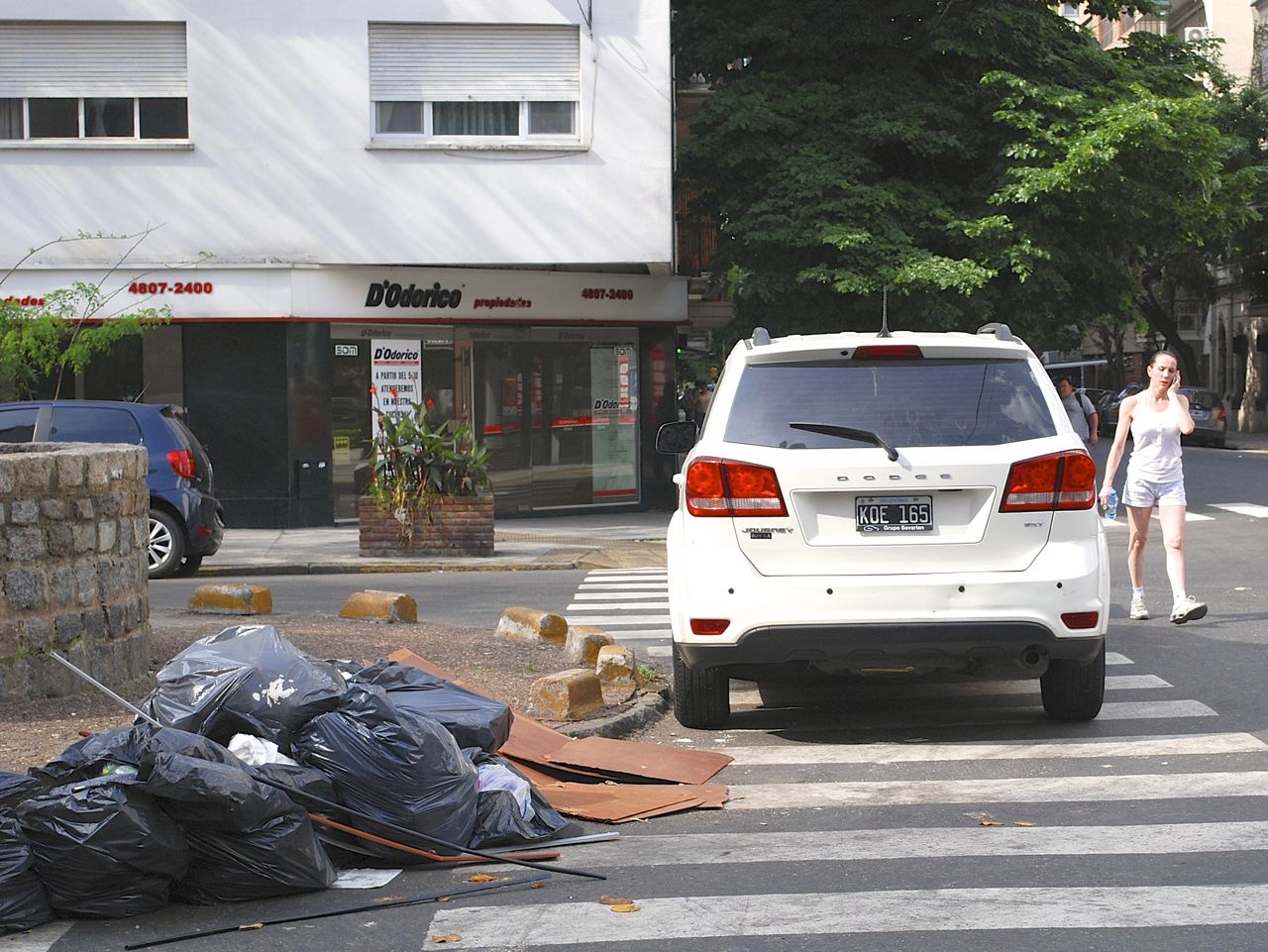
Recently, the Buenos Aires daily La Nación published a summary of urban problems that would suggest that Mercer’s survey overlooked many more issues: the deteriorating inter-urban rail system that killed 52 Argentines and injured 700 in a February crash; collapsing balconies that killed citizens on the sidewalks below; frequent power outages; floods that inundated city streets because the drainage system is inadequate; and overflowing garbage on the sidewalks (as pictured below).
With the definitive Subte transfer to the city, that problem may ease – already, authorities are closing Línea A for the summer to replace its picturesque but aging wooden cars, but even then, cleaning up damage from vandals on the rest of the system will take some time. On balance, I can’t see how Buenos Aires manages to finish ahead of Santiago on any infrastructure survey. I’ll have more to say about this, especially with regard to public transport, in the near future.
Custom Search