SinceMarch of 2020, when I fled Argentina and Chile with the onslaught of the COVID-19 virus, I’ve been not quite housebound, but have only managed scattered day trips in the Bay Area and the couple short road trips to California’s Central Coast and the Sonoma/Mendocino County shorelines. Like many others, I’ve spent more time than I might care to admit in front of the TV screen, streaming whodunits and other dramas before retiring early enough to let me walk the dog at daybreak. I've avoided travel shows, because they remind me of what I can’t do until the pandemic recedes (very tentatively, my wife and I plan to return to Buenos Aires in early March for a month).
Meanwhile, in the course of exploring streaming services, I stumbled across an oddball series, a sort of black comedy, set in North Carolina but with links to Argentina. In Good Behavior, which first showed on TNT in 2016 and 2017, English actress Michelle Dockery plays the role of Letty Raines, a resourceful thief and scammer with addiction issues, who’s out on parole and trying to regain custody of her pre-teen son. This rather differs from Dockery’s role as the aristocratic Lady Mary Talbot in the PBS historical series Downton Abbey (disclaimer: I am not a fan of British costume dramas, and have not watched more than a few minutes of that one, to which my wife is addicted).
Shortly after her release from prison, Letty stumbles upon a contract killing and does her utmost to stop it (albeit unsuccessfully). In the process, she becomes involved with Javier Pereira (Juan Diego Botto), an Argentine hitman with a conscience of sorts (Botto is in fact an Argentine who spent part of his youth in the US). The Pereira character is also a chef who sometimes works in the Argentine-style parrilla (grill restaurant) owned by his sister Ava (played by Botto’s real-life sister María in a sort of meta-role).
This Javier, in Oakland, is not a contract killer.
Javier is not a Hannibal Lecter wannabe, but he does have issues with his father Oscar (played by the Argentine-American Daniel Faraldo), who has a dark past of his own. There’s an additional complication in Ava’s ex-boyfriend Teo (played by Canadian actor Juan Riedinger), but there’s plenty of comic relief as well.
Unfortunately, TNT cancelled the show after two seasons, but it remains available on Hulu (no endorsement here, but there are 30-day free trials).
Support Southern Cone Travel
If you've found this blog informative and/or useful, please click a (hopefully appropriate) ad to earn me a few pennies.
At the end of last month, I wrote that my wife and I had postponed a planned trip to Buenos Aires because of the spread of the Omicron variant of the COVID-19 virus there. In addition, our route would have taken us through COVID-friendly Texas and, given the frequency of flight cancellations by American Airlines, it was possible we might have had an unwelcome delay of a day or more in Dallas/Fort Worth.
Mapping the heat wave, from Argentina's Servicio Meteorológico (in degrees C)
Very tentatively, we’re hoping to try again in March, but early January provided us yet another reason to justify our decision—a brutal heat wave that struck the Argentine capital and much of the rest of the country. In summer, of course, we would expect warm and even hot temperatures, but last week the mercury soared to 106° F (41° C) in the city and, in the north-central city of Córdoba, it reached 108.5° F (42.5° C). The western desert city of San Juan was a near-furnace at 111° F (44° C).
A few years ago, we reluctantly installed air-conditioning in our Palermo apartment, but we’ve never used it during our time there—our idea was that it would appeal to short-term rentals. Even that mightn’t have mitigated this heat wave, though, as there were power outages in much of the city. Global warming, anybody?
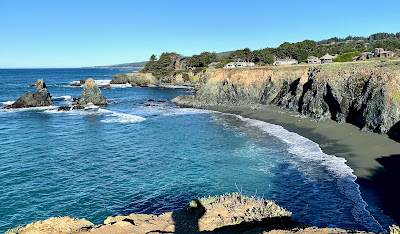
A typical landscape at Sea Ranch (note the houses in the background)
The town of Gualala (as seen from Sea Ranch)
With that in mind, we took a mini-vacation with our daughter, her boyfriend, and our two dogs, up the Sonoma County coast to Sea Ranch—an ostensibly eco-friendly development that I’m personally ambivalent about. The scenery resembles coastal Chile, the night skies sparkle, and there’s almost total silence except for occasional gobbles from wild turkeys outside your windows and waves crashing on the beach. Still, I find the supposedly cutting-edge architecture monotonous and the absence of any urban amenities bothersome—there’s no alternative to the automobile for transportation to the town of Gualala, some miles north, for essential shopping. In effect, Sea Ranch is a de facto “gated community” even though the State of California requires obligatory coastal access for non-residents.
The village of Mendocino, as seen from the nearby headlands
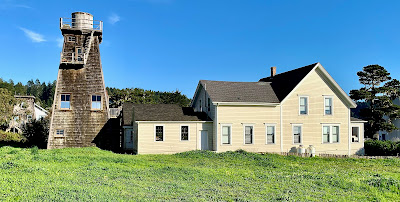
Some Mendocino water towers have been repurposed for residential use.
We spent four nights in a short-term rental house, arriving on a Friday afternoon and leaving the following Tuesday morning. Two full days is about my limit there but, given the late Friday arrival, Saturday and Sunday were dedicated to extended dog walks on the coastal trails (significantly cooler than Buenos Aires). On the Monday, though, we escaped north to the truly picturesque seaside town of Mendocino (population 855), where we walked along the coastal cliffs and explored its quaint architecture, including numerous water towers—some of them since converted to housing.
In popular culture, Mendocino has been a location for numerous films and TV series, but I recall it best for the 1968 hit song “Mendocino” by the Sir Douglas Quintet (Texas transplants to California whose producer chose the name to try to capitalize on the Beatles-inspired “British invasion” craze; the above video is a version by Sahm's later band, the Texas Tornados). Interestingly, my wife knew the song even before we met, as it was also a big hit in Argentina; though neither she nor her friends really understood the lyrics except for the title, they could dance to it.
Even more interestingly, the group leader Doug Sahm (born in San Antonio) was of German extraction and, I recently learned, Michael Holm (above) recorded a German-language version that became a chart-topper in then West Germany the following year. Does this explain the fact that the German real-estate firm Engel & Völkers maintains an office in Mendocino, and that all its window listings there are bilingual in English and German? Perhaps it does, as the comments on Holm's YouTube video include one by a German whose wife insisted he take her to visit there (German used to be my second language, but it’s now a distant third to Spanish and I couldn’t catch much of Helm’s lyrics).
Mendocino seems idyllic, but it’s not immune to the rest of the country’s problems. Almost everyone we saw in town was masked up but, not that long ago, the anti-vax owner of Fiddleheads Café posted notices that he would collect a surcharge for any client wearing a mask, and an additional charge for anyone who bragged about being vaccinated. He’s since gone out of business, but might still be welcome in Texas (in fairness, the state has great food and music despite its COVID-friendly politics).
Recently I dreamt that, having arrived at Buenos Aires’sAeropuerto Internacional Ministro Pistarini(commonly called “Ezeiza”), I was in a taxi to our apartment in the barrio ofPalermo—where my wife and I had been longing to go ever since the pandemic began. En route, though, I realized I’d left the keys at our California home—and then I awoke wondering whether that was a metaphor for the times we’re in. In fact, we’d planned to fly to Argentina this New Year’s Eve, and were eager to see friends and family in and around the Argentine capital, but I’d begun to have my doubts as news of the Omicron variant hit the country especially hard.
In fact, I’d contemplated postponing the trip a few days earlier, but María Laura was still committed to going until Monday, when she first expressed doubts and then consulted with siblings, nephews, nieces, and friends (some of whom are directly involved in the healthcare system there). Everyone concurred that the situation was worsening, and expressed doubts about the trip despite their eagerness to see us.
Argentina's vax rollout has actually been pretty good, but I couldn't resist posting this photo from my nephew's Parque Patricios neighborhood.
For our part, we are fully vaccinated and boostered, and live in an area where people take vaccinations and masking seriously, so we were never panic-stricken. That said, we could still theoretically be carriers, and we didn’t want to risk a breakthrough case that could put others at risk. We also worried, however, that flight cancellations and layovers might disrupt the trip—partly because San Francisco International Airport (SFO) is notorious for weather delays and also with respect to our connecting flight in COVID-friendly Texas. That state has great food and music, but deplorable government.
That said, we look forward to trying again in March or so. I might stay a bit longer than the month we originally planned on, as I’m starting to work on the upcoming sixth edition of Moon Patagonia—perhaps an excursion to Ushuaia is in order.
Meanwhile, in Chile…
Chile, of course, will be a key part of the Patagonia update, and its high vaccination rates have made it an example to emulate in handling the pandemic. It’s been circumspect about the entry of non-resident foreigners, though, and that seems likely to complicate the upcoming tourist season, even though more border crossings are opening with Argentina and its other neighbors. Still, there are fairly stringent requirements, including quarantine, and the Chilean bureaucracy has also been slow to acknowledge intending visitors’ vaccination status—according to a friend of mine who’s a permanent resident, a friend of his spent two weeks stranded in Lima because LATAM Airlines would not let him board a connecting flight.
Chile's border are reopening, at least in theory.
For me, as an independent traveler having to cross the border multiple times while updating my book, frequent retesting and quarantines would mean significant delays and expense. As the attached screenshot shows, that situation may be improving), but requirements are likely to change even more so that southern spring—October or November—seems more agreeable.
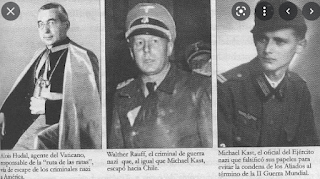
The losing candidate's late father, at right, was literally a Nazi.
Even so, Kast partisans’ accusations of extremism have continued, the “markets” were not pleased with the result, and the peso has slipped against the US dollar (any visitor so inclined could now eat a Weißwurst more cheaply at the Bavaria restaurant chain that is the basis of the Kast family fortune). Still, as Chile proceeds with a Convención Constitucional to draft a new constitution to replace the Pinochet-friendly document authored by the late rightist lawyer Jaime Guzmán, the challenges to a long overdue reform won’t disappear. The new charter must be approved by plebiscite but until then and even after, governing could be a challenge.
In Other News…
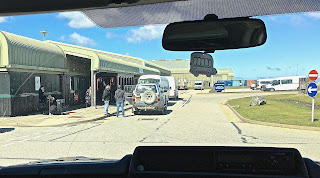
My Patagonia title also includes the Falkland Islands, where I once spent an entire year and have revisited at least half a dozen times. Except for my initial trip, when I flew from and back to the United Kingdom (with a memorable stopover on Ascension Island), I’ve always arrived via the southern Chilean city of Punta Arenas but, since the start of the pandemic, there’ve been no flights on that route, which requires overflying Argentine airspace.
The passenger terminal at the Falklands' Mount Pleasant Airport
In 1970, Chilean filmmaker Alejandro Jodorowsky released El Topo, a surrealist movie that seemingly created the Acid Western genre and was a Mexican entry for the Oscars (it was filmed in Mexico, but ultimately not nominated). This year, Chilean director Maite Alberdi’s El Agente Topo (The Mole Agent) is most emphatically not a sequel, but this rather differently offbeat picture earned a nomination for best documentary, even though it didn’t take home the prize last Sunday.
On one level, The Mole Agent is a real-life spy movie in which a private detective recruits Sergio Chamy, a charming 80-something widower, to infiltrate a nursing home where the detective’s client suspects her mother has been subject to elder abuse. This involves a crash course in surveillance techniques and technology for Chamy, whose sociability swiftly inserts him into a milieu where women outnumber men by ten to one.
Alberdi’s production crew filmed the entire work, with permission (but perhaps some deception), at the Hogar de Ancianos San Francisco in the Santiago suburb of El Monte, in an area I’ve visited as a lesser-known wine region. The finished film is an outgrowth of what was originally a more general focus on Chile’s aging population—by the end of this decade, it could be Latin America’s fastest-aging country, but that’s not what foreign tourists see.
With some minor shortcomings, the Hogar de Ancianos appears to be a well-kept facility, with comfortable accommodations and pleasant gardens, that provides attentive services to its residents. Chamy eventually frustrates his handler by insisting that there is no abuse but, in the end, he concludes that loneliness and familial neglect are major issues that don’t get the attention they deserve. When the popular Chamy finally departs the home, the result is more like a feel-good comedy than an exposé. In fact, it hardly feels like a documentary at all, and Alberti has stated that there’s interest in doing a fictional version—which she herself won’t do because she’s too invested in the one she’s just finished.
El Agente Topo is available for streaming on Hulu (with English-language subtitles, free trial available).
In 1939, as the Spanish Civil War wound down, thousands of refugees fled across the border into France—which then confined tens of thousands in a deplorable detention camp at d'Argelès-sur-Mer. In partial response, poet Pablo Neruda—also a diplomat—chartered the French cargo vessel Winnipeg to carry 2,200 Spanish refugees across the Atlantic and through the Panama Canal to his homeland of Chile where, despite isolated episodes of xenophobia, they integrated themselves into local society.
Chartered by Pablo Neruda, the French freighter Winnipeg carried Spanish refugees to Chile.
That’s the historical background for Isabel Allende’s latest novel, A Long Petal of the Sea, which becomes a tale of exile and adaptation that includes several larger-than-life figures, most notably Neruda himself but also the late President Salvador Allende (Isabel’s father’s cousin) and the notorious Augusto Pinochet (mentioned only in passing). Some characters are fictionalized versions of historical figures, such as pianist Roser Bruguera, clearly based on the painter Roser Bru (who turned 98 in February).
Isabel Allende's novel focuses on one exceptional refugee family.
Bruguera is one focus of a complex family story that melds with an equally complex political history that involves her going into exile, with her husband Víctor Dalmau, from Pinochet’s dictatorship. Allende is especially good at depicting the intrigues and obstacles her characters must navigate, including neighborhood informants, imprisonment, intra-familiar conflicts that tore many Chileans apart, and the disruptions of exile.
The first Spanish refugees would have passed through Arica's customs house (now a cultural center).
Being a geographer, I try to be alert to people and place, and I found one unfortunate error. I expected that, after the Winnipeg passed through the Panama Canal, it would go directly to Valparaíso, whence the refugees would proceed to Santiago and elsewhere in the densely populated heartland. As it happened, though, the ship made a stop in the northern port of Arica, a city I know well, where Chilean officials met the vessel and some of the passengers came ashore to stay.
The nitrate port of Pisagua was the northernmost point on Chile's contiguous rail network.
Allende, though, claims the officials arrived by train, but the northern Chilean railroad network, developed to help exploit the Atacama Desert’snitrate deposits, never reached Arica—the most northerly major station was in the port of Iquique, roughly 200 km to the south (though there was a smaller station in the nitrate port of Pisagua, only about 125 km to the south). It might have been possible to reach Arica by rail at this time, but that would have involved a roundabout route via Buenos Aires and slow trains to northwestern Argentina and then Bolivia, where the Ferrocarril Arica-La Paz connected the two countries. Given the time, distances, and often contentious relations between Bolivia and Chile, it’s unlikely that anyone would have taken this route and, as it happens, there were flights from Santiago to Arica as early as 1929.
Oficina Chacabuco was the camp where Víctor Dalmau was presumably imprisoned.
Allende describes, but does not specifically identify, the location where her protagonist Dalmau “ended up at a camp for saltpeter miners in the north that had been abandoned for decades and was now converted into a prison.” That description fits Oficina Chacabuco, about 100 km northeast of the port city of Antofagasta, which is now a national monument and in situ museum that I’ve visited several times. She also offers a plausible description of the Dalmaus’ ostensible rural retreat, outside Santiago, when they return from exile in Venezuela.
All in all, Allende’s novel is a rewarding read that provides an insider’s view of refugees, immigrants, and the contributions they make to their new countries—with lessons for countries still including Chile and, of course, the United States (where Allende now makes her home).
On February 24th, I received my second dose ofModerna’s COVID-19 vaccineand, two weeks later, I undertook a full-scale grocery mission toBerkeley Bowl Westfor the first time in a year (my wife—also fully vaccinated now—was doing the shopping in that time, while I had only made occasional brief sorties to a neighborhood grocery). It felt like a milestone, one of the first, perhaps, in my quest to return to southernmost South America (even if, for now, I may have to settle for the pears on display here).
The aisles at Berkeley Bowl, on my first visit in a year
A nice pair?
I have yet to renew my passport—having waited purposefully until a new and competent administration took over the reins of government in Washington—but, in any event, I won’t be heading south until November at the earliest. That said, I couldn’t help but notice that LATAM Airlines was offering flights from Los Angeles to Santiago for as little as US$500 r/t. For some time after I returned from Chile to LAX last March 27th, the pandemic had closed the border to all but Chilean citizens and permanent residents but now, it appears, times may be changing.
Is Chile Winning the Arms Race?
Part of the reason, surely, is Chile’s success in vaccinating its population. According to Latin America Reports, five million Chileans may have already received their inoculations, and the government has agreements with China (Sinovac), Pfizer, Johnson & Johnson, and AstraZeneca to acquire 36 million doses (the country’s population is roughly 19 million). While President Sebastián Piñera’s second term has been shaky, there’s no doubt that his administration has been proactive in protecting the population (though there’ve been conflicting data on the Chinese vaccine’s effectiveness). Quarantines, curfews, and other sanitary measures also remain in force.
What does this mean for intending for potential foreign visitors (like myself and my readers)? Because of the previous US administration’s malfeasance and negligence, it’s been worrisome that US passports may have lost the cachet they once had but, as LATAM’s promotional fare would suggest, that’s not an issue at present. That said, any trip to Chile will run into various restrictions: there are several COVID requirements, including a negative PCR test, a sworn pre-boarding statement, a health insurance policy, an electronic tracking form on arrival, and an obligatory ten-day quarantine. Santiago’s Aeropuerto Internacional Arturo Merino Benítez is the only authorized entry point, and there are additional requirements for traveling beyond Santiago, especially to Patagonia, which may entail additional PCR tests.
How Hard is the Border?
These are Argentina's open border crossings - but with restrictions
In my case, the need to cross the Argentine border complicates matters even further, but I’m probably better placed than most. At present, the only non-Argentines permitted to enter must be relatives of Argentines and, being married to one for nearly 40 years, I technically qualify—but only if there’s a family-related issue at stake. There are just a handful of open crossings, the most convenient of which is Aeropuerto Internacional Ministro Pistarini, commonly known as “Ezeiza,” in suburban Buenos Aires. The only option in Patagonia is Paso San Sebastián, shared by Argentina and Chile, in Tierra del Fuego, but if I somehow managed to enter Argentina, a patchwork of local and provincial travel restrictions could make any such achievement a pyrrhic victory. Instead, I’ll wait.
In most years, the Northern Hemisphere winter becomes my Southern Hemisphere summer and, while I’m not a stereotypical summer beachgoer, these short California days get me thinking about the area below the Equator. Sadly, during this pandemic, it’s gotta be virtual, but one option is the cinema. Fortunately, Argentina has one of the Western Hemisphere’s most vibrant film industries, and this has been an opportunity to catch with some things I hadn’t yet seen. It’s vicarious travel but, on one level, it’s satisfying until I can return to the road—ideally, later this year.
In that context, here are brief reviews of Argentine films that I’ve watched lately, all on Netflix. Only one of them is recent, but all of them focus on absorbing (but less than edifying) aspects of life in the country.
Pizza, Birra, Faso (1998)
I’d long intended to watch Pizza, Beer, Smokes (title explanation follows in an endnote), but only recently managed to watch the feature film directorial debut by Uruguayan-born Adrián Caetano (who partnered with Bruno Stagnaro; English-language interview with Stagnaro here). It’s the tale of a group of petty thieves with few scruples—colluding with a taxi driver to rob his passengers, for instance, and stealing the earnings of a double amputee street musician.
Part of their activity is cheekily adolescent, as when they scale a fence to break into the landmark Obelisco—equivalent to DC’s Washington Monument—and climb its staircases in the darkness with the aid of cigarette lighters and paper scraps. Later they get into more elaborate and violent schemes, including an attempted restaurant robbery at gunpoint, but there is also comic relief, as when the delincuentes—who don’t know how to drive—rely on one of their taxi victims, a grandmotherly woman, to chauffeur them around the city. In an fit of compassion, they drop her off at the city airport, where she calls the cops on them.
In the movie the gang climbs the Obelisco, but the directors couldn't get official permission and thus used a studio to replicate the interior staircases.
It is something of an ensemble cast, though Héctor Anglada stands out as El Cordobés, an immigrant from the provinces who wants to run away to Uruguay with his pregnant girlfriend but can’t resist attempting one last big score (in real life, Anglada died in a motorcycle accident at the age of 26). Without spoiling the ending, I will say that this is not an inspiring movie, but it does depict a reality that most visitors will not experience but should at least acknowledge.
Ugi's is the gang's pizzería of choice.
Endnote: Pizza, beer, and smokes are the gang’s priorities, but it’s symbolic of their (lack of) status that, when one of them suggests pizza at the modest Banchero (known as creator of the iconic fugazzeta), the rest of the group overrules him for takeout at the lowest-common-denominator chain Ugi’s. Birra, of course, is the Italian word for beer, and is widely used in Buenos Aires; their preferred Quilmes is the Ugi’s of fermented beverages (no craft brews for these guys!). Faso, meanwhile, is a lunfardo (slang) term for cigarettes (everybody in this film smokes), but it can also mean a joint.
Palermo Hollywood (2004)
Set mostly in one of Buenos Aires’s fashionable neighborhoods—home to the TV and movie industry, and vigorous nightlife—Eduardo Pinto’s film has much in common with Caetano’s, but there’s a major distinction. The protagonists, Mario and Pablo, may be petty thieves (not to mention party animals), but they’ve formed a friendship across class boundaries. While Mario’s father is prosperous and politically connected, Pablo’s working-class family is feeling the pressures of living in an area that’s undergoing rapid gentrification (The trailer above is Spanish-only).
Mario and Pablo profit off Palermo Hollywood's nightlife, but the barrio's gentrification is squeezing Pablo out.
Like the characters inPizza, Mario and Pablo find themselves in a dangerous situation that, in this case, will test the limits of their loyalty to each other. For ne’er-do-well Mario, his lifestyle is a sustained teenage rebellion against his father, but for Pablo it’s his only option for survival and escape from an untenable personal predicament. To say much more would spoil an ending that some might think they anticipate.
Brian Maya, who plays Mario, also wrote the screenplay. Palermo Hollywood showed at the 2005 Sundance film festival.
Al Acecho (2019)
The most recent of these films, Francisco D’Eufemia’s Al Acecho (translated somewhat ambiguously as Furtive) tells the tale of a Pablo Silva, a park ranger who’s trying to reinvent (redeem?) himself after apparent legal problems. In the process, Silva finds himself dealing with various problems including corruption in the park’s administration, some of whom may have condoned or even promoted poaching in an area of surprising biodiversity.
Viewers shouldn’t rush to sanctify Silva, portrayed by Rodrigo de la Serna (who appeared as Che Guevara’s companion Alberto Granado in The Motorcycle Diaries and also plays a key role in the Spanish Netflix hit Money Heist). As with Palermo Hollywood, the ending may not be totally unexpected given the way the plot develops, but it’s not what D’Eufemia’s opening scenario might give us hopes of seeing.
One review described the setting for Al Acecho, Parque Provincial Pereyra Iraola, as “remote” and “little visited.” Even allowing for the fact that the film is fiction, I can’t refrain from pointing out that the park is only about 20 km northwest of the Buenos Aires Province capital of La Plata, and just 40 km from Argentina’s capital, via a major paved highway (When my wife was a student at the Universidad de La Plata, she went there with her brother and friends on day trips for barbecues). I apologize but, as a geographer, I still can’t overlook these things.
Tuesday afternoon, I received my first dosage of the Moderna COVID-19 vaccine, and am scheduled for the follow-up in about a month. The vaccination itself was painless but, later that night, my left shoulder started feeling sore and I could not shift positions as I normally would during sleep. In the morning I awoke with a slight headache, but that subsided after a walk with the dog(s) – unfortunately, as I’m recovering from ankle surgery, I’m in a walking boot and can’t handle them myself, but my wife and daughter can still hold the leashes.
Since then, the pain has dissipated and I look forward to receiving the booster shot that should provide immunity from the virus—liberating me, in theory, to travel again, though there are so many contingencies that I don’t anticipate returning to South America until at least the end of the year.
Now it’s the morning after a four-year nightmare and, while I have no immediate travel plans, I feel confident to submitting my application to a professionally run government department. Moderna and a new government may be the vaccines we needed, but they’re only a start. Still, it seems, we may be better in a better position than our trans-Atlantic cousins suffering through the self-inflicted economic and political traumas ofBrextremism—not to mention their own issues with the pandemic.