Saturday, March 21, 2020

White Line Fever? Travel in the Time of Coronavirus

Last Monday, having heard that Chilean land borders would close on Wednesday the 18th because of the coronavirus crisis, I drove from San Carlos de Bariloche to Argentina’s Paso Cardenal Samoré border post—where mine was the only vehicle in sight. At a roadside booth, as a young Argentine gendarme (border guard) handed me a ticket to present at immigration and customs, he asked me whether I was suffering any symptoms and, then, he himself sneezed!

With all due respect to Merle and Gabo..
In fairness to him, he averted his face and blew into his elbow. When I remarked that he, instead, might have been showing symptoms, he smiled sheepishly and I continued to what might have been the quickest departure ever at what is normally the second-busiest border crossing between the two countries (only the Los Libertadores crossing between Santiago and Mendoza gets more traffic).
Argentina's border post at Paso Cardenal Samoré
The actual borderline between Argentine and Chile
Chile's tentative tactic to deal with coronavirus at the border
On Chile’s side of the border, a handful of vehicles made the process—which included filling out a brief epidemiological questionnaire—slightly slower, but the stroll through immigration, customs and agricultural inspection was still expeditious. Oddly, no official even glanced at the questionnaire, which we had to deposit in a box for presumed data collection. Then I was on my way into Chile, a tale I’ll continue below.
Welcome to Chile!
How It All Started
This trip has changed dramatically since it began in late February, when I arrived in Santiago with the goal of updating the current 5th edition of Moon Patagonia. On arrival in the capital, my biggest concern was the estallido social (social explosion) protests that—whatever their inconsistencies—have brought decades of social and economic inequality into focus. For the few days I was in town, things were relatively quiet, but there was plenty of evidence of the fierce demonstrations that left several Metro stations and other services in near-ruin (the previous link here reports what stations may be closed at any given time).
Information screens let Metro riders know which stations are closed or with limited access.
I was staying in the house of Marializ Maldonado, a long-time friend who is working for the constitutional referendum to replace the one drawn by pro-Pinochet ideologue Jaime Guzmán. Guzmán’s custom constitution disproportionately favors Chile’s more conservative elements—rather as gerrymandering favors Republicans in the United States.
Protestors have defaced monuments such as Plaza Baquedano (informally renamed Plaza de la Dignidad).  This site has since been cleaned up.
Marializ hosted several meetings of activists favoring a new constitution, the vote for which was scheduled for April 26th, but has since been postponed until October 25th because of the Coronavirus crisis. Her Revolución Democrática party considers the rowdier elements who’ve gotten the most publicity in the estallido as outsiders (a term they’ve adapted from English).
The Plaza de Armas at Lonquimay features native Araucarias and a knitted tree apparently left over from Xmas.
When I arrived, the coronavirus issue was not yet critical, and I drove south with the idea that I’d spend two months in Chilean and Argentine Patagonia. That would put me on track to submit a new manuscript toward year’s end, and I began with a long drive that took me to Curacautín, at the northern approach to Parque Nacional Conguillío, where I spent a night at the Bavarian-run guest house Andenrose. The next morning I circled the park via the town of Lonquimay and thence to Melipeuco, the park’s southern gateway but, on this occasion, I decided I couldn’t make the detour into the park.
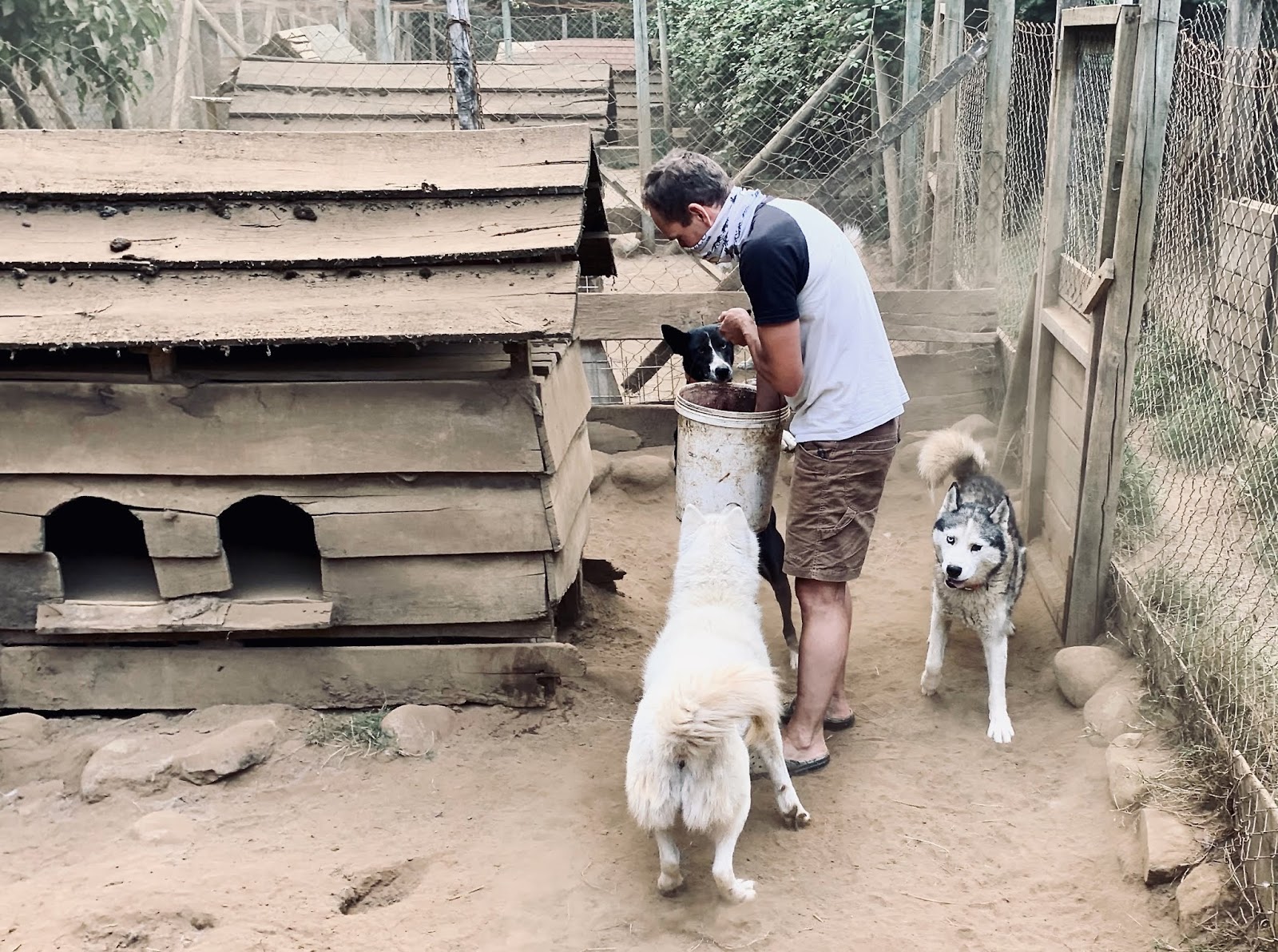
Feeding time at Aurora Austral, for just three of Konrad's 55 huskies
Instead, I continued to the lakeside town of Villarrica and, after a brief reconnoiter of the town, on to the Aurora Austral husky farm, where another Bavarian expat, Konrad Jakob, offers sledding trips in winter and carting trips in summer with his kennel of 55 huskies and a handful of mixes (full disclosure: I’m a devotee of northern dogs and have recently adopted a rescue husky, after four malamutes and one Akita). I spent two nights in one of Konrad’s cabañas, commuting to Villarrica to update practical information on the city. I only regret that I’ve never seen the area in winter, when I’d love to go mushing.
My cabaña accommodations at Aurora Austral
On the third day, I headed to Pucón, at the east end of Lago Villarrica, where I stayed at my long-time favorite Hostería Ecole, but there was an issue that aroused anxiety even before coronavirus entered the conversation. Some years ago, Chile fiddled with the regulations for non-residents crossing the border with their own Chilean vehicles. Were I unable to cross with my vehicle, it would be disastrous for my work.
Template for the declaración jurada that let me cross the border.
Fortunately, Hans and Verónica Liechti of Pucón’s Travel Aid agency had put me in touch with an American couple who own a house outside town and were in much the same non-resident situation. That couple had found an apparent loophole that allows such vehicle owners to leave the country so long as they obtain a notarized declaración jurada (“sworn declaration”) that they intend to return the vehicle to Chile. They’d done it several times and sent me a template for the document that I completed, printed out, and took to Pucón’s only notary public for verification.

When I Get to the Border…
Loretano is a worthy new Peruvian addition to Pucón's dining scene.
After three nights in Pucón, where I really enjoyed the new Peruvian restaurant Loretano (presently closed for the virus emergency), I headed east to the border at Mamuil Malal; I couldn’t completely contain my apprehension until, when I produced the declaración jurada, the Chilean customs official gave me a smiling thumbs-up. Entering Argentina was similarly routine, despite the presence of a list of various nationals subject to coronavirus quarantine but not—yet—US citizens. I got in under the wire, as that would happen a couple days later.
At the Mamuil Malal border crossing, Araucarias line the road, which passes through Parque Nacional Lanín.
Parque Nacional Los Arrayanes was presumably closed to hikers, but there was no  visible enforcement at Villa La Angostura.
The next few days were relatively routine, as I spent a night at Estancia Huechahue, two in San Martín de los Andes, and one in Villa La Angostura, where Argentina’s budding coronavirus precautions became more obvious. En route there had been evidence for concern, as I saw Argentines from a tour bus still sharing yerba mate, and many still greeting each other with kisses on the cheek—men as well as women. Argentina had closed all its national parks, though, and Parque Nacional Los Arrayanes—a popular hiking destination with an entrance in town, was supposedly off-limits (there were still people crossing the line into the park).
Probably now closed because of Argentina's widespread quarantine, the Bariloche tourist office was keeping  distance between its personnel and visitors.
Then I was headed to Bariloche—arguably Argentine Patagonia’s de facto capital, with the notion of continuing south to El Bolsón and Esquel, and then across the broad steppe to Puerto Madryn and Península Valdés. It was not to be, however, as I heard the next morning that Chile was about to close it land borders and, if I did not return before Wednesday, I would be unable to leave (and potentially unable to comply with my declaración jurada).

That information I heard second-hand but, for confirmation, I walked to the Chilean consulate—which was closed. Nevertheless, I rang the bell and, after a middling wait, was assured that US citizens like myself would be able to cross. I left almost immediately, returning via Villa La Angostura and thence to the border crossing described above. Before leaving, though, I managed to visit the new locale of Helados Jauja, arguably Patagonia's best ice creamery (the mother ship is in El Bolsón).
Helados Jauja has new quarters in Bariloche, with a secluded patio in the back.
When in Chile…
My accommodations at Zapato Amarillo were picturesque, comfortable and - in the current situation - socially remote.
After crossing the border, I headed to Puerto Octay’s Zapato Amarillo guesthouse, where the Swiss-Chilean couple Armin and Nadia Dübendorfer have hosted me many times over the years. On the outskirts of town, its stylishly rustic cabins were also an ideal place for self-quarantine, with nobody else about. I had considered staying several days, and perhaps even continuing to Puerto Varas, but after Armin and Nadia told me that international flights were being drastically reduced, I took their suggestion to drive to the city of Osorno and reschedule my April 29th departure for California. Otherwise, I would be spending nearly six weeks in Chile in virtual seclusion.
LATAM'S Osorno office switched my flight. It's a nice touch both the agent and the client can watch the computer screen.
Osorno’s about an hour away, but I was fortunate enough to find parking in the densely built downtown area, barely a block from the surprisingly small LATAM office (Osorno has an airport, but flights are fairly few). There were also few clients, so I quickly got seated and, though my preferred departure date from Santiago on Monday the 23rd was not available, the agent found me space for Tuesday the 24th. She first suggested the route via New York City, then with Delta to SFO, but having heard of huge delays at JFK immigration I chose to fly from Santiago to Mexico City, thence to SFO with Aeroméxico. Time will tell whether I’ve made the right decision, but I’m due home by 1 pm on Wednesday the 25th.

Then there remained the issue of getting back to Santiago, amid rumors there would be a toque de queda (curfew) at midnight. I returned to Puerto Octay immediately and packed my bags for the Chilean capital, a distance of roughly 970 km (about 600 miles) that I covered in 10-1/2 hours, with just two stops to fill the tank (plus some slowdowns for construction). I got to Marializ’s house at 11:30 p.m., just half an hour before the supposed curfew (that’s still not happened, though authorities are encouraging people to stay home). By then, with all apologies to Merle, I'd seen enough white lines for the day.

Here, until Wednesday, I’m in modified self-quarantine, taking short walks around the neighborhood  but avoiding contact with anybody—and making minimal purchases from the nearby shop. And writing stuff like this as, for the foreseeable future, we’ve had to suspend work on the new edition of Patagonia.

Friday, February 21, 2020

Buenos Aires Airports (Including the Newest)

The terminal building at Aeropuerto El Palomar
Buenos Aires has airport issues. That’s long been apparent, given the accessibility issues of the main international airport at Ezeiza, the problematical logistics of the urban Aeroparque and, now, a third airport in the suburb of El Palomar, used primarily for the burgeoning low-cost market.
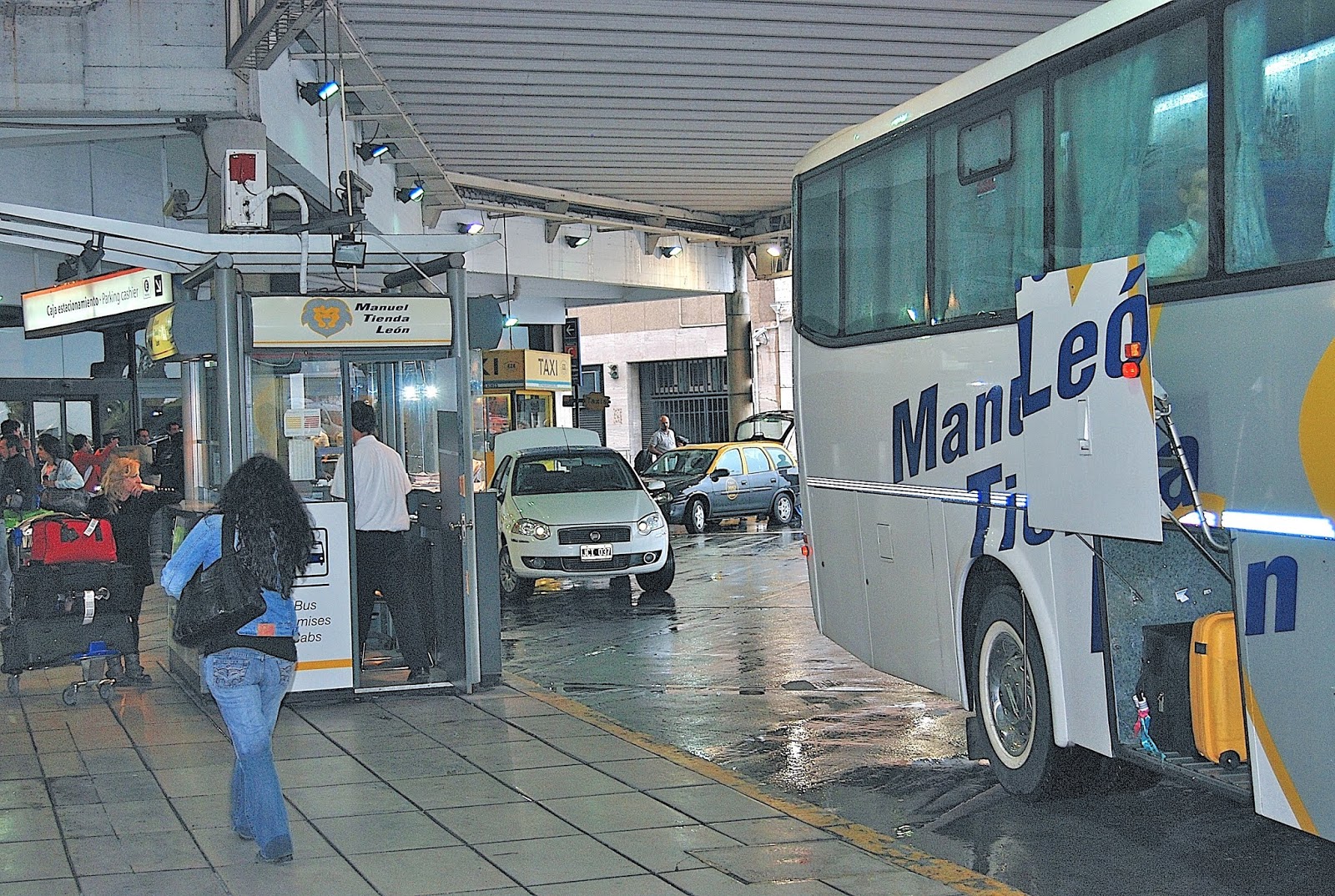
Manuel Tienda León is my default option from Ezeiza into Buenos Aires.
It’s the last of the three that I’ll be most concerned with there, but I’ll briefly mention the first two. Ezeiza, formally known as Aeropuerto Internacional Ministro Pistarini (EZE), is about 22 km south of the city center via the freeway known as the Autopista Teniente General Pablo Riccheri. That’s not far, but transportation can be problematical when suburban traffic clogs the highway at rush hour. Ideally Ezeiza would have rail service but, when I made this observation to a taxi driver, he responded that it would kill one of his main income sources (never underestimate the collective power of taxistas). When arriving at Ezeiza, I normally take the Manuel Tienda León bus/taxi combo into town—short delays don’t mean as much then—but, when leaving the country, I usually choose a cab or remise (livery car) directly there because luggage can be an issue. I still leave plenty early, though.
Aeroparque has few gates, so passengers must often take a shuttle to their plane.
Aeroparque Jorge Newbery (AEP) has different issues. It’s almost walking distance from our apartment in Palermo—or about a ten-minute cab ride—but the narrow road that runs alongside it (currently being widened by a landfill that projects into the Río de la Plata) can also get congested. Aeroparque’s biggest problem, though, is its very convenience, which brings low-flying planes to land on a crowded airfield with so few gates that passengers must often board shuttle buses for the relatively short distance to their plane. Immigration facilities also get really busy on international flights (mostly to and from neighboring countries).
Immigration gets backed up at Aeroparque.
El Palomar (EPA) is something else entirely. Only 20 km from downtown Buenos Aires, just outside the city limits, it’s a converted military airfield with only a single runway to serve FlyBondi and JetSmart, which provide cheap flights to provincial Argentine cities and to Brazil, Uruguay, Paraguay and Chile. Because of objections from neighbors, there are no nighttime flights.
The Ferroccaril San Martín is a commuter line that serves El Palomar.
On board the train to El Palomar
Getting there can be interesting. Manuel Tienda León offers remise service, but the congested approach makes public transportation a better option. The modernized Ferrocarril San Martín, a commuter line that once crossed the entire country to Mendoza, offers direct service from the central Estación Retiro, but I chose to walk from our apartment to the refurbished Estación Palermo (newly constructed overpasses have made the route quicker than it used to be). It’s 37 minutes from Retiro to El Palomar, and only 29 from Palermo, with frequencies every 15 minutes.
The gates to Aeropuerto El Palomar
This disconcerting panel stands outside the gates to Aeropuerto El Palomar.
Better yet, Estación El Palomar is barely a five-minute walk from the airport gates (presuming you’re not weighed down with heavy baggage). Some travelers may find it disconcerting, though, to be greeted by a sign that says that “This base operated as a clandestine detention center under the Air Force. According to witnesses, this was the departure point for ‘death flights’ with the purpose of killing detained and disappeared individuals from various points in the country.” During Argentina’s 1976-83 dictatorship, the military often threw sedated prisoners from planes or helicopters into the river or the open South Atlantic.
El Palomar's check-ins are congested.
After that, the terminal can’t help but be a relief, though its claustrophobic facilities are far inferior to of both Ezeiza and Aeroparque—even if conspicuous signs assure patrons that “We are modernizing El Palomar.” Not intending to fly out of there, I was unable to visit the departure areas, but I was still relieved that my own flight to Neuquén, on low-cost Norwegian Air Argentina, would depart from Aeroparque.

That scenario could change in the near future, as JetSmart has acquired Norwegian Argentina’s routes and will phase out the brand in favor of “JetSmart Argentina.” JetSmart should hold onto those gates at Aeroparque, which many if not most Porteño fliers should still find more convenient than El Palomar. That doesn’t mean, however, that I wouldn’t consider a cheap flight from El Palomar to, say, Bariloche or Ushuaia.

Tuesday, February 4, 2020

The Delta Equation...

I’m old enough to remember when flying was a pleasure, something to look forward to rather than a test of one’s endurance. In my teens, my first flight ever was from Seattle to Los Angeles, and a window seat enthralled me with vistas of Mount Rainier and the Cascade Range, followed by the Sierra Nevada and the Mediterranean landscapes of Southern California. I can’t recall what airline I flew—it might have been the now defunct Northwest—but the experience itself was memorable.

I’ve had comparable experiences since—once I flew a nearly empty Aerolíneas Argentinas jet from Buenos Aires to Miami that let me move around for the best views of the Andes, and provided three seats to stretch across after dark. Many times I’ve also flown the length of the Chilean Andes, and have relished the opportunities to snap aerial photographs of their natural and cultural landscapes, including cities, in the days before window seats cost extra.

Something New (For Me, at Least)
Still, I looked forward to my December flight with Delta to Buenos Aires via Atlanta, if only because I’d never flown that airline—which absorbed Northwest in 2008—nor had I ever been to the Hartsfield-Jackson Atlanta International Airport (ATL), the world’s busiest single airport as recently as 2017. Delta, a legacy airline, began its operations as a cotton crop-dusting operator in 1925—in the Mississippi Delta, of course—and has offered commercial passenger flights since 1929.

Anecdotally speaking, Delta has a pretty good reputation, and my first impressions were positive. For my morning departure at San Francisco International Airport (SFO), the personnel were congenial, lines were short, and I breezed through security without even having to remove belt or shoes. Because of that, I had a longer wait at the gate than I anticipated and, though I found Delta’s boarding procedures a bit confusing, we left SFO on time and arrived at ATL with plenty of time to spare.

Happily, there was no need to go through security again at Hartsfield. I had only eaten a small packet of almonds on the four-hour flight from SFO—another contrast with the past, of course—but found nothing but the lowest-common denominator fast-food options in Atlanta, so I refrained from snacking in anticipation of an on-board meal en route to Argentina. Again, Delta’s boarding procedures were a bit opaque, but we were all seated by the scheduled 9 p.m. departure time.

That’s when things started going wrong, however. As we waited patiently for takeoff, it was half an hour before an announcement informed us that we could not take off until the pilot’s seat received a necessary adjustment, and that mechanics were attending to the problem. In an update an hour later, we heard that the entire seat would require replacement, and cabin crew proceeded to distribute water to passengers (not having eaten since breakfast, I was feeling the first pangs of hunger). An hour later, we learned that the mechanics were successful, but that the repair would require an inspection. Finally, at midnight, we taxied onto the runway and took off for Argentina.
Finally in the air...
Delta's southbound menu from Atlanta
That was only the start of it. About an hour into the flight, as we were anticipating meal service, the crew began to serve a “Peach Bellini” sparkling cocktail that I would have turned down had I had the chance—but, somehow, only passengers on the right side aisle of the plane received them. I have a personal aversion to sparkling wines but, on the left side, I never even had the chance to decline.
The remains of Delta's dinner (no disrespect intended toward Ben & Jerry's)
Finally, dinner arrived in the form of a so-so grilled chicken salad, accompanied by bread that turned to be harder and colder than the ice cream dessert that followed. I managed to sleep about two hours before the egg and Swiss breakfast sandwich arrived and, shortly thereafter, we landed in Buenos Aires—at noon, three hours behind schedule, of course.

It's Better in Argentina?
Over my six weeks in Argentina, I had two orderly no-frills flights from Aeroparque, one with Aerolíneas Argentinas to the southern coastal city of Comodoro Rivadavia and the other on Norwegian Air Argentina to northern Patagonia’s fracking boomtown of Neuquén, capital of its namesake province. I didn’t expect anything special on board, though I was a little surprised that Comodoro’s glisteningly modernized Aeropuerto Internacional General Enrique Mosconi had no food service inside the security area. No matter, as I had abundant lunch options near our Palermo apartment.

Northbound Improvements?
My return to California, late last month, went somewhat more smoothly—Delta left on time, I had the opportunity to decline the Peach Bellini, the grilled chicken salad had mango rather than strawberries (which I don’t much care for), and I got a nightcap of Bailey’s on request. The breakfast sandwich, consisting of an Argentine medialuna with ham and cheese, was an improvement on its southbound counterpart. On balance, though, I found no reason to choose Delta over any of its competitors except that the price was right, but I’ll stop short of saying the company should have stuck with crop-dusting.

An Explanation
I've not posted anything on this blog in more than six weeks, and that's because of a computer issue that occurred as soon as I arrived in Buenos Aires that would have cost a small fortune to repair there, and the iPad and iPhone were too awkward to manage. That's left me with lots of material and, now that I've got my computer repaired, I'll be posting more frequently in the near (and not so near) future-—in the hope that everyone will follow along.

Saturday, December 21, 2019

Returning - to This Blog and Aeroparque

First of all, apologies to my readers for an unavoidable absence - though I’ve been in Argentina for more than two weeks now, computer issues have prevented my posting details of my time in Buenos Aires and parts of coastal Patagonia, from which I just returned late Friday night. At the moment, and for the foreseeable future, I’m working on a tablet, which makes inserting links and photos more awkward, so you may have to bear with me for the time being.

That said, I’ll offer a short account of my return to Aeroparque, Buenos Aires’s main domestic airport (though it does have some international flights). My flight from the southern city of Comodoro Rivadavia was late but, given that I had only carry-on luggage, I was hopeful of getting home quickly, but it wasn’t quite that simple.
My ticket to Palermo 

I walked quickly to the taxi stands and lined up, but then I spotted a sign telling me I should have a ticket to be in line, and realized that I would have to re-enter the terminal and line up again to get a ticket indicating my destination from a touch-screen machine. This was more difficult than it sounds, as I couldn’t find my reading glasses to decipher the small print in dim light.

Finally succeeding, I lined up again outside and finally grabbed a cab to my Palermo apartment. En route, I spoke to the driver about the absurdity of lining up twice to get a ride and, while he agreed with me on one level, he added that this new system - which began last April - has reduced abuses by the taxi mafias that once controlled Aeroparque access. He once avoided the airport, but now it’s a regular part of his routine, and the passenger knows the fare in advance.

While my first impression was negative, I’ll admit to having had unpleasant experiences in previous Aeroparque visits, and this now seems like a step forward - notwithstanding the need to line up twice.

Monday, November 18, 2019

Monday Musings - Mar del Plata, Money and Baseball

Today’s entry will be a potpourri about Argentina and sports. It ranges from the serious (the effect of Argentina’s Dirty War on my wife’s family) to the utilitarian (money and exchange rates) to the whimsical (my own tenuous link between baseball and Patagonia).

Southward Bound
Maru Sanllorenti's hometown of Tandil
As I prepare to head to Buenos Aires, early next month, my wife María Laura Massolo and our daughter Clío are already there (but will return to California before I leave). Their trip is partly vacation but also a family mission, as the remains of my brother-in-law’s first wife—a victim of Argentina’s 1976-83 military dictatorship—have been transferred from her hometown of Tandil to a new Panteón de la Memoria (Pantheon of Memory) in the Cementerio de La Loma in the coastal resort city of Mar del Plata.
My brother-in-law's first wife disappeared shortly after giving birth in 1976.
Maru's mother Eva and son Manuel at Mar del Plata's Panteón de la Memoria (photo by María Laura Massolo)
Abducted on the street in the Buenos Aires Province capital of La Plata in 1976, Maru Sanllorenti is survived by family members that include her mother Eva (now aged 94) and her son (my nephew) Manuel (now 43), who was an infant when she disappeared. My wife accompanied her brother Carlos (Manuel’s father) to Mardel for the ceremony there, then returned almost immediately to Buenos Aires, where Clío arrived on Friday. Yesterday, both of them attended a talk that Manuel regularly gives to visiting tour groups at the city’s Parque de la Memoria, which includes a commemorative plaque with his mother’s name.
Manuel Massolo (right) recounts his mother's story to visiting US tourists at the Parque de la  Memoria.
Money Matters
I haven’t been to Argentina since last year and, consequently, my recent information on exchange rates, prices, and transactions has been mostly second-hand. Since last month’s elections, though, exchange rates have remained relatively stable, and my wife informs me that a fine Peruvian dinner for three at downtown’s Chan Chan cost about US$10 per person, including three entrees plus a beer per person. It’s not an elite restaurant by Buenos Aires standards, but that’s still excellent value.
Our neighborhood cueva, on Palermo's Cabello street, was closed on the weekend.
Changing money, though, always requires reorientation. Bank lines are long, exchange houses are mostly downtown, and there’s still a difference between formal and blue (informal) rates. The difference isn’t huge, though, and the informal exchange houses known as cuevas are fewer than they once were. My wife has used the one near our apartment in Palermo, which remains open, but Dan Perlman of Casa Saltshaker informs me that street changers have taken over the business near his apartment (including the weekend’s Plaza Francia crafts fair outside the Cementerio de la Recoleta). Street-changing, of course, holds potential risk for the inexperienced—not the least of which is counterfeit currency.

It’s possible to change at ATMs, but that has its own issues—on the weekend, when our neighborhood cueva was closed, my wife paid a bank charge of US$10 to withdraw approximately US$50 from the machine. I’m not sure what the maximum withdrawal is at the moment, but it’s almost certainly low by international standards. In Chile, I regularly withdraw the equivalent of US$300 per transaction, but Argentina has been roughly half that—making the service charge a true burden.

Baseball and Patagonia
I love baseball and, for decades now, I’ve enjoyed saying that I leave for South America after the World Series and return in time for Opening Day. This year, I’m still stateside, through two weeks without baseball, but I’m looking forward to being back in Buenos Aires (where I’ve played the game myself) in another fortnight.

Actually, the month of October was a big disappointment, as my own Los Angeles Dodgers fell to the mild card (sic) Washington Nationals in the National League Division Series, and I didn’t pay a lot of attention the subsequent rounds or the World Series itself. The Dodgers were clearly the NL’s best but, as they say, anything can happen in a short series. Of all major sports, baseball is probably the likeliest for a lesser team to prevail—there’s really no such thing as an upset.
The top three finishers in the National League's Most Valuable Player voting
Last week, though, the post-season individual awards drew my attention because of a friendly rivalry with my Wisconsin-born but Chile-based friend Todd Temkin, who’s a diehard Milwaukee Brewers fan (his Cerveceros lost to Washington in a one-game playoff for the right to meet the Dodgers). Todd (who splits his time between Valparaíso/Viña del Mar and a farm in Futaleufú) and I disagree on who’s the NL’s best player; his choice is Milwaukee outfielder Christian Yelich, while mine is LA’s versatile outfielder/first baseman Cody Bellinger.
Dinner will probably take place at Futaleufú's Martín Pescador.
Hand-written menu at Martín Pescador
On one level, that’s a subjective judgement, as they’re both elite players, but Todd suggested that we place a bet on the Most Valuable Player award, “given to a player in each league who has contributed the most to the success of a player’s team,” according to the Baseball Writers Association of America. Depending on which player scored most highly in that poll, the loser would treat the winner to dinner—probably at Futaleufú’s Martín Pescador, with its frequently changing menu.
On my last visit, I enjoyed gnocchi with morels...
and a cheesecake for dessert.
As it happened, Bellinger edged out Yelich for the award, while Anthony Rendón of the champion Nationals came in a respectable third (the vote takes place at the end of the regular season, so the Nationals' playoff success was not a factor here). I’m looking forward to that meal, probably in March, when I’ll be updating Moon Handbooks Patagonia there. If Todd’s not around at that time, though, it could happen in Valparaíso or nearby Viña.

Friday, November 1, 2019

Patagonia's Adventure Connect(ion) in San Francisco

Last week, I attended a promotional event for Chilean Patagonia in the Adventure Connect series, organized by the Adventure Travel and Trade Association (ATTA). At a time when Chile’s undergoing political upheaval, the occasion brought the Magallanes regional representative of Sernatur, the national tourism secretariat, and representatives of several different operators to San Francisco as part of a national promotional tour.
The setup at San Francisco's Hotel Zetta
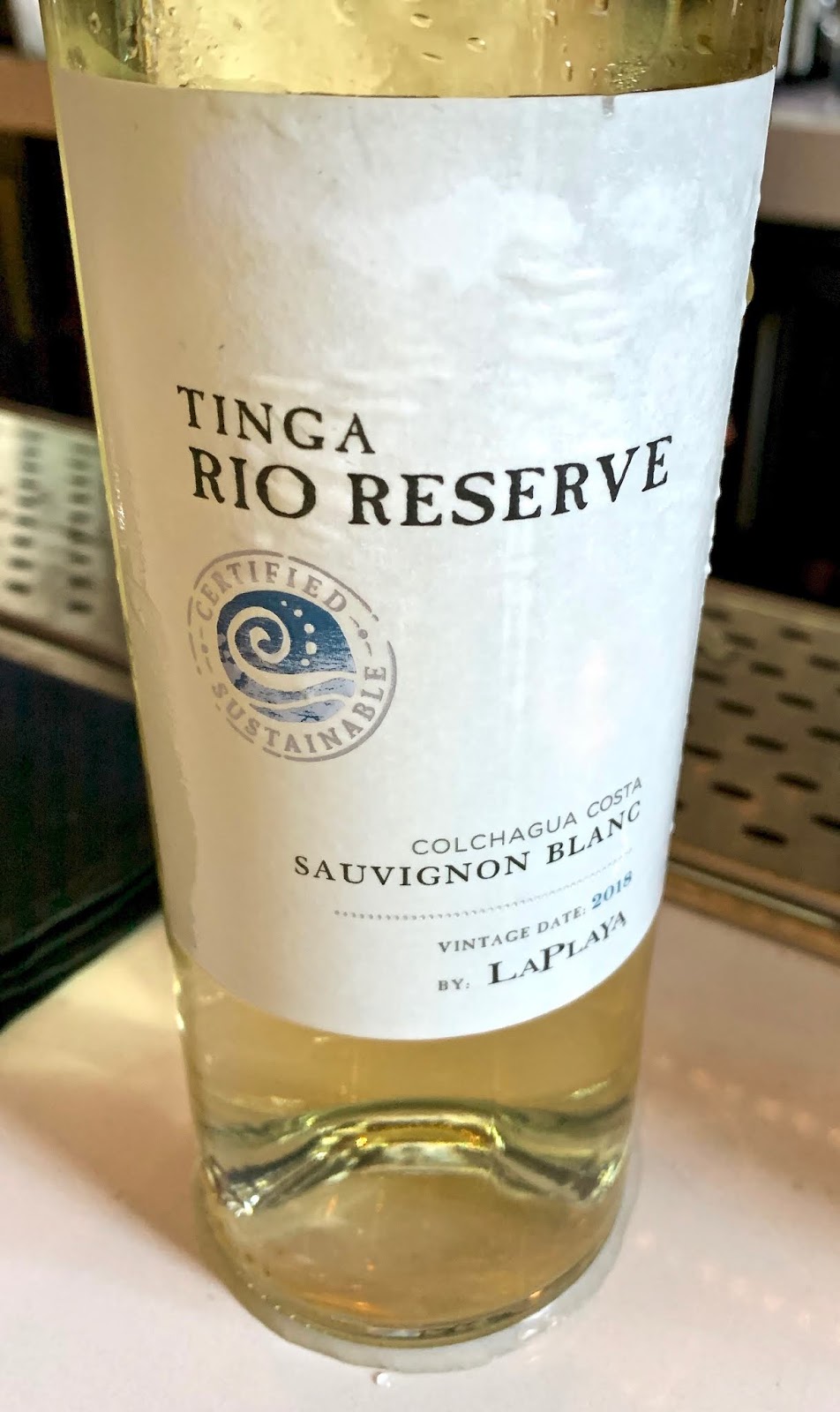
The event took place in the lobby of Hotel Zetta, where eight different operators were to discuss their services with Bay Area travel companies and invited writers (of whom I was one). The format was a sort of musical chairs in which each operator met with one or more attendees for eight minutes before a timer sounded to move elsewhere. This went on for 2-1/2 hours, with a coffee break that included a giveaway raffle, before adjourning to a conference room for a presentation by Sernatur’s regional director Ximena Castro that was probably most useful to those with less experience than mine in the region. Later, there was a Chilean social hour that included snacks and one of the finest Sauvignon Blancs I’ve ever tasted—especially welcome on an unusually hot San Francisco day.

Ximena Castro addresses the attendees.


The Chileans brought this Sauvignon Blanc along with them and, so far, I've been unsuccessful in finding it stateside.
Originally, eight different operators—some of whom I already knew—were to attend the event. In the aftermath of the recent upheavals in Santiago, though, the representatives of Antarctic Airways—with whom I would have liked to discuss their updated services—and Lago Grey - Experience Hotel were unable to get flights out of Santiago. I already knew the owners of Big Foot Patagonia Adventure and the representative of Vértice Patagonia (operator of mountain huts on the famed Paine Circuit, plus a new boutique hotel in Puerto Natales), and was familiar with Antártica 21  and Australis Cape Horn & Patagonia (both of whom sent US-based representatives). New to me were the Chile Nativo adventure operator and HD Hotel Natales (the rebranded Hotel Cisne de Cuello Negro) in Puerto Bories.

The not quite unspoken topic that permeated the meeting was what effect Chile’s recent political disruptions and disorder might have on the upcoming season. There was certainly concern, but also consensus that the Región Metropolitana de Santiago and the coastal region of Valparaíso would be more directly hit than remote Magallanes. That said, cruise ship and hotel cancellations would certainly affect a city like the regional capital of Punta Arenas, which has seen some demonstrations. I recently saw an online story—can’t find the link now—whose headline spoke of “80 percent cancellations” in Chile, but what the story actually said was that 80 percent of hotels and other services had experienced cancellations (which could have been just a single cancellation each for some).

That’s not to dismiss the issue of vandalism and disorder by a destructive fringe, even as the great majority of demonstrations have been peaceful, but President Sebastián Piñera’s embattled government has cancelled the upcoming COP climate conference (at which Swedish activist icon Greta Thunberg was due to appear and also the Asia-Pacific Economic Cooperation summit.

Personally, I would not hesitate to travel to Santiago, Valparaíso or elsewhere in Chile at present, even though I’d advise those with little or no experience of the country to be on alert. In a recent newsletter, the private Federación de Turismo de Chile cited the Subsecretaría de Turismo to the effect that  “our tourism continues to function throughout the country and the most popular destinations visited by international tourists, such as San Pedro de AtacamaElqui Valley, the islands of Rapa Nui [Easter Island] and Juan Fernández [Robinson Crusoe], the Chilean Patagonia and Torres del Paine National Park, are operating with normality.” Aeropuerto Internacional Arturo Merino Benítez is back to normal, but visitors would still do well to have travel insurance in case of disruption.

And the Money?
For foreign visitors, there may be a bright side to all this. About two months ago, the last time I wrote about exchange rates, both the Argentine and Chilean pesos were slipping against the US dollar, and that has continued with the upheaval in Chile and the recent election in Argentina, when the Peronist Alberto Fernández defeated the incumbent president Mauricio Macri.
The Dólar Blue Hoy app is a useful addition to one's smartphone.
The so-called “markets” (and many individual Argentines) have little confidence in Peronism and, consequently, Argentina’s Banco Central (Central Bank) has reinstituted a cepo cambiario (“currency clamp”) that restricts Argentines’ overseas ATM advances to US$50 per transaction (oddly, it puts no restrictions on the number of transactions per day, but those ATM charges could really add up. Meanwhile, individual Argentines can now officially purchase no more than US$200 per month, a measure that seems to be encouraging the informal dólar blue (visitors to Argentina might consider downloading the Dólar Blue Hoy app, pictured here, on their smartphones). Exactly this will develop as the Macri administration gives way to Fernández remains to be seen, but it seems likely that the informal exchange rate will benefit tourists in the short to medium term.
Chile's peso has also slipped against the US dollar and some other currencies.
In Chile, meanwhile, the peso has dipped to 740 per dollar, a fall of roughly three percent since August. This may affect prices slightly, but if foreign visitors avoid the country because of the perception of instability, services such as hotels and tour operators may drop their prices. In any event, matters are less predictable than they seemed even a few months ago.


Monday, October 21, 2019

Chaos in Chile?

In 1978, when I first traveled to Chile—then under the dictatorship of General Augusto Pinochet Ugarte—there was an 11 p.m. curfew in the capital city of Santiago. That put a dent in the city’s commerce and nightlife—though young people adapted with parties that lasted until dawn—and, of course, its political life. Not so widespread in the provinces, the curfews gradually gave way and, since the return to democracy in 1990, Santiago’s been a 24-hour city.
Chile's capital as seen from the hills of Parque Metropolitano
Or at least until last Friday, when all hell broke loose in apparent response to a relatively modest increase in Metro subway fares. Starting as a social-media encouragement of fare evasion, it escalated into a wider disorder that involved arson, looting and then declaration of a state of emergency by President Sebastián PiñeraAccording to Guardian correspondent John Bartlett (a personal acquaintance of mine), “[T]he headquarters of Italian energy company Enel were engulfed in orange flames as the sounds of helicopters and wailing sirens filled the night sky.”
President Piñera's initial statement on the events in Santiago.
In truth, the discontent is far more than just transport fares, as many if not most Chileans have struggled with dictatorship’s legacy of hyper-privatization on issues like health-care and old-age pensions, even as the country has become—on paper at least—the continent’s most prosperous on a per capita basis. Income distribution, though, is wildly skewed in favor of the very wealthiest—many of them in Piñera’s cabinet.
This stenciled mural in the borough of Quinta Normal suggests the inequalities of contemporary Chile.
Certainly there was need to restore order, but the tone-deaf Piñera made it worse by stating, publicly, that “We are at war...” and sending troops and tanks into the streets. That evoked unwelcome memories of the Pinochet years, even though Piñera himself supported the plebiscite vote that ended the dictatorship in 1990. Speaking more diplomatically, the general in charge of security in Santiago seemed to contradict him in saying that “I’m not at war with anyone.”

Santiaguino friends with whom I’ve been in contact have offered useful perspective on this. Marializ Maldonado, who lives in the working-class borough of Renca, wrote me on Saturday that “We were in the Plaza de Renca, with lots of protestors everywhere. Incredible and unexpected. After a group tried to loot a supermarket, [the authorities] dispersed us with tear gas.” She then went home.

Martín Maldonado (no relation to Marializ), who lives in the middle- to upper-middle class borough of Ñuñoa and teaches at the Universidad de Santiago, forwarded me a brief video of a peaceful cacerolazo (pot-banging protest) there. He suggested that there are two separate issues: One is “a movement that rejects economic policies and claims in favor of health, utilities, salaries and transport.” There’s an incisive analysis of these issues by political scientist Patricio Navia in Americas Quarterly.
Curfews have expanded beyond Santiago.
On the other hand, says Martín, “there’s a covert movement that loots supermarkets, shops, public buildings, buses and the Metro, and then burns them.” The university is closed until at least Wednesday, and the curfew now extends from 8 p.m. to 6 a.m. According to the Metro de Santiago website, the city’s subway system has suffered some US$200 million in damages.

Friends outside Santiago tell similar stories. Christián Guntert, a German who teaches at the Universidad Católica in Valparaíso, was returning from a field trip with ecotourism students when he found the roads blocked with burning tires and had to walk into town. There he saw burning shops in the commercial downtown, with firemen and policemen attempting to restore order. Todd Temkin, an American who’s lived nearly 30 years in Valpo and Viña del Mar, said “they burned a couple of supermarkets, a car dealership, and the Cathedral. Lots of looting. Also quite a bit of looting in downtown Viña.” He was, he told me, “heartbroken.”

The Impact on Tourism?
Curfews are expanding to other cities, but I did find one exception to the chaos. Andreas La Rosé, a German who operates the Casa Azul guesthouse in tourist-friendly Puerto Varas, said “Everything is calm, just all supermarkets are closed.” Prosperous Varas may have been spared the destruction, at least to this point, but he worries about how this might affect the upcoming tourist season.

Chilean operators, of course, are hoping against hope that everything remains calm, but there’s certainly concern. While attractions like Torres del Paine are likely to remain so, getting to them through the capital and larger regional cities like Punta Arenas could be problematic. This is a matter that’s likely to come up tomorrow (Tuesday the 22nd), as I attend AdventureConnect San Francisco, an event where many operators from the Magallanes region will be present. I already know several of them, and I’m hoping they’ll be candid about the upcoming season.
Custom Search