Tuesday, November 16, 2010

Observations from Santiago

Normally, when updating my guidebooks to Argentina, Buenos Aires, Chile and Patagonia, I first fly from Los Angeles with LAN Airlines to Santiago, which is my mobile base in South America - the place where my car is parked, at a friend’s house on the outskirts. Earlier this year, though, LAN started three flights weekly from San Francisco, across the Bay from my Oakland home, to the Peruvian capital of Lima - with easy connections south to Santiago, and that was the flight I took yesterday.

At SFO, LAN’s check-in (pictured above) was crowded and a bit slow, but airport security was quicker than I expected - a long line to get into the secure area but, once we did, it went fast. Thanks to a business-class waiver, I managed to talk my way into the first-class security line and got through much quicker.

It was only at the last minute, though, that the gate staff confirmed my seat in business class, which was packed - not an empty seat that I could see. With a midday departure, the lunch was exquisite by airline standards - a shrimp and scallop ceviche, a cheese sample, a savory green salad and a grilled steak (a little overdone by my standards, but onboard food does have its limits) What really stood out was the wine list, which included an outstanding Sauvignon Blanc from Chile’s Matetic, a Malbec from Argentina’s Salentein, and a Syrah from Chile’s Concha y Toro.

Formally, the flight from SFO continues to São Paulo (Brazil), but even through passengers had to disembark in Lima - and, for my part, I had to change planes for Santiago-bound flight from LAX. The main problem with this flight is arriving at 6:30 Chilean time, which is 1:30 a.m. California time, which can make for a rough first day.

I left California’s warm weather - we’re having a late Indian summer - for equally warm spring temperatures in Santiago. Fortunately, because Santiago sits about 600 meters above sea level, it cools off at night, and my early morning arrival was pleasant enough except for the awkward hour.

The Albanian Connection
What do the United States, Canada, Australia, Mexico and Albania have in common? Well, with a new passport in hand for the first time in a decade, I had to pay Chile’s so-called “reciprocity fee” levied against citizens of countries that collect a similar visa fee from Chilean citizens. When I last paid the fee, in the year 2000, it was US$40 for American citizens, but that’s risen to US$140; Canadians pay US$132, Australians US$61, and Mexicans and Albanians US$30 - though, as far as I could tell, there were no Albanians in the queue.

I’ve written several posts about the futility of reciprocity fees, so I won’t repeat them all here but will add that this was the longest line I’ve ever seen at Santiago’s Aeropuerto Arturo Merino Benítez (SCL is looking surprisingly good, by the way, in the aftermath of the massive February earthquake). All I’ll say is that we can only hope that the United States accelerates its proposal to extend the visa waiver program to Argentina, Brazil and Chile, to everybody’s benefit.

Taxis for Nightowls
In other news, last week the city legislature of Buenos Aires approved yet another taxi fare increase, on top of a 26 percent boost that took effect only last month. This time, though, it’s more selective, as it will affect those who dine out at what are normal hours in Buenos Aires - after 10 p.m. -and partake of the city’s hyperactive nightlife, as a 20 percent fare increase will apply only until 6 a.m.

By global standards, Buenos Aires taxis remain cheap but, given the phenomenal increase since 2002, it’s not hard to imagine where they’re going.

Thursday, November 11, 2010

Vino Argentino: an English-Language Guide

In California, the leaves on my backyard grapevines are yellowing and falling softly to the ground but, in the southern hemisphere, the vines are leafing out and, soon enough, the fruit will be forming for next year’s harvest. That means it’s time to tour the austral vineyards again and, though I’ll be heading to Chile rather than Argentina next Monday, it's still a good excuse to review Laura Catena’s Vino Argentino, a detailed and lavishly illustrated account of Argentine wines, food (including recipes), and wine regions, with suggestions for wineries to visit as well as places to eat.

Despite its Spanish-language title, Vino Argentino is a English-language book subtitled “An Insider’s Guide to the Wines and Wine Country of Argentina” but, as the previous paragraph suggests, is more than just that. Laura Catena, for her part, is the daughter of Nicolás Catena (founder of the Catena Zapata winery, pictured below) and now president of the company, but she is also a Harvard and Stanford graduate, an emergency room physician, and an assistant professor of medicine at the University of California at San Francisco Medical Center. Though she spent much of her youth in Berkeley where her father was a grad student in economics and took an interest in California wines - frequently visiting the Napa valley - she spends about a third of the year in and around Mendoza province, where she learned the family business.

While the Catena family business figures prominently in her background, the book itself goes well beyond narrow self-interest. In a single volume of fewer than 250 pages, she covers all the regions and many micro-regions: Mendoza city (including the subregions of Eastern Mendoza), Maipú and Luján de Cuyo, Perdriel, Agrelo and Ugarteche, Tupungato, Tunuyán, San Carlos, Patagonia, and Salta. Geographically, the one notable omission is San Rafael, in southern Mendoza province. She also profiles major figures in the Argentine wine industry such as Susana Balbo, who is largely responsible for giving the fruity but dry white Torrontés a higher profile.

Published by San Francisco’s Chronicle Books, Vinos Argentinos is both a thematic account of Argentine wines and a selective guidebook for wine-oriented visitors, even suggesting an ambitious itinerary that begins in Buenos Aires and visits all major wine regions in 14 days. While it offers numerous recommendations for wineries and restaurants (several wineries have their own), it’s short on accommodations information. Its main drawback, though, is that it’s a bit big and heavy to carry comfortably in the field - in that sense, it’s a reference book more suitable for planning which regions and vineyards to visit.

Of course, it’s also useful as a reference to Argentine wines in a general and specific sense - as well as an encouragement to prepare traditional dishes such as empanadas salteñas (from the Andean Northwest, they’re spicier than their standard Argentine equivalent) and rib-eye steak with chimichurri (a savory marinade that also serves as a sauce). For a true experiment, readers can attempt an helado de Torrontés - with “the flowery perfume of Torrontés wine and the creaminess and grainy texture of homemade ice cream.”

Laura Catena in Person
For residents of the Bay Area, Laura Catena will participate in a wine tasting and book signing at San Francisco’s Ferry Plaza Wine Merchant, next Wednesday, November 17, at 4:30 p.m. I'd personally love to go but, by then, I will be walking the streets of Santiago de Chile as I begin to update the current edition of Moon Handbooks Patagonia.

Monday, November 8, 2010

Monday Miscellanea

Today’s entry will be a summary of events regarding Argentina and Chile, some of them more notable than others.

Chaos at Ezeiza
Over the weekend, things didn’t go well at Buenos Aires’s Aeropuerto Internacional Ministro Pistarini (Ezeiza), which failed to accommodate the transfer of flights from the domestic airport Aeroparque - a topic on which I wrote two weeks ago. Partly because of a labor dispute, 22 of 62 domestic flights were canceled, and many passengers planning to fly to the city of Córdoba - barely an hour from Buenos Aires by air - had to take a nine-hour bus trip instead; bus companies at the Retiro terminal (pictured below) had to double their frequencies.

According to recent reports, things are gradually returning to normal, but overseas arrivals should be prepared for delays and complications. Even when Aeroparque reopens, that won’t necessarily end the frequent disruptions in Argentine air services.

Presidents Fail to Reach Antarctica
Meanwhile, despite elaborate plans, Chilean president Sebastián Piñera and his Ecuadorean counterpart Rafael Correa were unable to make their joint visit to Antarctica as the weather intervened - their Hercules C-130 was unable to land at King George Island (pictured below) in the South Shetlands because of dicey weather and had to return to Punta Arenas. Correa, for his part, pledged to return with Piñera at another time.

Piñera and Correa are not the first to experience such disappointment, nor will they be the last. When I flew to King George with Aerovías DAP in 2005, it was two days before the weather calmed enough to permit a landing so that we could transfer to the Antarctica XXI cruise; fortunately, on one of those days, Antarctica XXI was good enough to fly us to Puerto Williams, on Isla Navarino, and then put us up in the new Hotel Lakutaia.

Still, anyone booking the fly/cruise tandem to Antarctica should be aware that it’s subject to weather delays - with side winds, King George’s narrow airstrip can be unusable. That said, when we finally landed and then boarded the ship waiting offshore, Antarctica XXI managed to get us to every place promised - even if it meant steaming faster and that some stops were shorter than we might have preferred. Early December’s long summer days, of course, made it easier to get everything in.

An Argentine Banknote Shortage?
For some time, Argentina has experienced a shortage of coins - a great inconvenience for those riding public transport and making small purchases - but now, apparently, there’s also a shortage of banknotes. According to the Buenos Aires Herald, as the peso declined from par with the dollar to the current four-to-one ratio over the past decade, banknote values have not changed and the mint can simply not produce enough of them because of antiquated technology.

Buenos Aires mayor Mauricio Macri has demanded the federal government create a 200-peso note (the largest at present in 100 pesos), but the Herald says that doing so would be to admit inflation - which the administration denies is a serious problem. In the Herald’s words, “the government has resorted to an alternative strategy whereby it will order the shortfall in banknotes from the Brazilian Mint, hoping that this, plus recent measures implemented to encourage the use of electronic banking, will enable it to sell the illusion that there is no inflation in Argentina.”

The Miner’s Marathon/Telethon
On the lighter side, rescued Chilean miner Edison Peña appeared Friday November 5th on the David Letterman show, where his ostensibly spontaneous performance of the Elvis Presley hit "Suspicion Minds" was a huge hit with the studio audience. It couldn’t have been as spontaneous as it looked - surely the house band rehearsed it with him - but Peña is nevertheless a natural. One of those rare persons who manages to communicate without knowing another language, he even overcame an inadequate interpreter who kept putting words in his mouth.
Having kept in shape during 69 days in the San Esteban mine near Copiapó by running through the shafts, Peña topped off his weekend by entering and finishing the New York Marathon, even if he had to walk a fair portion of it. Limping across the finish line, then icing sore knees, he probably put his health at risk - but that’s what miners often do. Peña stands out because, unlike a large majority of working-class Chileans who might feel uncomfortable with the spotlight on them, he is remarkably extroverted and gregarious.

Friday, November 5, 2010

A Frigid Presidential Summit


According to Montevideo-based Mercopress, it will be an icy summit between Chile’s center-right President Sebastián Piñera and his left-of-center Ecuadorean counterpart Rafael Correa tomorrow, but that’s not because the two dislike each other or have ideological differences. Nor does it mean the two countries are at diplomatic loggerheads. Rather, it’s because the two will observe “Chilean Antarctic Day” on King George Island in the South Shetland Islands - where both countries maintain bases.

President Correa will, in fact, be the first president ever to visit his country’s Base Pedro Vicente Maldonado, its scientific research station on Greenwich Island, to the west of King George in the South Shetland group, though several Chilean presidents have visited their Base Presidente Eduardo Frei Montalva (pictured below, it’s also known as Base Teniente Rodolfo Marsh). Like Argentina, Britain and several other countries, Chile claims a slice of the Antarctic, although all such territorial claims are on hold by international agreement.

Meanwhile, in the Patagonian city of Punta Arenas, a week-long celebration that started last Sunday will continue, as Punta considers itself Chile’s gateway to Antarctica (though most tourist traffic leaves from the Argentine port of Ushuaia). According to Mercopress, mayor Liliana Kusanovic has stated that “The purpose of all these activities is to show the relevant aspects of the territory regarding tourism, science research, logistics, culture and government policies, besides creating awareness and a regional identity with Antarctica.” In July, the regional government of Magallanes - whose jurisdiction includes the Chilean sector of Antarctica - announced the construction of a new International Antarctic Center that will include offices of the Instituto Antarctico Chileno.

Piñera and Correa will likely arrive at King George on a presidential plane from Punta Arenas, but tourists will still be able to reach the island with Aerovías DAP (pictured above, landing at King George), which has leased a new 100-passenger aircraft for its summer flights to Antarctica and elsewhere in the region. DAP, which is celebrating its third decade of service in the region, is also the link for the “air cruise” operated by Antarctica XXI, which saves visitors two days’ crossing the gut-wrenching Drake Passage - in each direction.

These trips don’t come cheap - a minimum of US$8,990 per person for a week navigating along the Antarctic Peninsula and the South Shetlands - but neither do shorter trips with DAP: a day trip to King George costs US$3,004 (taxes included) and an overnight stay costs US$1,000 more. Still, for anyone with more money than time who wants to visit Antarctica, it’s an option worth consideration.

Tuesday, November 2, 2010

Argentine and Chilean Coastlines Rate Highly

Annually, National Geographic Traveler magazine (for whom I write occasionally) produces an annual survey of “destinations rated” and, in the new November-December issue, this year’s list evaluates the “world’s great islands, beaches and coastlines.” In a print magazine, of course, there’s not room for much more than a list of all 99 places - Newfoundland’s Avalon Peninsula comes in first - but the online version goes into more detail.

I was pleased to read that two Southern Cone destinations - the Chilean fjords (No. 4, pictured above) and Argentina’s Península Valdés (No. 10) made the top ten of places “In excellent shape, relatively unspoiled, and likely to remain so.” Chile’s Viña del Mar (No. 56) made the mid-list as “a mixed bag of successes and worries, with the future at risk.”

In fact, there are two sets of Chilean fjords. One lies along the west coast, where Navimag passenger ferries between Puerto Montt and Puerto Natales make occasional incursions from the inland sea of the Aisén and Magallanes regions to the edge of the Southern Patagonian Icefield, and the Skorpios cruise line visits Parque Nacional Laguna San Rafael and offers a longer tour of the continental glaciers.

In this case, though the article doesn’t make it clear from the beginning, the fjords in question are those on the south side of the Isla Grande de Tierra del Fuego, visited only by the relatively small vessels of the Cruceros Australis line. Traditionally, their Mare Australis and Via Australis vessels (carrying about 120 passengers each) shuttle between the Chilean city of Punta Arenas and the Argentine port of Ushuaia; this season, they will be adding the Stella Australis, capable of carrying about 200 passengers with greater amenities, to the fleet.

This, of course, contrasts with huge cruise ships that carry thousands of passengers and are, fortunately, incapable of navigating the narrow glacial channels in question here. According to one of Traveler’s anonymous panelists, “Local officials are aware of the damage cruise-ship operators have done elsewhere and working to create a sustainable tourism strategy.” Cruceros, for its part, has created an elaborate statement of its own environmental goals.

Meanwhile, on the Atlantic coast of Chubut province, Argentina’s Península Valdés draws praise for facilities “that are set up in a way to minimize their impact on the local environment.” The anonymous commentators, though, differ in their assessments: One dissents that “Development is relatively unregulated” and, from personal experience, I would say that the growth of the gateway town of Puerto Pirámides (pictured above) is cause for some concern.

Península Valdés, like most of Argentina’s Atlantic coast, is a desert, with no surface streams and an annual rainfall of only 246 mm (less than ten inches). Over two decades and at least half a dozen visits to the reserve, I have seen Puerto Pirámides expand from a oversized fish camp to a substantial village, with many more hotels and restaurants, that depends on groundwater for its existence. Some of those hotels, such as the Hostería Ecológica del Nómade, are designed to limit their environmental impact, but the town’s growth is nevertheless a serious concern.

That happened a long time ago in Viña del Mar (pictured above), Chile’s traditional seaside resort, whose proximity to the capital city of Santiago ensures an invasion of tourists not just in summer but year-round on weekends. According to Traveler, “overbuilding has damaged the ecology of its beaches, and peak season crowds and traffic are poorly handled.” For my part, I prefer the neighboring city of Valparaíso, with its quirky geography and colorful hills neighborhoods.

One other coastal destination caught my attention in this month’s Traveler, but it’s not part of the ratings game. A photo gallery on animal migrations includes a nesting colony of black-browed albatrosses - to my mind, one of the world’s most beautiful birds - in the Falkland Islands. I’ve been to several albatross colonies there, most notably on Saunders Island (pictured above), but I don’t recognize the one in the Traveler photograph; from the topography, my guess is that it’s remote, hard-to-reach Steeple Jason Island.

Friday, October 29, 2010

Bolivia Sees the Sea; Argentina's Sea Change

In the War of the Pacific, which lasted from 1879 to 1884, Chile acquired about a third of its current territory, in the northerly Atacama Desert, from Peru and Bolivia. That marks the last time that Bolivia enjoyed direct access to the ocean but, with the cooperation of Peruvian president Alán García, the landlocked country will soon do so again - Peru has granted a strip of coastal access about 200 kilometers (roughly 120 miles) north of the Chilean border for Bolivia to do as it pleases - including establishing a naval presence there. At present, Bolivia’s navy is confined to Lake Titicaca (shared between Peru and Bolivia), and the eastward-draining rivers of the Amazon Basin.

The rights and wrongs of the war aside - and it’s easy to argue that the nitrate-rich Atacama would have contributed to prosperity for both Peru and Bolivia as it did to Chile - it’s questionable whether this “outlet to the sea” for which Bolivia has clamored for more than a century will revive anything other than Bolivian nationalism. In reality, for more than two decades since a paved road from the Chilean port of Arica (pictured above, it was part of Peru in the 19th century) reached the Bolivian border, Bolivia’s access to the sea is better than it ever was - for commercial ends at least. By far the closest and quickest route from the Andean highlands to the Pacific, Arica is also the place where Bolivians take their beach holidays.

In the 19th century, when Bolivia’s main port was the now crumbling ghost town of Cobija (pictured above, Cobija served as a location for the recent James Bond flick Quantum of Solace), it exported silver from the bonanza mine at Potosí, though Antofagasta eventually succeeded it. Today, though, it probably means that Bolivia will build a Pacific fleet that it doesn’t need, and can’t afford, in peacetime - primarily because of a long-lived irredentist grudge against Chile.

Kirchner's Candidacy Expires

Across the Andes, meanwhile, Argentina is experiencing a sea change of its own with the fatal heart attack of former president Néstor Kirchner on Wednesday morning in the tourist center of El Calafate - a town which the Santa Cruz province native helped put on the map with massive infusions of capital that helped build an international quality airport for the gateway to the Moreno Glacier (pictured above). With his widow, the current president Cristina Fernández, he also built the town’s sprawling Casa Los Sauces luxury hotel complex (pictured below), where accommodations go for around US$700 per night. The Kirchners maintain their own house on a contiguous property.

Kirchner, who served as president from 2003 to 2007 before being succeeded by Fernández, was by most accounts a notorious Type A personality who had had several other health scares in recent months. Widely considered the leading candidate to return to the presidency next year, he leaves a political vacuum despite the immediate outpouring of support for his widow from along the entire political spectrum. Soon enough, Argentines will learn whether Fernández can survive, politically, without the man that many of them considered her co-president, even as he held no formal executive power.

Monday, October 25, 2010

Bandidos Rurales: Beyond Butch and Sundance

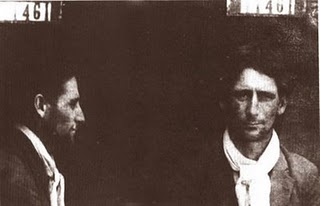
Like the Wild West of the United States, Patagonia was a frontier region and, as such, it was often a lawless place where might made right - and, as often as not, that might came out of the barrel of a pistol or a rifle. Like the West, it spawned legends such as the Robin Hood figure Juan Bautista Bairoletto (pictured below in a mugshot) and the rebel ranchhand José Font (also known as Facón Grande, or “Big Knife,” he was a key character in director Héctor Olivera’s film La Patagonia Rebelde). In fact, the Argentine folk-rock singer León Gieco recorded an album, Bandidos Rurales, whose title song gave the same treatment to Bairoletto and others that Bob Dylan did to John Wesley Harding.

In fact, several Old West figures, such as the self-styled sheriff and tall-tale teller Martin Sheffield of Texas, even made their presence known in southernmost South America (Bruce Chatwin recounted Sheffield’s tale in his classic travelogue In Patagonia). Sheffield’s was not the only yanqui presence in Patagonia, though - in the early 1900s, Robert Leroy Parker and Harry Longabaugh fled the United States to homestead near Cholila, a hamlet in southern Chubut province, where US author Anne Meadows tracked down their homestead more than a decade ago.

Better known as Butch Cassidy and the Sundance Kid, Parker and Longabaugh didn’t last long at Cholila, but they did build a distinctive cabin that survives today. The province of Chubut acquired the then crumbling cabin (pictured above), long occupied by the aging gaucho Aladín Sepúlveda (who died in 1999), and has since restored it without turning it into a theme park attraction - at least, there are no cardboard cutouts of Paul Newman and Robert Redford standing outside or peeking through the windows.

Meadows detailed her findings and much more in a book, Digging Up Butch and Sundance, that has gone through several editions since its initial publication in 1994. More than anything else, their book has been probably responsible for bringing gringos to Cholila, even if many only catch a glimpse of the cabin from the left side of the bus that goes from the city of Esquel through Parque Nacional Los Alerces to the town of Lago Puelo.

Butch and Sundance, though, may not have been the most interesting outlaw in Patagonia - that title might well fall to an unsung Englishwoman, their contemporary Elena Greenhill, whose story may hit the big screen some time in the future. According to the Buenos Aires daily La Nación, Olivera would like to bring journalist Francisco Juárez’s account of Greenhill’s life to the cinema.

And there’s a colorful story to tell. Born in Bath, Ellen Greenhill arrived in Chile in 1888, at the age of 13. Six years later, she married a rustler twenty years her senior who died, mysteriously, in the backcountry - amid tales of marital discord and spousal abuse. Continuing her husband’s activities, she became known as la bandolera inglesa (the English bandit) and, though she apparently never killed anybody herself, she once kidnapped two Chubut policemen and humiliated them by forcing them to do household chores.

That challenge to their machismo, apparently, inspired the police to seek revenge. At the locality of El Chacay, on the Patagonian steppe midway between Esquel and the coastal city of Puerto Madryn, they set an ambush at which Greenhill died in 1914.

Events Reminder: Last Chance for Exploring Argentina
This week, I wind up my tour promoting Moon Handbooks Argentina with two events in Chicago: Tuesday evening with a 6 p.m. dinner meeting at the Adventurers Club, under the auspices of the Geographic Society of Chicago, and Wednesday afternoon at the Chicago Cultural Center, also with the sponsorship of the Geographic Society, at 3:15 p.m.

Friday, October 22, 2010

Ezeiza Subs for Aeroparque

According to the Buenos Aires daily Clarín, the city airport Aeroparque Jorge Newbery will soon be closing for repairs for nearly a month, from early November until December. In that period, all domestic flights as well as the usual international flights will operate out of Aeropuerto Internacional Ministro Pistarini (pictured here), popularly known as "Ezeiza" after the suburb in which it is located.

In some ways, this will be more convenient for foreign travelers making immediate connections for destinations elsewhere in the country, who will not have to undertake the cross-town trek to Aeroparque - rather, they will just be able to wait for their connecting flight. On the other hand, for those spending at least a night in Buenos Aires, it will be notably less convenient and more expensive - instead of catching a cheap taxi to close-in Aeroparque, they will have to take a more expensive taxi/remise or a shuttle service, such as Manuel Tienda León. This will also require leaving earlier than otherwise, as the taxi or shuttle, in turn, will have to navigate heavy freeway traffic, especially if the departure time is anywhere near rush hour.

In another sense, arriving at Ezeiza could be even more expensive, at least for some nationalities. At the end of last year, Argentina instituted a so-called tasa de reciprocidad (“reciprocity fee”) for nationals of countries, such as the United States (US$140), Canada (US$70), and Australia (US$100), that require similar fees from Argentine visa applicants (Argentina does not, however, require US citizens, Canadians and Australians to obtain advance visas).

The hitch here is that the “reciprocity fee” is, at present, collected only at Ezeiza and not at Aeroparque. While all intercontinental flights land at Ezeiza, many regional flights from Brazil, Chile and Uruguay normally land at Aeroparque, where nationals of the countries in question are not required to pay the fee. If flying from, say, Santiago de Chile, passengers with “qualifying” passports should be ready to fork over those fees in November. That said, for Americans and Australians, at least, the fee is valid for ten years; for Canadians it only earns a single entry.

Events Update
This coming week, I will wind up my tour promoting Moon Handbooks Argentina with two events in Chicago: Tuesday evening with a dinner meeting at the Adventurers Club, under the auspices of the Geographic Society of Chicago, and Wednesday afternoon at the Chicago Cultural Center, also with the sponsorship of the Geographic Society.
Custom Search